GLOBAL STUDY PROVES INCINERATORS WORSEN CLIMATE IMPACTS WHILE COMMUNITIES PUSH FOR JUST SOLUTIONS

(SPANISH AND PORTUGUESE TRANSLATION BELOW)

[PRESSCON RECORDING]

Addis Ababa, Ethiopia  – 04 September 2025 — From Asia to Latin America to Africa, communities are at the frontlines of both climate impacts and the fight against false solutions in waste management. A new report released by the Global Alliance for Incinerator Alternatives (GAIA), launched this Second Climate Week in Africa, demonstrates that zero waste offers the clearest, most effective path forward—outperforming incineration and other “business-as-usual” practices in reducing long-term climate impacts.

The publication, Zero Waste as an Effective Climate Strategy: Avoiding Warming Tradeoffs from Incineration, is one of the four GAIA Technical Guidance Series for Policymakers and Financiers on Fast Action on Waste and Methane. It examines the long-term global warming impacts of three waste management approaches: open dumping and landfilling, waste-to-energy (WTE)  incineration, and zero waste systems that include source separation, composting, and recycling.

Drawing from case studies in Lagos, Nigeria; Barueri, Brazil; and Quezon City, Philippines, the report applies the Solid Waste Emissions Estimation Tool (SWEET) and the FaIR climate model to project temperature outcomes through 2060. The findings are irrefutable: zero waste is the most effective and resilient strategy to reduce climate impacts from the waste sector. Unlike incineration, which trades short-term methane reductions for increased carbon dioxide emissions, zero waste delivers rapid methane cuts without creating new warming problems.

Beyond the data, the report spotlights how frontline communities in all three regions are resisting incinerator projects and advancing decentralized zero waste systems. These movements show how climate solutions can deliver environmental justice, social co-benefits, and a just transition for wastepickers.

The report comes at a pivotal moment. In Latin America, Brazil—host of the upcoming COP—is facing local battles over incineration even as it positions itself as a climate leader. In Asia, cities like Manila are at the forefront of both incineration threats and zero waste innovation. And in Africa, governments are weighing climate finance options that will determine whether communities are locked into polluting infrastructure or supported in building resilient zero waste systems.

For GAIA, the message is clear: Zero Waste offers the fastest, fairest, and most cost-effective way to cut methane emissions, and it must be at the center of global climate strategies.

SPEAKERS QUOTES: 

The Global Methane Pledge is a promise we cannot afford to break. Our findings show that zero waste delivers the rapid methane reductions the world needs to meet climate targets, without the carbon penalty of incineration. If governments are serious about keeping warming under 1.5°C, zero waste must be at the heart of their plans heading into COP30. – Neil Tangri, Science and Policy Director of GAIA

Communities in Africa are rejecting incinerators because we see firsthand the toxic smoke, the health risks, and the debt they bring. We deserve climate solutions that clean our air, not poison it. Zero waste programs protect our children’s health, create real jobs, and keep decision-making in the hands of local people. – Weyinmi Okotie, GAIA Africa

Waste pickers have been the backbone of recycling in our cities for decades. As validated by these findings, they are already showing us real climate solutions. Supporting zero waste also means dignity, stable livelihoods, and a just transition for workers. Incineration does the opposite by burning this all away. – Brex Arevalo, Climate and Anti-Incineration Campaigner, GAIA Asia Pacific

As Brazil prepares to host Conference of the Parties (COP) 30, we have a chance to show the world that climate leadership means rejecting dirty technologies. Investing in zero waste can slash methane emissions, create thousands of green jobs, and align with Brazil’s pledge to protect our people and our planet. – Rafael Eudes, Zero Waste Alliance Brazil

Cutting methane quickly is critical to slowing climate change, and zero waste strategies gives us the tools to do it without causing new problems. Incinerators may look like an easy fix, but they simply swap one greenhouse gas for another and lock communities into decades of pollution. – Mariel Vilella, the Global Climate Program Director of GAIA

MEDIA CONTACTS:

Sonia Astudillo, Global Climate Communications Officer, Global Alliance for Incinerator Alternatives (GAIA) I sonia@no-burn.org I +63 917 5969286

Dan Abril, Communications Officer for Programs, GAIA Asia Pacific | dan@no-burn.org  | 

Ibrahim Khalilulahi Usman, Africa Communications Associate, GAIA Africa | khalil@no-burn.org

GAIA is a worldwide alliance of more than 1,000 grassroots groups, non-governmental organizations, and individuals in over 90 countries. With our work we aim to catalyze a global shift towards environmental justice by strengthening grassroots social movements that advance solutions to waste and pollution. We envision a just, zero waste world built on respect for ecological limits and community rights, where people are free from the burden of toxic pollution, and resources are sustainably conserved, not burned or dumped. 

[SPANISH ]

LA ESTRATEGIA BASURA CERO ES MÁS EFECTIVA QUE LA INCINERACIÓN EN LA REDUCCIÓN DE LA CONTAMINACIÓN CLIMÁTICA

UN ESTUDIO GLOBAL DEMUESTRA QUE LAS INCINERADORAS AGRAVAN EL IMPACTO CLIMÁTICO, MIENTRAS LAS COMUNIDADES EXIGEN SOLUCIONES JUSTAS

Addis Abeba, Etiopía 4 de septiembre de 2025 —Desde Asia hasta América Latina y África, las comunidades están en la primera línea tanto de los impactos climáticos como de la lucha contra las falsas soluciones en la gestión de residuos. Un nuevo informe publicado por la Alianza Global para Alternativas a la Incineración (GAIA), presentado durante la Segunda Semana del Clima en África, demuestra que la estrategia basura cero ofrece el camino más claro y eficaz para avanzar, superando a la incineración y otras prácticas «habituales» en la reducción de los impactos climáticos a largo plazo.

La publicación, titulada «Basura cero como estrategia climática eficaz: Evitando las compensaciones de calentamiento global derivadas de la incineración», es una de las cuatro series de orientaciones técnicas de GAIA para responsables de políticas y financiadores sobre la acción rápida en materia de residuos y metano. En ella se examinan los efectos a largo plazo del calentamiento global de tres enfoques de gestión de residuos: vertidos a cielo abierto y rellenos sanitarios, incineración para la producción de energía a partir de residuos (WTE) y sistemas de basura cero que incluyen la separación en origen, el compostaje y el reciclaje.

A partir de estudios de casos en Lagos (Nigeria), Barueri (Brasil) y Quezon City (Filipinas), el informe aplica la herramienta de estimación de emisiones de residuos sólidos (SWEET) y el modelo climático FaIR para proyectar los resultados de temperatura hasta 2060.  Los hallazgos son irrefutables: basura cero es la estrategia más eficaz y resiliente para reducir los impactos climáticos del sector de los residuos. A diferencia de la incineración, que intercambia la reducción de metano a corto plazo por un aumento en las emisiones de dióxido de carbono, basura cero  logra recortes rápidos de metano sin generar nuevos problemas de aumento de la temperatura.

Más allá de los datos, el informe destaca cómo las comunidades de primera línea de las tres regiones se resisten a los proyectos de incineración y promueven sistemas descentralizados de basura cero. Estos movimientos muestran cómo las soluciones climáticas pueden aportar justicia medioambiental, beneficios sociales colaterales y una transición justa para los recicladores de base.

El informe llega en un momento crucial. En América Latina, Brasil, anfitrión de la próxima COP, se enfrenta a batallas locales sobre la incineración, incluso cuando se posiciona como líder climático. En Asia, ciudades como Manila están a la vanguardia tanto de las amenazas de la incineración como de la innovación en materia de basura cero. Y en África, los gobiernos están sopesando opciones de financiamiento climático que determinarán si las comunidades quedan atrapadas en infraestructuras contaminantes o si se les apoya en la construcción de sistemas resilientes de basura cero.

Para GAIA, el mensaje es claro: Basura cero ofrece la forma más rápida, justa y rentable de reducir las emisiones de metano, y debe estar en el centro de las estrategias climáticas globales.

CITAS DE LOS PONENTES:

El Compromiso Global sobre el Metano es una promesa que no podemos permitirnos incumplir. Nuestros hallazgos demuestran que la estrategia basura cero proporciona la reducción de metano rápida que el mundo necesita para cumplir los objetivos climáticos, sin la penalización de carbono que supone la incineración. Si los gobiernos se toman en serio el objetivo de mantener el calentamiento por debajo de 1,5 °C, basura cero debe ocupar un lugar central en sus planes de cara a la COP30. – Neil Tangri, director de Ciencia y Política de GAIA

Las comunidades africanas rechazan las incineradoras porque vemos de primera mano el humo tóxico, los riesgos para la salud y la deuda que conllevan. Merecemos soluciones climáticas que limpien nuestro aire, no que lo envenenen. Los programas de basura cero protegen la salud de nuestros hijos, crean puestos de trabajo reales y mantienen la toma de decisiones en manos de la población local. – Weyinmi Okotie, GAIA África

Los recicladores han sido la columna vertebral del reciclaje en nuestras ciudades durante décadas. Tal y como demuestran estos hallazgos, ya nos están mostrando soluciones climáticas reales. Apoyar la basura cero también significa dignidad, sustento estable y una transición justa para los trabajadores. La incineración hace lo contrario al quemarlo todo. – Brex Arevalo, activista por el clima y contra la incineración, GAIA Asia Pacífico

Mientras Brasil se prepara para acoger la Conferencia de las Partes (COP) 30, tenemos la oportunidad de mostrar al mundo que el liderazgo climático significa rechazar las tecnologías contaminantes. Invertir en basura cero puede reducir drásticamente las emisiones de metano, crear miles de empleos verdes y alinearse con el compromiso de Brasil de proteger a nuestra gente y nuestro planeta. – Rafael Eudes, Alianza Basura Cero BrasilReducir rápidamente las emisiones de metano es fundamental para frenar el cambio climático, y las estrategias de basura cero nos proporcionan las herramientas para hacerlo sin causar nuevos problemas. Las incineradoras pueden parecer una solución fácil, pero simplemente sustituyen un gas de efecto invernadero por otro y condenan a las comunidades a décadas de contaminación. – Mariel Vilella, directora del Programa Climático Global de GAIA

[PORTUGUESE]

A ESTRATÉGIA DE RESÍDUO ZERO É MAIS EFICAZ DO QUE A INCINERAÇÃO NA REDUÇÃO DA POLUIÇÃO CLIMÁTICA

ESTUDO GLOBAL COMPROVA QUE INCINERADORAS AGRAVAM OS IMPACTOS CLIMÁTICOS, ENQUANTO COMUNIDADES PRESSIONAM POR SOLUÇÕES JUSTAS

Adis Abeba, Etiópia 04 de setembro de 2025 — Da Ásia à América Latina e África, as comunidades estão na linha de frente tanto dos impactos climáticos quanto da luta contra falsas soluções na gestão de resíduos. Um novo relatório publicado pela Aliança Global para Alternativas à Incineração (GAIA), apresentado durante a Segunda Semana do Clima em África, demonstra que a estratégia de resíduo zero oferece o caminho mais claro e eficaz para avançar, superando a incineração e outras práticas “habituais” na redução dos impactos climáticos a longo prazo.

A publicação, intitulada Resíduo Zero como estratégia climática eficaz: Evitando as compensações do aquecimento global derivadas da incineração, é uma das quatro séries de orientações técnicas da GAIA para responsáveis por políticas e financiadores sobre a ação rápida em matéria de resíduos e metano. Nela são examinados os efeitos de longo prazo do aquecimento global de três abordagens de gestão de resíduos: lixões a céu aberto e aterros sanitários, incineração para a produção de energia a partir de resíduos (WTE) e sistemas de lixo zero que incluem a separação na origem, a compostagem e a reciclagem.

Com base em estudos de caso em Lagos, Nigéria; Barueri, Brasil; e Quezon City, Filipinas, o relatório aplica a Ferramenta de Estimativa de Emissões de Resíduos Sólidos (SWEET) e o modelo climático FaIR para projetar os resultados de temperatura até 2060. As conclusões são irrefutáveis: Resíduo zero é a estratégia mais eficaz e resiliente para reduzir os impactos climáticos do setor de resíduos. Ao contrário da incineração, que troca reduções de metano de curto prazo por aumento das emissões de dióxido de carbono, resíduo  zero proporciona cortes rápidos de metano sem criar novos problemas de aquecimento.

Além dos dados, o relatório destaca como as comunidades da linha de frente nas três regiões estão resistindo aos projetos de incineradores e promovendo sistemas descentralizados de resíduo zero. Esses movimentos mostram como as soluções climáticas podem proporcionar justiça ambiental, benefícios sociais e uma transição justa para os catadores.

O relatório chega em um momento crucial. Na América Latina, o Brasil — anfitrião da próxima COP — enfrenta batalhas locais sobre a incineração, mesmo se posicionando como líder climático. Na Ásia, cidades como Manila estão na vanguarda tanto das ameaças da incineração quanto da inovação do resíduo zero. E na África, os governos estão avaliando opções de financiamento climático que determinarão se as comunidades ficarão presas a infraestruturas poluentes ou serão apoiadas na construção de sistemas resilientes de resíduo zero.

Para a GAIA, a mensagem é clara: o desperdício zero oferece a maneira mais rápida, justa e econômica de reduzir as emissões de metano e deve estar no centro das estratégias climáticas globais.

CITAÇÕES DOS PALESTANTES:

O Compromisso Global com o Metano é uma promessa que não podemos quebrar. Nossas descobertas mostram que resíduo zero proporciona as rápidas reduções de metano de que o mundo precisa para cumprir as metas climáticas, sem a penalidade de carbono da incineração. Se os governos estão seriamente empenhados em manter o aquecimento abaixo de 1,5 °C, resíduo zero deve estar no centro de seus planos para a COP30. – Neil Tangri, Diretor de Ciência e Política da GAIA

As comunidades na África estão rejeitando os incineradores porque vemos em primeira mão a fumaça tóxica, os riscos à saúde e as dívidas que eles trazem. Merecemos soluções climáticas que limpem nosso ar, não o envenenem. Os programas de resíduos zero protegem a saúde de nossas crianças, criam empregos reais e mantêm a tomada de decisões nas mãos da população local. – Weyinmi Okotie, GAIA África

Os catadores têm sido a espinha dorsal da reciclagem em nossas cidades há décadas. Conforme validado por essas descobertas, eles já estão nos mostrando soluções climáticas reais. Apoiar resíduo  zero também significa dignidade, meios de subsistência estáveis e uma transição justa para os trabalhadores. A incineração faz o oposto, queimando tudo isso. – Brex Arevalo, ativista climático e anti-incineração, GAIA Ásia-Pacífico

Enquanto o Brasil se prepara para sediar a Conferência das Partes (COP) 30, temos a chance de mostrar ao mundo que liderança climática significa rejeitar tecnologias sujas. Investir no resíduo zero pode reduzir drasticamente as emissões de metano, criar milhares de empregos verdes e se alinhar com o compromisso do Brasil de proteger nosso povo e nosso planeta. – Rafael Eudes, Aliança Resíduo Zero Brasil

Reduzir rapidamente o metano é fundamental para desacelerar as mudanças climáticas, e as estratégias de resíduo zero nos dão as ferramentas para fazer isso sem causar novos problemas. Os incineradores podem parecer uma solução fácil, mas eles simplesmente trocam um gás de efeito estufa por outro e prendem as comunidades a décadas de poluição. – Mariel Vilella, Diretora do Programa Climático Global da GAIA

Following the commitments within the Global Methane Pledge and the COP29 Declaration to Reduce Methane from Organic Waste (ROW declaration), signatory countries have pledged to significantly reduce waste methane emissions by 2030. While this will pose an increase of political and financial resources driven towards the waste sector, there is a need to ensure the implementation of measures to reduce methane emissions is in alignment with the Environmental Justice Principles for Fast Action on Waste and Methane.  

In order to support policy makers and implementers to ensure effective solutions to reduce waste methane, GAIA, with support from the Climate and Clean Air Coalition (CCAC) and the Global Methane Hub presents this series of technical publications  to address challenging issues related to methane emissions in the waste sector.


Zero Waste as An Effective Climate Strategy: Avoiding Warming Tradeoffs from Incineration assesses the long-term global warming impacts of three waste management strategies —business-as-usual disposal-based practices such as dumping and landfilling (BAU), incineration, and zero waste practices such as source separation and treatment of organics and recyclables (ZW). The analysis focuses on three urban contexts: Lagos (Nigeria), Barueri (Brazil), and Quezon City (Philippines). Using the Solid Waste Emissions Estimation Tool (SWEET) and the Finite Amplitude Impulse Response (FaIR) climate model, the analysis calculates projected temperature impacts for each strategy through 2060.

(EN) Zero Waste as An Effective Climate Strategy Avoiding Warming Tradeoffs from Incineration

(ES) Basura Cero como Solución Eficaz: Evitar el Calentamiento que Provoca la Incineración

(FR) Le zéro déchet comme stratégie climatique efficace : éviter les compromis de réchauffement liés à l’incinération

(Infographics) False Solutions for Waste: Why They Fail People and the Planet

(Infographics)Waste-to-Energy (WtE) Incineration: Wasted Time, Energy, and Resources


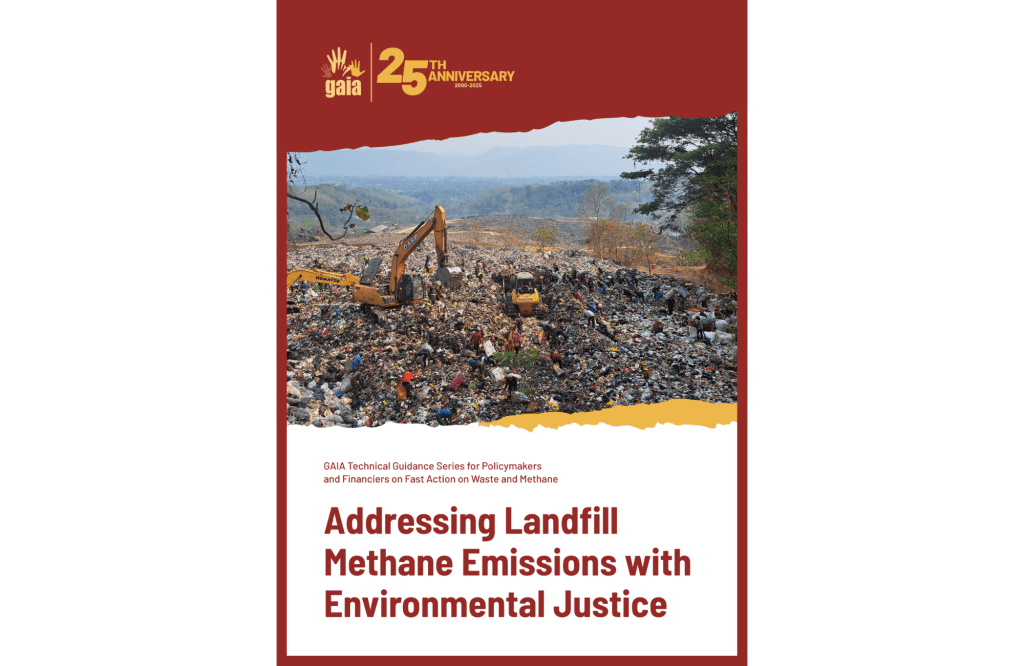
Addressing Landfill Methane Emissions with Environmental Justice outlines the risks of business-as-usual (BAU) approaches to landfill methane mitigation and makes the case for a sustainable, justice-centered response. It draws on international evidence, current policy trends, and community experience to identify what works, and what doesn’t, when it comes to landfill closure and organics management.

(EN) Addressing Landfill Methane Emissions with Environmental Justice

(ES) Abordar las emisiones de metano de los rellenos sanitarios con justicia ambiental

(FR) Lutter contre les émissions de méthane des décharges grâce à la justice environnementale

(Infographics) False Solutions for Waste: Why They Fail People and the Planet


Municipal Strategies for Organic Waste: A Toolkit to Cut Methane Emissions is the 1st of the GAIA Technical Guidance Series for Policymakers and Financiers on Fast Action on Waste and Methane. This toolkit introduces six key strategies to help municipalities reduce methane emissions from organic waste: animal feed, composting, vermicomposting, anaerobic digestion, black soldier fly processing, and landfill biocovers. The primary objective is to prevent organic waste from reaching landfills by prioritizing diversion and resource recovery.

(EN) Municipal Strategies for Organic Waste: A Toolkit to Cut Methane Emissions

(ES) Residuos orgánicos Municipales: Estrategias para reducir las emisiones de metano

(Infographics) Why Zero Waste?


By Mariel Vilella, Global Climate Program Director

New report recommends financing and scaling-up community-led organic waste management to reduce waste methane emissions

(This article was first published by We Don’t Have Time)

Opposite to the saying “for big problems, big solutions”—when it comes to reducing waste methane emissions, we should be thinking big, but not in terms of large-scale infrastructure. Precisely, a new report by the Climate Policy Initiative (CPI) highlights that community-led, decentralized waste management models are not only more cost-efficient but also deliver numerous co-benefits — from cutting waste and emissions to strengthening local livelihoods — underscoring the urgent need for greater investments.

In Bandung, Indonesia, nine zero-waste city models have demonstrated the power of community-driven strategies to keep organic waste out of landfills. These initiatives enable nearly half a million people to avoid sending their organic waste to disposal sites, collectively diverting up to 6,500 tons of organic waste each year.

Instead, household organic waste is routed to composting facilities, where it is transformed into rich compost that can be used to nourish soil and improve food security. “There’s no such thing as ‘throwaway’ in organic waste management – composting ‘throws’ life back to the earth,” says Yobel Novian Putra, who has been involved in implementing these zero waste models with local organisation YPBB for several years.

In Brazil, waste picker cooperatives are thriving and increasingly taking a lead role in managing organic waste, alongside collecting, sorting, and processing recyclable materials — the most valuable resources in the waste stream. These cooperatives not only provide income and dignity to waste pickers, but also form key partnerships with municipalities and organizations to drive forward a more inclusive and sustainable waste management system.

“We must invest in people and social technologies—not outdated infrastructure—and rethink finance to support inclusive climate solutions,” said Victor Argentino of Instituto Polis. “The CPI’s report demonstrates that in Brazil, effective waste solutions already exist — the answers are in our hands and at our disposal. In the short term, cities must deliver essential public services, including proper waste management that prioritizes the inclusion of waste pickers and local groups in the process.” 

These stories underscore the main report’s conclusion: investing in community- and waste picker-led organic waste management is a faster, more cost-effective approach. Most importantly, these investments create jobs and strengthen local economies. According to GAIA’s analysis, organic waste management generates the highest number of jobs per tonne of waste — making it a powerful tool for both climate action and development.

“Cities have a huge opportunity to show leadership in climate action through organic waste,” says David Sutasurya of YPBB. “The most effective solution for Indonesia is to implement decentralized, community-based systems that use low-methane practices. These approaches directly address the escalating dumpsite crisis by preventing the costly treatment of wastewater polluted by decomposing organic waste.”

“Unfortunately, funding priorities are misguided. While organic waste management and treatment receive only 1% of funding, a staggering 94% goes to expensive incinerators that fail to solve landfill pollution without prior waste separation. By contrast, source separation of food waste produces food-grade organics that can directly support local food production. The lack of funding for such initiatives highlights a clear policy gap at the national level,” adds Sutasurya.

As national governments prepare to submit their new climate action plans ahead of COP30 this November, they must prioritize funding and support for community and locally led waste management initiatives on organic waste. These approaches create the most jobs, protect the environment, and offer sustainable, low-cost solutions. 

At the individual level, we all have a role to play within the community, support local composting efforts, and engage with policymakers to advocate for waste management systems that place people, the environment, and the planet at their core. 

FACT BOX

    • Human-driven methane emissions are responsible for nearly 45% of current net global warming, with waste (solid and wastewater) contributing around 20%.

    • Source-separated collection and treatment of waste can reduce methane emissions from landfills by 62% (GAIA, 2022).

    • Public budget allocations for waste management are low and mainly go to large scale projects: 1.9 to 5.1% of each municipality budget across the country in Brazil and 0.3 to 2.4% in the sampled five cities.

    • Community-based and informal operators are competitive in terms of levelized cost of waste management (LCOW = total investment + operational cost for 20 years/total volume of waste treated for 20 years) (CPI, 2025)

    • The use of composting to manage organic waste generates an average of 6.6 jobs/10,000 tonnes per year. (GAIA; 2022)

    • Around 94% (USD4.08 billion) of methane abatement finance in the waste sector went to waste-to-energy incineration in 2021/22, and only 1% (USD 20 million) to organic waste management (CPI, 2025)

    • Thermal waste-to-energy technologies (i.e. waste incineration) emit 1.43 tonnes of CO2 per tonne of plastic burned, even after energy recovery (GAIA, 2022)

This is the default image

New report recommends financing and scaling-up community-led organic solid waste management 

10 June 2025 — A new report by the Climate Policy Initiative (CPI) reveals that community-led, decentralized waste management models are not only more cost-efficient but also provide multiple co-benefits1  beyond waste and methane emissions reduction – underscoring the urgent need for greater investment in these approaches. [DOWNLOAD THE REPORT]

The report presents case studies that highlight community-based composting programs, waste pickers cooperatives, and home composting initiatives in Indonesia and Brazil. 2 It reveals that investing in community- and waste picker-led organic waste management is faster and a more cost-effective approach.3 

“Most methane abatement finance currently goes to large-scale  waste disposal infrastructure. However, the report shows that those approaches are not always the most cost-efficient. It is time for policymakers and financiers to take urgent action to make funding available to existing, successful community-led initiatives, and waste pickers groups. These local actors are already implementing climate solutions in the waste sector and offer some of  the most compelling co-benefits,” says Yobel Putra, GAIA Climate Program Officer. 

“Cities have a big opportunity to show leadership in delivering climate action through organic waste,” says David Sutasurya of YPBB. “The most effective solution for Indonesia is to implement decentralized, community-based systems that utilize ‘low-methane’ practices . These approaches directly address the escalating dumpsite crisis by preventing the costly treatment of wastewater polluted by decomposing organic waste.”

“Unfortunately, funding priorities are misguided. While organic waste management and treatment receive only 1% of funding, 94% goes to expensive incinerators that fail to solve landfill pollution without prior waste separation. By contrast, source separation of food waste yields food-grade organics that can directly support local food production. The lack of funding for such initiatives highlights a clear policy gap at the national level,” adds Sutasurya. 

According to Victor Argentino of Instituto Polis (Brazil) the cases in Brazil demonstrate that effective waste solutions already exist. “We must invest in people and social technologies—not outdated infrastructure—and rethink finance to support inclusive climate solutions. The solution is in our hands and at our disposal. In the short term, cities must deliver essential public service including proper waste management prioritising the inclusion of waste pickers and local groups.” 

“As national governments prepare to submit their new climate action plans ahead of COP30 this November, they must prioritize funding and support for  community and locally led waste management initiatives – particularly organic waste composting. These approaches create the most jobs, protect the environment, and offer sustainable, low-cost solutions. At the individual level, we all have a role to play  within the community, support local composting efforts, and engage with policymakers to advocate for waste management systems that place people, the environment, and the planet at their core. Remember: “There’s no such thing as ‘throwaway’ in organic waste management. Composting “throws” life back to the earth.” says Putra.

In the long-term, national governments must recognize these practices as a low-hanging climate solution and work to  institutionalize zero waste systems. Such approaches can bring us closer to a clean, toxic-free world –  a future where everyone  can breathe fresh air, and no one is left behind. 

Notes: 

  1. The report demonstrates  that beyond waste and methane emissions reduction, government and community-operated models present other benefits in job creation, food provision from use of waste management byproducts, and improved air and water quality from reduced methane and CO2 emissions from waste processing and transportation. 
  2. The report looks at seven cases from Indonesia that are run by the government, private companies, and communities, and ten cases from Brazil run by government, private companies, waste picker cooperatives, public-private partnership, and composting by households.  
  3. Compared to large  waste management industries, smaller, home, or cooperative models can operate with a lot less infrastructure without having to invest in land and buildings.

Media Contact: Sonia Astudillo, Global Climate Communications Officer, Global Alliance for Incinerator Alternatives (GAIA) I sonia@no-burn.org I +63 917 5969286

[SPANISH VERSION]

El sector de los residuos es clave para soluciones climáticas rentables

Un nuevo informe recomienda financiar y ampliar la gestión de residuos sólidos orgánicos liderada por la comunidad

— Un nuevo informe de la Iniciativa de Política Climática (CPI) revela que los modelos de gestión de residuos descentralizados y dirigidos por la comunidad no solo son más rentables, sino que también proporcionan múltiples beneficios adicionales más allá de la reducción de los residuos y las emisiones de metano,1 lo que subraya la urgente necesidad de aumentar la inversión en estos enfoques. [DESCARGAR EL INFORME]

El informe presenta estudios de casos que destacan los programas de compostaje comunitario, las cooperativas de recicladores y las iniciativas de compostaje doméstico en Indonesia y Brasil. 2 Revela que invertir en la gestión de residuos orgánicos dirigida por la comunidad y los recicladores es un enfoque más rápido y rentable.3

«La mayor parte de la financiación para la reducción de metano se destina actualmente a infraestructuras de eliminación de residuos a gran escala. Sin embargo, el informe muestra que esos enfoques no siempre son los más rentables. Es hora de que los responsables políticos y los financiadores tomen medidas urgentes para destinar fondos a las iniciativas comunitarias existentes que han tenido éxito y a los grupos de recicladores. Estos actores locales ya están aplicando soluciones climáticas en el sector de los residuos y ofrecen algunos de los beneficios colaterales más convincentes», afirma Yobel Putra, responsable del programa climático de GAIA.

«Las ciudades tienen una gran oportunidad de mostrar su liderazgo en la lucha contra el cambio climático a través de los residuos orgánicos», afirma David Sutasurya, de YPBB. «La solución más eficaz para Indonesia es implementar sistemas descentralizados y comunitarios que utilicen prácticas de «bajo metano». Estos enfoques abordan directamente la creciente crisis de los vertederos, al evitar el costoso tratamiento de las aguas residuales contaminadas por la descomposición de los residuos orgánicos».

«Lamentablemente, las prioridades de financiación están mal orientadas. Mientras que la gestión y el tratamiento de los residuos orgánicos solo reciben el 1 % de la financiación, el 94 % se destina a costosas incineradoras que no resuelven la contaminación de los vertederos sin una separación previa de los residuos. Por el contrario, la separación en origen de los residuos alimentarios produce materia orgánica apta para el consumo que puede apoyar directamente la producción local de alimentos. La falta de financiación para este tipo de iniciativas pone de manifiesto una clara laguna en las políticas a nivel nacional», añade Sutasurya.

Según Víctor Argentino, del Instituto Polis (Brasil), los casos de Brasil demuestran que ya existen soluciones eficaces para los residuos. «Debemos invertir en las personas y en las tecnologías sociales, no en infraestructuras obsoletas, y replantearnos la financiación para apoyar soluciones climáticas inclusivas. La solución está en nuestras manos y a nuestra disposición. A corto plazo, las ciudades deben prestar servicios públicos esenciales, incluida una gestión adecuada de los residuos, dando prioridad a la inclusión de los recicladores y los grupos locales».

«Mientras los gobiernos nacionales se preparan para presentar sus nuevos planes de acción climática antes de la COP30 en noviembre, deben dar prioridad a la financiación y el apoyo a las iniciativas de gestión de residuos impulsadas por la comunidad y a nivel local, en particular el compostaje de residuos orgánicos. Estos enfoques crean más puestos de trabajo, protegen el medio ambiente y ofrecen soluciones sostenibles y de bajo coste. A nivel individual, todos tenemos un papel que desempeñar dentro de la comunidad, apoyar los esfuerzos locales de compostaje y colaborar con los responsables políticos para promover sistemas de gestión de residuos que sitúen a las personas, el medio ambiente y el planeta en el centro. Hay que recordar: «No existe el «desecho» en la gestión de residuos orgánicos. El compostaje «devuelve» la vida a la tierra», afirma Putra.

A largo plazo, los gobiernos nacionales deben reconocer estas prácticas como una solución climática fácil de implementar y trabajar para institucionalizar los sistemas de basura cero. Estos enfoques pueden acercarnos a un mundo limpio y libre de tóxicos, un futuro en el que todos podamos respirar aire fresco y nadie se quede atrás. 

Notas:

  1. El informe demuestra que, más allá de la reducción de los residuos y las emisiones de metano, los modelos gestionados por el gobierno y la comunidad presentan otras ventajas, como la creación de empleo, el suministro de alimentos a partir de los subproductos de la gestión de residuos y la mejora de la calidad del aire y el agua gracias a la reducción de las emisiones de metano y CO2 procedentes del tratamiento y el transporte de los residuos.
  2. El informe analiza siete casos de Indonesia gestionados por el gobierno, empresas privadas y comunidades, y diez casos de Brasil gestionados por el gobierno, empresas privadas, cooperativas de recicladores, asociaciones público-privadas y compostaje doméstico.  
  3. En comparación con las grandes industrias de gestión de residuos, los modelos más pequeños, domésticos o cooperativos pueden funcionar con mucha menos infraestructura, sin necesidad de invertir en terrenos y edificios.

##

See related article: WASTE SECTOR HOLDS KEY TO COST-EFFICIENT CLIMATE SOLUTIONS

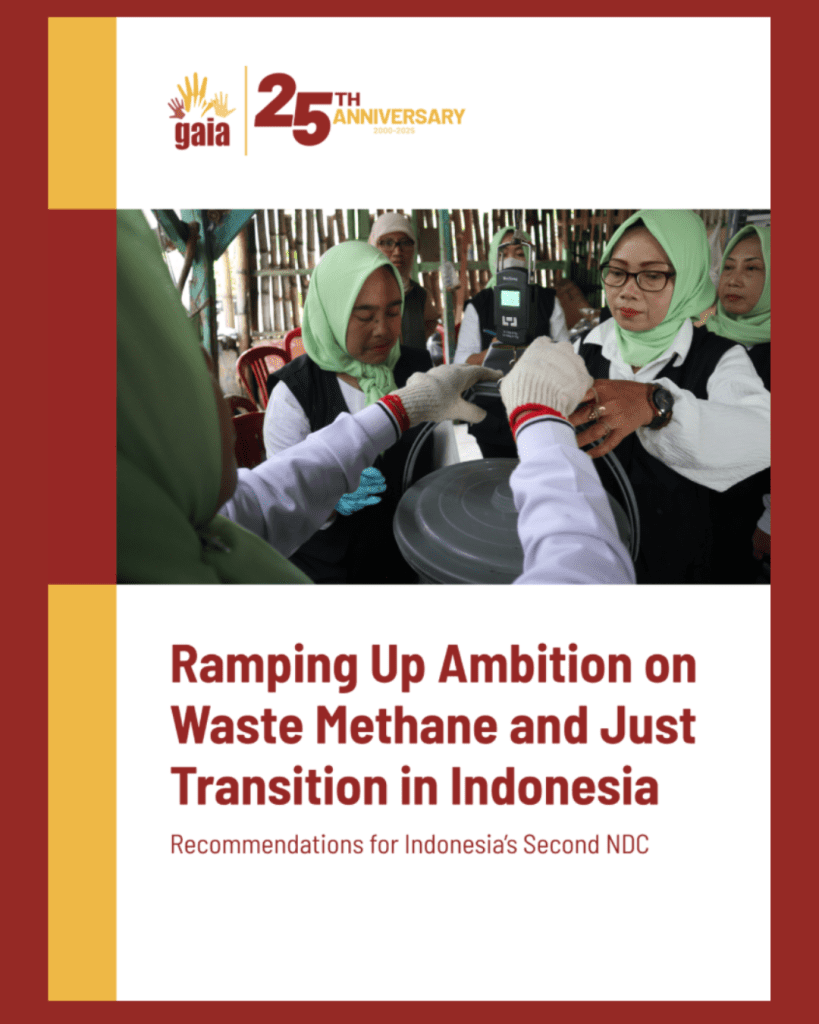
In 2025, the Government of Indonesia (GoI) is scheduled to submit its Second Nationally Determined Contribution (NDC). This presents a crucial opportunity for the government to enhance its ambition regarding emissions mitigation in the waste sector and to mobilize significant climate finance specifically for methane emissions.

This policy brief offers six key recommendations as follows:

  1. Establish source separation and separate organic waste collection & treatment as a core strategy prioritized above all others, as it is a precondition for successful downstream organic waste treatment.
  2. Prioritize strategies that follow the waste hierarchy, focusing on organic waste and waste methane. This means shifting from end-of-pipe measures to upstream measures, including increasing targets for organic waste treatment (like composting, BSF, and biodigesters), integrating FLW prevention, and replacing WtE, RDF, and LFG with methods like biologically active landfill cover.
  3. Integrate a just transition in the dumpsite closure plan to ensure that affected communities, particularly waste pickers, are not left behind. This requires meaningful consultation and enabling waste pickers to participate in organic waste treatment initiatives.
  4. Increase participation and boost leadership in international spaces and forums to mobilize climate finance. This includes joining the Climate and Clean Air Coalition (CCAC) as a state member as well as initiatives like the Lowering Organic Waste Methane (LOW-M) Initiative, the Reducing Organic Waste Methane (ROW) Declaration, and CCAC’s Methane Roadmap Action Program (MRAP) and Targeted Expert Assistance (TEA) service. All of which can signal Indonesia’s commitment and attract funding.
  5. Set up institutional and governance capacity as the preconditions for successful Second NDC implementation. This involves reclassifying waste management as an essential service with mandated budget allocation, distributing the financial burden across national and subnational levels, as well as banning untreated organic waste from dumpsites.
  6. Build supporting environments for local governments to treat organic waste properly and sustainably. This includes enforcing source separation implementation, creating a stable and appealing market for producer and offtaker, and improving financing accessibility at the implementation level.

By implementing these recommendations, Indonesia can attract external and domestic funding, streamline implementation, configure best practices, and ensure a just transition for those impacted by dumpsite closures.

RESOURCES

Practical roadmaps and guidelines on implementing zero waste strategies:

Relevant external reference documents and processes from close and aligned allies:

Celebrating methane reduction advancements in the waste sector guided by the Environmental Justice Principles

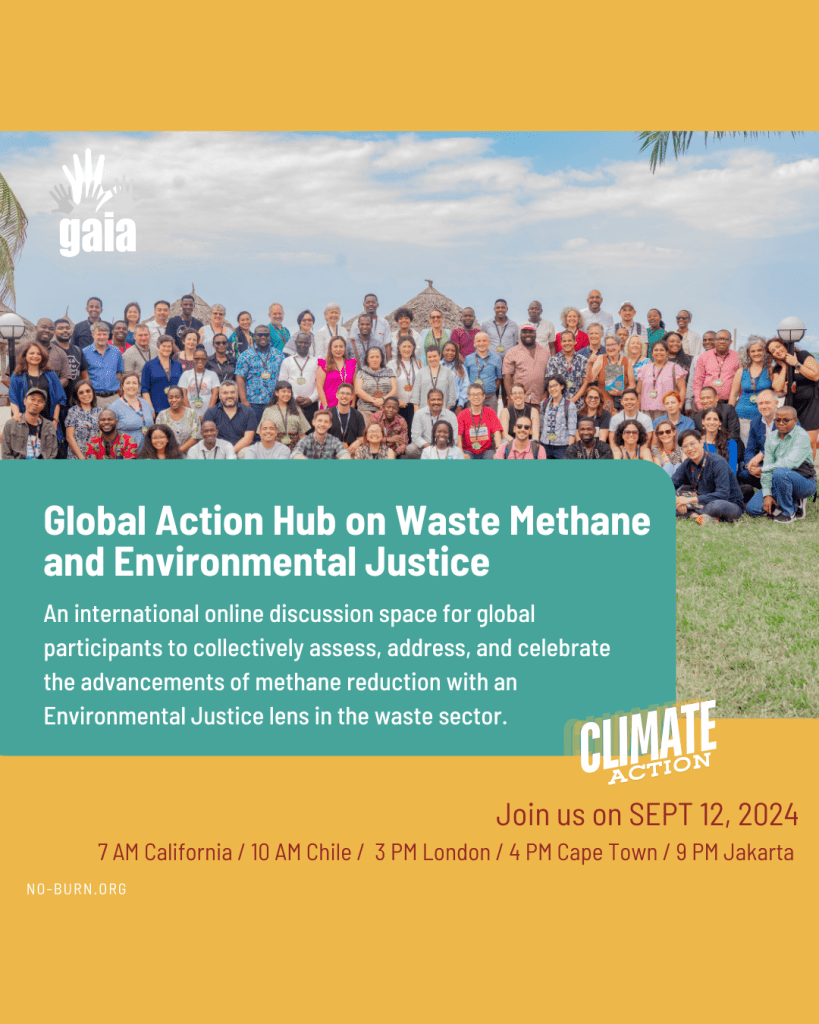
The Global Action Hub on Waste Methane and Environmental Justice is an international online space to collectively assess, address, and celebrate the advancements on this field of climate action and support the implementation of the Global Methane Pledgeand the COP 29 Declaration on Reducing Methane from Organic Waste (ROW Declaration) in alignment with the Environmental Justice Principles

Launched in July 2024 at the Methane Action and Environmental Justice Summit in Tanzania, the GAH is an open space to support all those working to this agenda and share expertise, strategise, celebrate, and ultimately hold an accountability space for environmental justice in the intersection between waste and climate. 

Currently facilitated by GAIA whose members are deeply engaged in promoting and implementing zero waste solutions as climate champions, the GAH is inspired by the great momentum and years of building the intersection between waste and climate, especially since the launch of the Global Methane Pledge at COP26 in 2021. 

Since then, several promising political and financial interests in tackling methane emissions from the waste sector have surfaced, yet it is crucial that those interventions must align with environmental justice principles to ensure methane emissions reduction go hand-in-hand with social and economical benefits for all stakeholders and that no one is left behind.  

JOIN THE GLOBAL ACTION HUB

Join the 8th quarterly meeting. Register here.

This discussion space is relevant especially for:

  • Policy makers and government officials
  • Non-government organizations
  • Implementers, waste workers,  and wastepickers
  • Think tanks
  • Philanthropists

GLOBAL ACTION HUB WEBINARS

1st Quarterly Meeting (12 Sep 2024)

In this inaugural call, we looked at the State of Play on Waste Methane Reduction and Environmental Justice, as well as some of the best practices from Chile, Ghana, and India. The space also served as a place to celebrate progress and express mutual support towards methane emissions and environmental justice.

Speakers: Harshad Barde (SWACH, India), Tamara Ortega (Fundacion Basura, Chile), Daniel Nkrumah (La Dade Kotopon Municipal Assembly, Ghana)

Link to presentation


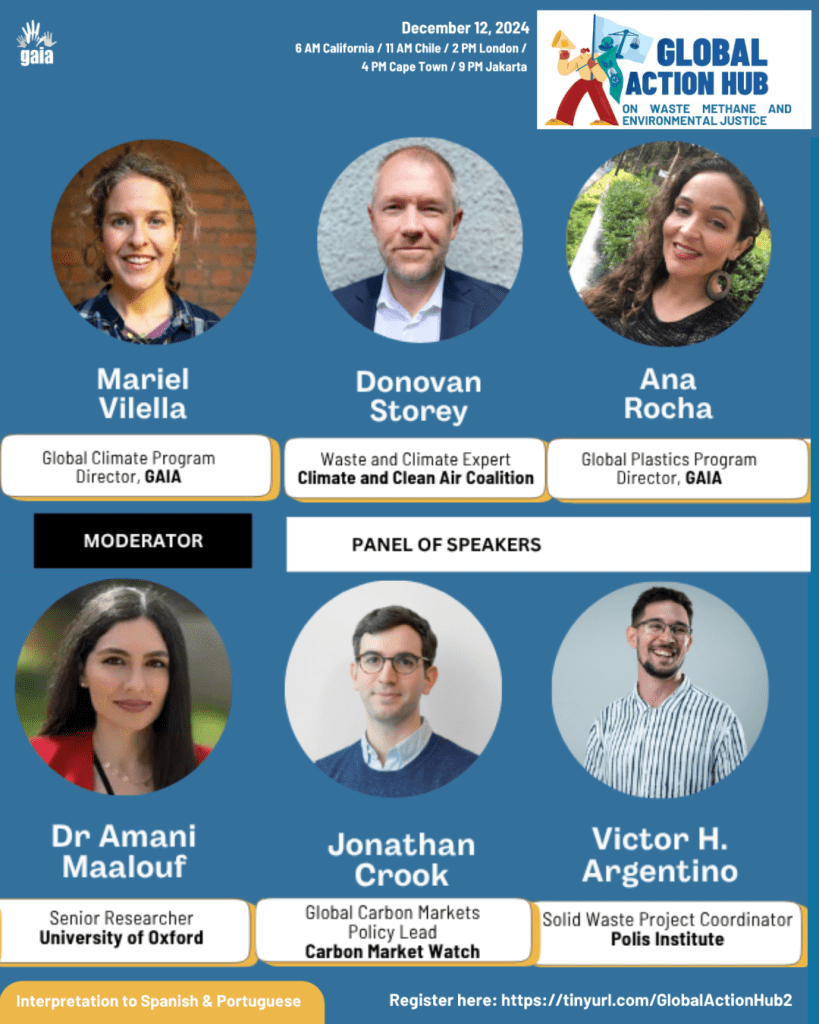
2nd Quarterly Meeting (12 Dec 2024)

With the recently concluded COP29, the meeting focused on the overall results from COP on waste and methane and a report back from the Global Plastics Treaty negotiations. Recognizing the impacts of Paris Agreement Article 6, we looked at the work that needs to be done to ensure that problematic projects are halted. Global efforts to close dumpsites and landfills and expectations for COP 30 were also on the agenda.

Speakers: Donovan Storey (Climate and Clean Air Coalition), Ana Rocha (GAIA), Jonathan Crok (Carbon Market Watch), Dr. Amani Maalouf (Oxford University), and Victor Argentino (Instituto Polis)

Link to recording

Link to presentation


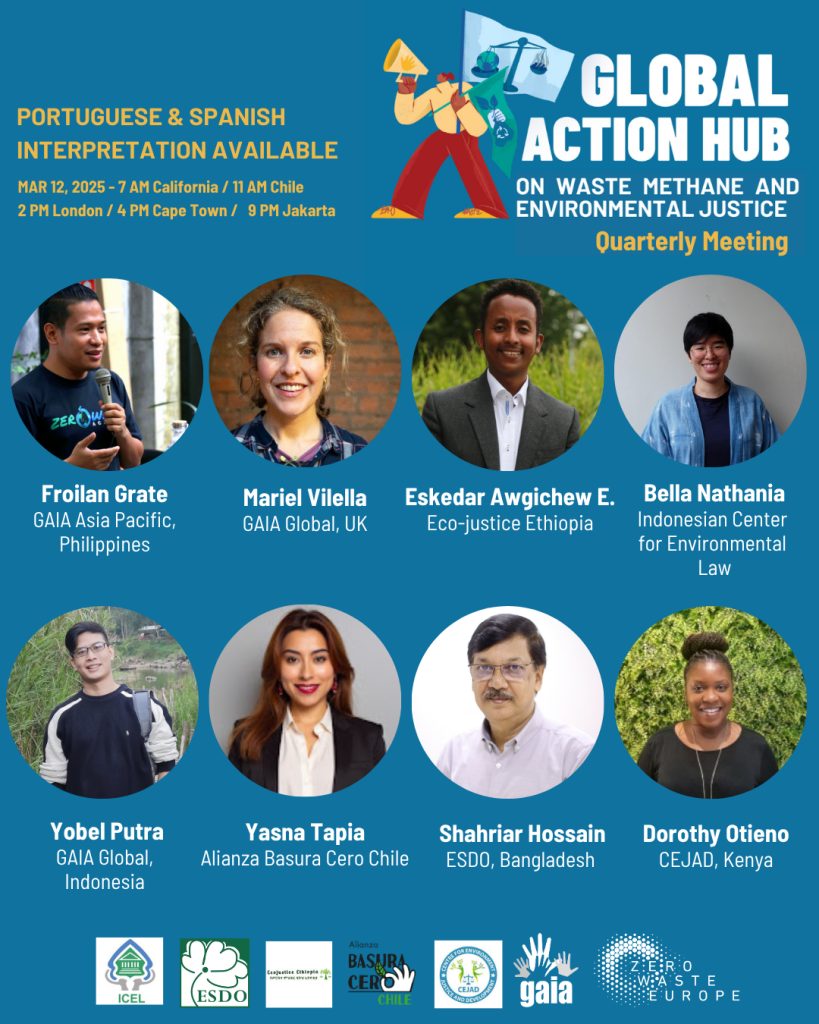
3rd Quarterly (12 Mar 2025)

This meeting focused on CSO’s input to waste methane reduction and EJ in the NDC3.0 and the criteria for climate finance for zero waste. 

Speakers: Mariel Villela (GAIA), Yasna Tapia (Alianza Basura Cero Chile), Dorothy Otieno (Center for Environmental Justice and Development, Kenya), Eskedar Ergete (Eco-justice, Ethiopia), Bella Nathania (Indonesian Center for Environmental Law), Shahriar Hossain (Environment and Social Development Organization, Bangladesh), and Yobel Putra (GAIA)

Link to recording

Link to presentation


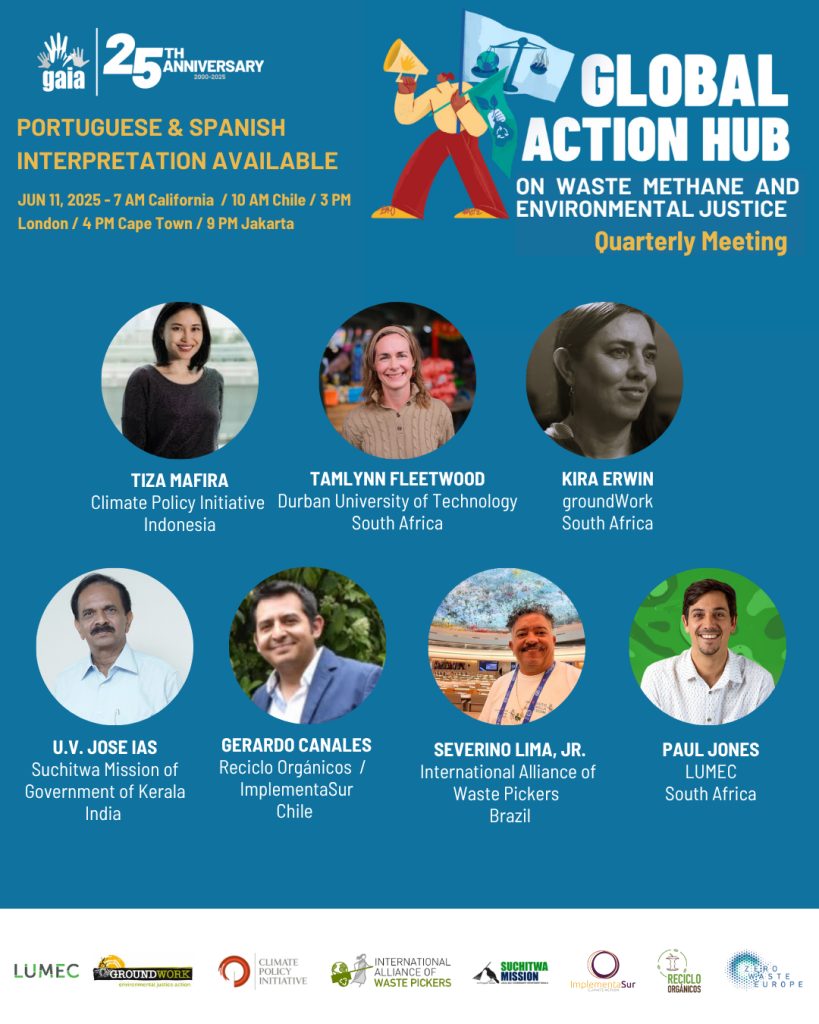
4th Quarterly Meeting (June 11, 2025)

This session focused on the recently released report by the Climate Policy Initiative, Financial Analysis of Solid Waste Management Business Models: Case Studies in Indonesia and Brazil and a cost-benefit analysis of zero waste system in Durban. This was followed by an open discussion on the challenges and opportunities to financing and scaling organic waste management.

Speakers: Tiza Mafira (Climate Policy Initiative, Indonesia), Tammlyn Fleetwood (Durban University of Technology, South Africa), Kira Erwin (groundWork, South Africa), Paul Jones (LUMEC, South Africa), UV Jose IAS (Suchitwa Mission of Government of Kerala, India), Gerardo Canales (Reciclo Orgánicos /ImplementaSur, Chile), and Severino Limo, Jr. (International Alliance of Waste Pickers, Brazil).

Link to recording (English, Spanish subtitle)

Link to presentation


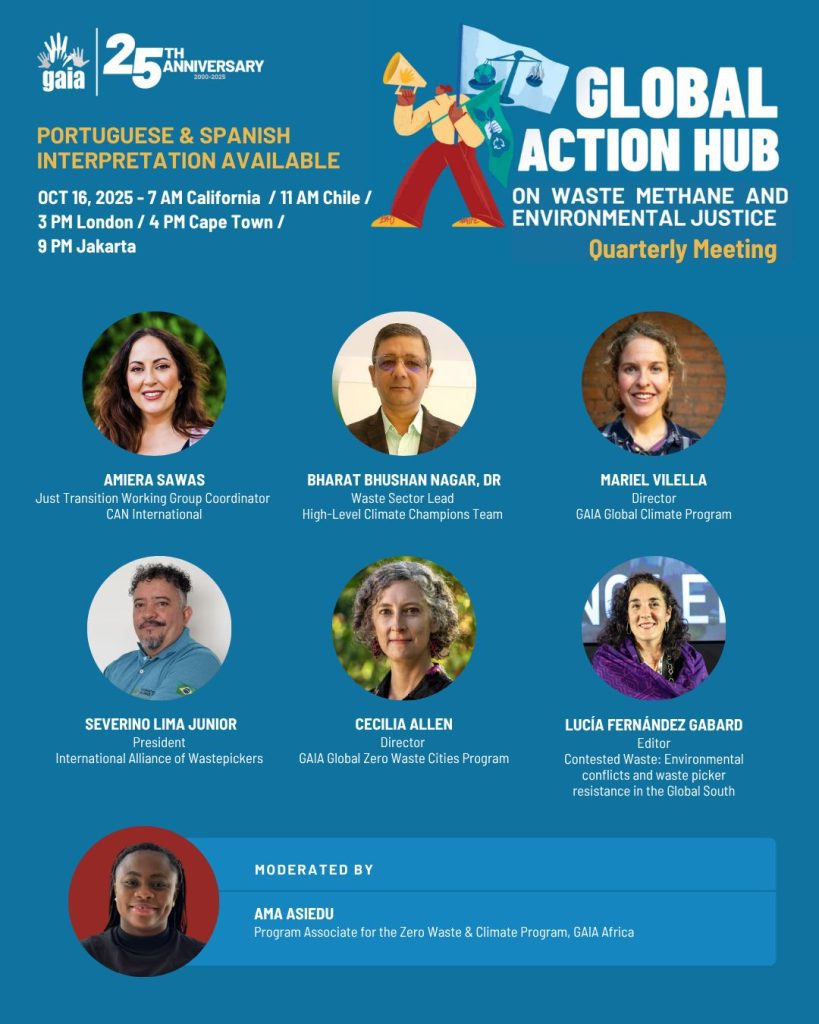
5th Quarterly Meeting (October 16, 2025)

With COP 30 jut around the corner, this session delved into the state of the climate negotiations. It also looked into waste, conflict, and community resistance and new publications and resources from GAIA. There was also a live update from the 1st gathering of the cohort for the U.S. Methane Reduction and Environmental Justice Regrant Program which supports community-based organizations reducing methane through zero waste strategies, centering justice and leadership in the communities most affected by pollution and climate change.
Speakers: Dr. Bharat Bhushan Nagar (High-Level Climate Champions Team), Dr. Amiera Sawas (CAN Just Transition Working Group), Mariel Vilella (GAIA), Severino Lima, Jr. (International Alliance of Wastepickers), Lucia Fernandez Gabard (WIEGO), Cecilia Allen (GAIA), and Denaya Shorter (GAIA US/Canada).

Link to recording (English, Spanish subtitle)

Link to presentation


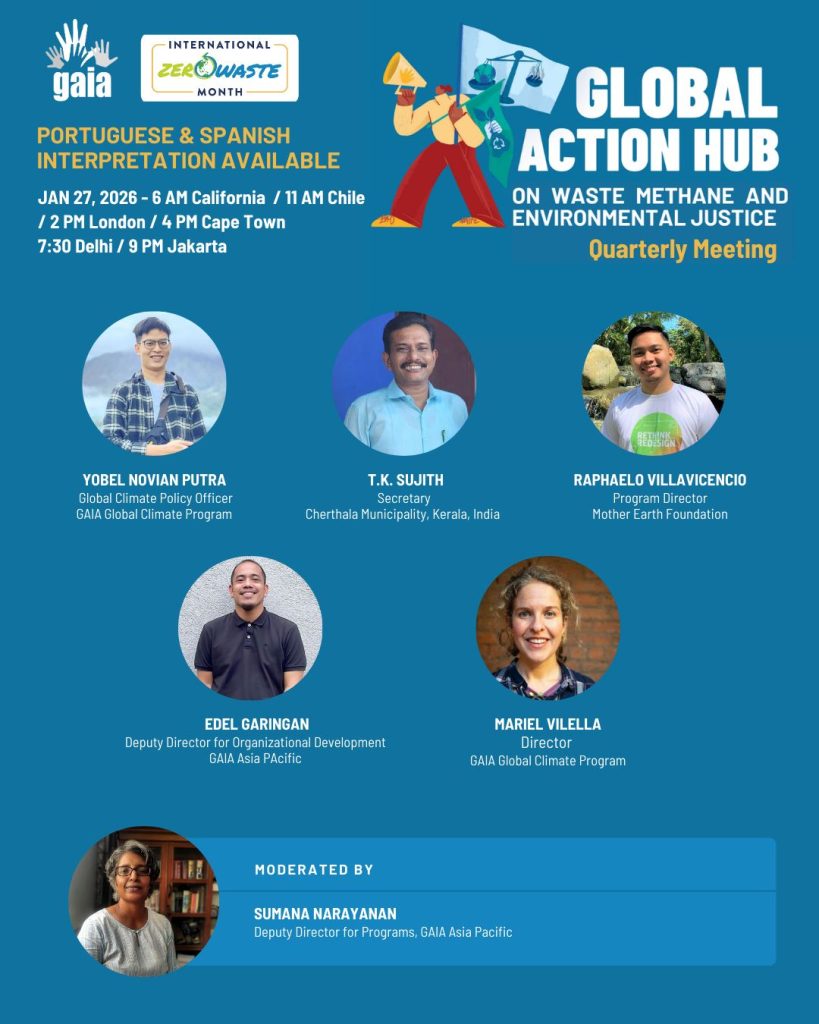
6th Quarterly Meeting (January 27, 2026)

In this Global Action Hub on Waste Methane and Environmental Justice, titled Financing Zero Waste: Driving Climate Justice, with special focus on Asia, we looked at Lessons from 2025: What Worked, What Didn’t, and Why, Financing and Scaling Community-Led Zero Waste Solutions, and Envisioning Zero Waste in Climate and Finance Agendas for 2026 and Beyond
Speakers: Yobel Putra (GAIA), T.K. Sujith (Cherthala Municipality, Kerala, India), Rap Villavicencio (Mother Earth Foundation, Philippines), Edel Garingan (GAIA Asia Pacific), and Mariel Vilella (GAIA). Moderated by Sumana Narayanan (GAIA Asia Pacific)

Link to recording (EnglishSpanish subtitle, Portuguese subtitle, French subtitle)

Link to presentation


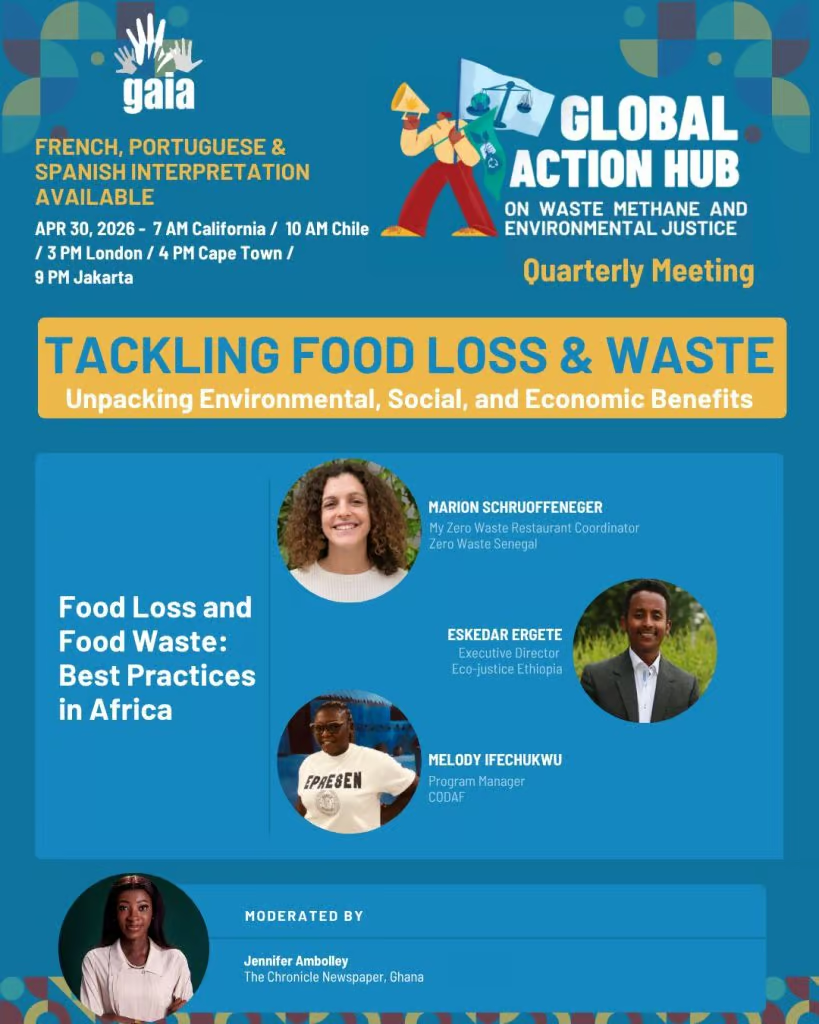
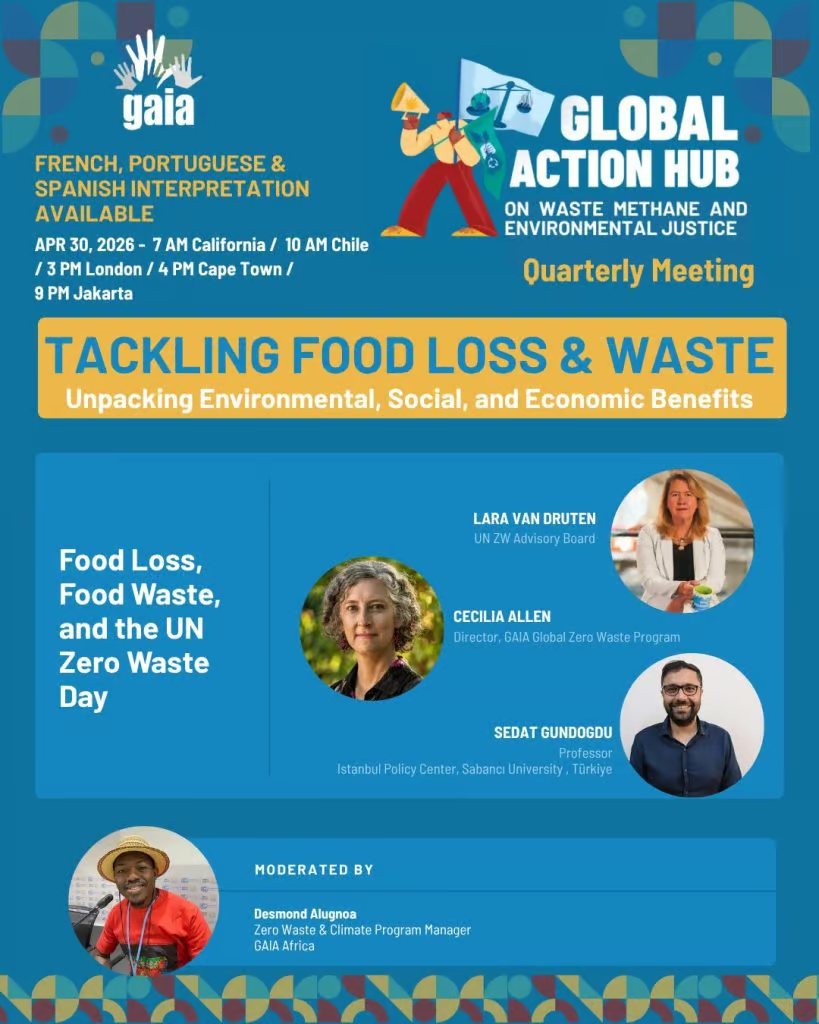
Tackling Food Loss & Waste: Unpacking Environmental, Social & Economic Benefits. In this session, we looked at key steps for tackling global food waste and loss while leveraging on the global momentum and discussions in global spaces. The spotlight is on the best practices from the Africa region. Speakers include: Lara Van Druten (UN ZW Advisory Board member), Cecilia Allen (GAIA Global Zero Waste Director), Sedat Gundogdu (Professor at Istanbul Policy Center, Sabancı University, Türkiye), Marion Schruoffeneger (Zero Waste Senegal), Eskedar Ergete (Eco-Justice, Ethiopia), Solomon Nii Noi (Head of Waste Management Department, Accra Metro), Melody Ifechukwu (CODAF), and Ama Acheampomaa Asiedu (GAIA Africa Zero Waste & Climate Program Associate. Moderated by Desmond Alugnoa (GAIA Africa Zero Waste and Climate Manager) and Jennifer Ambolley (The Chronicle Newspaper, Ghana).

Link to recording

Link to audio in French, Spanish, and Portuguese

Link to presentation


RESOURCES

Practical roadmaps and guidelines on implementing zero waste strategies:

Relevant external reference documents and processes from close and aligned allies:

The zero waste movement is gaining momentum from different corners of the globe. Recently, Kerala, a state in India, has been awarded a waste-free status by the country’s Minister for Local Self Government while Tallinn, the capital of Estonia became a candidate for the zero waste certification of the Mission Zero Academy, the world’s first Zero Waste Cities Certification.    

This shows that by empowering the community, working with different stakeholders, putting environmental justice at the center, and a strong commitment to positive change, zero waste as a climate solution is not a far-fetched goal.

May the  experience of Kerala and Tallinn serve as a blueprint for cities and communities working towards managing waste while mitigating the climate crisis. Visit  no-burn.org and https://www.missionzeroacademy.eu/ to know more.

Vavada Casino Online

Vavada Casino to popularna platforma hazardowa online, zaprojektowana z myślą o polskich graczach, oferująca dynamiczne i bezpieczne środowisko do gry. Regulowana prawnie i działająca na podstawie pełnej licencji, gwarantuje legalność rozgrywki oraz ochronę danych osobowych i finansowych użytkowników. Kasyno stawia na przejrzystość zasad, szybkie wypłaty i odpowiedzialną rozrywkę.


  • E-portfele: do 24 godzin
  • Karty bankowe: 1-3 dni robocze
  • Kryptowaluty: do 1 godziny

Weryfikacja konta: Wymagana tylko przy wypłatach powyżej 2000 ZŁ. Proces jest prosty i odbywa się bezpośrednio w aplikacji.

Status prawny Vavada w Polsce

Vavada posiada międzynarodową licencję hazardową wydaną przez rząd Curaçao (nr 8048/JAZ), jednak nie posiada licencji Ministerstwa Finansów Polski. Oznacza to, że działa w tzw. szarej strefie prawnej.

Mimo to, polscy gracze mogą:

  • Swobodnie rejestrować konta
  • Korzystać z pełnej oferty gier
  • Wypłacać wygrane bez ograniczeń

Ważne: Vavada nie blokuje dostępu graczom z Polski i oferuje pełne wsparcie w języku polskim.

Porównanie Vavada z innymi kasynami

Funkcja Vavada Casino Mostbet Total Casino

Typ platformy Kasyno online Bukmacher + kasyno Kasyno online
Bonus powitalny 1500 ZŁ + 100 FS 2500 ZŁ + FS 1000 ZŁ + 50 FS
Aplikacja mobilna Android/iOS (APK) Android/iOS (APK) Android/iOS (Google Play/App Store)
Płatności BLIK, krypto BLIK, Skrill BLIK, Przelewy24
Licencja w Polsce Brak Brak Tak

Najczęściej zadawane pytania

Czy aplikacja Vavada jest bezpieczna?

Tak, aplikacja wykorzystuje zaawansowane szyfrowanie SSL i certyfikowane generatory liczb losowych (RNG). Kasyno posiada międzynarodową licencję Curaçao (nr 8048/JAZ).

Jak aktywować bonus powitalny?

Po zarejestrowaniu się w aplikacji, wykonaj pierwszy depozyt (min. 50 ZŁ) i wpisz kod promocyjny VAVADA100 w odpowiedniej zakładce. Bonus zostanie przyznany automatycznie.

Czy mogę grać bez depozytu?

Vavada okresowo oferuje darmowe spiny za samą rejestrację, jednak główne bonusy wymagają wykonania depozytu. Warto śledzić aktualne promocje w aplikacji.

Dlaczego aplikacji nie ma w Google Play?

Ze względu na restrykcyjną politykę sklepu Google wobec aplikacji hazardowych. Pobieranie APK ze strony operatora jest w pełni bezpieczne i zapewnia dostęp do wszystkich funkcji.

Jak długo trwają wypłaty?

Czas realizacji wypłat zależy od metody: e-portfele (do 24h), karty bankowe (1-3 dni), kryptowaluty (do 1h). Wypłaty poniżej 2000 ZŁ nie wymagają weryfikacji.

November 19, 2024, Baku Azerbaijan—The COP 29 Presidency today announced the COP29 Declaration on Reducing Methane from Organic Waste which aims to work towards targeted commitments in the waste sector.

“While the intention is good and civil society organizations like GAIA welcome the Declaration, it leaves a lot of room on whether it will be put into practice and how,” said Yobel Putra, GAIA Global Climate Policy Officer, further emphasizing the need to exclude false solutions such as waste burning in the picture to achieve real climate impact.

Mariela Pino, Waste Methane Climate Campaigner at GAIA Latin America and the Caribbean calls for an emphasis on waste pickers, saying “While the Declaration mentioned waste pickers and waste workers towards the end, there is no clarity on how this will take into effect.  Waste pickers have always been at the forefront of waste management and there is no denying their contribution in waste methane emissions reduction, however they continue to be ignored.  The Declaration needs to have a stronger stance on waste pickers recognition and access to climate finance.”

Other than putting emphasis on waste pickers and workers, Desmond Alugnoa, Zero Waste & Climate Program Manager at GAIA Africa and Earthshot Prize 2024 Winner.highlighted the needs for the Declaration to be supported by concrete action of local and national governments, grounded in the context of local communities, especially in the Global South where waste management is very much lacking and open burning is still prevalent, and supported by climate finance that is accessible to the communities.  

Jayakumar C, Executive Director of Thanal in India shared about the successful zero waste implementation work in Kerala and how aligning the work with the environmental justice principles that prioritizes impacted communities, local knowledge, accountability, and holistic solutions are critical. 

As countries are submitting their NDC 3.0, in Bangladesh, Dr. Shahriar Hossain, Founder, Environment and Social Development Organization cautions on the importance of NDC 3.0 to be supporting right solutions. “ Investments are still geared towards technological quick fixes that do not address the root of the waste and climate problem,” he said.  According to Hossain, the Declaration should  (1) incorporate Organic Waste Methane in NDCs, (2) Support National Policy and Budget for Decentralized Waste Management, (3) Adopt Environmental Justice (EJ) Principles, and (4) Promote Source-Level Waste Management.

____________

Media Contacts:

Sonia Astudillo, Senior Communications Officer, Global Alliance for Incinerator Alternatives (GAIA) Asia Pacific  I sonia@no-burn.org I +63 917 5969286

About GAIA  |  GAIA is a network of grassroots groups as well as national and regional alliances representing more than 1000 organizations from 92 countries whose ultimate vision is a just, toxic-free world without incineration. www.no-burn.org