


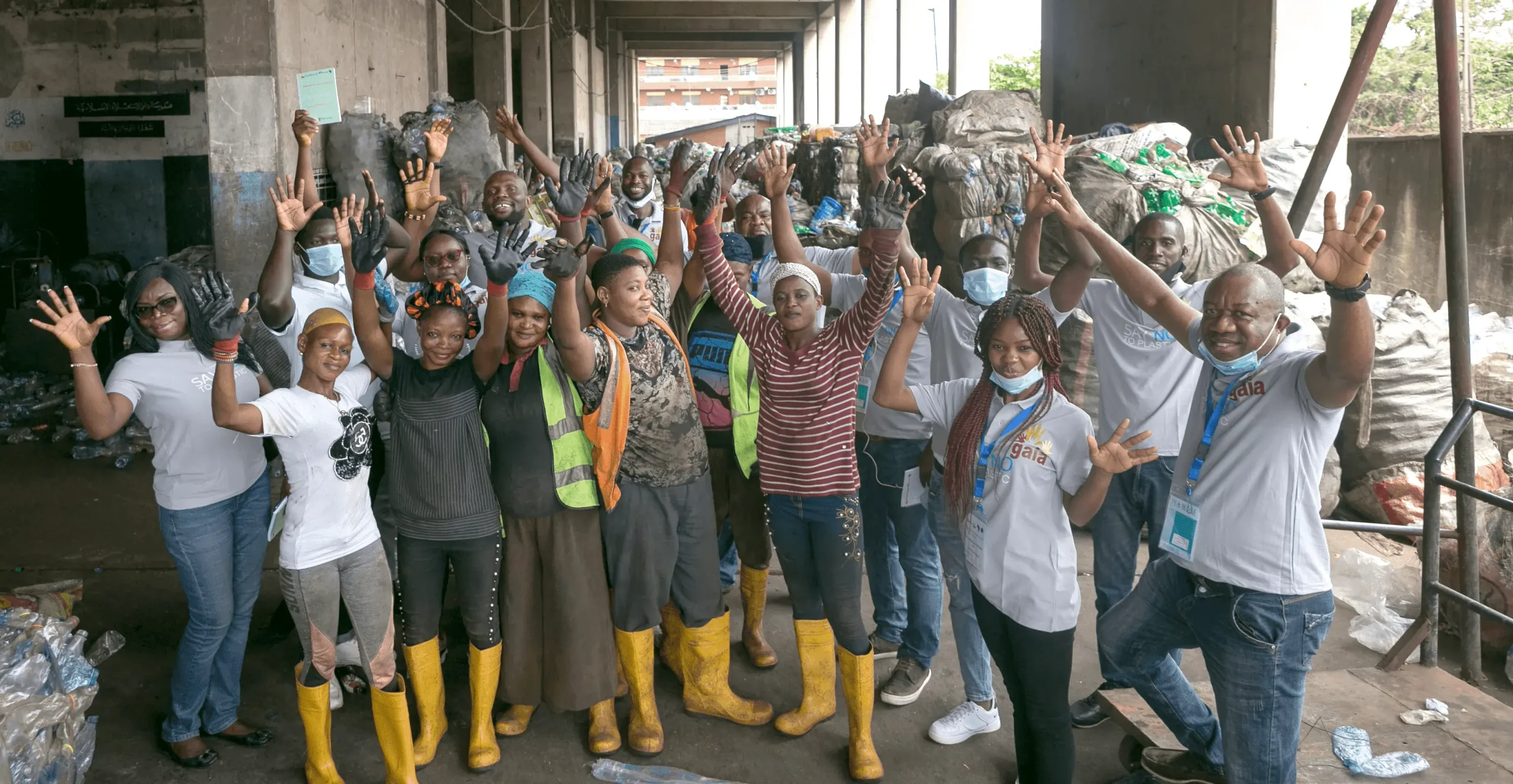

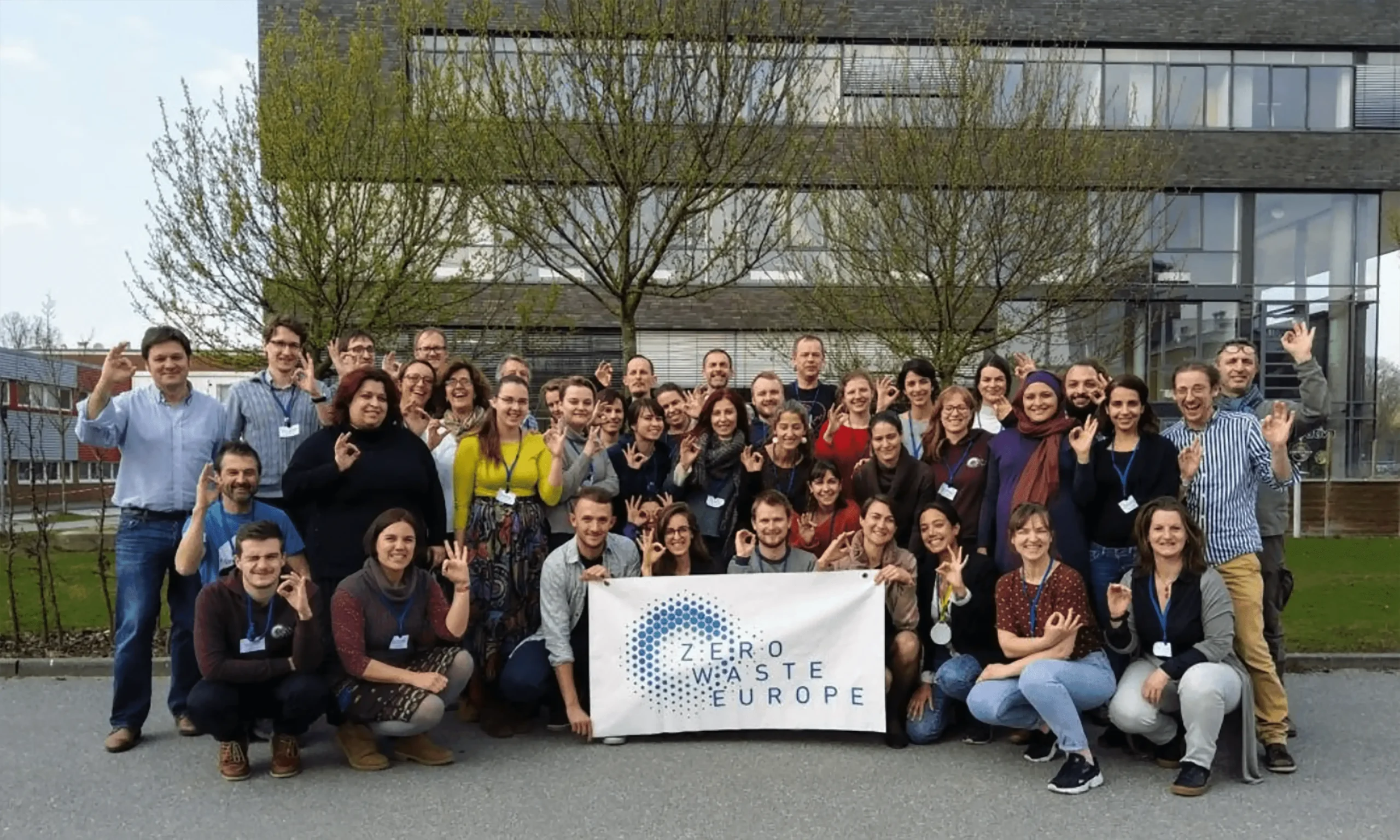


Together, GAIA members across the globe are moving humanity towards a zero waste future that’s fair for all. Through the exchange of deeply-rooted community knowledge, our network is able to create democratized zero waste solutions founded on both research and on-the-ground expertise.


AFRICA
GAIA in Africa strives to shift the narrative on plastic pollution, challenge incineration, promote zero waste and demand climate justice.
Waste Energy Has No Place in Africa
Making Waste Work. The South African Waste Picker’s Association’s Success Stories
ASIA-PACIFIC
GAIA’s work in Asia Pacific is focused on spotlighting and providing support for the many innovative and on-the-ground zero waste solutions.
Route to Zero Waste. A Flood-Prone City Show’s How It’s Done
EUROPE
Zero Waste Europe (ZWE), GAIA’s European branch works on a wide range of projects and policy areas with a single objective: advancing the zero waste future for Europe.
LATIN AMERICA & THE CARIBBEAN
Our work aims to both address the current inadequate waste management in the region that results in inequality, abuses and exploitation, and implement zero waste solutions that help overcome these injustices.
Inclusion of Waste Pickers in Zero Waste Programs: The Case of Buenos Aires City
Integral System for Waste Management: The Futaleufú Experience
UNITED STATES & CANADA
GAIA’s work in the U.S. and Canada began in the early 2000s, when a wave of incinerator proposals hit the region. Today we continue to work at the intersection of social and environmental issues.
U.S. Municipal Solid Waste Incinerators: An Industry in Decline
All Talk and No Recycling: An Investigation of the U.S. “Chemical Recycling” Industry
A Global community
Latest Resources
Africa’s Waste Crisis Is Attracting the Wrong Solution: Waste-To-Energy Incineration

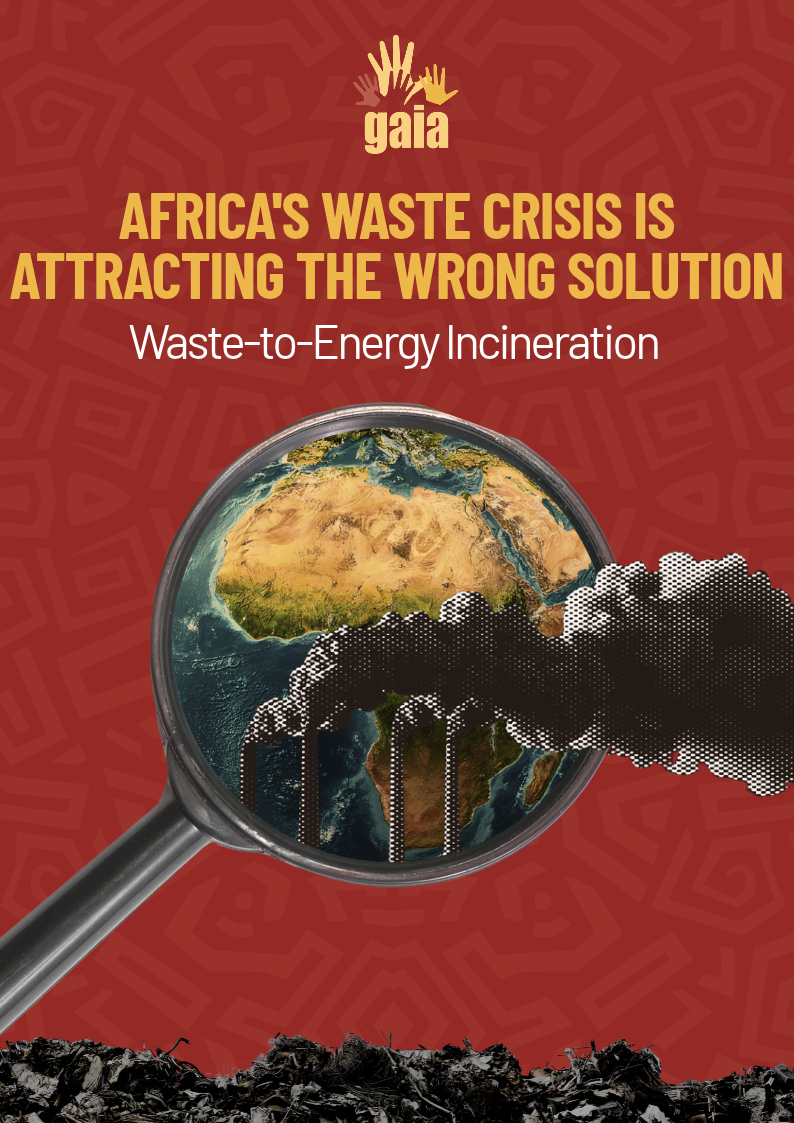
As African cities grapple with a growing waste crisis, waste-to-energy incineration is increasingly being promoted as a solution. This new report examines 15 waste-to-energy projects and proposals across 10 African countries, revealing the environmental, public health, and financial risks of pursuing incineration. And makes the case for prioritising zero waste solutions that address the root causes of the crisis rather than locking cities into decades of costly, polluting infrastructure.
Key findings
- 15 projects in 10 countries: one plant is operational (Reppie, Ethiopia), two are under construction and twelve are at the approval, financing, planning or proposal stage.
- Over US$4 billion in combined capital expenditure, for an estimated 520–550 MW of capacity.
- Public money and public risk: African public funds are the largest source of finance, and long contracts can shift economic risk onto the public sector even when projects are described as private.
- Waste pickers lose out: interviews near the Koshe dumpsite found a 50% drop in waste pickers’ earnings linked to the Reppie incinerator.
Frequently asked questions
How many waste-to-energy projects are proposed in Africa?
GAIA’s report tracks 15 waste-to-energy projects and proposals across 10 African countries: Egypt, Ethiopia, Ghana, Kenya, Morocco, Nigeria, Sierra Leone, South Africa, Uganda and Zimbabwe. Only one, the Reppie plant in Ethiopia, is operational.
Why is incineration the wrong solution for Africa’s waste crisis?
Most of Africa’s waste is organic and wet, so it burns poorly and may need fossil fuel support. Incinerators release toxic pollutants and ash, cost hundreds of millions of dollars, and lock cities into 25–30 year contracts that require a constant supply of waste.
What does the report recommend instead?
A moratorium on new incineration agreements until independent assessments are done, public disclosure of contracts and impact assessments, formal integration of waste pickers, and investment in source separation, collection, composting and recycling.
Related resources
The Reppie (Ethiopia) and Pomona (Zimbabwe) incinerators are also documented in GAIA’s Burn Book. Learn more in Waste-to-Energy Incineration: The Facts, Costs & Risks and Waste-Burning 101, join the Global Week of Action to Stop Incineration, and read 20 Inspiring Stories of Victory Against Incinerators.
Download This Resource
Related Resources
The Burn Book: Incinerators that Threaten the Climate, Public Health, and our Finances
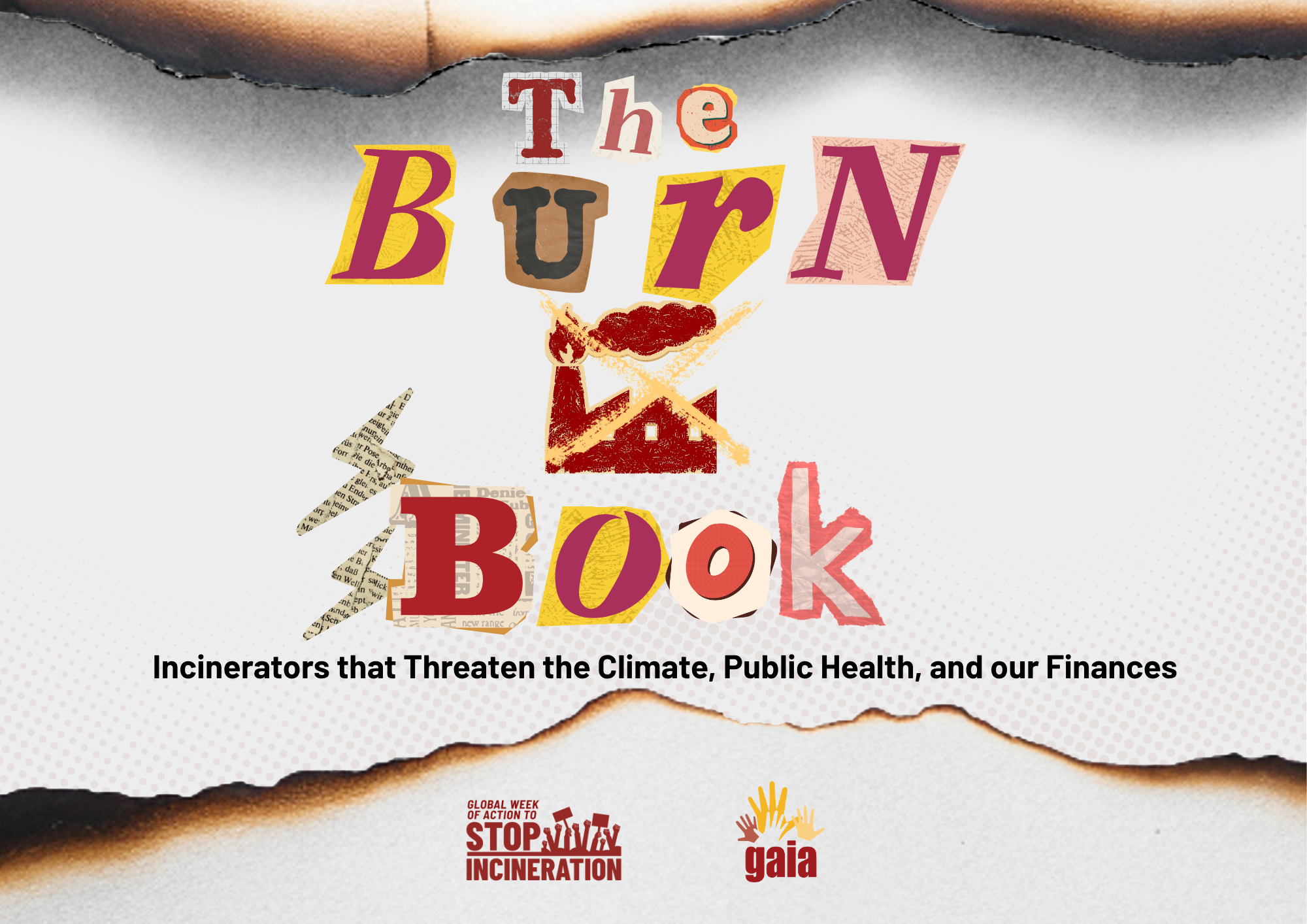
This publication analyzed data from twenty incinerators and incinerator proposals worldwide, focusing on public debt and subsidies, climate and air pollution, toxic byproducts, and other common issues surrounding the industry– identifying key patterns that emerged regardless of regional contexts:
- “Waste-to-energy” incinerators turn waste into toxic air and ash pollution. Based on public data, these incinerators alone produced at least 1.7 million tons of toxic ash per year– the equivalent in weight to 230 Eiffel Towers. There is also significant documentation of air pollutants that threaten human health– including carbon monoxide, nitrous oxide, dioxin, and furans. Many communities surrounding these plants complained of odors, respiratory issues, and ground contamination.
- These facilities have a large climate footprint. Despite studies showing that waste-to-energy incineration produces more climate emissions than any other power source, many of the incinerators on the list do not monitor or publicly disclose their emissions levels. The eleven that did have available data release a cumulative 5.5 million metric tons of CO2e per year, the equivalent of 1.3 million passenger cars.
- “Waste-to-energy” is a waste of money. The twenty incinerators profiled have racked up nearly $7 billion of investments to date, with a portion of that directly from taxpayers in the form of government subsidies and municipal borrowing. In some cases municipalities are on the hook for millions of dollars in debt that stretches for decades. Waste incinerators are the most expensive form of waste management.
- Burning waste undermines waste reduction. Once built, “waste-to-energy” incinerators require large volumes of waste to stay in operation, and many municipalities have “put-or-pay” contracts that disincentivize waste reduction. Much of the material burned in these incinerators could have been composted, recycled, or avoided altogether.
Frequently asked questions
What is GAIA’s Burn Book?
The Burn Book is a GAIA report that analyzes public data on twenty waste incinerators and incinerator proposals worldwide, looking at public debt and subsidies, climate and air pollution, toxic byproducts and community impacts.
How much pollution do the Burn Book incinerators produce?
Together they produce at least 1.7 million tons of toxic ash per year. The eleven facilities with available climate data emit a cumulative 5.5 million metric tons of CO2e per year, equivalent to 1.3 million passenger cars.
How much money has gone into these incinerators?
The twenty incinerators profiled have attracted nearly $7 billion in investments to date, part of it from taxpayers through government subsidies and municipal borrowing.
Explore the Burn Book
Read the profiles of all twenty facilities in GAIA’s Burn Book blog and the press release on the Burn Book findings. New to the issue? Start with Waste-Burning 101 and Waste-to-Energy Incineration: The Facts, Costs & Risks.
This report was released for the Global Week of Action to Stop Incineration. See how communities are fighting back in 20 Inspiring Stories of Victory Against Incinerators.
Waste-Burning 101: What You Need to Know about So-Called Waste-to-Energy Incinerators

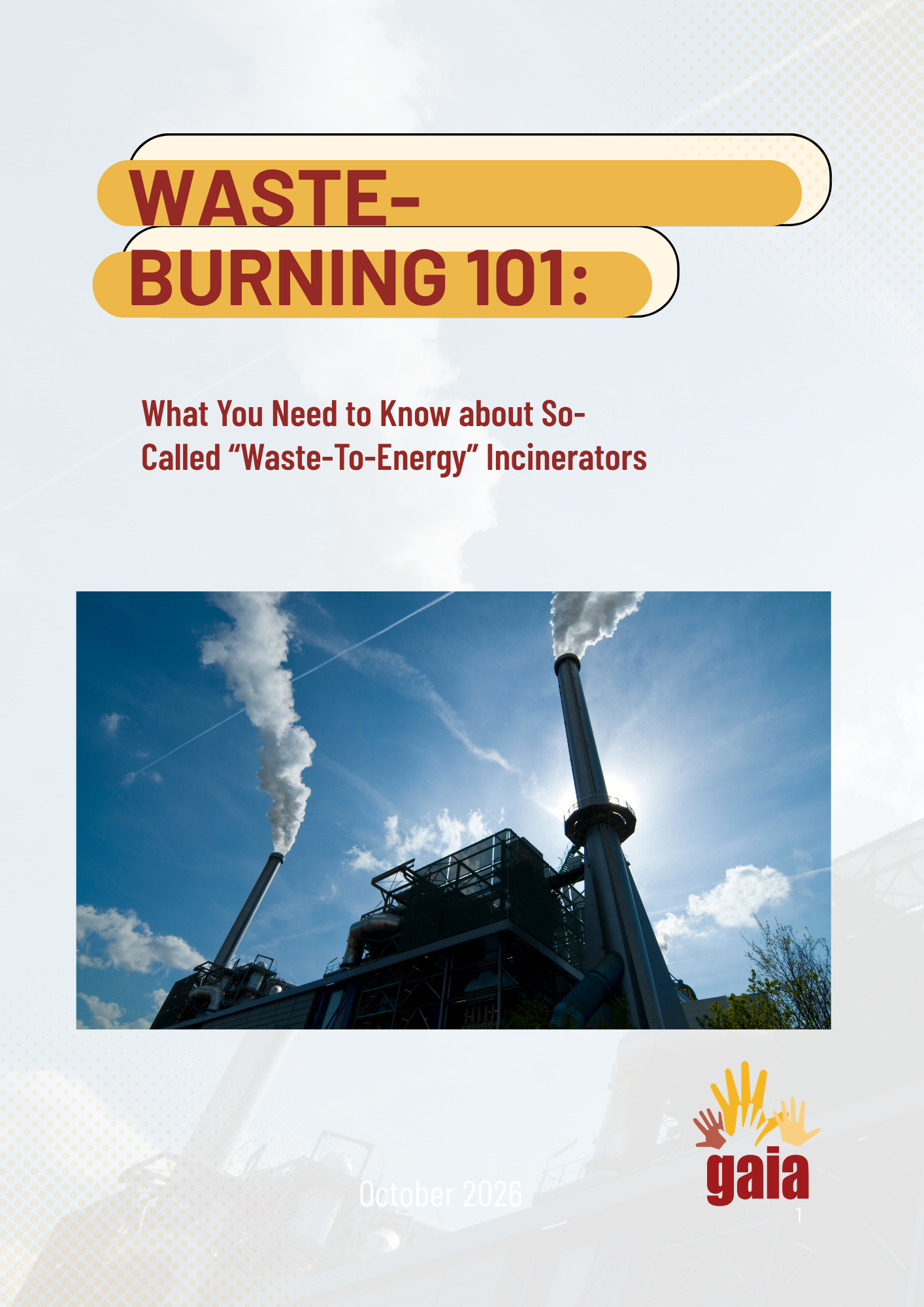
This toolkit compiles key facts, data and strategies to help communities and organizers understand the impacts of waste burning, challenge proposed or existing facilities, and engage in waste policy and planning decisions.
Waste-to-energy explained
“Waste-to-energy” is the industry name for incinerators and other facilities that burn waste to generate electricity or heat. Waste-Burning 101 explains why these facilities are a pollution, climate and financial problem rather than a waste solution, and how communities can respond. For a deeper look, read Waste-to-Energy Incineration: The Facts, Costs & Risks.
What’s inside the guide
- Understanding waste incineration: mass-burn incinerators, pyrolysis and gasification, cement kilns and open burning.
- The global shift away from incineration: policy changes in Europe, Asia Pacific and the United States.
- Why incineration is a problem: impacts on health and the environment, the climate, waste reduction, public budgets and environmental justice.
- Better solutions: how zero waste strategies outperform burning.
- A community checklist: questions and actions for communities facing a proposed or existing facility.
Frequently asked questions about waste burning
What is waste-to-energy?
“Waste-to-energy” is a marketing term for incinerators and other thermal facilities that burn waste to produce electricity or heat. Burning does not make waste disappear: it turns it into air emissions, greenhouse gases and toxic ash.
What types of waste-burning facilities are there?
The main types are mass-burn incinerators, plastic pyrolysis and gasification plants (often marketed as “plastic-to-fuel” or “chemical recycling”), co-incineration of refuse-derived fuel in cement kilns, and open burning.
Is waste-to-energy renewable or climate-friendly?
No. Incineration is the most carbon-intensive way to manage waste because it burns fossil-derived materials such as plastic. Per unit of electricity, incinerators emit more greenhouse gases than coal.
How can communities stop an incinerator?
Communities can learn who owns and funds the facility, track its pollution, review permits and impact assessments, gather their own evidence, and organize around a clear goal such as denying permits or transitioning to zero waste.
Take action
Use this guide during the Global Week of Action to Stop Incineration, explore the incinerators documented in The Burn Book, and learn from 20 Inspiring Stories of Victory Against Incinerators. Organizing locally? See How Communities Can Refuse Incineration and Win.
¿Necesitamos un tratado sobre el reciclaje deplásticos y puede este poner fin a lacontaminación por plásticos?


El mundo exigió —y la Resolución 5/14 del PNUMA lo dispuso— un instrumento global para poner fin a la contaminación por plásticos, que incluyera medidas a lo largo de todo el ciclo de vida de los plásticos. ¿Puede cumplir con este objetivo un tratado que evita los controles sobre la producción de plástico y, en cambio, se enfoca únicamente en el reciclaje y la quema de plásticos? ¿Es un enfoque que prioriza el reciclaje serio y efectivo, o es un planteamiento engañoso que perpetúa la sobreproducción de plástico y la contaminación, y destruye nuestro clima?
Related Resources
Nous faut-il un traité sur le recyclage duplastique – et peut-il mettre fin à la pollution plastique ?
La communauté internationale a réclamé un instrument mondial pour mettre fin à la pollution par les plastique, équipé de mesures couvrant l’ensemble de leur cycle de vie – et la résolution 5/14 du PNUE a ordonné a ordonné sa mise en place. Un traité qui laisse le champ libre à la surproduction, et se focalise uniquement sur le recyclage et l’incinération des plastiques, peut-il être efficace ? L’approche du tout-recyclage est-elle sérieuse et efficace, ou s’agit-il d’un discours trompeur qui perpétue la surproduction de plastique et la pollution, tout en portant atteinte à notre climat?
Related Resources
Do we need a plastic recycling treaty -and can it end plastic pollution?
The world demanded – and UNEP Resolution 5/14 mandated – a global instrument to end plastic pollution, including measures along the full life cycle of plastics. Can a treaty that avoids controls on plastic production, and instead focuses only on recycling and burning plastics, deliver? Is a recycling-first approach serious and effective, or deceptive framing that perpetuates plastic overproduction and pollution and trashes our climate?
Financing Zero Waste: A High-Level Synthesis Report
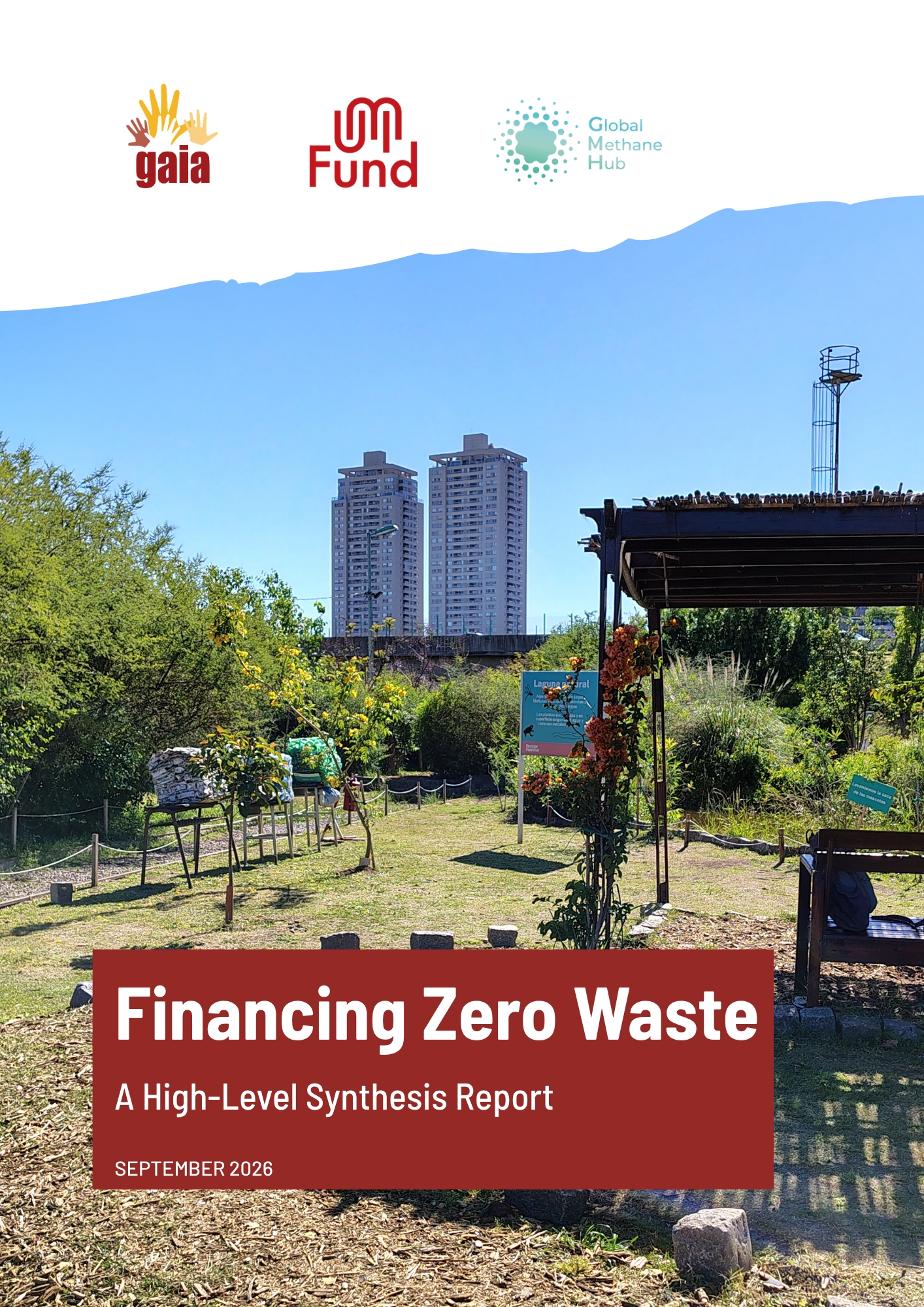
Zero waste is increasingly recognized as a strategic public investment, not a cost burden. This high‑level synthesis distills the core insights from Financing Zero Waste: Practical Guidance for Immediate Action by Local and National Governments, showing how governments can finance zero waste systems by aligning local implementation with national enabling conditions—and by recognizing the broader public value that zero waste generates across climate, health, livelihoods, and resilience.

Financing Zero Waste: Practical Guidance for Immediate Action by Local and National Governments

Zero waste is emerging as one of the most powerful, immediate climate actions available to governments. This publication provides practical, context‑specific guidance to help local and national governments finance and sustain zero waste systems that cut methane, improve public health, strengthen livelihoods, and build fiscal resilience.
Separation at Source (S@S): 12 Real-World Zero Waste Practices That Work
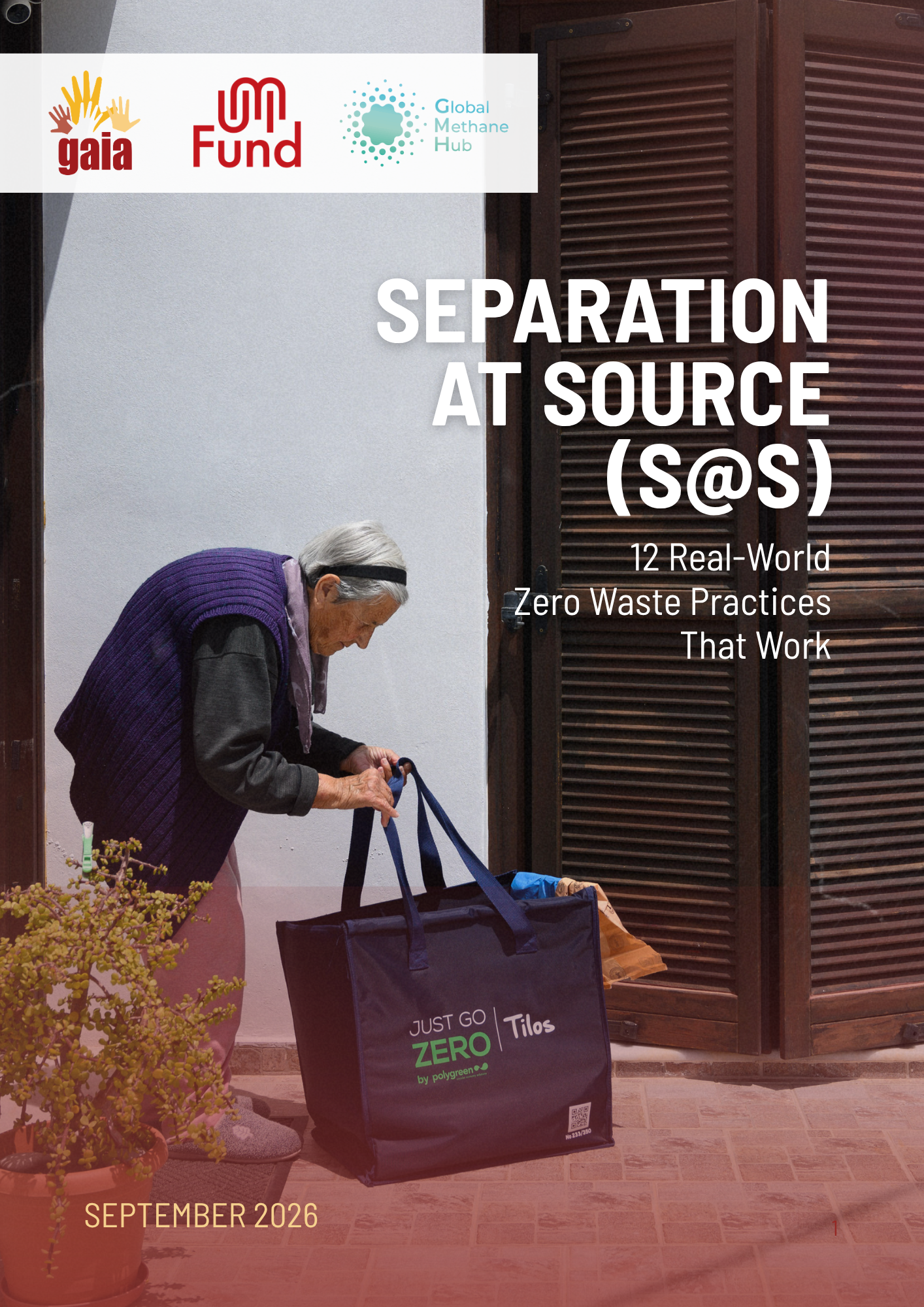
Establishing waste separation at source (S@S) is the foundation of zero waste systems. It means separating different types of waste—such as organic, recyclable, and residual materials—at the point where waste is generated, keeping materials clean and preventing contamination. This publication presents 12 diverse successful cases from five regions: Africa (Tanzania), Asia (India, The Philippines), Europe (Greece, Slovenia, Italy), North America (USA), and Latin America (Costa Rica). The communities featured range in scale, from Tilos Island with a permanent population of 700 residents, to megacities such as Bengaluru, where the zero waste systems reach approximately 2 million people. Across these jurisdictions, source separation rates vary according to local mandates and frameworks, ranging from 30-33% organic waste diversion in Portland to outstanding rates of 80- 95% in places such as Varkala, San Fernando, and Dar es Salaam, and reaching 100% in Tilos Island.
Download This Resource
Building Community Resilience and Green Jobs through Organic Waste: The Case of Durban, South Africa


The Durban Zero Waste Project pilot shows that decentralized organic waste management can deliver powerful environmental and economic outcomes when regarded as a municipal public service rather than a commercial enterprise. The model reduces costs already borne by the municipality through avoided landfill disposal, avoided transport, avoided compost purchases, and reduced greenhouse gas (GHG) emissions.
Building Community Resilience and Green Jobs through Organic Waste: The Case of Bandung, Indonesia
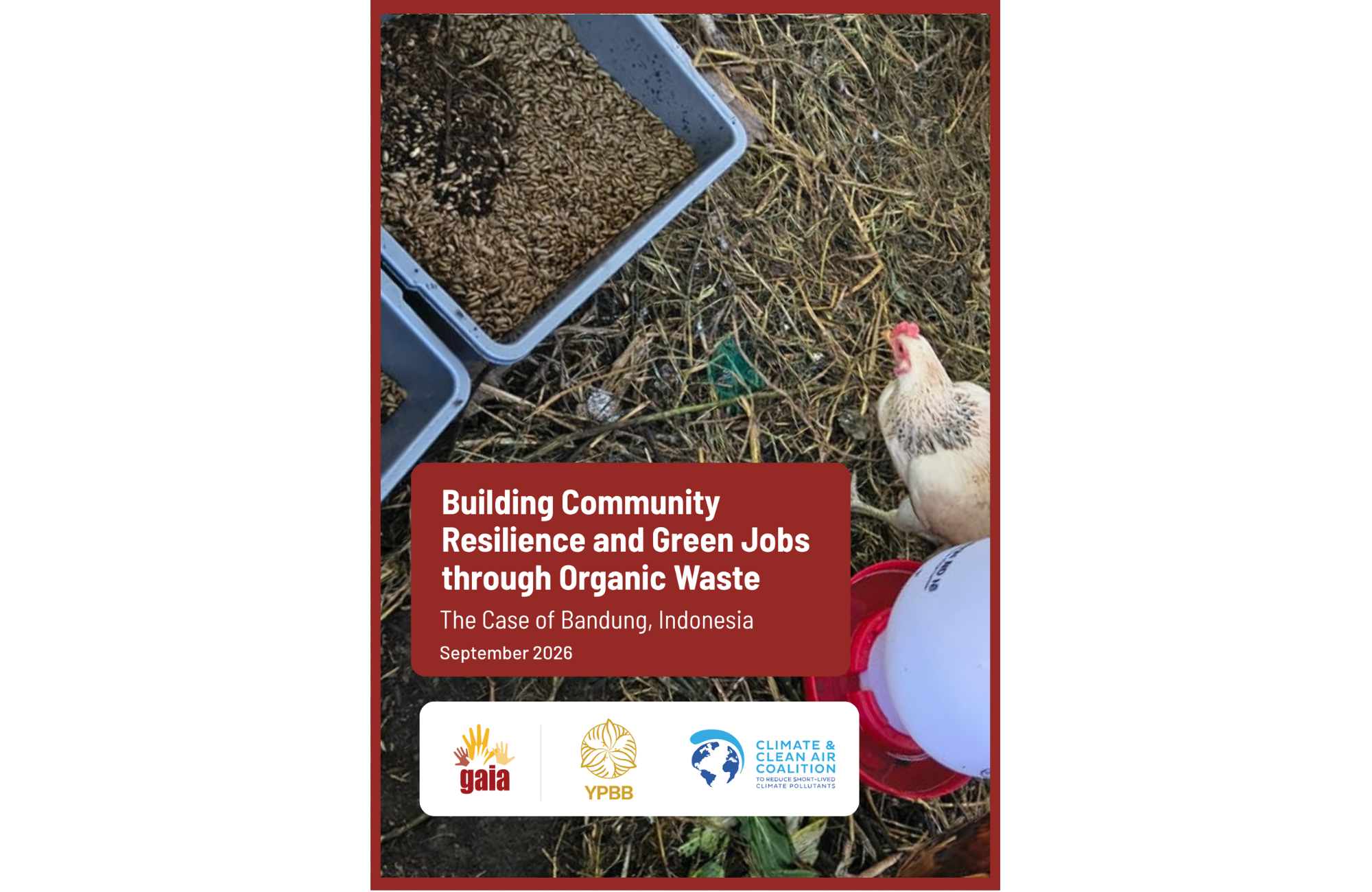
The Neglasari pilot project in Bandung, Indonesia demonstrates that community-based organic waste management can be financially feasible when the government finances the public-service functions that markets do not pay for, particularly land, source-separated organics collection, education, and waste treatment. This model is financially attractive as it generates public goods such as recoverable organic products, local livelihoods, and avoided landfill costs.
Download This Resource
Fiche d’information: Les Bioplastiques

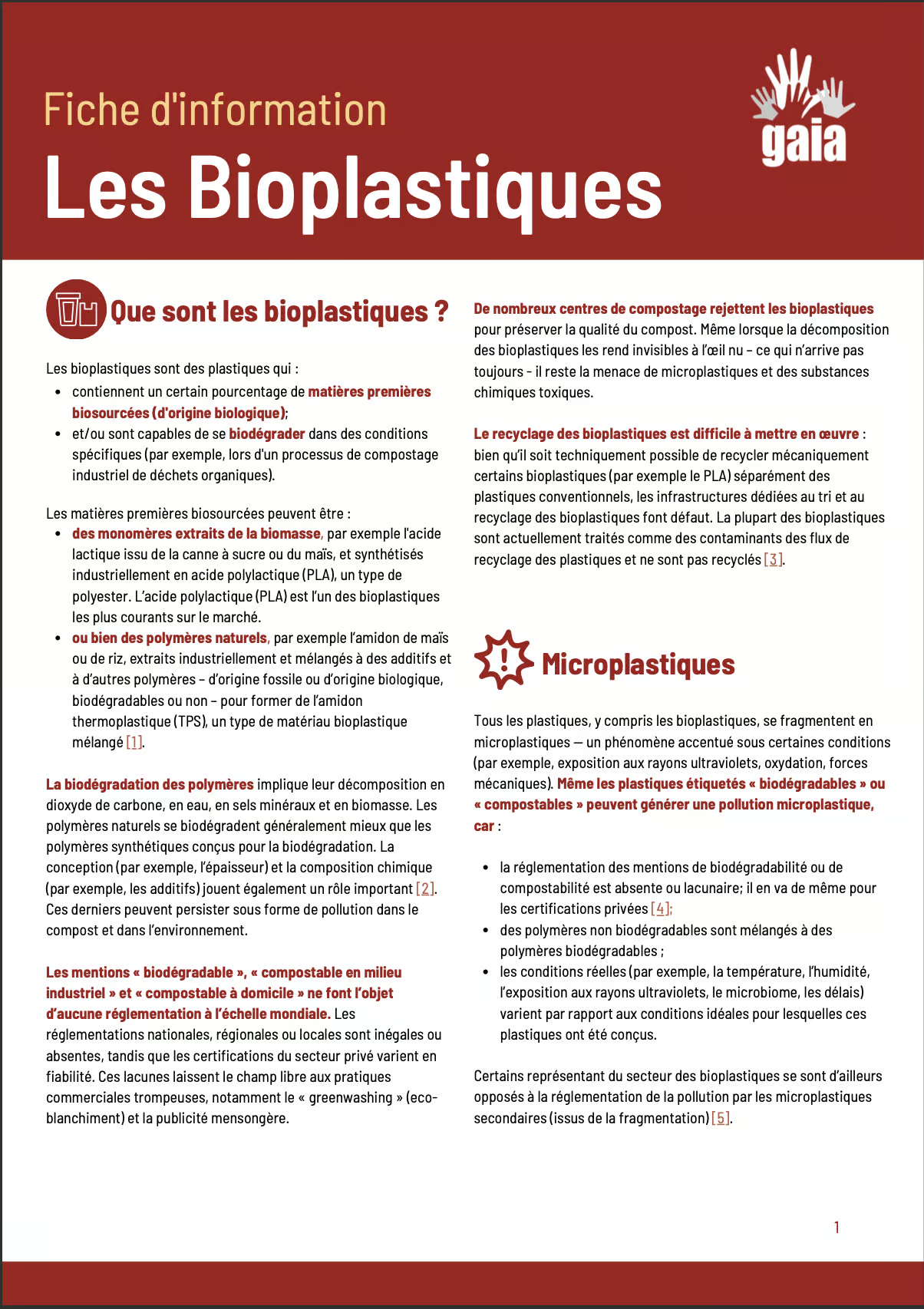
« Bio » ne signifie pas « bon » ou « sans danger ». Trop souvent, l’accent mis sur les bioplastiques sert à masquer la surproduction massive de plastiques jetables ou à usage unique. Les bioplastiques actuels sont, dans leur grande majorité, des substituts regrettables aux plastiques conventionnels, destinés à finir en décharge et à perpétuer la pollution microplastique.