De los datos a la acción: Guía para usar la base de datos anti-incineración
Latin America & the Caribbean - Incineración y cementeras -
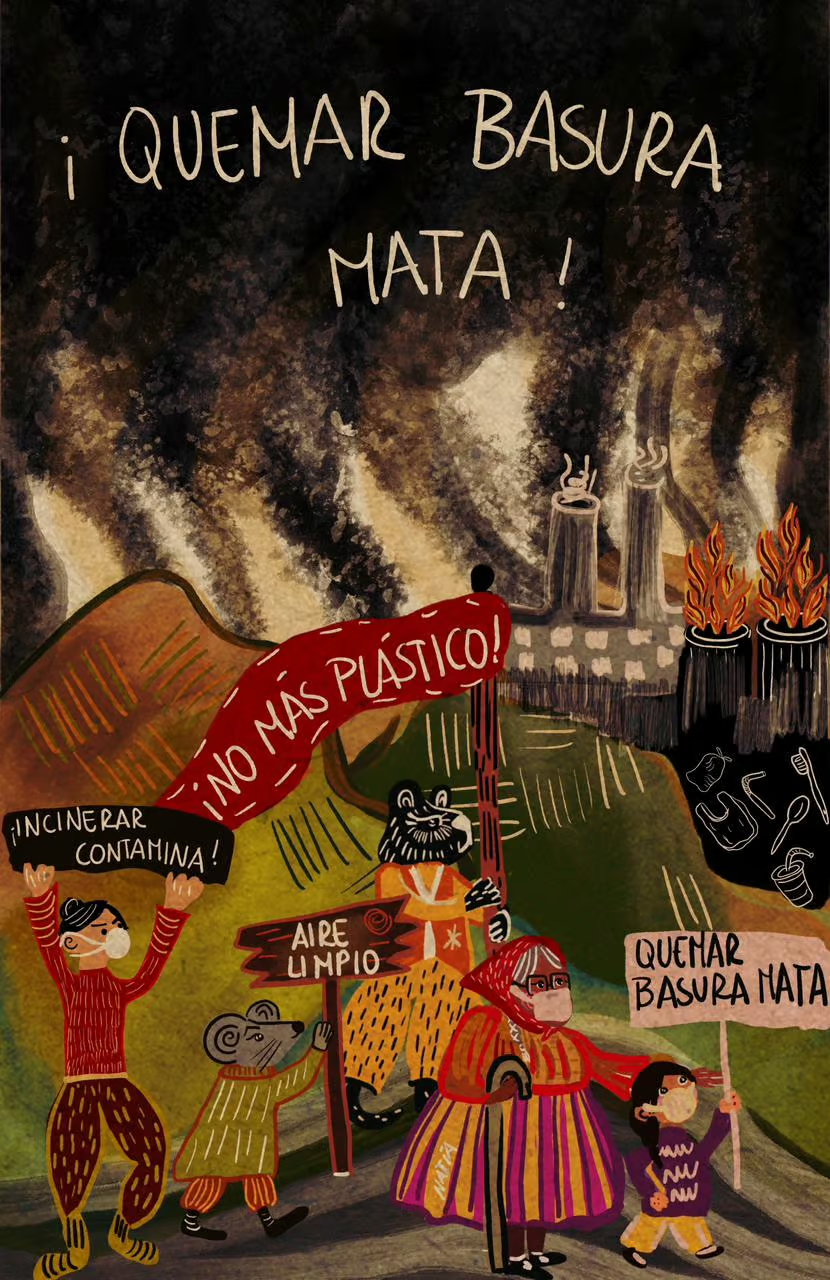
Esta base de datos nace como una respuesta colectiva frente a la creciente ola de proyectos que promueven falsas soluciones para la gestión de residuos en América Latina y otras regiones del Sur Global. Incineradoras, plantas de "waste to energy", co-procesamiento en cementeras o reciclaje químico, se presentan como respuestas técnicas modernas, pero en la práctica reproducen impactos profundos y desiguales sobre los territorios, las comunidades y los sistemas públicos de gestión de residuos.
En este contexto, las organizaciones sociales, ambientales y comunitarias no pueden enfrentar estos proyectos únicamente desde la indignación o la urgencia del conflicto, por más legítimas que estas emociones sean. La experiencia en los territorios ha demostrado que quienes impulsan estas tecnologías se amparan en lenguajes técnicos, estudios fragmentados y marcos regulatorios complejos que buscan desplazar el debate hacia terrenos donde las comunidades o siempre cuentan con herramientas suficientes para responder.
Esta base de datos surge, entonces, para equilibrar esa asimetría, poniendo al alcance de las organizaciones evidencia científica, académica y técnica que permita sostener las luchas desde argumentos sólidos, verificables y contextualizados.
El objetivo no es reemplazar la experiencia territorial ni despolitizar los conflictos, sino articular el conocimiento técnico con la realidad vivida. La quema de residuos no es solo un problema ambiental, tiene impactos económicos, sociales, sanitarios y políticos que se entrecruzan. Afectan presupuestos públicos, redefine modelos de desarrollo local, afectan la salud de las comunidades, debilitan el trabajo del movimiento reciclador y consolidan decisiones tomadas sin participación real.
Esta base de datos busca ofrecer una mirada integral de estos impactos, demostrando que las falsas soluciones no pueden evaluarse de forma aislada, sino como parte de un modelo que profundiza desigualdades y sacrifica territorios en nombre de la eficiencia.
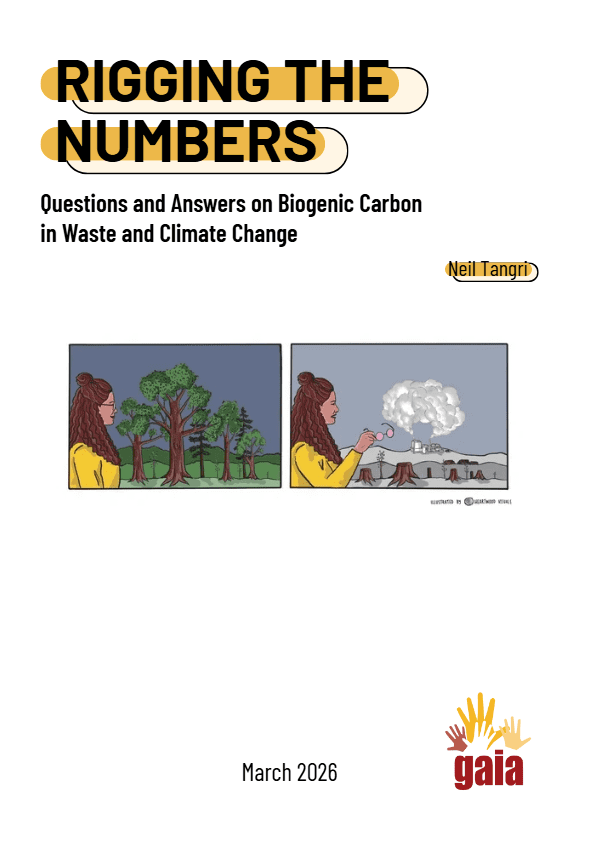
RIGGING THE NUMBERS: Questions and Answers on Biogenic Carbon in Waste and Climate Change
UN Day of ZW 2026 - Climate -
This brief Q&A explains why biogenic CO2 is not inherently climate-neutral, how IPCC inventory guidance is frequently misinterpreted to justify these exclusions, and how waste facilities must report biogenic carbon emissions as well as fossil carbon emissions.
Lutter contre les émissions de méthane des décharges grâce à la justice environnementale
- Climate -
Le présent rapport décrit les risques liés aux approches habituelles (« Business As Usual » ou BAU) en matière de réduction des émissions de méthane provenant des décharges et plaide en faveur d'une réponse durable et axée sur la justice. Il s'appuie sur des données internationales, sur les tendances politiques actuelles et sur l'expérience des communautés pour identifier les solutions efficaces et inefficaces en matière de fermeture des décharges et de gestion des déchets organiques.
GAIA condemns the Environmental Protection Agency‘s (EPA) official revocation of its 2009 Endangerment Finding (“Finding”) under Section 202(a) of the Clean Air Act. The Finding was based on decades of overwhelming scientific evidence and legal precedent that greenhouse gas emissions (GHG) endanger public health and welfare. The administration argued that the Clean Air Act does not give it legal authority to regulate GHG, thereby destroying the legal foundation upon which vital climate protections were based.
By decoupling greenhouse gas emissions from the documented harm they do to human and environmental health, the administration is flinging open the door for massive deregulation at the federal level. Their initial stated intent for revoking the Finding is to gut motor vehicle emissions regulations. But it won’t stop there.
On Wednesday, the day before officially revoking the Finding, the administration continued to prop up the coal industry in an Executive Order requiring the Pentagon to source energy from coal-fired power plants, following up on their June 2025 proposed “Repeal of Greenhouse Gas Emissions Standards for Fossil Fuel-Fired Electric Generating Units.”
For GAIA and our members working at the intersection of waste and environmental justice, this revocation will limit the tools we have to hold polluters accountable and to protect our communities, and especially Black, Brown, and Indigenous communities where polluting infrastructure is most often sited.
The waste sector is one of the biggest emitters of methane, a greenhouse gas with 82.5 times the warming potential of CO₂ over a 20-year period. Ending the Finding will take away the authority of the EPA to regulate methane and co-pollutants from landfills, incinerators, and other waste facilities. Additionally, this will stall progress toward true zero waste systems, such as organics diversion, composting, and nontoxic reuse, that cut methane at the source while advancing climate, health, and equity goals.
Plastics production and disposal are exponentially expanding GHG emitters. If plastics were a country, it would be the world’s fifth-largest GHG emitter. Without EPA authority to regulate GHG emissions, the plastics and petrochemical industry will be free to expand all of the processes–including pyrolysis and gasification–that release extensive GHG emissions, in addition to using toxic chemicals.
This decision is so egregious that numerous organizations have promised to sue the administration, which GAIA fully supports.
FOR IMMEDIATE RELEASE: January 30, 2026
Berkeley, CA — In response to ongoing violence, deaths, and repression caused by U.S. Immigration and Customs Enforcement (ICE) and U.S. Customs and Border Protection (CBP), the Global Alliance for Incinerator Alternatives (GAIA) issued the following statement:
GAIA stands in solidarity with the people of Minneapolis and with communities across the country that are resisting these violent occupations and repressive tactics. What we are witnessing is not public safety, it is state violence. The people of Minneapolis and other communities are standing up to protect their neighbors, resisting repression, and protesting against this authoritarian federal government.
The right to speak out and protest is fundamental to a functioning democracy and a critical tool for communities defending their safety, health, land, and futures. GAIA and our members rely on this right every day to challenge environmental injustice, corporate impunity, and policies that sacrifice frontline communities while undermining the right to a clean and healthy environment for all. The current U.S. administration is deploying federal agencies implementing militarized enforcement tactics to suppress both protest and community-led resistance, intimidate and criminalize those documenting abuses, and silence those who speak out against injustice.
Since the start of this year, at least nine deaths have been reported in connection with ICE custody or enforcement actions. We mourn the deaths of Keith Porter, Geraldo Lunas Campos, Luis Gustavo Nunez Caceres, Luis Beltran Yanez–Cruz, Victor Manuel Diaz, Parady La, Heber Sanchez Dominguez, Renee Nicole Good, and Alex Pretti, whose killings reveal a pattern of escalating state violence, systemic failures, and blatant disregard for human life.
GAIA demands immediate accountability from DHS, ICE, and CBP for all deaths, abuses, and violations committed under their authority. We call for an end to violent enforcement practices, the protection of the right to protest, and policies rooted in care, dignity, and community power.
###
The Global Alliance for Incinerator Alternatives (GAIA) is a member-based, environmental justice network working at the intersection of waste, climate, and justice. In the United States and Canada, GAIA supports grassroots organizations that advance zero waste solutions, challenge the plastics and petrochemical industries, reduce methane emissions, and promote safe, sustainable practices for electric vehicle battery production and recycling.
Press contacts:
María Guillén, Communications & Network Development Manager
Berkeley, CA — In the wake of the U.S. Environmental Protection Agency’s (EPA) decision to stop accounting for the economic value of health benefits, including lives saved, when setting air pollution standards, Denaya Shorter, Senior Director of the U.S. & Canada Region at the Global Alliance for Incinerator Alternatives (GAIA), issued the following statement:
“As a global network of environmental justice organizations, GAIA rejects the idea that human life should be reduced to an economic calculation in the first place. But if economic frameworks are being used, no polluting facility, plastics plant, incinerator, or corporate balance sheet should ever be valued above people’s lives or their right to a clean environment.
By effectively valuing human life at zero, this administration is prioritizing industry profits over public health, dismantling long-standing safeguards, and rewriting the rules to shield polluters from accountability. This decision exacerbates inequity and disproportionately impacts the most marginalized members of our society, often low-income and communities of color, and it will cost the US more than just dollars — it will cost lives.
We have seen this industry-driven “cost-first” narrative before. It has been used to weaken environmental protections and justify toxic plastics, waste incineration, and environmental racism across the globe. When industry costs are put above human lives, the result is not balanced policymaking but a system that treats frontline communities as expendable and disregards decades of established science.
At GAIA, we remain bold, determined, and unwavering in our mission to strengthen grassroots movements toward a just, zero waste world rooted in respect for ecological limits and community rights, and where people are free from the burden of toxic pollution. Our voices and resolve are stronger than their power.”
###
The Global Alliance for Incinerator Alternatives (GAIA) is a member-based, environmental justice network working at the intersection of waste, climate, and justice. In the United States and Canada, GAIA supports grassroots organizations that advance zero waste solutions, challenge the plastics and petrochemical industries, reduce methane emissions, and promote safe, sustainable practices for electric vehicle battery production and recycling.
Press contacts:
María Guillén, Communications & Network Development Manager
As we close out 2025, and mark GAIA’s 25th year as a global network, I find myself holding a mix of exhaustion, gratitude, and deep pride for what we’ve built. This was a year that asked a lot of us. A year that reminded me, again and again, that this work is as much about how we care for one another as it is about what we are fighting against.
Many of those moments were heavy, echoing the kinds of crises and injustices this movement has been confronting for decades. We carried the grief and anger of witnessing the ongoing genocide in Gaza unfold in real time, while governments that claim to champion human rights continued to fund and defend violence.
We watched crises deepen across parts of Africa, including Sudan, where war, displacement, and extraction collide. Meanwhile, familiar patterns surfaced in climate conversations closer to home, where so-called solutions like advanced recycling and incineration were promoted while ignoring whose land is being mined for critical energy transition minerals, whose communities are overburdened by pollution, and whose lives are treated as expendable.
Other moments grounded us. They came from rooms filled with community members refusing to be ignored. From organizers who kept showing up to city council meetings, board hearings, and public comment periods long after it would have been easier to walk away. From members who reminded us that environmental justice is not an idea, but something shaped by where people live, what they breathe, and what they carry home at the end of the day.
This was the reality in which GAIA’s US and Canada network organized in 2025. In many ways, this year tested what 25 years of organizing, deep relationships, and shared values have made possible.
It was a year defined by deep political uncertainty. In the United States, environmental protections were aggressively rolled back, pollution controls weakened, and environmental justice communities placed squarely in the crosshairs of deregulation and neglect. In Canada, many of the same extractive pressures persisted, layered on top of ongoing colonial harm and environmental racism. And yet, across this region, you kept organizing anyway, even as the ground shifted beneath us.
Together, we responded when the US federal government moved to undermine the Endangerment Finding and weaken Clean Air Act protections. We spoke out when incineration was used to destroy life-saving humanitarian aid, naming it clearly as an environmental and humanitarian injustice. We provided training that helped organizers and advocates build the capacity to use data and monitoring tools to support local campaigns, including efforts to expose methane pollution from landfills and waste facilities.
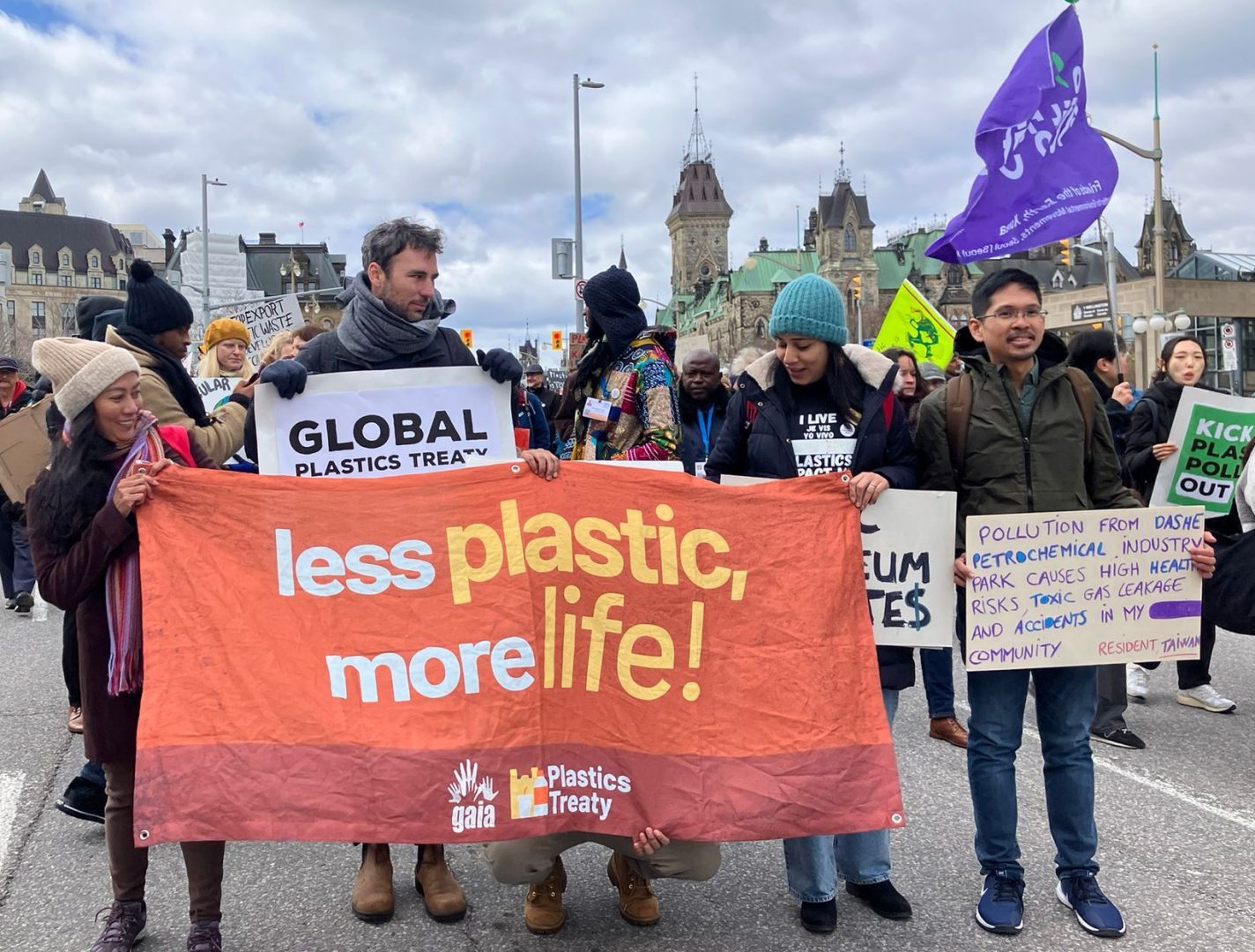
We stood with communities facing proposed incinerators, EV battery recycling facilities, fossil fuel power plants, and dirty materials recovery facilities. We showed up in global spaces, from plastics treaty negotiations to climate convenings, insisting that waste, methane, reuse, and worker protections belong at the center of real climate solutions.
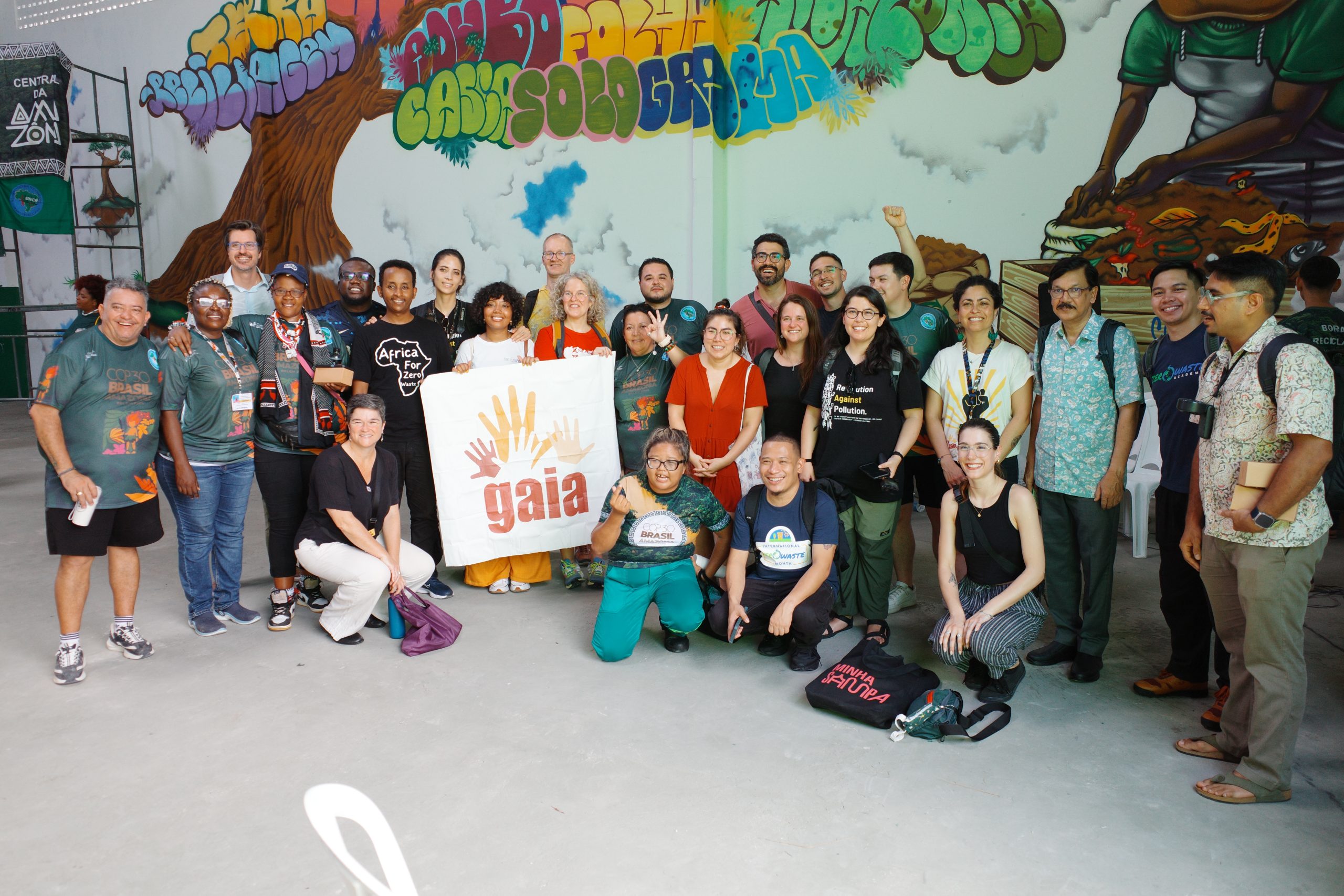
Part of GAIA’s delegation at COP30 in Belém, Brazil.
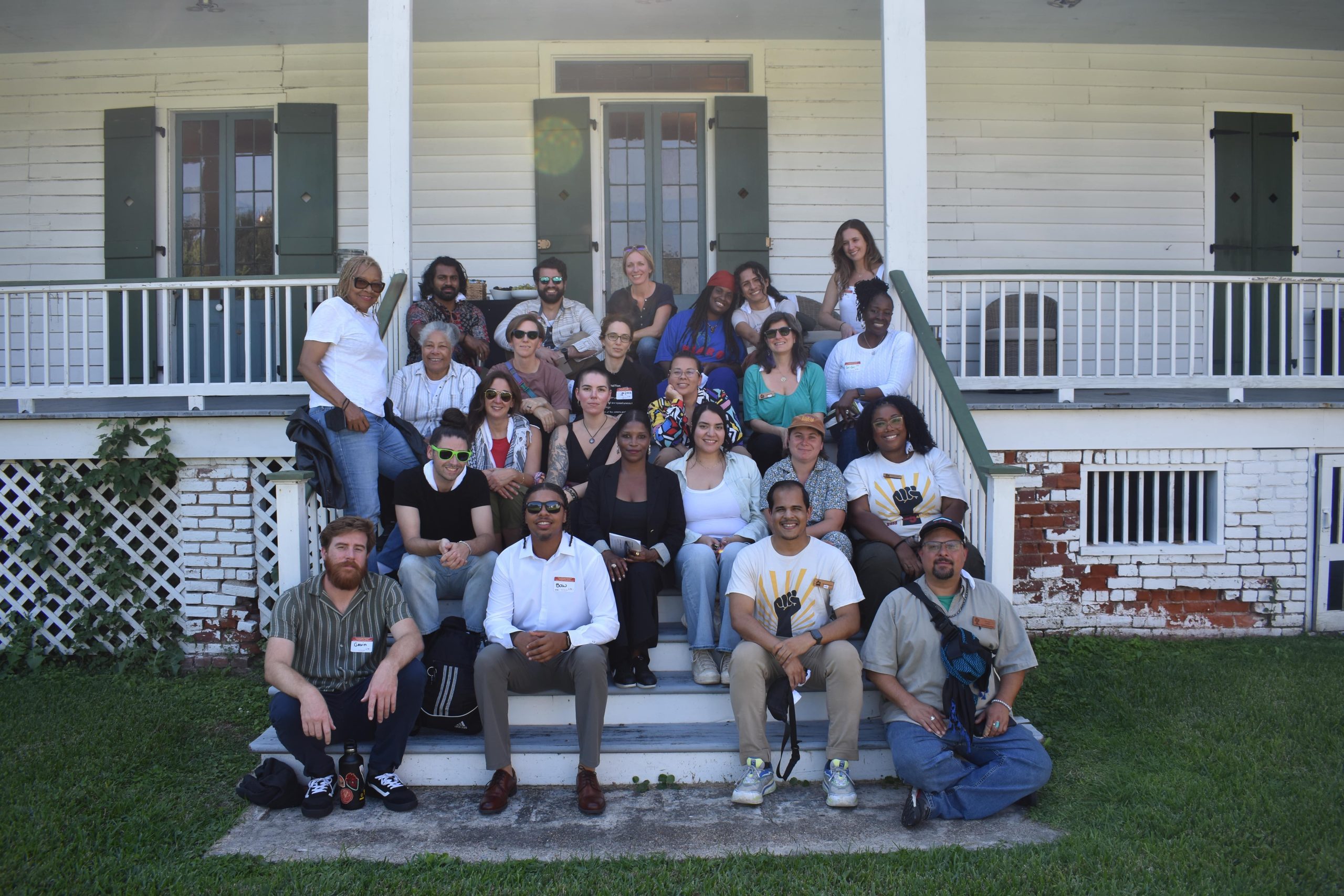
GAIA’s U.S. Methane Reduction & Environmental Justice Cohort at the Woodland Plantation in St. John the Baptist Parish, Louisiana.
For me, this year was personal too. It was shaped less by milestones and more by endurance. By the quiet decision, made day after day, to keep going even when the path forward felt unclear. It reminded me that this work is not sustained by certainty, but by people willing to keep showing up.
As we look back on this year, I hope you find more than a series of moments or milestones.. I hope you see the story underneath it all: a network that understands environmental justice as inseparable from human rights, democracy, and liberation, and people who continue building even as systems push back.
Thank you for being part of this movement, and for being part of GAIA’s 25-year journey. Thank you for the solidarity and resolve you brought into 2025. We are still here, and we are still building together.
In solidarity, Denaya Shorter Senior Director, US & Canada Regional Program Global Alliance for Incinerator Alternatives
[Espańol abajo]
Estimados miembros, amistades y aliadas del movimiento,
Al cerrar el año 2025 y conmemorar el 25 aniversario de GAIA como red global, me encuentro sosteniendo una mezcla de agotamiento, gratitud y un profundo orgullo por lo que hemos construido. Este fue un año que nos exigió mucho. Un año que me recordó, una y otra vez, que este trabajo tiene tanto que ver con cómo nos cuidamos unos a otros, tal como con lo que estamos luchando en contra.
Muchos de esos momentos fueron pesados y resonaron con los tipos de crisis e injusticias que este movimiento ha enfrentado durante décadas. Cargamos con el duelo y la rabia de presenciar en tiempo real el genocidio en curso en Gaza, mientras gobiernos que afirman defender los derechos humanos continuaron financiando y justificando la violencia
Vimos cómo se profundizaban las crisis en distintas partes de África, incluido el Sudán, donde la guerra, el desplazamiento y el extractivismo se entrecruzan. Al mismo tiempo, reaparecieron patrones conocidos en las conversaciones climáticas más cercanas a casa, donde se promovieron supuestas “soluciones” como el reciclaje avanzado y la incineración, mientras se ignoraba de quiénes son las tierras que se explotan para obtener minerales críticos para la transición energética, qué comunidades están sobrecargadas por la contaminación y qué vidas se consideran prescindibles.
Otros momentos nos dieron sustento. Surgieron en salas llenas de personas de la comunidad que se negaron a ser ignoradas. De organizadoras y organizadores que siguieron presentándose en reuniones de concejos municipales, audiencias de juntas y períodos de comentarios públicos, mucho después de que habría sido más fácil alejarse. De integrantes que nos recordaron que la justicia ambiental no es una idea, sino algo moldeado por donde vive la gente, por lo que respira y por lo que lleva a casa al final del día.
Esta fue la realidad en la que la red de GAIA en Estados Unidos y Canadá se organizó en 2025. En muchos sentidos, este año puso a prueba lo que han hecho posibles 25 años de organización, relaciones profundas y valores compartidos.
Fue un año marcado por una profunda incertidumbre política. En Estados Unidos, las protecciones ambientales fueron desmanteladas de forma agresiva, se debilitaron los controles de la contaminación y las comunidades de justicia ambiental quedaron directamente en la mira de la desregulación y el abandono. En Canadá, persistieron muchas de las mismas presiones extractivas, superpuestas a los daños coloniales continuos y al racismo ambiental. Y aun así, en toda la región, ustedes siguieron organizándose, incluso mientras el terreno cambiaba bajo nuestros pies.
Juntas y juntos, respondimos cuando el gobierno federal de los Estados Unidos intentó socavar la Determinación de Peligro (Endangerment Finding) y debilitar las protecciones de la Ley de Aire Limpio (The Clean Air Act). Alzamos la voz cuando la incineración se utilizó para destruir ayuda humanitaria que salva vidas y la nombramos claramente como una injusticia ambiental y humanitaria. Brindamos capacitaciones que ayudaron a organizadoras y defensoras a fortalecer su capacidad para usar datos y herramientas de monitoreo en apoyo a campañas locales, incluidos los esfuerzos para exponer la contaminación por metano de vertederos e instalaciones de residuos.
Acompañamos a comunidades que enfrentaban incineradores propuestos, instalaciones de reciclaje de baterías de vehículos eléctricos, plantas eléctricas a combustibles fósiles y centros contaminantes de recuperación de materiales. Estuvimos presentes en espacios globales, desde las negociaciones del tratado global sobre plásticos hasta los encuentros climáticos, insistiendo en que los residuos, el metano, la reutilización y las protecciones laborales deben estar en el centro de las verdaderas soluciones climáticas.
Y hubo victorias reales, ganadas con mucho esfuerzo.
Al mismo tiempo, invertimos directamente en el liderazgo comunitario, continuando un compromiso de larga data, dentro de GAIA, de mover los recursos hacia donde pertenecen. A través de nuestros programas de reasignación de fondos, movilizamos más de 700 mil dólares para apoyar a organizaciones comunitarias de justicia ambiental en los Estados Unidos que impulsan la reducción de metano, el residuo cero y soluciones lideradas por las comunidades.
Para mí, este año también fue personal. Se caracterizó menos por los logros importantes y más por la resiliencia. Por la decisión silenciosa, tomada día tras día, de seguir adelante, incluso cuando el camino no estaba claro. Me recordó que este trabajo no se sostiene en la certeza, sino en personas dispuestas a seguir presentándose.
Mientras reflexionas sobre este año, espero que encuentres algo más que una serie de momentos o logros. Espero que vean la historia que subyace a todo: una red que entiende la justicia ambiental como inseparable de los derechos humanos, la democracia y la liberación, y de personas que continúan construyendo incluso cuando los sistemas se resisten.
En solidaridad, Denaya Shorter Directora Senior, Programa Regional de Estados Unidos y Canadá La Alianza Global por Alternativas a la Incineración (GAIA)
FOR IMMEDIATE RELEASE: December 15, 2025
Berkeley, CA — The Global Alliance for Incinerator Alternatives (GAIA) is proud to announce the 2025 recipients of its U.S. Environmental Justice Action Microfunds. Sixteen grassroots partners across the country were selected for their leadership in advancing transformative zero waste solutions, strengthening community power, and confronting pollution threats in frontline communities.
Made possible through an investment from the Cloud Mountain Foundation, the microfunds provide $2,500 in flexible support for frontline and community-based organizations advancing environmental and waste justice in regions overburdened by polluting waste infrastructure. Awardees are addressing impacts related to incineration, so-called chemical recycling, plastics and petrochemicals, landfills and methane, battery-related issues, and more. This year’s awardees are launching projects ranging from youth-led environmental leadership and community education to site fights, expansion of reuse systems, and local zero waste infrastructure. This year’s initiatives reflect the importance of zero waste solutions as cities grapple with the shortcomings of recycling and mounting plastic pollution.
“Frontline communities have the solutions to our waste crisis, and they are leading some of the most effective strategies that make a real impact. GAIA is honored to help resource these efforts and uplift the solutions that are already working,” said Denaya Shorter, Senior Director of the US & Canada Region at GAIA.
The 2025 U.S. Environmental Justice Action Microfunds recipients include:
ZW Ithaca will expand Ithaca and Tompkins County’s Bring Your Own (BYO) foodware reuse network by hiring a coordinator to strengthen and grow the BYO sticker program.
Sustainable Community Farms will establish the Food-Energy-Water (FEW) Ambassador program in Detroit to train middle and high school students in environmental leadership, connect school and community-based learning through outdoor projects at Sustainable Community Farms, and empower youth to advocate for more sustainable efforts in their communities.
Center for Environmental Transformation will educate Camden residents on the health detriments of living near waste incineration facilities like Reworld (formerly Covanta). Through a six-part workshop, CET will provide workbooks and include an “environmental tour” highlighting the local incinerator.
Heirs to Our Ocean (H2OO) will use microfunds to support the youth members of the U.S. Youth Action Council for the UN Ocean Decade (U.S. YAC UNOD) and their efforts to tackle plastic pollution through brand audits, policy, and movement building.
Post-Landfill Action Network (PLAN) will use microfunds to support four cohorts of the Reusable To-Go ROI Calculation Course, which will train student leaders at 16–24 campuses to conduct ROI analyses and logistics plans for college campus reusable dining systems that replace single-use plastics.
Cherokee Concerned Citizens will use microfunds to support the “Relocation to Restoration” initiative by helping residents of Pascagoula, Mississippi, relocate from high-risk areas adjacent to major facilities, including the Chevron Refinery, the Enterprise gas processing plant, Gulf LNG, Bollinger, and the Mississippi Phosphates Superfund site, and restore these areas into native Gulf Coast habitats.
Buckeye Environmental Network (BEN) will hold a one-day statewide convening in Ohio to train and connect community members fighting chemical recycling plants and petrochemical expansion, providing workshops on site-fighting strategies, permit review, public comment, and communication skills to strengthen local campaigns and statewide collaboration.
People of Red Mountain will use microfunds to support travel, lodging, and food expenses for members of People of Red Mountain, a grassroots group committed to protecting sacred lands from lithium mining in the McDermitt Caldera, for the 12th Annual Oak Flat March/Run.
ZW Detroit will engage Detroit-area residents, youth, elders, and local partners through education and workshops on methane reduction, food waste prevention, and air quality, providing practical tools to reduce climate impact and improve public health.
Breathe Free Detroit will use microfunds to support capacity and participation in quarterly county meetings that oversee the waste management plan and the implementation of the first U.S. model of city-run decentralized composting.
Physicians for Social Responsibility PA will strengthen grassroots power in Pennsylvania by educating and organizing communities impacted by incinerators and landfills, providing workshops, canvassing materials, and policy support to help residents build leadership and advance local ordinances.
New Jersey Environmental Justice Alliance (NJEJA) will support community farms in South New Jersey in engaging and educating local communities on zero waste principles, deepening partnerships, co-launching sustainable reuse and circular economy initiatives, and sharing a replicable, community-led model for building zero waste solutions.
Damascus Citizens for Sustainability will work to prevent a proposed county “waste-to-energy” incinerator by educating and organizing residents, working with local groups, and promoting alternatives such as recycling, composting, and waste reduction.
Rise for Environmental Justice (RiSE4EJ) will use microfunds to support a site fight and build capacity to defend a recent win against a proposed chemical recycling facility by Reworld (formerly Covanta) in the EJ community of Armourdale, KS.
Baltimore Compost Collective will transform a new property into a zero waste hub offering local composting, youth green jobs training, and community workshops to reduce waste, build leadership, and promote a healthier Baltimore.
Our ZW Future will support Zero Waste Rio Grande Valley, the South Texas branch of OZWF, in training five colonia residents in zero waste practices and cooperative business development, advancing economic mobility, and launching a pilot zero waste cooperative that benefits families across the Valley.
The 2025 Environmental Justice Action Microfunds represent GAIA’s continued commitment to resourcing community-led strategies that address pollution at its source while strengthening local leadership and long-term capacity. GAIA looks forward to supporting these partners as they advance effective, community-centered zero waste solutions.
Additional Quotes:
“It is our goal to equip and fortify residents so that they can hold these industries accountable for their crimes against health and the environment. Without the strength and determination of committed individuals, we get nowhere. When communities win, we all win.” — Tonyehn Verkitus, Executive Director, Physicians for Social Responsibility Pennsylvania
“We are grateful for GAIA’s investment in the youth leaders of the U.S. Youth Action Council for the UN Ocean Decade, who are organizing to confront plastic pollution at the source through science, policy, and community leadership. This support will help ensure youth are leading action to shape the solutions our climate, shared ocean, and communities urgently need.” — Emily Berglund, Executive Director, Heirs To Our Ocean
“We’re deeply grateful for GAIA’s EJ Microfunds and proud to be among this cohort of frontline zero waste and environmental justice projects. With this support, Zero Waste Ithaca will strengthen and grow our Bring Your Own foodware reuse network and expand our BYO sticker program.” — Yayoi Koizumi, Founder, Zero Waste Ithaca
“Stay positive, stay centered, and we can overcome.” — Barbara Weckesser, Cherokee Concerned Citizens
Press contact:
María Guillén, Communications & Network Development Manager, U.S. & Canada
mariaguillen@no-burn.org
###
GAIA is a worldwide alliance of more than 1,000 grassroots groups, non-governmental organizations, and individuals in over 90 countries. With our work, we aim to catalyze a global shift towards environmental justice by strengthening grassroots social movements that advance solutions to waste and pollution. We envision a just, zero waste world built on respect for ecological limits and community rights, where people are free from the burden of toxic pollution, and resources are sustainably conserved, not burned or dumped.
FOR IMMEDIATE RELEASE: December 1, 2025
Armourdale, Kansas — After months of Armourdale community action, led by RiSE for Environmental Justice (RiSE4EJ), Reworld (formerly Covanta) withdrew its permit application to build a chemical waste processing facility in Armourdale, Kansas. Among other concerns, residents flagged significant deficiencies in the permit filing and raised objections to unpermitted construction. The permit withdrawal comes after residents demanded transparency and accurate information about many key threats to public health, including increased truck traffic, wastewater transport and discharge, and flooding–none of which were addressed in the permit application.
On July 10, 2025, Reworld submitted a Special Use Permit (SUP) application to construct a Materials Processing Facility (MPF) in Armourdale, Kansas, and began construction at the site before any such permit was granted. Led by RiSE4EJ, a local community-based, environmental justice organization, and with support from the Global Alliance for Incinerator Alternatives (GAIA), the Armourdale community spent the past four months organizing community residents–including numerous meetings and trainings, informational sessions, and uplifting community expertise. They have also been working to ensure transparency and to provide information to the boards of commissioners during their evaluation of Reworld’s permit application. This effort turned out community members who provided powerful testimony–some for the first time–at every City Planning Commission permit hearing.
“This win belongs to the people: to every neighbor who showed up, spoke up, translated, shared flyers, gathered signatures, counted trucks, made calls, and refused to be silenced,” said Beto Lugo Martinez, Executive Director of RiSE4EJ. “It’s proof that grassroots power works and that when communities come together, we can protect our health, our air, and our future.”
“When we work together to uplift and center the voices of the most impacted communities, we wield a powerful tool against the corporations trying to build their dirty, toxic infrastructure near our homes,” said Jessica Roff, Plastics & Petrochemicals Program Manager, US/Canada at GAIA. “Industry already overburdens specific communities–mostly Black, Brown, Indigenous, and lower wealth communities–so it is critical that we hold them accountable for truth and transparency, and when they don’t deliver, they don’t get to operate.”
City Planning commissioners recognized the potential threats posed by the MPF and required Reworld to provide studies on the facility’s public health and environmental impacts, as well as to hold numerous meetings to engage and hear from community members. After months of delays and failing to comply with these requirements, Reworld withdrew its SUP application from the Planning and Zoning board.
RiSE4EJ, GAIA, and the Armourdale community will work to ensure that Reworld does not move its toxic proposal to another community down the road.
###
About RiSE 4 Environmental Justice (RiSE4EJ): RiSE4EJ organizes in resistance to chemical exposures, environmental toxins, environmental racism, and ecological destruction to improve and protect the health and well-being of fenceline communities. RiSE4EJ centers on community solutions to dismantle the root causes of injustice through self-determination, affirming the rights of people of color to represent and speak for themselves, and reclaiming a future where our rights to clean air, land, and water are safeguarded.
About the Global Alliance for Incinerator Alternatives (GAIA): GAIA is a worldwide alliance of more than 1,000 grassroots groups, non-governmental organizations, and individuals in over 90 countries. With our work, we aim to catalyze a global shift towards environmental justice by strengthening grassroots social movements that advance solutions to waste and pollution. We envision a just, zero waste world built on respect for ecological limits and community rights, where people are free from the burden of toxic pollution, and resources are sustainably conserved, not burned or dumped.
New Orleans, LA — As world leaders meet at COP30 to address the global climate crisis, community leaders on the frontlines of pollution gathered in one of its most visible epicenters. Less than an hour from Louisiana’s notorious “Cancer Alley,” thirteen grassroots organizations from over a dozen states across the United States convened in New Orleans last month to deepen collaboration, political analysis, and shared strategy on landfill methane as part of GAIA’s Methane Reduction and Environmental Justice Cohort.
With an investment from the Global Methane Hub, GAIA regranted $675,000 to grassroots organizations advancing community-led strategies to reduce methane emissions from the waste sector, one of the most significant yet overlooked drivers of climate change. Cohort members are proving that effective, equitable climate action begins at the local level through initiatives such as composting, landfill monitoring, food waste prevention, and zero waste policy advocacy.
“The convening created an opportunity to bring the cohort together to deepen connections and strengthen alignment within the program. We saw it as critical to host this space in the Gulf Coast Region, as we recognize the interconnectedness of our landfill methane fights and wider environmental injustices that have devastated these communities for generations,” said Marcel Howard, U.S. & Canada Zero Waste Program Manager at GAIA. “By prioritizing the building of solidarity across the supply chain, we — as a movement — gain more power and traction to fight against the very industries working to destroy our communities.”
The convening took place just an hour from “Cancer Alley,” an 85-mile stretch of the Mississippi River between New Orleans and Baton Rouge that hosts roughly 200 fossil fuel and petrochemical plants, which produce a quarter of the nation’s petrochemical products. The cohort visited the region to learn from local leaders confronting generations of industrial pollution and environmental racism.
Participants were welcomed by The Descendants Project at the Woodland Plantation in St. John the Baptist Parish, where efforts to transform a former plantation into a museum and community space highlight the enduring link between plantation economies and today’s petrochemical industry. The visit highlighted the connection between waste, plastic, and pollution — from the extraction of fossil fuels used to make plastics to the methane emissions from landfills, where those plastics often end up.
According to the EPA, landfills accounted for 17.1% of all methane emissions in the country, with food waste accounting for an estimated 58% of fugitive methane emissions (FME). Methane is a highly potent greenhouse gas and short-lived climate pollutant (SLCP), with 82.5 times the warming potential of CO₂ over a 20-year period. Even modest improvements in organic waste collection and composting can reduce landfill methane emissions by more than 60 percent.
GAIA’s U.S. Methane Reduction & Environmental Justice Cohort at the Woodland Plantation in St. John the Baptist Parish, Louisiana.
Across the country, GAIA’s cohort members are implementing on-the-ground solutions that reduce methane and build community power in several states.
“Connecting with other members of the GAIA Cohort to reduce methane created a sense of solidarity and connection that helps sustain this work. I am bringing back lessons to the communities we support in organizing across the northeast,” said Eva Westheimer, Northern Region Lead Organizer at Slingshot.
As the climate crisis accelerates, the work of these grassroots organizations demonstrates that the path forward is not only possible, it is already being paved by the people most affected. While global leaders debate how to curb methane, these community-based organizations are already demonstrating that a just, zero waste future is possible and underway, and it is rooted in justice and love for our communities.
“Being kind and thoughtful to this planet should be as intentional as being mean to it,” said Gi-Gi Hagan-Brown, resident and member of Concerned Citizens of Waggaman, Louisiana.
###
GAIA is a worldwide alliance of more than 1,000 grassroots groups, non-governmental organizations, and individuals in over 90 countries. With our work, we aim to catalyze a global shift towards environmental justice by strengthening grassroots social movements that advance solutions to waste and pollution. We envision a just, zero waste world built on respect for ecological limits and community rights, where people are free from the burden of toxic pollution, and resources are sustainably conserved, not burned or dumped.
Press contact:
María Guillén, Communications & Network Development Manager, U.S. & Canada
mariaguillen@no-burn.org
In this info session, GAIA Batteries team members and Dr. Paul Connett, former professor of chemistry and activist in the No Burn Broome campaign, describe the risks posed to frontline communities and workers of a proposed EV battery recycling facility in Detroit that will shred batteries into black mass, and highlight the questions to ask in support of community right-to-know.
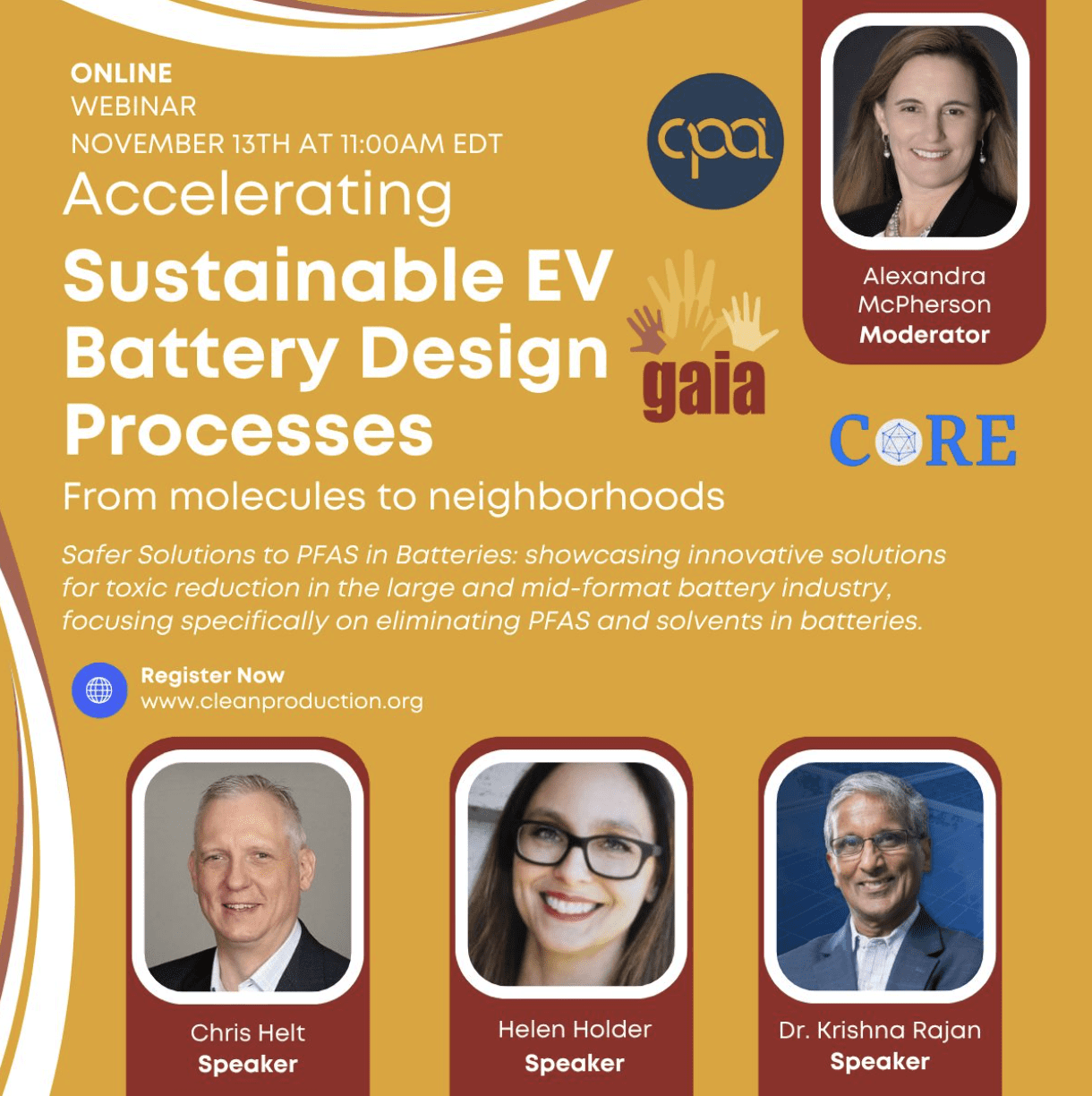
Join us on November 13, 2025, at 11 a.m., with the Collaboratory for a Regenerative Economy (CORE) for a webinar on innovative solutions for toxic reduction in the large- and mid-format battery industry, focusing specifically on eliminating PFAS and harmful solvents in EV and storage batteries. The expert panel will also discuss chemical screening tools, the decision-making processes for chemical selection among battery manufacturers, factors influencing the broader adoption of safer alternatives, and action steps you can take as we work toward adopting safer alternatives.
Moderator: Alexandra McPherson, Clean Production Action, Director of Investor Environmental Health Network
Speakers:
Chris Helt, Clean Production Action, Director Greenscreen – Discussing available safer alternatives, human health and environmental impact screening, and the use of inherently safer substitutes.
Helen Holder, formerly of ionobell (battery start-up) and HP – Addressing the challenges of adopting safer solutions in the emerging energy storage industry.
Krishna Rajan, UB Materials Design and Innovation, School of Engineering and Applied Science – Sharing insights on avoiding regrettable substitutions and accelerating the transition to safer materials.