GAIA Members

The tides turned at INC-5, and the way forward to an ambitious plastics treaty is now clearer than it’s ever been. At previous INCs, the majority of Member States showed willingness to compromise in the spirit of good-faith negotiations, even as petro-states used multiple tactics to delay and dilute progress towards a meaningful treaty. This time, they fought back.

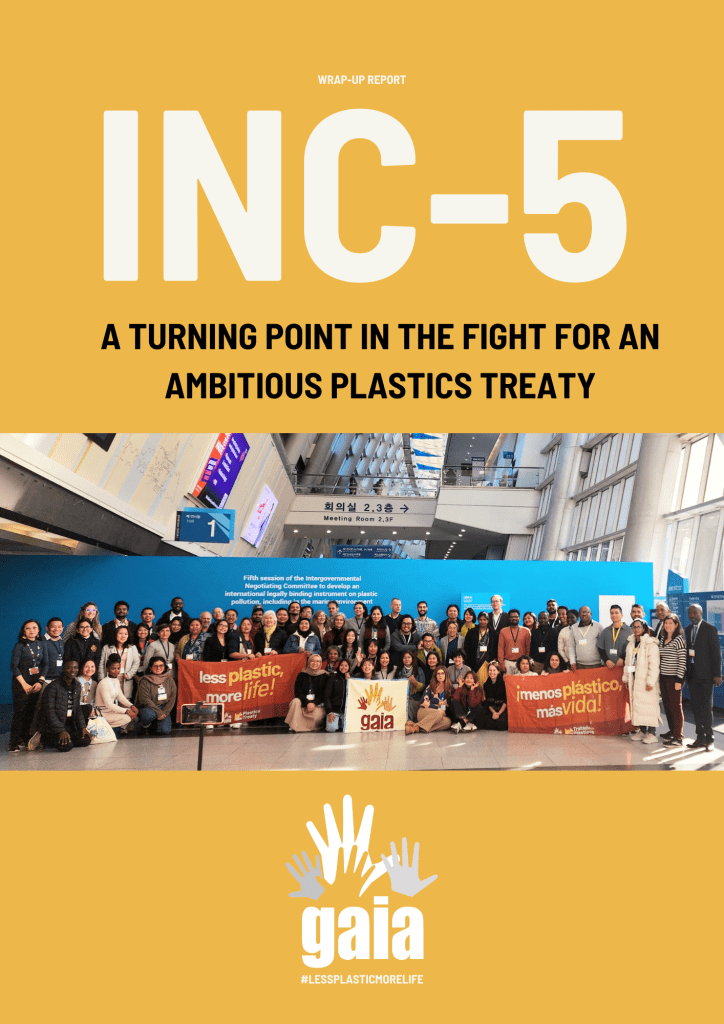
cover to GAIA Plastics Treaty INC-5 Outcomes. Includes group photo of civil society and banner reading Less Plastic More Life

Read GAIA’s report on the outcomes of INC-5, and our network’s impact. The report includes:

  • An analysis of the outcomes of INC-5, the bigger picture, and what’s next
  • A list of GAIA’s daily recaps from INC-5
  • A timeline of progress towards a plastics treaty
  • GAIA’s member engagement
  • GAIA’s media, social media, and advertising impact


1 de diciembre de 2024: Día 7 del INC-5

La mayoría de los Estados miembros, del lado de la ambición

Busan, Corea del Sur – Cuando se agotaba el tiempo para que los negociadores cerraran un tratado sólido sobre plásticos en Busan, la Presidencia y el Programa de las Naciones Unidas para el Medio Ambiente (PNUMA) anunciaron que celebrarán una INC 5.2, para dar a los Estados miembros más tiempo para acordar el texto final. 

Sin embargo, hay pocas garantías de que el próximo INC tenga éxito cuando el INC-5 no lo tuvo. El proyecto de texto del Presidente mantiene la reducción de la producción sobre la mesa, pero también está plagado de concesiones a los Estados petroquímicos en lugar de honrar la voluntad de la gran mayoría de los Estados miembros y la sociedad civil que piden un tratado ambicioso. Sin una acción decisiva, es muy probable que la misma minoría de petroestados continúe con sus tácticas obstruccionistas y ponga aún más en peligro el proceso del tratado sobre plásticos. 

Ana Rocha, Directora de Política Global de Plásticos de la Alianza Global para Alternativas a la Incineración (GAIA), afirma: “Celebramos la voluntad de los Estados miembros de luchar por un acuerdo mejor en lugar de apresurarse a firmar un tratado débil en aras de un plazo arbitrario. Pero no podemos seguir haciendo las cosas de la misma manera y esperar resultados diferentes: esa es la definición de locura. La ambiciosa mayoría tiene que hacer lo que sea necesario para encarrilar de nuevo estas negociaciones y recuperar el espíritu del multilateralismo. No es momento para la timidez. Es hora de luchar por nuestra supervivencia colectiva”. 

Hay muchos caminos a seguir, tanto dentro como fuera del PNUMA. La mayoría podría convocar una votación, o decidir que este proceso deje de estar bajo la inepta tutela del PNUMA.  

Cecilia Bianco, del Taller Ecologista de Argentina, afirma: “Cada minuto que pasa, nuestros ríos, el aire y nuestros cuerpos están más contaminados. Un gran grupo de países está de acuerdo en lo que hay que hacer, pero no es suficiente. Esperamos que el próximo año traiga el ambicioso tratado que la crisis exige”.

En una alentadora muestra de unidad en favor de un tratado ambicioso, Ruanda presentó una declaración en la sesión plenaria de clausura en nombre de más de 85 países de África, América Latina y el Caribe, las islas del Pacífico y Europa, en la que destacaba su compromiso común con un tratado jurídicamente vinculante que consagre objetivos de reducción, la eliminación progresiva de sustancias químicas nocivas, una transición justa y un mecanismo financiero equitativo. 

Esta demostración de poder colectivo fue un cambio bienvenido tras cuatro INC de tibia oposición a la tiranía de la minoría, y el fruto del esfuerzo de años de la sociedad civil para invertir la marea de la contaminación por plástico. Más de 100 países expresaron su apoyo a la propuesta de Panamá de adoptar un objetivo mundial para reducir la producción de plástico. 

La sociedad civil  también ha encendido las alarmas por la falta de transparencia, la desigualdad y la exclusión de la sociedad civil y los titulares de derechos a lo largo de las negociaciones. En el INC-5, la sociedad civil, incluidos los Pueblos Indígenas, los recicladores, las comunidades de primera línea, científicos, mujeres y líderes juveniles, se vieron excluidos del proceso, con un acceso limitado a los grupos de contacto y un bloqueo total durante los dos últimos días de negociaciones, que se desarrollaron a puerta cerrada. Por otro lado, el número récord de grupos de presión de combustibles fósiles y productos químicos eclipsó a todas las delegaciones nacionales

Magdalena Donoso, Coordinadora regional de GAIA América Latina y el Caribe, afirma:  “Un mal proceso no conduce a un buen resultado. Una y otra vez las acciones del PNUMA han demostrado sus intenciones: silenciar las voces de la sociedad civil, mientras se doblegan para tratar de complacer a los pocos países que no tienen un interés real en acabar con la contaminación por plástico.”

Rahyang Nusantara, Director Adjunto de Dietplastik Indonesia y Coordinador del Consorcio de Reutilización de Asia, afirma: “El texto actual ha perdido la oportunidad de avanzar en soluciones reales. El futuro acuerdo debe incluir un artículo específico con ambiciosos objetivos de reutilización financiados por un mecanismo financiero nuevo y específico que permita el establecimiento, las operaciones y la ampliación de los sistemas de reutilización y reparación de materiales no plásticos. Esto es clave para una transición justa, segura y libre de tóxicos que permita abandonar los plásticos y acabar realmente con la contaminación por plásticos.”

Eskedar Awgichew, de Ecojustice Etiopía, afirma: “Para África, este tratado es crucial para abordar los retos únicos a los que nos enfrentamos, incluido el impacto sobre los recicladores, las comunidades de primera línea y nuestro medio ambiente. El viaje continúa, pero la urgencia de una solución integral sigue existiendo.”

Contacto de prensa:

Camila Aguilera | América Latina y el Caribe

camila@no-burn.org | +56 9 8913 619

Claire Arkin | Global

claire@no-burn.org | +1 973 444 4869

Recursos

INC-5 Day 7: December 1, 2024

Majority of Member States on the Side of Ambition

Busan, South Korea – As time ran out for negotiators to clinch a strong plastics treaty in Busan, the Chair and United Nations Environment Programme (UNEP) announced that they will be holding an INC 5.2, to give Member States more time to agree upon the final text. 

However, there is little assurance that the next INC will succeed where INC-5 did not. The Chair’s draft text keeps production reduction on the table, but is also littered with concessions to petrochemical states instead of honoring the will of the vast majority of Member States and civil society calling for an ambitious treaty. Without decisive action, there is a strong probability that the same petro-state minority will continue their obstructionist tactics and further imperil the plastics treaty process. 

Ana Rocha, Global Plastics Policy Director of the Global Alliance for Incinerator Alternatives (GAIA), states, “We welcome Member States’ willingness to fight for a better deal instead of rushing into a weak treaty for the sake of an arbitrary deadline. But we cannot keep doing things the same way and expect different results– that is the definition of insanity. The ambitious majority needs to do whatever it takes to get these negotiations back on track and reclaim the spirit of multilateralism. Now is not the time for timidity. It is time to fight for our collective survival.” 

There are many paths forward, both within and outside of UNEP. The majority could call for a vote, or move to take this process out of UNEP’s inept stewardship entirely.  

Cecilia Bianco of Taller Ecologista, Argentina states, “Every minute that passes, our rivers, our air, and our bodies become more contaminated. A large group of countries are in agreement on what must be done, but it is not enough. We hope that next year will bring the ambitious treaty the crisis demands.”

In a heartening display of unity for an ambitious treaty, Rwanda presented a statement in the closing plenary on behalf of over 85 countries across Africa, Latin America and the Caribbean, the Pacific Islands, and Europe, emphasizing their shared commitment to a legally binding treaty enshrining reduction targets, phase-out of harmful chemicals, a just transition, and an equitable financial mechanism in the treaty. 

This show of collective power was a welcome change after four INCs of lukewarm opposition to the tyranny of the minority, and the fruiting of civil society’s years-long effort to turn the tide of plastic pollution. Over 100 countries expressed support for Panama’s proposal to adopt a global target to reduce plastic production. 

Civil society and rightsholders have also been sounding the alarm about the lack of transparency, inequity, and exclusion of civil society and rights holders throughout the talks. At INC-5, civil society, including Indigenous Peoples, waste pickers, front and fenceline communities, scientists, women, and youth leaders were kept out of the process, with limited access to contact groups and a total lock-out for the last two days of negotiations, which were held behind closed doors. To add insult to injury, record numbers of fossil fuel and chemical lobbyists dwarfed every country delegation

Magdalena Donoso, Regional Coordinator of GAIA Latin America and the Caribbean, states:  “A bad process does not lead to a good outcome. Time and time again UNEP’s actions have shown their intentions: to silence the voices of civil society, while bending over backwards to try to please the few countries who have no real interest in ending plastic pollution.”

Rahyang Nusantara, Deputy Director, Dietplastik Indonesia & Convenor of Asia Reuse Consortium, states: “The current text missed the opportunity to advance real solutions. The prospective agreement must have a dedicated article with ambitious reuse targets financed by a new and dedicated financial mechanism to enable the establishment, operations and scaling up of non-plastic reuse and repair systems. This is key for a safe and toxic-free just transition away from plastics to truly end plastic pollution.”

Eskedar Awgichew of Ecojustice Ethiopia states, “For Africa, this treaty is crucial to address the unique challenges we face, including the impact on waste pickers, frontline communities, and our environment. The journey continues, but the urgency for a comprehensive solution remains.”

Contact:

Claire Arkin, Global Communications Lead

claire@no-burn.org | +1 973 444 4869

Africa: Carissa Marnce, carissa@no-burn.org 

Latin America and the Caribbean: Camila Aguilera, camila@no-burn.org

Asia Pacific: Dan Abril, dan@no-burn.org

References: 

For more information about GAIA’s treaty advocacy, please visit  no-burn.org/unea-plastics-treaty, follow us on LinkedIn, and read our Press kit.

Delegados y expertos reaccionan ante el texto del Tratado propuesto por el Presidente

Delegados y expertos reaccionan ante el texto del Tratado propuesto por el Presidente

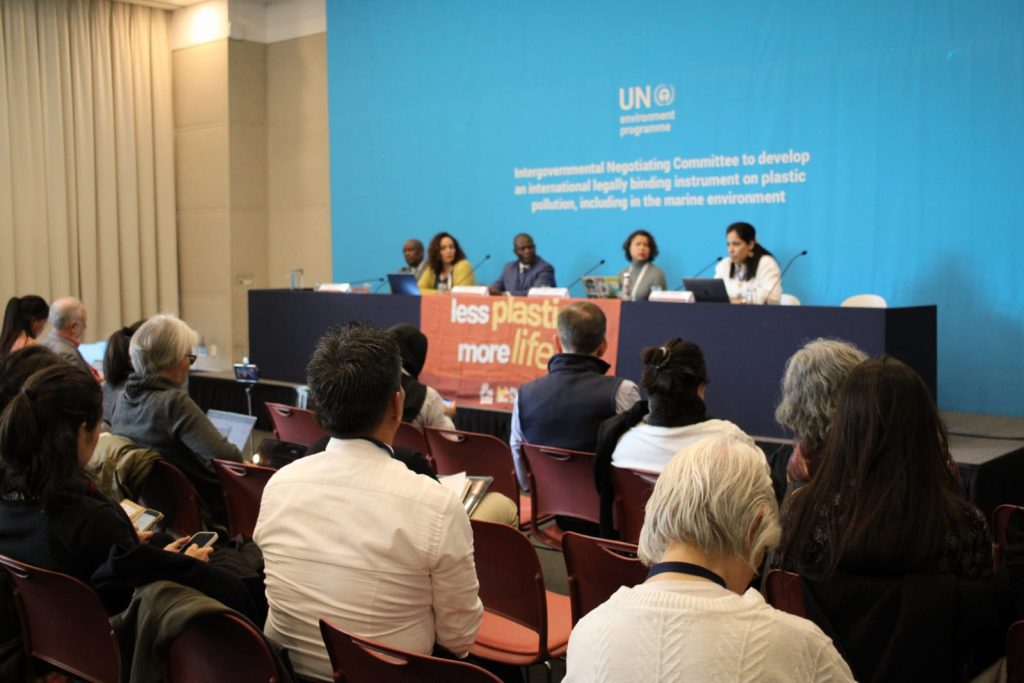
Busan, Corea del Sur – Los delegadas/os del Sur Global y líderes de la sociedad civil participaron esta tarde en una conferencia de prensa en el Centro de Convenciones BEXCO para compartir su visión sobre el avance de las negociaciones y lo que significan para el Sur Global. Una hora antes de la rueda de prensa, el Presidente hizo público su último documento, en el que propone un texto para el tratado que servirá de base para el último tramo de las negociaciones. 

Arpita Bhagat, Directora de Plásticos de GAIA Asia Pacífico, afirmó: “El último texto del Presidente es inaceptable para la mayoría de los países del Sur Global y los miles de millones de personas que representan: personas que están luchando por sus vidas por un tratado fuerte. Tampoco es aceptable para las personas perjudicadas por los plásticos en el Norte Global, incluidas las comunidades que luchan por la justicia medioambiental, las que viven en primera línea de playa y los Pueblos Indígenas, que han sido marginados del proceso durante mucho tiempo. No refleja la voluntad de la inmensa mayoría de los Estados miembros, que apoyan la adopción de medidas ambiciosas en un instrumento mundial jurídicamente vinculante. Una vez más, como a lo largo de todo este proceso, el Presidente se ha plegado a la voluntad de los Estados petroquímicos mientras desestima las demandas de la mayoría, en un proceso totalmente carente de transparencia y excluyente. Se trata de una cuestión de vida o muerte, especialmente para las comunidades del Sur Global. Los Estados miembros no se rendirán ni se quedarán de brazos cruzados. Mientras los países ambiciosos se mantengan firmes en sus principios, la sociedad civil tendrá su apoyo.”

Cheikh Ndiaye Sylla, Punto Focal Nacional de Senegal, afirma: “Esta versión del texto es… inaceptable… Para el ciclo de vida, tenemos que negociar esto desde el polímero, es decir, la producción. Es legalmente  vinculante conforme al  título… Ningún texto es mejor que un mal texto.”

El Dr. Sam Adu-Kumi, negociador de Ghana, afirmó: “El mundo entero está esperando algo de nosotros… están esperando algo mejor que proteja el medio ambiente, la salud humana, a nuestros hermanos y hermanas, y a nuestras poblaciones jóvenes… Por lo tanto, no estamos aquí para aceptar nada menos que un tratado ambicioso.”

Estos son elementos del nuevo texto que  son especialmente problemáticos:

Sobre las obligaciones básicas:

  • Producción de plástico (“Suministro”): el texto del Presidente no representa el lenguaje fuerte que Panamá y más de otros 100 países propusieron, incluyendo un objetivo global de reducción de la producción; está lleno de opciones de texto débiles, como referirse a un objetivo de reducción como “aspiracional”. Este artículo crítico debe fortalecerse con objetivos nacionales. 
  • Sustancias químicas preocupantes: El Presidente ha eliminado de este artículo los controles sistemáticos sobre sustancias químicas tóxicas, donde necesitamos las medidas más contundentes para hacer frente a la amenaza fundamental que suponen las sustancias químicas preocupantes. 
  • Gestión de residuos: se ha eliminado la jerarquía de residuos; y se mantiene la “recuperación de energía” -código para las tecnologías de incineración de residuos-.

Sobre los medios de implementación:

  • Mecanismo financiero: Al menos 126 países apoyan un fondo independiente y específico, la disposición más ampliamente respaldada del instrumento, pero el texto del Presidente lo socava con un lenguaje débil y opcional que no proporciona los fondos adecuados, como por ejemplo a través de una tasa de producción de polímeros.

La infraestructura del tratado es débil:

  • No derecho a voto: El texto del Presidente no otorga a los países el derecho a votar, asegurando una mayor parálisis del proceso. Este no es el tratado de “iniciar y fortalecer” que se nos prometió.

La semana en Busan empezó con los Estados petroquímicos amenazando con hacer descarrilar el proceso si los Estados miembros ejercían su derecho a pedir una votación, lo que nos ha llevado a este punto. Continuar el trabajo en un INC 5.2 sólo valdrá la pena con un proceso transparente en el que los Estados pongan fin a la tiranía de una minoría.  

Ante el posible fracaso de las negociaciones, recordamos a los Estados miembros que, como ellos mismos han declarado, ningún acuerdo es mejor que un mal acuerdo.

Contacto de prensa:

Camila Aguilera | América Latina y el Caribe

camila@no-burn.org | +56 9 8913 619

Claire Arkin | Global

claire@no-burn.org | +1 973 444 4869

Recursos

Delegates and Policy Experts React to the Chair’s Proposed Treaty Text

Busan, South Korea – Global South delegates and civil society leaders spoke at a press conference at BEXCO Convention Center this afternoon, to share their outlook on the negotiations thus far and what it means for the Global South. In the hour before the press conference, the Chair released his latest paper, which proposes text for the treaty to serve as a basis for the final bout of negotiations. 

Arpita Bhagat, Plastics Lead at GAIA Asia Pacific states: “The Chair’s latest text is unacceptable to the majority of Global South countries and the billions of people they represent: people who are fighting for their lives for a strong treaty. Nor is it acceptable to people harmed by plastics in the Global North, including environmental justice, front and fenceline communities, and Indigenous Peoples who have long been sidelined in the process. It is not a reflection of the will of the vast majority of Member States, who support ambitious measures in a legally-binding, global instrument. Once again, as throughout this process, the Chair has bent to the will of the petrochemical states while dismissing the demands of the majority, in a completely non-transparent, exclusionary process. This is a matter of life and death, especially for Global South communities. Member States will not roll over and play dead. As long as ambitious countries hold on to their principles, civil society will have their backs.” 

Cheikh Ndiaye Sylla, National Focal Point for Senegal, states, “This version of the text is…not acceptable…For life cycle, we have to negotiate this from the polymer, meaning the production. It is legally binding as per the title…No text is better than bad text.”  

Dr Sam Adu-Kumi, Negotiator for Ghana, states, “The whole world is looking up to us…they are expecting something better that will protect the environment, human health, our brothers and sisters, and our young populations….So we are not here to accept anything short of an ambitious treaty.” 

These elements in the new text are particularly problematic:

On core obligations:

  • Plastic production (“Supply”): the Chair’s text does not represent the strong language Panama and more than 100 other countries proposed, including a global target on production reduction; it is full of weak text options, such as referring to a reduction target as  “aspirational.” This critical article must be strengthened with national targets. 
  • Chemicals of concern: The Chair has stripped away systematic controls on toxic chemicals from this article, where we need the strongest measures to address the fundamental threat posed by chemicals of concern. 
  • Waste management: the waste hierarchy has been removed; and “energy recovery” – code for waste-burning technologies– remains.

On means of implementation:

  • Financial mechanism: At least 126 countries support an independent, dedicated fund– the most widely supported provision in the instrument– yet the Chair’s text undermines it with weak, optional language that fails to provide adequate funds, such as through a polymer production fee.

The treaty infrastructure is weak:

  • No right to vote: The Chair’s text fails to give countries the right to vote, ensuring further paralysis of the process. This is not the “start and strengthen” treaty that we were promised. 

The week in Busan started with petrochemical states threatening to derail the process if Member States exercised their right to call for a vote, which brought us to this point. Continuing the work in an INC 5.2  will only be worthwhile with a transparent process where states put an end to the tyranny of the minority.  

As we confront the potential failure of the negotiations, we remind Member States that, as they themselves have stated, no deal is better than a bad deal.

Contact:

Claire Arkin, Global Communications Lead

claire@no-burn.org | +1 973 444 4869

###

GAIA is a worldwide alliance of more than 1,000 grassroots groups, non-governmental organizations, and individuals in over 90 countries. With our work we aim to catalyze a global shift towards environmental justice by strengthening grassroots social movements that advance solutions to waste and pollution. We envision a just, zero waste world built on respect for ecological limits and community rights, where people are free from the burden of toxic pollution, and resources are sustainably conserved, not burned or dumped.

References: 

For more information about GAIA’s treaty advocacy, please visit  no-burn.org/unea-plastics-treaty, follow us on LinkedIn, and read our Press kit.

30 de noviembre de 2024: Día 6 del INC-5

El juego de la espera

Durante los últimos dos días, las negociaciones sobre el tratado de los plásticos han sido en gran medida una caja negra para los observadores, las comunidades de primera línea, los recicladores y las naciones y grupos de los Pueblos Indígenas. El Presidente del INC y los Estados miembros han estado enclaustrados en «reuniones informales» y «bilaterales» a puerta cerrada, mientras que las comunidades de primera línea, los recicladores y las naciones y grupos de Pueblos Indígenas se han quedado al margen, preguntándose si el ambicioso tratado por el que hemos luchado durante los últimos dos años sigue sobre la mesa. Mientras tanto, los diplomáticos toman decisiones en nombre de las mismas personas cuyas vidas y comunidades se ven más afectadas por este sistema de producción y consumo masivos de plástico.

La absoluta falta de transparencia en las negociaciones es una prueba más de que el proceso es rehén de unos pocos Estados, que comparten la misma línea de pensamiento, principalmente estados petroleros. No hay forma de saber a qué países está atendiendo el Presidente y a cuáles está excluyendo, reproduciendo así, exactamente los mismos desequilibrios geopolíticos y coloniales que han alimentado la crisis de los plásticos, y contradiciendo directamente sus promesas de un proceso de negociación del tratado abierto y transparente. Para colmo de males, es muy probable que mientras la sociedad civil debe conjeturar sobre el destino del tratado desde fuera, la industria de los combustibles fósiles está incluida en estas sesiones a puerta cerrada, escondiéndose a plena vista entre las delegaciones de los países.

Esta no es la primera vez que la sociedad civil ha sido excluida de las negociaciones críticas – también se nos prohibió asistir a los trabajos intersesionales antes del INC-5, y hay innumerables ejemplos de la semana pasada y a lo largo de los INC que ejemplifican cómo el PNUMA y el Presidente tienen poco interés en garantizar que los titulares de derechos, los recicladores, los Pueblos Indígenas, los jóvenes, los científicos y los líderes de la justicia ambiental tengan un asiento en la mesa.

El próximo documento oficioso (non paper del Presidente será un reflejo de las conversaciones que ha elegido tener, y aquellas que no. Esperamos que el documento sea representativo de la ambiciosa mayoría, y no un apaciguamiento para aquellos pocos que no tienen ningún interés real en acabar con la contaminación por plásticos.

Las consultas informales a puerta cerrada se han prolongado hasta bien entrada la noche y se han centrado en algunas de las cuestiones más polémicas, como la producción y la financiación.

El plástico es colonización: Los pueblos indígenas se manifiestan en el INC-5

Hoy, el Foro Internacional de los Pueblos Indígenas sobre el Plástico dio  una rueda de prensa en  BEXCO de Busan para poner de relieve los efectos desproporcionados de la contaminación por plásticos en los pueblos indígenas a lo largo del «ciclo de la muerte» del plástico, la falta de transparencia en las negociaciones, su exclusión injusta del proceso y la importancia vital de consagrar los derechos y el liderazgo indígenas en el tratado final.

Juan Mancias, de la Sociedad de Naciones Nativas, habló de lo absurdo que resulta que los países no sean capaces de llegar a un consenso sobre la necesidad de frenar la producción de plástico: «No hubo ‘consenso’ cuando decidieron empezar a fabricar plásticos».

Tori Cress, de la Sociedad de Naciones Nativas y copresidenta del Foro Internacional de los Pueblos Indígenas sobre el Plástico, describió los efectos devastadores que las arenas bituminosas de Canadá han tenido en las comunidades indígenas de la zona: «Si pasas tiempo en la región de las arenas bituminosas lo olerás, no puedes escapar de él, es ineludible. Los Dene, Métis y el pueblo Cree han sido testigos a lo largo de su vida de la destrucción del agua de la que bebían cuando eran niños».

Jo Banner, cofundadora y codirectora del Proyecto Descendientes, declaró: «Entré en la tienda de comestibles de al lado de mi hotel y encontré algo que era una locura. Era un solo huevo, en un recipiente de plástico; ¡había más plástico que huevo! Y pensé: por ésto es por lo que nos estamos muriendo. Un huevo en un recipiente de plástico… La industria quiere hacernos creer que nos estamos muriendo por válvulas cardíacas y piezas de cohetes espaciales y no digo que eso no forme parte de lo que hace el plástico, pero al fin y al cabo nos estamos muriendo por tonterías, por pequeñeces como sorbetes.»

Matt Perryman, coordinador y científico indígena de la Coalición Tāngata Whenua por un Tratado sobre el Plástico Eficaz, se refirió a cómo los derechos de los pueblos indígenas fueron ignorados a lo largo del proceso del tratado: «El hecho de que la industria pueda sentarse en las salas de toma de decisiones con los gobiernos, tomando decisiones sobre nuestro futuro, sobre nuestros hijos, mientras nos expulsa activamente. ¿Se espera que estemos de acuerdo con la total falta de transparencia que estamos viendo? No está bien, y tenemos que asegurarnos de que lo entiendan».

Contacto de prensa:

Camila Aguilera | América Latina y el Caribe

camila@no-burn.org | +56 9 8913 619

Claire Arkin | Global

claire@no-burn.org | +1 973 444 4869

Recursos

INC-5 Day 6: November 30, 2024

The Waiting Game

For the past two days, negotiations on the plastics treaty have largely been a black box to observers, frontline communities, wastepickers, and the Indigenous Peoples nations and groups. The INC Chair and Member States have been cloistered away in closed-door “informals” and “bilaterals” while frontline communities, wastepickers, and the Indigenous Peoples nations and groups have been left out in the cold, wondering whether the ambitious treaty that we have fought for over the past two years is still on the table. Meanwhile diplomats make decisions on behalf of the very people whose lives and communities are most impacted by this system of mass production and consumption of plastic. 

The utter lack of transparency in the negotiations is further evidence of a  process that is being held hostage by a few like-minded mainly petro-states. There is no way of knowing which countries the Chair is catering to and which he is excluding, therefore replicating the exact same geopolitical and colonial power imbalances that have fueled the plastics crisis, and directly contradicting his promises of an open and transparent treaty negotiation process. To add insult to injury, it is highly likely that while civil society must conjecture about the fate of the treaty from the outside, the fossil fuel industry is embedded in these closed-door sessions, hiding in plain sight among country delegations.  

This is not the first time that civil society has been excluded from critical negotiations– we were also barred from attending intersessional work in advance of INC-5, and there are countless examples from the past week and throughout the INCs exemplifying how UNEP and the Chair have little interest in ensuring that rightsholders, waste pickers, Indigenous Peoples, youth, scientists, and environmental justice leaders have a seat at the table. 

The Chair’s next non paper will be a reflection of the conversations he has chosen to have, and the conversations he hasn’t. We hope that the paper will be representative of the ambitious majority, and not an appeasement to those few who have no actual interest in ending plastic pollution. 

Closed-door informal consultations ran well into the night, focusing on some of the most contentious issues including production and finance. 

Plastic is Colonization: Indigenous Peoples Speak Out at INC-5

Today, the International Indigenous Peoples’ Forum on Plastics held a press conference at BEXCO in Busan, to highlight the disproportionate impacts of plastic pollution on Indigenous Peoples throughout the plastic “death cycle,”  the lack of transparency in negotiations, their wrongful exclusion from the process, and the vital importance of enshrining Indigenous rights and leadership in the final treaty. 

Juan Mancias of the Society of Native Nations discussed the absurdity of countries not being able to reach consensus about the need to curb plastic production: “There was no ‘consensus’ when they decided to start making plastics.” 

Tori Cress, Society of Native Nations and Co-Chair of the International Indigenous Peoples’ Forum on Plastics, described the devastating impacts that Canada’s tar sands have had on Indigenous communities in the area: “If you spend time in the tar sands region you will smell it,  you can’t escape it, it’s inescapable.  Dene, Métis, and Cree people in their lifetime have witnessed the destruction of the water that they used to drink from as children.” 

Jo Banner, Co-Founder and Co-Director of The Descendents Project stated,  “I went into the convenience store next to my hotel, and I found something that was crazy. It was a single egg, in a plastic container; there was more plastic than there was egg! And I’m thinking, this is what we are dying for. An egg in a plastic container…The industry wants to make us want to think that we’re dying for heart valves and space rocket parts and I’m not saying that’s not part of what plastic makes, but at the end of the day we are dying for foolishness, for straws.” 

Matt Perryman, Coordinator and Indigenous Scientist-Tāngata Whenua Coalition for an Effective Plastics Treaty, addressed how Indigenous Peoples rights were ignored throughout the treaty process: “The fact that industry can sit in decision-making rooms with governments, making decisions about our future, about our children, while actively pushing us out. The total lack of transparency that we’re seeing we’re expected to be ok with? It’s not ok, and we need to make sure that they understand that.” 

Contact:

Claire Arkin, Global Communications Lead

claire@no-burn.org | +1 973 444 4869

References: 

For more information about GAIA’s treaty advocacy, please visit  no-burn.org/unea-plastics-treaty, follow us on LinkedIn, and read our Press kit.

29 de noviembre de 2024: Día 5 del INC-5

Declaración de GAIA sobre el Non paper 4 del Presidente

Busan, Corea del Sur- Después de días de lentos avances en las negociaciones del tratado de plásticos (INC-5), los facilitadores de los cuatro grupos de contacto donde se están llevando a cabo las negociaciones entregaron un texto propuesto al Presidente del INC. Esta tarde, el presidente ha publicado una nueva versión del borrador («non paper»), que se convertirá en la base de las negociaciones de los dos últimos días del INC-5.

Ana Rocha, Directora de Política Global de Plásticos de GAIA, afirma:

«El último documento oficioso (non-paper) del Presidente muestra los múltiples caminos que podría tomar el tratado. Uno sería histórico: por primera vez, el texto incluiría opción de un tope a la producción de plástico, un testimonio de los 103 países y una sociedad civil unida que exigen su inclusión.

El otro camino parece desalentador. Un tratado débil, no vinculante, con un mecanismo financiero débil, que promueva la eliminación sin lógica de sustancias químicas preocupantes, sin ningún lenguaje significativo sobre salud, derechos humanos o derechos de los Pueblos Indígenas, una puerta abierta a falsas soluciones, como a la incineración de residuos, y que de pase libre para algunas de las industrias más contaminantes.

Las «reuniones informales», secretas y entre bastidores, que precipitaron este documento oficioso, muestran claramente que el Presidente está jugando con favoritismos, atendiendo a los pocos países de mala fe y a los grupos de presión (grupos de lobby) presentes en la sala, mientras excluye a la sociedad civil, a los titulares de derechos y a los países del Sur global que lideran un tratado ambicioso.

Un mal proceso no conduce a un buen resultado. Para conseguir el tratado sobre plásticos necesario para vencer la amenaza existencial de la contaminación por plásticos, los países que defienden un tratado ambicioso no deben ceder a presiones arbitrarias de tiempo y a los pocos saboteadores que piden «consenso» por encima de justicia. Éstos países deben estar dispuestos a salir del punto estancamiento e insistir en votar a favor del tratado que apoye la mayoría de los Estados miembros y, si es necesario, estar dispuestos a abandonar un mal acuerdo. Mientras los países que lideran un tratado ambicioso mantengan sus principios, la sociedad civil los respaldará».

Contacto de prensa:

Camila Aguilera | América Latina y el Caribe

camila@no-burn.org | +56 9 8913 619

Claire Arkin | Global

claire@no-burn.org | +1 973 444 4869

Recursos

INC-5 Day 5: November 29, 2024

GAIA’s Statement on the Chair’s Non Paper 4

Busan, South Korea– After days of halting progress in plastics treaty negotiations (INC-5), the facilitators of the four contact groups where negotiations are taking place delivered proposed text to the Chair of the INC. The chair then released a new iteration of a draft (“non paper”) this afternoon, meant to become a basis for negotiations in the final two days of INC-5. 

Ana Rocha, Global Plastics Policy Director of GAIA, states: 

“The Chair’s latest non paper shows multiple paths that a treaty could take. One would be historic– for the first time, the text includes the option for a plastic production cap,  a testament to the 103 countries and a united civil society demanding its inclusion. 

The other path looks grim. A weak, non-binding treaty with an anemic financial mechanism, the illogical removal of chemicals of concern, no meaningful language on health, human rights, or rights of Indigenous Peoples, an open door to false solutions like waste incineration, and a free pass to some of the most polluting industries. 

The secretive, behind-the-scenes “informals” that precipitated this non paper clearly show that the Chair is playing favorites– catering to the few bad-faith countries  and lobbyists in the room while excluding civil society, rights holders, and Global South countries leading ambition on the treaty. 

A bad process does not lead to a good outcome. In order to land the plastics treaty needed to beat the existential threat of plastic pollution, countries championing ambition must not bow to arbitrary time-pressures and the few bullies calling for “consensus” over justice.  They must be willing to break the deadlock and insist on voting for the treaty the majority of Member States support, and if necessary, be willing to walk away from a bad deal. As long as ambitious countries hold to their principles, civil society will have their backs.” 

Contact:

Claire Arkin, Global Communications Lead

claire@no-burn.org | +1 973 444 4869

References: 

For more information about GAIA’s treaty advocacy, please visit  no-burn.org/unea-plastics-treaty, follow us on LinkedIn, and read our Press kit.