





Delegates and Policy Experts React to the Chair’s Proposed Treaty Text
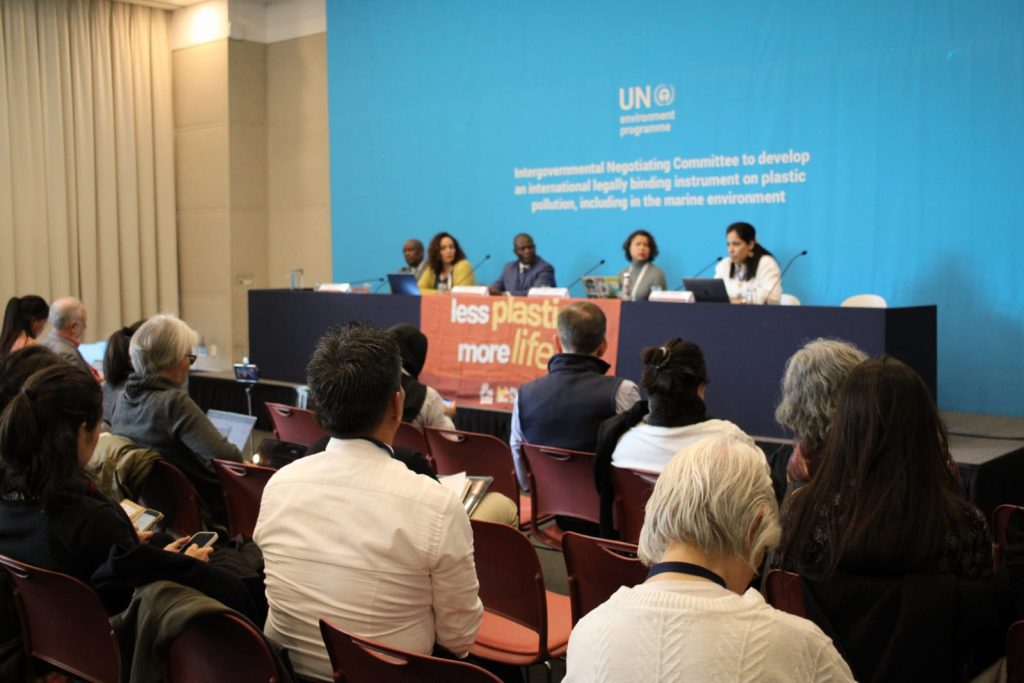
Busan, South Korea – Global South delegates and civil society leaders spoke at a press conference at BEXCO Convention Center this afternoon, to share their outlook on the negotiations thus far and what it means for the Global South. In the hour before the press conference, the Chair released his latest paper, which proposes text for the treaty to serve as a basis for the final bout of negotiations.
Arpita Bhagat, Plastics Lead at GAIA Asia Pacific states: “The Chair’s latest text is unacceptable to the majority of Global South countries and the billions of people they represent: people who are fighting for their lives for a strong treaty. Nor is it acceptable to people harmed by plastics in the Global North, including environmental justice, front and fenceline communities, and Indigenous Peoples who have long been sidelined in the process. It is not a reflection of the will of the vast majority of Member States, who support ambitious measures in a legally-binding, global instrument. Once again, as throughout this process, the Chair has bent to the will of the petrochemical states while dismissing the demands of the majority, in a completely non-transparent, exclusionary process. This is a matter of life and death, especially for Global South communities. Member States will not roll over and play dead. As long as ambitious countries hold on to their principles, civil society will have their backs.”
Cheikh Ndiaye Sylla, National Focal Point for Senegal, states, “This version of the text is…not acceptable…For life cycle, we have to negotiate this from the polymer, meaning the production. It is legally binding as per the title…No text is better than bad text.”
Dr Sam Adu-Kumi, Negotiator for Ghana, states, “The whole world is looking up to us…they are expecting something better that will protect the environment, human health, our brothers and sisters, and our young populations….So we are not here to accept anything short of an ambitious treaty.”
These elements in the new text are particularly problematic:
On core obligations:
- Plastic production (“Supply”): the Chair’s text does not represent the strong language Panama and more than 100 other countries proposed, including a global target on production reduction; it is full of weak text options, such as referring to a reduction target as “aspirational.” This critical article must be strengthened with national targets.
- Chemicals of concern: The Chair has stripped away systematic controls on toxic chemicals from this article, where we need the strongest measures to address the fundamental threat posed by chemicals of concern.
- Waste management: the waste hierarchy has been removed; and “energy recovery” – code for waste-burning technologies– remains.
On means of implementation:
- Financial mechanism: At least 126 countries support an independent, dedicated fund– the most widely supported provision in the instrument– yet the Chair’s text undermines it with weak, optional language that fails to provide adequate funds, such as through a polymer production fee.
The treaty infrastructure is weak:
- No right to vote: The Chair’s text fails to give countries the right to vote, ensuring further paralysis of the process. This is not the “start and strengthen” treaty that we were promised.
The week in Busan started with petrochemical states threatening to derail the process if Member States exercised their right to call for a vote, which brought us to this point. Continuing the work in an INC 5.2 will only be worthwhile with a transparent process where states put an end to the tyranny of the minority.
As we confront the potential failure of the negotiations, we remind Member States that, as they themselves have stated, no deal is better than a bad deal.
Contact:
Claire Arkin, Global Communications Lead
claire@no-burn.org | +1 973 444 4869
###
GAIA is a worldwide alliance of more than 1,000 grassroots groups, non-governmental organizations, and individuals in over 90 countries. With our work we aim to catalyze a global shift towards environmental justice by strengthening grassroots social movements that advance solutions to waste and pollution. We envision a just, zero waste world built on respect for ecological limits and community rights, where people are free from the burden of toxic pollution, and resources are sustainably conserved, not burned or dumped.
References:
- GAIA Press Kit
- GAIA INC-5 Booklet (policy briefings and recommendations)
For more information about GAIA’s treaty advocacy, please visit no-burn.org/unea-plastics-treaty, follow us on LinkedIn, and read our Press kit.