GAIA IN ASIA PACIFIC
Falsely blamed as the source of pollution and the nexus of our plastic crisis, the Asia Pacific region is full of examples that counter this narrative perpetuated by an unjust system of waste trade across countries. GAIA’s work in Asia Pacific is focused on spotlighting and providing support for the many innovative and on-the-ground zero waste solutions. Our work also seeks to remedy the systemic injustices of global waste trade—which depends on the cheap labor and lower standards of environmental protection in developing countries—by stopping waste trade and putting an end to burn technologies such as incinerators exported from countries in the Global North, China, and Japan.
In the span of 20 years, GAIA Asia Pacific has successfully shut down 19 incinerator projects and proposals, influenced governments to allocate annual budget towards the inclusion of waste pickers and zero waste sites in several cities, strengthened extended producer responsibility legislation through brand audits in India, and implemented plastic waste bans across the region.
Current Campaigns
#NoTrashTalk
A campaign to call out international financing institutions (IFIs), governments, and investors to walk the talk by withdrawing support for incinerators and other false solutions to waste management, pollution, and fossil fuel-based energy sources. We demand that finance be shifted to accelerated, just, and transformative solutions.
The Global Plastics Treaty: Asia Pacific Perspectives
The Intergovernmental Negotiating Committee on Plastic Pollution or INC 2, 3, 4, and 5 are happening in the next two years. While some see this as an opportunity to push forward our plastics work, some see it as lip service to a treaty with no binding commitments from countries to really put an end to plastic pollution.
LATEST NEWS IN ASIA PACIFIC
Blending More Problems: Co-firing Biomass with Power Plants
Co-firing biomass is a technology that burns biomass alongside other fuels, typically coal, in existing power plants. This technology presents a different set of complexities and harms. In the context of ADB’s policy to support the early retirement of coal-based power plants—including decommissioning of coal-fired power plants and site redevelopment for new economic activity—co-firing of biomass with power plants, whether from energy crops or biomass waste, poses risks with long-term harms to air quality, local communities, ecosystems and efforts to address the triple planetary crisis of climate change, pollution, and biodiversity loss in a region most vulnerable to these interlinked threats.

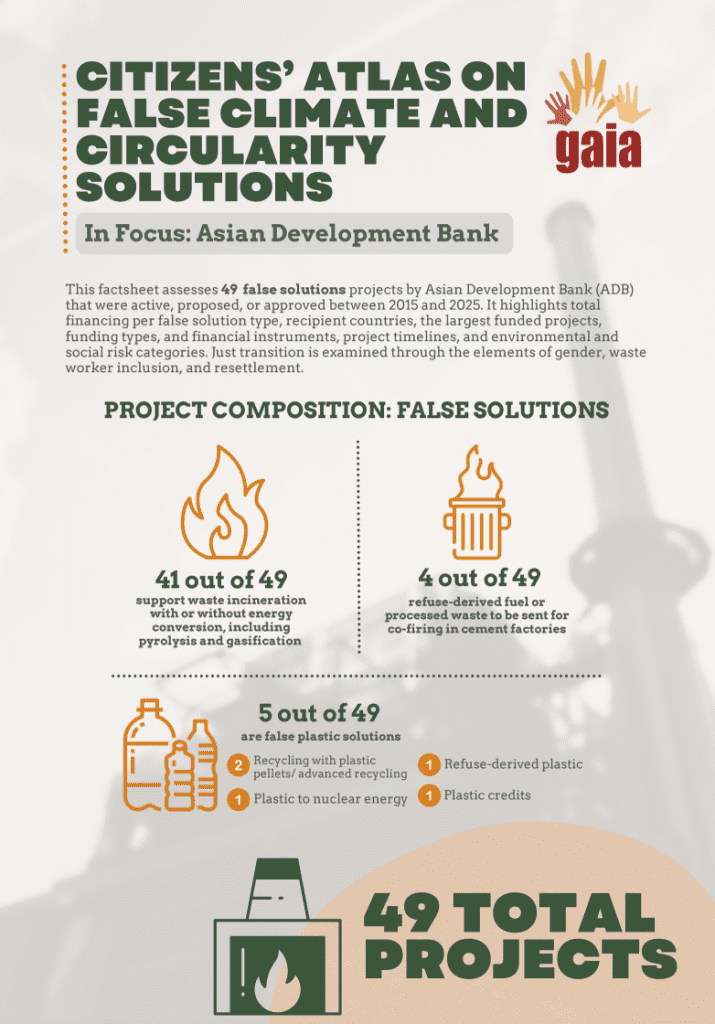
Citizens’ Atlas on False Climate and Circularity Solutions
This factsheet assesses 49 “false solutions” projects by ADB that were active or approved between 2015 and 2025. It highlights total financing by solution, recipient countries, the largest funded projects, funding types and financial instruments, project timelines, and environmental and social risk categories these projects belong to. Since 2015, the bank has supported USD 15.3 billion worth of projects with false solutions to circularity and climate action, worsening the debt burdens of countries already challenged with the triple planetary crisis.

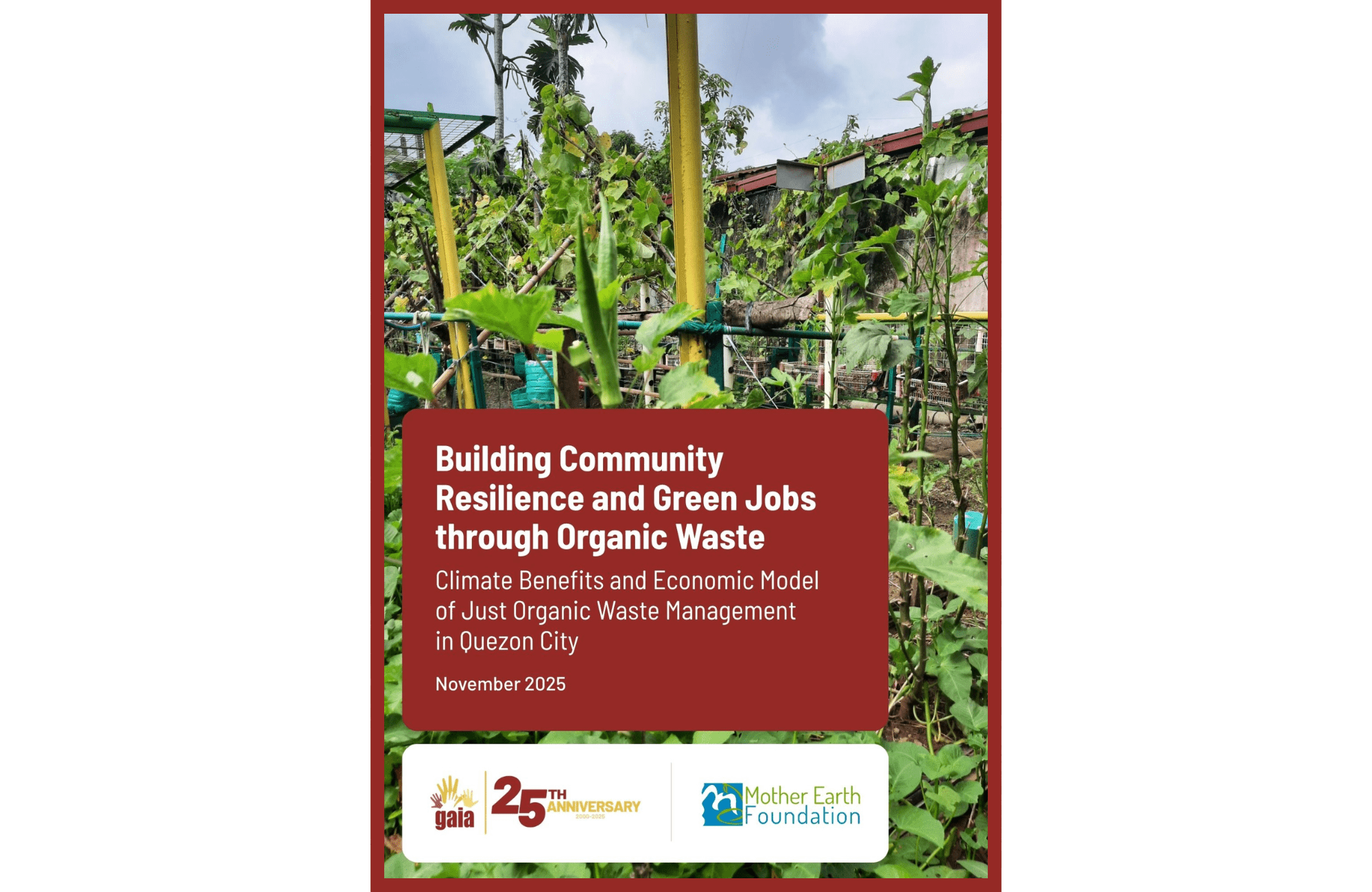
Building Community Resilience and Green Jobs through Organic Waste: Climate Benefits and Economic Model of Just Organic Waste Management in Quezon City
The organics diversion project in Quezon City demonstrates how decentralized, community-based waste systems can advance both climate action and social inclusion. The Barangay Payatas Zero Waste and Urban Farming Project, launched in 2024, stands as a model of how cities can integrate organic waste management, food production, and livelihood creation to achieve just and sustainable methane mitigation.
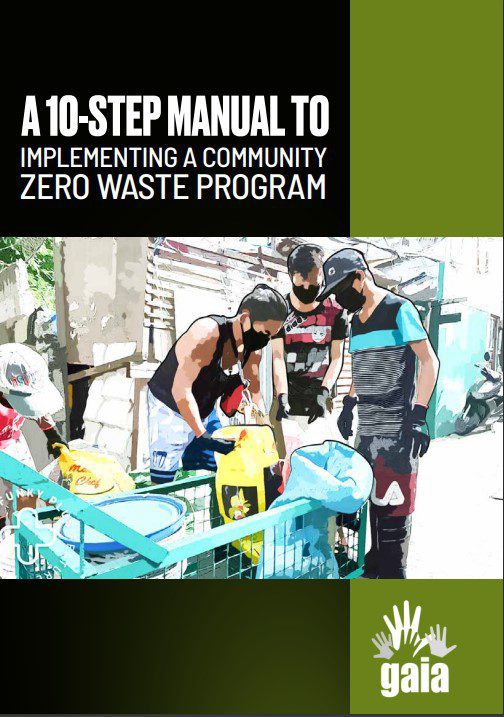
A 10-Step Manual to Implementing a Community Zero Waste Program

Establishing Zero Waste Communities seemed like a very daunting task some 10 years ago. Thanks to the determination and commitment of the Mother Earth Foundation (MEF) team, led by its president and GAIA Asia Pacific’s Regional Coordinator, Mr. Froilan Grate, the steps to achieve this are now available in the “10 Steps in Establishing a Community Ecological Solid Waste Management (ESWM) Program” manual. Many publications on how to implement an ESWM program have been published, but this is a first of its kind as it is presented in a detailed, step-by-step format.
This manual guides stakeholders through the process, which, if followed, will make implementers and local government leaders realize how doable it is. The Ecological Solid Waste Management Act of 2000, also known as RA 9003, provides the framework for this 10-step program.
Download This Resource
GAIA CONTACTS IN ASIA PACIFIC
Robi Kate Miranda
Robi is a development communication professional specializing in environmental advocacy, sustainability, and climate action. A cum laude graduate of Development Communication from the University of the Philippines Los Baños, she has worked with various local and international organizations. In 2024, she was selected for the YSEALI Academic Fellowship on Environmental Issues at the University of Montana.
Anthony Fernandez
Anthony, or Tony, is a dynamic professional skilled in resource mobilization and project management, partnership and business development, training, talent acquisition, and life coaching. With over a decade of experience, Tony has excelled in diverse roles across non-profit organizations and corporate settings, leading transformative projects to maximize resources for impactful outcomes. Beyond his professional life, Tony is a proud LGBTQIA+ advocate, openly bisexual, and a fur parent. He finds joy in camping adventures, blending his diverse skill set with unwavering dedication to make a meaningful difference in his community.
Bernadette Torno
Dette is a development professional with more than four years of experience in public policy research, project development and coordination, and capacity building and knowledge transfer activities. She previously worked on sustainable marine transport initiatives and for an independent policy think tank on projects focused on the southern region. She completed her degree in Political Science from the University of the Philippines, Diliman in 2019.
Sumana Narayanan
Sumana is a seasoned ecologist and environmental researcher with experience in advocacy, research, and program implementation. Her skills span sustainable transport, solid waste management, and environmental policy.
Edel Garingan
Edel S. Garingan is a development work professional with over fifteen years of experience in program management, training, research, and resource mobilization. He has worked at different nonprofits on the issues of biodiversity conservation, sustainable development, human rights, social enterprise, children and youth development, and participatory community development processes. He is also a visual artist (Pinoy Mandala) and a Certified Therapeutic Art facilitator.
Ralph Retamal
Ralph is a GIS and Data Specialist with an advocacy for open-source mapping and for livable cities through green and open spaces. He has experience in mapping for the government, and providing data visualizations for several academes in the Philippines. He aims to create a positive impact through well-designed maps that are insightful and purposeful, communicated through the lens for the marginalized, and facilitate positive change one map at a time.
Albrecht Arthur N. Arevalo
Brex Arevalo is a climate and environmental justice advocate with over five years of experience working with youth, civil society, and faith-based organizations. He recently completed a graduate degree in Global Studies at Sophia University in Tokyo, where he wrote a thesis about climate justice in Southeast Asia. Alongside his studies, he worked with KASA Sustainability in organizing sustainability-related events for local and international audiences, and running a campus farm based on circular economics. Brex previously played a lead role with the 2030 Youth Force in the Philippines in promoting youth-led collaborations around the Sustainable Development Goals through workshops, policy lobbying, and events. He also worked with faith communities through the Ecojesuit global ecology network, where he played key roles in UN-connected engagements and Global Climate Strike actions highlighting local and indigenous communities.
Yehlen Benedicto
Yehlen has worked in different international development NGO since 2009 in providing assistance on procurement and logistics. She’s a hardworking and versatile team member with reliable organizational skills and thorough knowledge of corporate policies and procedures.
Archie Abellar
Archie started his environmental activism in 2005 as a direct dialogue campaigner in an environmental and protest organization. He has a background in history and occupational therapy. Prior to going GAIA, he worked as community organizer in an inclusive community-based disaster risk reduction and management project of a faith-based organization in the Philippines.
Arpita Bhagat
Arpita is the Plastic Policy Officer for the Asia Pacific region. Her work focuses on strengthening the capacity and engagement of members in Global and national advocacy work towards plastic production caps, advancing Zero Waste policies, just transition for waste pickers and workers, and phasing out false solutions. Since 2012, she has worked across international and Indian organizations leading public mobilization, advocacy, and movement-building campaigns and programs across diverse issues including clean energy, sustainable agriculture, climate-resilient cities, gender justice, and plastics.
Leo Jaminola
Leo has more than three years of work experience in quantitative and qualitative research, project management, and stakeholder coordination. They have published journal articles, book chapters, and policy notes on a wide range of topics including political dynasties, Philippine politics, inclusive growth, environmental cooperation, and fertility. They completed their undergraduate degree in Political Science from the University of the Philippines Diliman and are currently completing their master’s degree in Demography at the same university. They are part of several youth-led environmental organizations in the Philippines.
Raimiel Dionido
| Raimiel is GAIA Asia Pacific’s Organizational Development and Human Resources Officer. His academic background is in Psychology, and has been working in Human Resources for the past five years. He has previously been involved in the Philippine Government’s Higher Education sector and has helped in delivering a few of its key programs for ensuring access to education. He strongly believes in community involvement in inspiring social change, and the role of Civil Society Organizations in this endeavor. |
Ambily Adithyan
Ambily is a sustainability practitioner with deep interest in solving local environmental issues. She actively works towards improving her city’s waste management practices through behavioural change and community engagement model. She is experienced in program strategy & delivery, research and program led advocacy across development and waste management sector.
Dan Abril
Dan carries almost 30 years of experience in communications work, from media publishing to marketing to web content writing, and as the Campaigns Coordinator of other non-government organisations. His traditional and modern approach to comms work is a solid support to GAIA AP campaigns.
Agnes Mampusti
Agnes Mampusti is GAIA’s Global Digital Communications Officer based in the Philippines. Prior to moving back to Manila, she was a Publishing Manager for over 13 business and lifestyle publications in Malaysia. Since then, Agnes has fallen in love with pursuing worthy advocacies through her work on communications and digital media for international organizations including the British Council. When not glued to social media for #trendingtopics, she can be found consuming media about (and by) empowered women.
Rhoda David
Rhoda handles administration and finance matters from GAIA’s office in Quezon City, the Philippines. She holds a degree in business administration with a major in accounting. She has over 30 years of experience in the fields of human resource, administration, and finance, and has worked with various NGOs working on issues related to family development and youth organizing, urban poor housing, and agriculture.
Sherma Benosa
Prior to joining GAIA in November 2016, Sherma worked for Philippine-based non-government organizations working on agriculture and health. She also worked as managing editor of a health magazine and has written feature stories on arts, culture, health, and business for various publications. A fictionist writing mostly in the vein of social realism, she uses storytelling to add her voice to the call for social justice and equity and to delve into issues that are often overlooked in discourses.
Shibu Nair
He has been active in movements and campaigns related to the environment and toxics since 1991. He entered the realm of environmental activism by organizing environmental education programs for schools in Kerala. He is one of the pioneers of the zero waste movement in India and led the zero waste campaigns and programs for Thanal — one of the oldest environmental organizations in South India. His expertise is in organics management, designing and developing zero-waste systems at the community level, and strategizing zero waste programs and campaigns.
Sonia G. Astudillo
Sonia has more than 15 years of experience working in media and communications for women’s magazines, a Philippine Senator and a Congressman, and three other NGOs: People for the Ethical Treatment of Animals (PETA) Asia Pacific, Health Care Without Harm (HCWH) Asia, and The Way To Happiness – Philippines. She studied Journalism and has a master’s degree in public policy from the National Graduate Institute for Policy Studies in Tokyo, Japan. She is also a certified raw vegan chef, detox coach, and yoga teacher. In her spare time, she does batik painting.
Patricia Parras
Patricia has a degree in foreign relations with a keen interest in international development and international organizations. She has led and participated in several notable international affairs, including the Asia-Pacific Economic Cooperation (APEC), where she played a significant role. She also led a delegation under the Japan-East Asia Network of Exchange for Students and Youths Program (JENESYS) and has gained valuable experience working with the United Nations Development Programme (UNDP). Patricia is passionate about the power of grassroots communities and civil society organizations in driving international development and creating change for a better world.
Yobel Novian Putra
Yobel’s interest in waste issues started from learning the history of a catastrophic landfill avalanche in his hometown, Bandung, Indonesia. Later on, his interest transformed into a passion for learning about zero waste. Before joining GAIA, Yobel worked for 2 years as Zero Waste Policy Advocacy staff at YPBB Bandung (a local NGO which implemented a Zero Waste Cities program since 2013). He was also involved in Aliansi Zero Waste Indonesia works. Yobel graduated from Institut Teknologi Bandung with a degree in environmental engineering.
Doun Moon
Doun has a background in law and has worked with national and regional civil society advocacy platforms including Korea Civil Society Forum on International Development, Asia Development Alliance, and Korea Zero Waste Movement Network. She joined GAIA’s U.S. office in 2017 and is currently based in Seoul, South Korea as part of GAIA’s Global Policy and Research Team.
GAIA AT WORK IN ASIA PACIFIC
REGIONAL NEWSLETTER
Sign up for our GAIA Asia Pacific Regional Newsletter to stay up today on our regional work..