The Inflation Reduction Act: A pivotal opportunity to push back against false solutions

The Inflation Reduction Act (IRA) channels $270 billion in tax credits for climate investments but raises concerns about incineration—a false solution to waste disposal that could generate 637.7 million tonnes of CO2e emissions over two decades, further harming the environment and disadvantaged communities.

By: Marcel Howard (Zero Waste Program Manager, US/Canada) and Jessica Roff (Plastics & Petrochemicals Program Manager, US/Canada)

Key Highlights

  • The Inflation Reduction Act (IRA) is primarily a tax bill. Of the promised $369 billion in climate investments, $270 billion will come in the form of tax credits1
  • Incineration is one of the most polluting and expensive waste disposal systems. Industry2 often greenwashes incineration as  “waste-to-energy”3 despite producing minimal amounts of usable energy and massive energy input
  • By measuring the lifecycle climate impacts of incineration accurately, the Department of the Treasury can deny polluting facilities billions in tax credits intended for actual sustainable energy solutions and ultimately delay or block their construction or expansion
  • If industry succeeds in propping up incinerators for 20 years, they will produce 637.7 million tonnes of climate-change-inducing CO2e emissions and further exacerbate toxic pollution and environmental racism4
  • Pairing new subsidies for incinerators with incentives for EVs is perverse
  • Turning waste, including fossil fuel-derived plastics, into jet fuel is dangerous and does not decarbonize air travel 
  • Two-thirds of US incinerators are located in states that include incineration in their renewable energy portfolio
  • The IRA allocated billions of dollars in lending subsidies specifically meant to drive reinvestment in low-wealth and environmental justice communities. Environmental justice, frontline, and fenceline groups should consider applying for these IRA lending programs

Background

The United States (US) has a waste problem compounded by a plastic problem. For decades, we have been handling our waste in ways that harm communities, our climate, and the natural world. Federal, state, and municipal governments continue to site waste incinerators of all forms in Black, brown, indigenous, and lower-wealth communities — plaguing them with decades of harmful air emissions, high levels of greenhouse gasses, toxic waste, accidents, and other health and safety-related concerns. From fossil fuel extraction to final waste product disposal, the entire production process damages these communities and numerous others. Across the board, incineration is one of the most polluting and expensive waste disposal systems.

Industry often greenwashes incineration as  “waste-to-energy” despite producing minimal amounts of usable energy and leverages this greenwashing to access billions of dollars in federal, state, and local green, renewable, and sustainable energy subsidies and tax breaks.
Against this backdrop, the Biden Administration signed the Inflation Reduction Act (IRA) into law on August 16, 2022. Many agencies are already approving and funding false solutions under the IRA. The Department of Energy (DOE) is funding new carbon capture programs at nearly $3.5 billion and allocating $1.2 billion of Justice40 money to develop direct air capture facilities. We are in a pivotal moment where the US must decide if it will take critical steps to lower greenhouse gas and toxic emissions and move toward a truly sustainable future or will continue to subsidize the dirtiest industries to annually emit millions of tonnes of new CO2 and other dangerous air pollutants.

IRA Overview

The Biden Administration claims its 755-page IRA is the most comprehensive climate bill in US history that is supposed to “make a historic commitment to build a new clean energy economy.” Its provisions on climate change mitigation, clean energy, and energy innovation dominate headlines, as it raises nearly $800 billion from multiple sources. President Biden said, “With this law, the American people won and the special interests lost.” To ensure this is true and stop the incinerator lobby and other special interests from cashing in on a new pool of taxpayer money, the federal government must implement critical changes to its business-as-usual model.

The IRA is primarily a tax bill. Of the promised $369 billion in climate investments, $270 billion will come in the form of tax credits. Before the IRA, Congress awarded tax credits to specific technologies (including incinerators) regardless of greenhouse gas emissions or community harm. Beginning in 2025, however, their eligibility will depend entirely on the Department of Treasury (Treasury) determining that they are zero-emission technologies. By measuring the lifecycle climate impacts of incineration accurately, Treasury can deny polluting facilities billions in tax credits intended for actual sustainable energy solutions and ultimately delay or block their construction or expansion.

Threats & False Solutions

Lifelines to Old, Failing Incinerators

Corporate polluters are corrupting the IRA, lobbying to weaken its rules and definitions to qualify for billions in new subsidies to expand and retrofit existing incinerators, most of which have been operating for an average of 32 years. It is nearly impossible to construct new conventional incinerators due to cost and community opposition, so industry is focused on expansion and modification. If industry succeeds in propping up incinerators for 20 years, they will produce 637.7 million tonnes of climate-change-inducing CO2e emissions and further exacerbate toxic pollution and environmental racism. 

Codifying False and Greenwashed Definitions

The incinerator lobby’s goal is to maximize subsidies, profits, and expansion and to use the IRA and other climate bills as a subsidized path to an undeserved sustainable image upgrade. In the context of the IRA, federal agencies such as the Treasury, the Department of Energy (DOE), and the Environmental Protection Agency (EPA) can either categorize incineration as the dirty, expensive, polluting process it is or bolster industry’s claims that incineration produces sustainable energy. If the federal government supports industry’s definitions in the earliest stages of IRA implementation, they will frame agency action and provide billions in tax credits, likely being codified for many climate laws, including the IRA.

IRA Breakdown & Opportunities for the Incinerator Lobby 

The incinerator lobby is working to undermine all aspects of the IRA, specifically focusing on (1) the Renewable Fuel Standard (RFS), (2) Sustainable Aviation Fuel (SAF), and (3) IRA lending programs. 

Renewable Fuel Standard (RFS)

In consultation with the Department of Agriculture and DOE, EPA implements the Renewable Fuel Standard (RFS) program. The RFS program is a “national policy that requires a certain volume of renewable fuel to replace or reduce the quantity of petroleum-based transportation fuel, heating oil, or jet fuel.” The four renewable fuel categories under the RFS are biomass-based diesel, cellulosic biofuel, advanced biofuel, and total renewable fuel. Although long limited to liquid fuels like ethanol, Biden’s EPA is in the process of allowing electricity from certain types of bioenergy to generate eligible credits. Under the current proposal, electric vehicle manufacturers would contract with power producers to generate highly profitable RFS credits.

Pairing new subsidies for incinerators with incentives for EVs is perverse. While support for electric vehicles is vital, it must not be fueled by dirty energy nor sacrifice frontline and fenceline communities. Incinerator interests recently launched a lobbying campaign to secure these incentives. Fortunately, EPA is not required to allow incinerator electricity into the program and has recently tabled an industry-backed eligibility proposal. But, only public pressure on Biden’s EPA and key Administration climate deciders will ensure they don’t approve such proposals.

Sustainable Aviation Fuel (SAF) 

As one of the most generous IRA incentives, the Sustainable Aviation Fuel Tax Credit (SAF) poses an urgent environmental justice concern. The credit increases in value for lower lifecycle emissions fuels. Treasury’s implementation will determine if this approach succeeds or fails. Industry interests are pushing to make the credit friendlier– and more lucrative–to a new generation of incinerators masquerading behind greenwashing like “pyrolysis,”  “chemical or advanced recycling,” and “plastic-to-fuel.” Turning waste, including fossil fuel-derived plastics, into jet fuel is dangerous and does not decarbonize air travel. 

Although the new aviation production tax credit theoretically excludes petroleum-based feedstocks like plastic, industry is pressuring the Administration to interpret the law to maximize benefits for incineration-based aviation fuels. President Biden and Treasury must decisively determine that plastic-derived fuel — including that derived from pyrolysis oil or any other product of chemical recycling/pyrolysis/gasification — is ineligible for these tax credits.

Lending Programs

The IRA allocated billions of new dollars to EPA and DOE, in particular, to expand existing lending programs and launch entirely new ones. Like the rest of the IRA, these programs’ climate and justice benefits depend on implementation. EPA is in charge of the new Greenhouse Gas Reduction Fund (GGRF), arguably the most important non-tax provision of the IRA. Worth $37 billion, it will be divided into three separate programs. EPA released broad, unenforceable guidelines in April 2023, suggesting they will focus lending on distributed generation, building decarbonization, and transport. These guidelines will not ensure the money is appropriately allocated, so EPA must prioritize applicants working on proven zero waste approaches. 

DOE is in charge of The Energy Infrastructure Reinvestment (EIR) Program, a new loan guarantee program with $250 billion that must be spent before 2026. It can fund energy infrastructure upgrades and the reopening of defunct energy infrastructure, both of which industry could coopt to support their ongoing incineration and chemical recycling plans. DOE must refuse to consider any incinerator applications to guarantee industry does not use loopholes to access clean energy tax credits. 

In July, the Republican-led House Appropriations Committee passed the Interior, Environment, and Related Agencies budget for Fiscal Year 2024. Their budget supports chemical recycling while cutting massive amounts from EPA’s budget and the IRA’s environmental justice efforts, including a nearly $4 billion EPA budget cut (a 39% reduction over 2023), reneging on the IRA’s $1.35 billion promised in environmental and climate justice grants.

Call to Action 

The incinerator lobby is so desperate for money and a government-greenwashed reputation that they launched a new, big-money–astroturf5 network, including DC power brokers and local government enablers. The combined movements6 for climate justice don’t have industry money, but we have people power, the truth, and a prime opportunity to fight against this industry push. There are three key areas in which to counter industry’s agenda: (1) Treasury engagement, (2) state-level renewable portfolio standards, and (3)  IRA lending subsidies. 

Treasury Engagement

As the Washington Post exposed in May 2023, the incinerator industry is among polluting industries racing to position themselves as green to access billions in subsidies and tax credits. In the last year alone, industry launched two trade groups to push their message: the Waste-to-Energy Association and the Circular Economy Coalition. Both have made comments to access benefits for incinerators under the Inflation Reduction Act, or considered prioritizing it. Industry is dedicated to getting Treasury to qualify incinerators as renewable, despite overwhelming evidence that incinerators are extremely polluting. 

It is critical to engage with Treasury as it develops policies, rules, regulations, and procedures to implement the IRA. If Treasury determines this most costly and polluting form of energy is zero emission, it will set an appallingly low bar within the IRA that will exacerbate rather than address the climate crisis, perpetuating and compounding the issues we currently face, and permanently scarring the Biden Administration legacy.

State-level Renewable Portfolio Standards 

The IRA has broad implications, reaching far beyond the federal level of government. Defeating federal government incinerator giveaways in the IRA and other federal climate initiatives will strengthen communities fighting state and local government incinerator giveaways. Currently, different states provide a patchwork of policies and incentives related to incineration. Perhaps most notable are state Renewable Portfolio Standards (RPS). Twenty-nine states, the District of Columbia, and four US territories have an RPS. Each RPS has its own renewable electricity targets, defines what technologies qualify as renewable, designates particular technologies as higher or lower tier within the mix, and enables the trading or sale of renewable energy credits. Two-thirds of US incinerators are located in the 26 US states and territories that include incineration in their renewable energy portfolio. Showing industry’s power, scope, and connections at both the federal and state levels of government. It also shows an entrenched mentality that incineration is a clean energy solution. It is imperative that the IRA does not follow suit.

IRA Lending Subsidies

Along with Treasury engagement, environmental justice, frontline, and fenceline groups should consider applying to IRA lending programs. The Greenhouse Gas Reduction Fund (GGRF) and DOE’s Energy Infrastructure Reinvestment (EIR) Program offers billions of dollars for projects specifically meant to drive reinvestment in low-wealth and environmental justice communities. Both programs provide an opportunity to fund proven zero waste solutions that push back against false solutions, like incineration. 

The Greenhouse Gas Reduction Fund (GGRF): The GGRFis a $27 billion investment program designed to achieve the following: “ (1) Reduce greenhouse gas emissions and other air pollutants;  (2) deliver benefits of greenhouse gas, and air pollution-reducing projects specifically to low-wealth and disadvantaged communities; and (3)  mobilize financing and private capital to stimulate additional deployment of greenhouse gas and air pollution reducing projects.” The GGRF is being implemented via three grant competitions, which include: (1) the National Clean Investment Fund, (2) the Clean Communities Investment Accelerator, and (3) the Solar for All Fund.”7 

The National Clean Investment Fund: “The National Clean Investment Fund competition will provide grants to 2-3 national nonprofit clean financing institutions7 capable of partnering with the private sector to provide accessible, affordable financing for tens of thousands of clean technology projects across the country.To learn more about the program and how to apply, visit Grants.gov. Application packages must be submitted on or before October 12, 2023, at 11:59 PM (Eastern Time) through Grants.gov.

The Clean Communities Investment Accelerator: “The Clean Communities Investment Accelerator competition will provide grants to 2-7 hub nonprofits that will, in turn, deliver funding and technical assistance to build the clean financing capacity of local community lenders working in low-wealth and disadvantaged communities so that underinvested communities have the capital they need to deploy clean technology projects.” To learn more about the program and how to apply, visit Grants.gov. Application packages must be submitted on or before October 12, 2023, at 11:59 PM (Eastern Time) through Grants.gov. 

DOE Energy Infrastructure Reinvestment (EIR) Program: “The EIR Program provides $250 billion for projects that retool, repower, repurpose, or replace energy infrastructure that has ceased operations or enable operating energy infrastructure to avoid, reduce, utilize, or sequester air pollutants or greenhouse gas emissions.” To learn more about the program and how to apply, visit Energy.gov. Individuals interested in applying should request a no-cost pre-application consultation with a member from DOE’s Loan Programs Office. 

USDA Empowering Rural America (New ERA) Program: “The ERA program provides $9.7 billion for projects that help rural Americans transition to clean, affordable, and reliable energy intending to improve health outcomes and lower energy costs for people in rural communities.” To learn more about the program and how to apply, visit USDA.gov. Individuals interested in applying should submit a Letter of Interest (LOI) by September 15, 2023.  

Conclusion 

On paper, the Biden Administration’s IRA may be the most comprehensive climate legislation in history, but it also has the immense potential to be a climate destroyer. We are at a crossroads where the Administration and all other levels of government have the power to use the IRA for its stated purpose to “confront the existential threat of the climate crisis and set forth a new era of American innovation and ingenuity to lower consumer costs and drive the global clean energy economy forward.” To make the promise a reality, the Administration — including all the executive agencies, particularly Treasury, Energy, and EPA — cannot succumb to industry greenwashing lobbying.

The Biden Administration must accurately measure the lifecycle climate and health impacts of all forms of incineration and its products (including pyrolysis and gasification) and unequivocally determine that it is not a source of clean energy or a safe way to make jet fuel. It will be up to our ever-expanding movement to hold the Administration accountable to the ideal of the IRA and ensure it is not another greenwashed handout to industry — and that its tax credits and funding go to sustainable solutions that benefit the Black, brown, indigenous, and low wealth communities as it initially intended. 

For more information on the Inflation Reduction Act and its lending programs, visit our fact sheet here.


Resources 
  1. As a tax bill, the categories and definitions of processes are critical because they will determine if a process is covered under it. Historically, there have been some good and some bad determinative definitions (including currently for chemical recycling). ↩︎
  2.  Industry refers to the plastics, incinerator, fossil fuel, and chemical industries who are all perpetuating the plastic waste problem ↩︎
  3.  Industry labels waste-to-energy (WTE) a number of different ways including: plastic-to-fuel (PTF), plastic-to-energy (PTE), refuse-derived-fuel, etc. ↩︎
  4.  This is entirely dependent on if the federal government places incinerators into favorable categories for purposes of massive amounts of tax credits and de facto subsidies. ↩︎
  5.  Astroturfing is the practice of hiding the sponsors of a message or organization (e.g., political, advertising, religious, or public relations) to make it appear as though it originates from, and is supported by, grassroots participants. ↩︎
  6.  The movement includes, but is not limited to – and is always open to expand – the environmental justice movement, climate movement, conservation movement, public health movement, plastics movement, etc. ↩︎
  7. The deadline for the Solar for All Competition has recently been extended to October 12, 2023. Please review this link for additional information: https://www.epa.gov/newsreleases/biden-harris-administration-launches-7-billion-solar-all-grant-competition-fund#:~:text=The%20Solar%20for%20All%20competition,%2C%20Tribal%20governments%2C%20municipalities%2C%20and ↩︎

Accra, Ghana – The City of Accra has officially unveiled its LOW-Methane Portfolio, a landmark roadmap that sets out bold actions to reduce methane emissions from the waste sector while advancing climate resilience, public health, job creation, and the city’s  transition toward a zero waste future.

The portfolio outlines Accra’s commitment to reducing methane emissions from waste disposal by at least 30% by 2030, in line with Ghana’s commitment under the Global Methane Pledge and the country’s Nationally Determined Contributions (NDCs). The initiative supports Ghana’s national target of reducing carbon dioxide (CO₂e) emissions by 21,313 kilotonnes (ktCO₂e) by 2030 through sustainable urban solid waste management solutions.

Developed with technical support from the Green Africa Youth Organization (GAYO), the Global Alliance for Incinerator Alternatives (GAIA), and C40 Cities, Accra’s LOW-Methane Portfolio provides a practical framework for transforming how waste is managed across the city. It places focus on source separation of organic waste and diversion of organic waste, while centering the role of waste pickers and community groups in reducing waste methane.

“Accra’s LOW-Methane Portfolio is proof that when local governments, national, regional, and global organisations pull in the same direction, climate targets can become real action on the ground. The opportunity to cut waste methane at the local level is enormous, and Accra is showing that cities across Africa are ready to move when communities, governments, and partners co-create practical, locally rooted zero waste solutions,”  Desmond Alugnoa, GAIA Africa, Zero Waste & Climate Program Manager. 

Accra’s LOW-Methane Portfolio is built around three strategic goals that together map a clear pathway to a LOW-Methane, zero waste city. 

  • First, Accra aims to achieve at least 50% source-separated organic waste collection by 2030 by establishing and enforcing citywide collection systems. 
  • Second, the city will build a decentralised organic waste management system capable of diverting at least 30% of organic waste by 2040.
  • Third, Accra will invest in people and data by launching comprehensive public education campaigns on the climate and health consequences of food waste and methane pollution, while tracking progress against the Global Methane Pledge and Ghana’s Nationally Determined Contributions.

“We envision an Accra where climate action is more than a policy commitment; it is a promise to our people, our children, and the generations who will inherit this city. We are demonstrating that when communities, institutions, and young people work together, Accra can become a beacon of climate leadership for Ghana, Africa, and the world,” Victor N. Kotey, Deputy Head of Waste Management, Accra Metropolitan Assembly. 

Together, the Accra Portfolio goals are projected to generate 13,500 tonnes of annual methane reduction by 2040, while creating local jobs, improving air quality, strengthening food systems through compost production, and building energy resilience through biogas utilisation.

For GAYO, the Accra LOW-Methane portfolio calls for partnership and investment for a cleaner, healthier, and more sustainable Accra.

“The next phase must focus on scaling decentralized, community-based zero waste systems rooted in local realities, supported by strong city leadership, and sustained through meaningful partnerships and investment,’’ explains Jacob Johnson Attakpah, Zero Waste Director, GAYO.

He added, “At the core of this transition is recognizing waste pickers as essential actors in implementation. Their knowledge, labour, and leadership must be fully integrated into how Accra reduces organic waste from landfill, strengthens resource recovery, and delivers measurable methane reductions  that advance Ghana’s Nationally Determined Contributions (NDCs).’’ 

The city of Accra was recently  recognized among the United Nations 20 cities moving towards zero waste. The LOW-Methane Portfolio lays the foundation for future collaboration with development partners, investors, philanthropic organizations, civil society, and the private sector to scale up zero waste as a just climate solution for the city. The launch of this portfolio marks a significant milestone in Accra’s climate journey and further positions the city as a climate action leader in Africa.

ENDS. 

ABOUT GAIA 

GAIA is a global network of grassroots groups, non-governmental organisations (NGOs), and individuals, in over 90 countries. The organisation envisions a just, zero-waste world built on respect for ecological limits and community rights, where people are free from the burden of toxic pollution, and resources are sustainably conserved, not burned or dumped. GAIA works to catalyse a global shift towards environmental justice by strengthening grassroots social movements that advance solutions to waste and pollution. www.no-burn.org 

For more information, please contact:

GAIA Africa: Ibrahim Khalilulahi Usman – khalil@no-burn.org 

Celebrating this Year’s Plastic Free July

In the more than ten years since Plastic Free July began, the global movement to reduce plastic pollution has grown into one of the world’s largest environmental campaigns. Every July, millions of people, organizations, businesses, and communities take action to reduce their reliance on single-use plastics while promoting more sustainable, zero waste alternatives.

At GAIA, Plastic Free July is an opportunity to highlight the urgent need to reduce plastic production, expand community-led zero waste solutions, and advocate for policies that protect both people and the planet. Together, we can stop plastic pollution while strengthening local economies, protecting public health, and building resilient communities worldwide.

Why Plastic Pollution Is a Global Environmental and Health Crisis

The science is clear: plastic overproduction is causing a worldwide environmental and public health crisis. Plastic pollutes at each stage of its existence, from fossil fuel extraction, manufacturing, use, and disposal in dumps, incinerators, or the open environment.  Microplastics are found contaminating our food, drinking water, and even our bodies, and plastic contains thousands of chemicals, some of which are known to be toxic to humans. Single-use plastic is used for seconds before thrown away, where it will remain forever as trash, or burned in an incinerator– turning it into air pollution and toxic ash or sludge, threatening the health of communities nearby. Much of this waste is also shipped from higher income countries to areas of the Global South who then have to deal with the toxic burden of other people’s pollution, called “waste colonialism.” 

Plastic pollution affects every ecosystem on Earth. From oceans and rivers to agricultural soils and urban communities, plastic waste threatens biodiversity, contaminates food systems, and disproportionately impacts communities already facing environmental injustice. Reducing plastic production is one of the most effective ways to address the problem at its source.

How Plastic Production Contributes to Climate Change

Not only is plastic a threat to our health and environment but plastic is also a significant concern for our climate. More than 99% of plastics are made of fossil fuels, and if plastic’s life cycle were a country, it would be the fifth largest emitter of greenhouse gases in the world, and unless the world takes action, primary plastic production will consume 21-31% of the global carbon budget by 2050. 

Reducing plastic production is not only a waste issue—it is also a climate solution. Every stage of the plastic life cycle generates greenhouse gas emissions, making plastic reduction an essential strategy for meeting global climate goals and protecting future generations.

The Plastics Treaty: A Battle for Production Reduction

Thanks to the advocacy of Indigenous Peoples and civil society organizations worldwide, in 2021 the United Nations began a process to develop a plastics treaty that addresses pollution at each stage of its life cycle, from extraction to disposal. GAIA members and other civil society leaders have been at each round of negotiations demanding a strong treaty that cuts plastic production. The process has been far from ideal: hundreds of Industry lobbyists are present, and petrochemical producing countries have worked to water down the treaty and stall negotiations. However, a large group of countries, particularly in Africa and other parts of the world most impacted and least responsible for the crisis, have not backed down on such topics as human health, a strong financial mechanism, and of course, reducing plastic production. As negotiations continue, GAIA remains committed to supporting ambitious governments and civil society organizations working toward a legally binding plastics treaty that addresses the full life cycle of plastics—from extraction to disposal—and prioritizes human health, environmental justice, and meaningful reductions in plastic production.

How GAIA and Communities Are Advancing Zero Waste Solutions

The zero waste solutions to the plastic crisis put forward by GAIA members around the world are gaining momentum: there is now even a United Nations Day of Zero Waste, and more and more countries are recognizing zero waste as a key climate solution. GAIA members are working with their cities to develop community-led zero waste systems that phase out plastic use while strengthening local economies, some of which were recognized by the United Nations in their list 20 Cities Towards Zero Waste this year. To date over 500 cities have committed to zero waste, and over 122 million people are living in a zero waste city. Our Zero Waste Academies have brought together over 500 participants from around the world to learn about how to develop and strengthen their zero waste projects. 

These community-led initiatives demonstrate that zero waste systems are not only possible—they are already delivering measurable environmental, economic, and public health benefits. By investing in waste prevention, reuse, composting and recycling instead of disposal, communities can reduce plastic pollution while creating local jobs and strengthening climate resilience.

Take the Plastic Free July Challenge

To get to a world free from plastic pollution, it’ll take both individual and collective action. Join us in the Plastic Free July challenge! Here are some actions you can take locally and in your daily life to reduce your plastic footprint:

  • Bring your own bag to go shopping
  • Ask for reusable foodware at your local establishments
  • Bring a reusable bottle with you to stay hydrated and go waste-free
  • Support local zero waste businesses 
  • Choose products with minimal or refillable packaging whenever possible.
  • Support policies and businesses that prioritize reuse over single-use plastics.

How You Can Help Reduce Plastic Pollution

Ending plastic pollution requires both individual action and systemic change. Whether you support local zero waste initiatives, advocate for stronger policies, or become part of GAIA’s global network, every action contributes to a healthier and more just future.

  • Donate. Your donation supports GAIA and incredible grassroots leaders fighting pollution, building movements, and transforming transforming cities into places centered on community power, worker rights, racial justice, gender equity, sustainability, and resilience. 
  • Find a GAIA member in your region. GAIA has members in Asia Pacific, Latin America and the Caribbean, Europe, the U.S. and Canada, and Africa. 
  • Already with an organization? Become a GAIA member! You will join an alliance of over 1,000 groups in over 100 countries, and gain access to materials that support local campaigning, regional and cross-regional power-building, and support from regional GAIA staff. 

Frequently Asked Questions About Plastic Free July

What is Plastic Free July?

Plastic Free July is a global movement that encourages people to reduce their use of single-use plastics and adopt more sustainable habits throughout July and beyond.

Why is plastic pollution harmful?

Plastic pollution contaminates ecosystems, threatens wildlife, contributes to climate change, and exposes people to microplastics and harmful chemicals throughout the plastic life cycle.

What are microplastics?

Microplastics are tiny plastic particles that have been found in oceans, rivers, soil, drinking water, food, and even the human body. They are created as larger plastic items break down over time.

How does plastic contribute to climate change?

More than 99% of plastics are made from fossil fuels. Greenhouse gas emissions occur during extraction, production, transportation, use, and disposal, making plastic pollution closely linked to the climate crisis.

What is the Plastics Treaty?

The plastics treaty is an international effort led through the United Nations to create legally binding measures that address plastic pollution across the entire plastic life cycle.

What is zero waste?

According to the Zero Waste International Alliance, zero waste is the conservation of all resources by means of responsible production, consumption, reuse, and recovery of products, packaging, and materials without burning and with no discharges to land, water, or air that threaten the environment or human health. Zero waste is both a goal and a plan of action to achieve it. 

Plastic Free July reminds us that ending plastic pollution requires both everyday actions and ambitious regional and international policies. Communities around the world are already proving that zero waste systems, reduced plastic production, and environmental justice go hand in hand.

By supporting local solutions, advocating for a strong plastics treaty, and choosing to reduce plastic waste in our daily lives, we can help create healthier communities and a more sustainable future.

Join GAIA in building a world beyond plastic pollution—not just in July, but every day of the year.

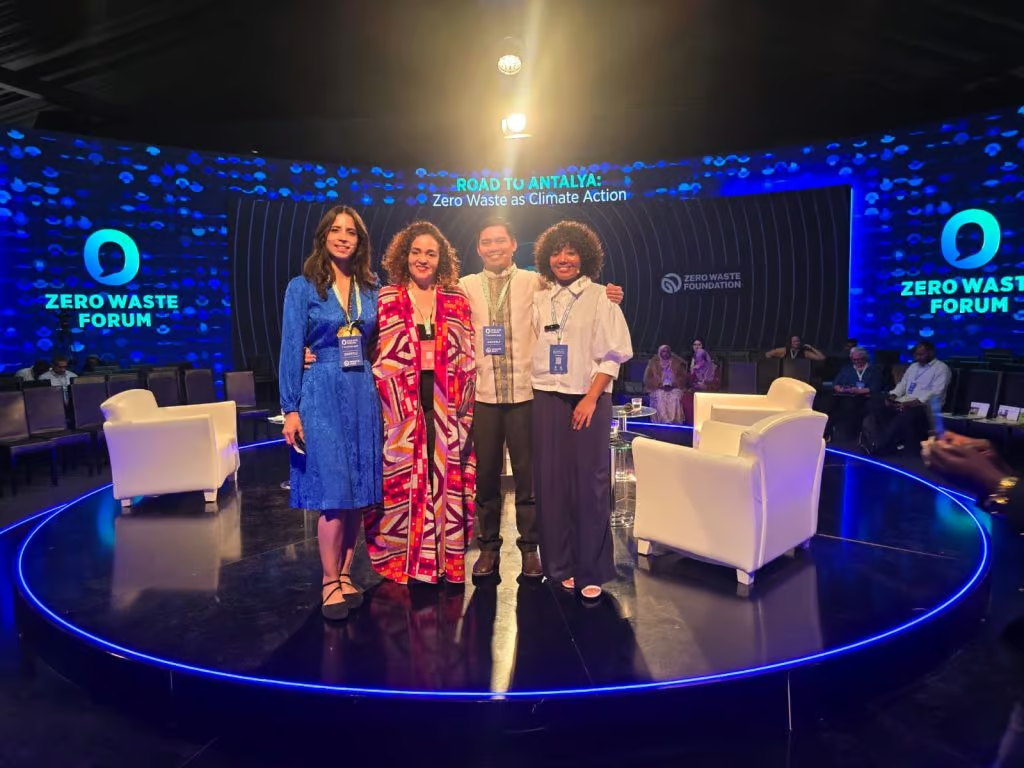
Melody Ifechi Enyinnayaat at the Zero Waste Forum in Türkiye

By Melody Ifechi Enyinnaya, Community Development Advocacy Foundation

Every evening in Nigeria’s cities, smoke rises from open dumpsites. It is easy to mistake it for burning waste, but it’s not. It is methane, one of the most potent greenhouse gases, silently escaping into our atmosphere at an alarming rate from mountains of rotting organic waste. 

Nigeria generates between 25 and 32 million tons of municipal solid waste every year. Less than a third gets collected. Almost none of it gets properly treated. The rest ends up in open dumps, where it rots, releasing gases that accelerate the very climate crisis our communities are already battling. I know this, not just from research. I know it from standing in those communities.

Between 5 and 7 June 2026, I was in Istanbul, Turkey, to attend the Zero Waste Forum, a global gathering of waste practitioners, scientists, policymakers, and community advocates. 

For well over three days and twenty-two sessions, I heard the same urgent message repeated from every corner of the world: the waste sector is one of the fastest, most cost-effective places to act on climate change. And the action needed is not complicated. It is mostly being blocked.

One session’s title stayed with me long after I left the room: “Organic Waste Is a Methane Story, Not a Waste Story”. The science is stark. When food scraps, market waste, and agricultural residues are dumped in landfills/dumpsites, rather than composted or reused, they decompose without oxygen and release methane gas. The fastest way to reduce these emissions is simply to stop putting organic waste in the ground. This is not a solution for tomorrow, but for now, because there indeed is a climate emergency.

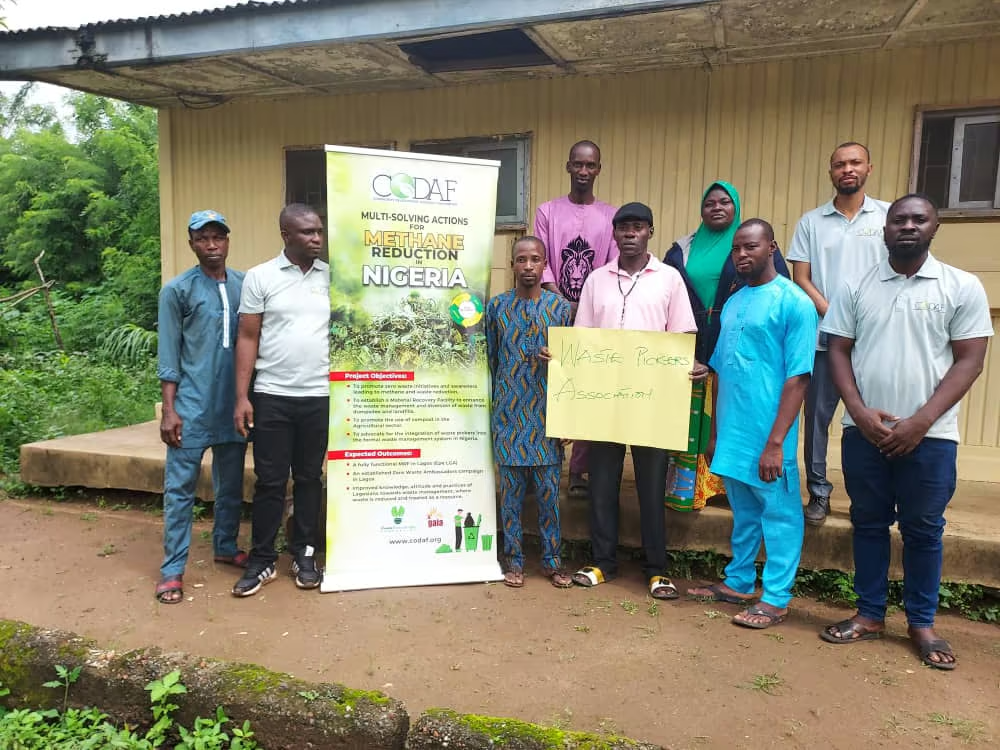
Back home in Nigeria, some communities in Lagos, Abuja, Benin City, and Jos are already doing exactly that. These communities in the different cities are not communities that appear on international climate agenda. They are agrarian communities where households generate organic waste daily, including food scraps, crop residue, and market leftovers, and where, until recently, this waste had one destination: the dumpsite.

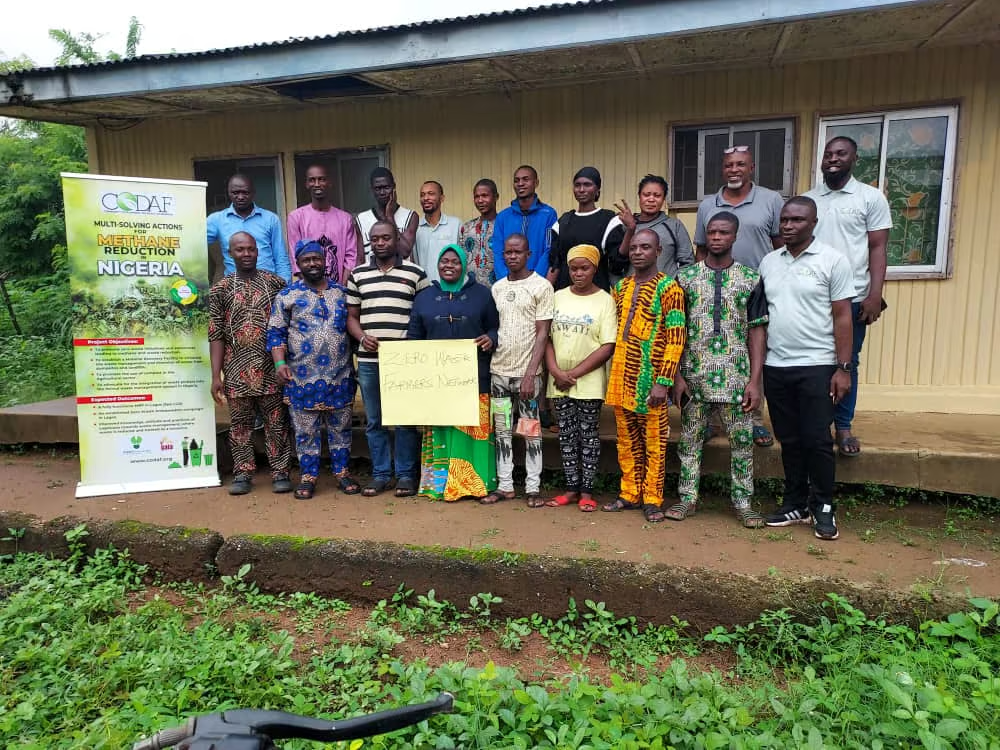
In 2024, members of the Global Alliance for Incinerator Alternatives (GAIA AFRICA) in Nigeria, CODAF, GKF, SEDi, PAVE, CfEW and SRADev launched the Multi-Solving Action for Methane Reduction in Nigeria (MAMRN) project in communities across Lagos, Abuja, Benin City and Jos. The name describes exactly what the project stands for; it solves multiple problems at once. Climate, Waste, Livelihoods, Food security, and Governance all through one system.

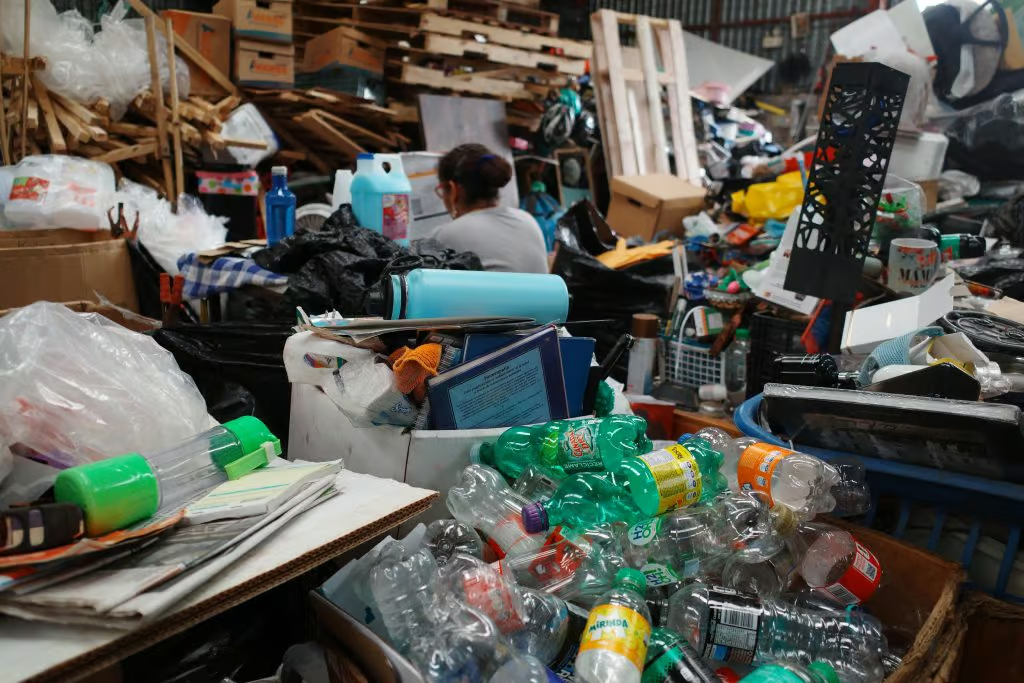
At the centre of that system are the Material Recovery Facilities (MRFs), purpose-built community hubs where household and market organic waste is collected, sorted, and transformed. Organic matter becomes compost and animal feed. Plastics are recovered for recycling. Nothing goes to the dumpsite. The methane that would have risen from those rotting heaps of waste simply never forms. But the facility is only part of the story.

In Istanbul, Elizabeth Nsimadala, President, Eastern Africa Farmers Federation (EAFF), made a statement that stopped me mid-note: “Zero waste is in the soil, not in the trash”.

In Nigeria, smallholder farmers are being trained through the MAMRN project to compost organic waste rather than burn or dump it. When a farmer composts crop residue instead of setting it alight, three things happen simultaneously: methane emissions fall, chemical fertiliser costs decrease, and soil health improves. These are not three separate wins. They are one decision, understood correctly. The farmers in the MAMRN project do not need to be convinced that their soil matters. They already know it. 

What the MAMRN project provides them is technical support, community infrastructure, and market connections that make composting economically rational, not just environmentally admirable. This is what the global conversation in Istanbul kept circling back to: the most effective zero waste solutions are not the ones imported from outside. They are the ones built around what communities already know, already need, and already have the capacity to do.

There is a community of people in every Nigerian city who have been practising resource recovery for decades without recognition, equipment, or protection. They are Waste Pickers. Every day, they move through markets and streets collecting plastics, metals, and organic matter that would otherwise end up in a dumpsite. 

By one estimate, informal waste workers divert millions of tonnes of recyclable material from landfills globally every year. They do it without government remuneration. Without a formal contract. Without data being kept on their contribution.

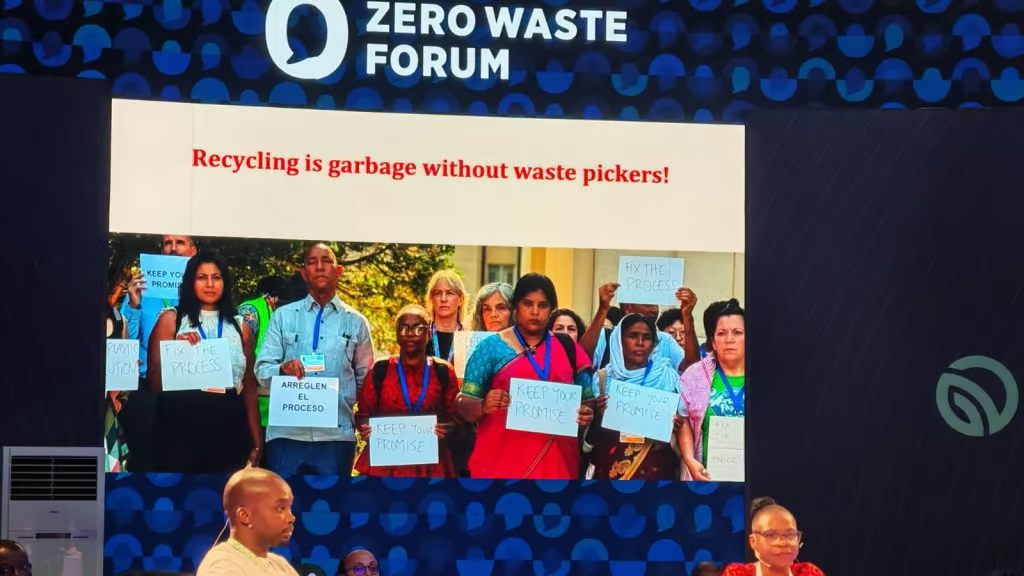
In Istanbul, a session on Global South zero waste leadership described waste pickers plainly: they are not a problem to be managed. They are climate actors. They deserve recognition, integration, and resources.

MAMRN project implementing organisations began to drive this work seriously prior to Istanbul.

At the launch of the Zero Waste Parliament in Lagos, a community governance body was created under the MAMRN project to give residents a formal voice in waste policy. The President of the Association of Scraps and Waste Pickers of Lagos was elected as its first Speaker. Not as a symbolic gesture. But as a statement of fact, the people who understand waste best must lead the institutions that govern it. 

The Parliament brings together waste pickers, farmers, women, youth, and community leaders to identify problems, propose solutions, and engage government institutions and policymakers on the policies that affect their communities. It is not waiting to be consulted. It is leading, and when the Parliament engages government agencies on waste policies, it is not asking for a favour. It is demanding accountability. This is what zero waste governance looks like when it is built from the ground up.

When people hear the phrase “zero waste”, they often imagine a distant, utopian future. A lifestyle trend for the privileged. A technical aspiration that requires perfect infrastructure and unlimited funding. The MAMRN project sites are evidence that it is none of those things.

Zero waste in those communities looks like a market woman bringing her food scraps to the MRF instead of throwing them into an open drain. It looks like a farmer spreading compost instead of buying chemical fertilizer that they cannot afford. It looks like a waste picker sitting in a Parliament chamber, putting a name and a face to the tonnes of material he recovers every week. It looks like a community that has decided its waste is a resource and built a system to prove it. None of this happened because the government mandated it. It happened because a community was organised, informed, and supported to act.

We will not pretend the system is complete or that the challenges are solved. Nigeria’s waste policies remain fragmented. Enforcement is weak. And the climate finance that could scale projects like MAMRN from one community to many more remains largely out of reach for frontline organisations.

In Istanbul, I sat in a session titled Governing Zero Waste: From Political Commitment to Climate Delivery”. The core message was uncomfortable: governments have made enough commitments. The problem is delivery. Civil society cannot afford to wait for political will; it must build it.

Nigeria has pledged methane reduction targets under the Global Methane Pledge. It has signed international climate agreements. But commitments made in conference rooms do not move waste off dumpsites. Community-built systems do. 

The MAMRN project is proof that those systems can exist. An MRF, A Zero Waste Farmers Network, A Zero Waste Parliament, Zero Waste Ambassadors moving through households, changing how families think about what they throw away. These are not pilot schemes waiting for government approval. They are working models waiting to be scaled.

Scaling them requires money, and the global system is failing communities here.

At the Forum, every conversation about finance ended the same way: the money exists, but it is not reaching the organisations doing the work. The Green Climate Fund, multilateral climate mechanisms, and circular economy investment are operational tools. 

But the frontline groups in Nigeria and across Africa that are building zero waste systems from scratch face structural barriers that keep that finance out of reach. National governments receive the funds. The funds do not reach communities. This has to change. Not some time in the future, but now. Because the climate window is closing, and the solutions are already here. 

The zero waste transition will not happen at scale until climate finance flows to the communities already doing the work, not just to the governments that promise to.

Nigeria does not need to wait for a perfect policy environment or unlimited resources to begin solving its waste crisis. It needs to scale what is already working. The MAMRN project is proof that community-based zero waste systems are not aspirational. 

They are operational, they reduce methane, they strengthen livelihoods, they build governance, they include the people most often left out of the climate conversation, including waste pickers, smallholder farmers, market women and put them at the centre of the solution.

What the global community did in Istanbul was name, with great precision and urgency, the future we need. What GAIA’s Nigeria members and the community we serve are doing is building it. The zero waste future is not waiting to be invented. In pockets of Lagos, Abuja, Jos, Benin-City and in communities across the Global South that the world rarely looks at, it is already alive. 

In Nigeria, the zero waste future is not coming. It is here and working.

That is the kind of future worth fighting for.

ENDS.

A hopeful narrative in need of consistent implementation

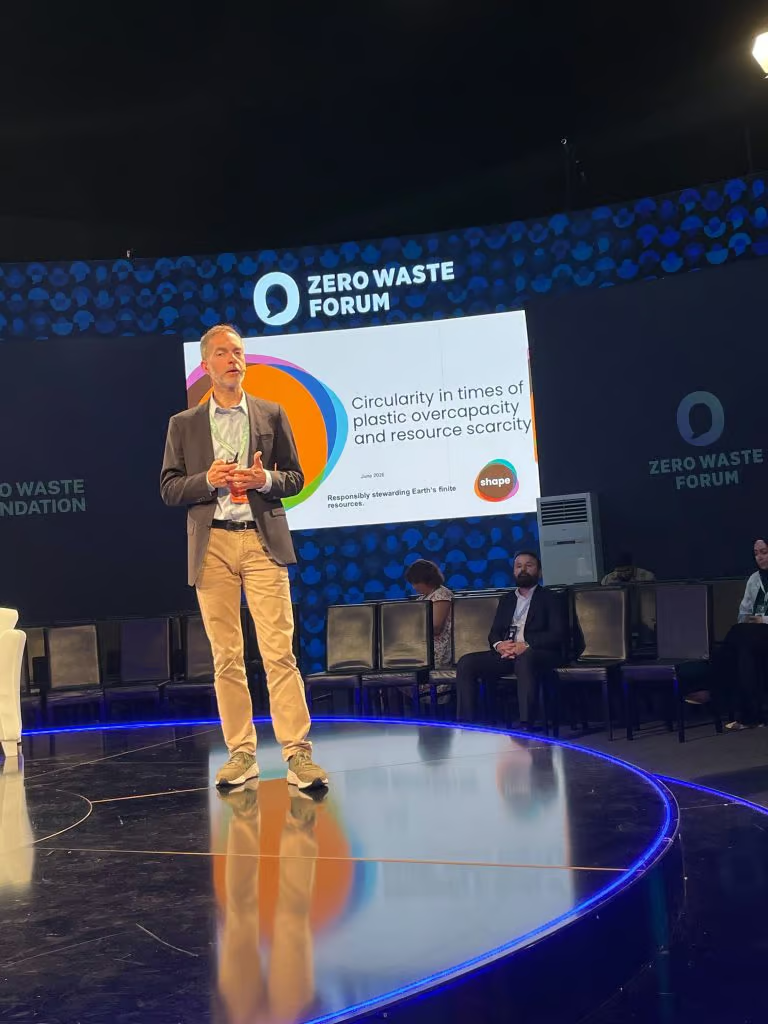
This past June 5–7, GAIA was present at the second Global Zero Waste Forum, organized by the Zero Waste Foundation in Istanbul, Türkiye, under the theme “Road to Antalya: Zero Waste as Climate Action.” The attendance was massive, with over 5,000 participants from 183 countries. Keynote presentations were delivered by Türkiye’s President Recep Erdoğan, First Lady Emine Erdoğan (Honorary President of the Zero Waste Foundation), and Samed Ağırbaş (President of the Foundation and Climate High-Level Champion for COP31).

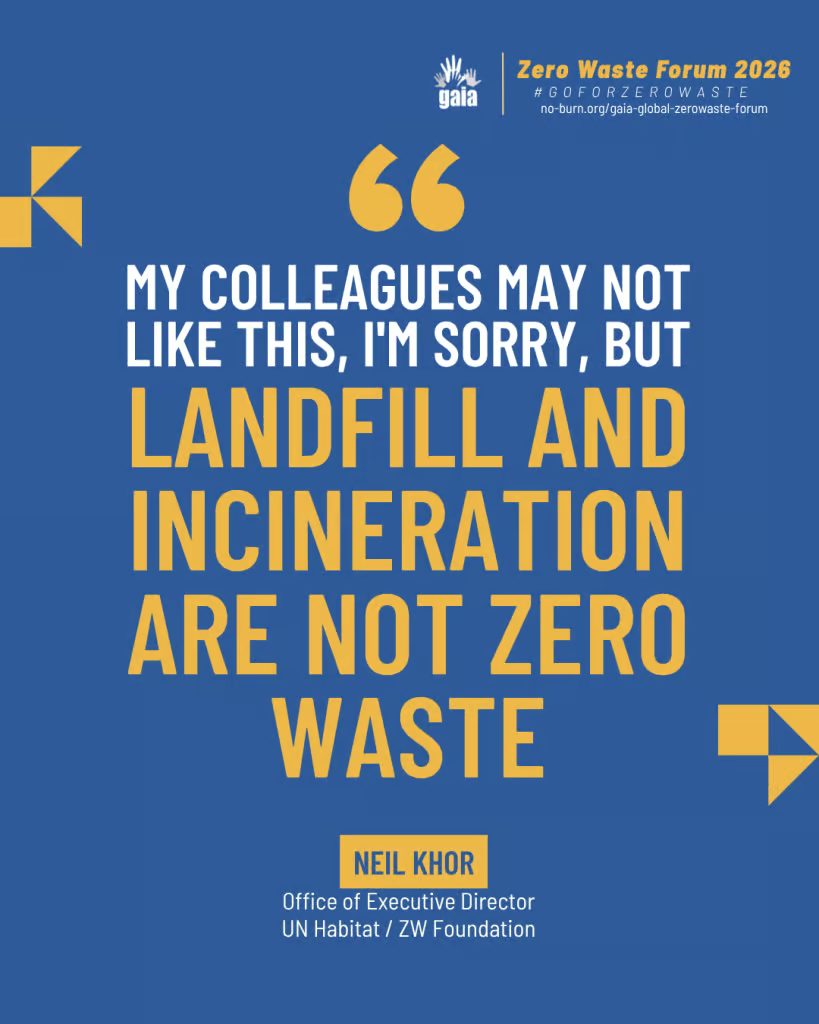
For those working to transition from linear waste management systems to zero waste, the Forum was a pleasant surprise. The program was well-designed and reflected the true spirit of zero waste by emphasizing upstream interventions and framing zero waste as a driver of systemic change. Discussions on reuse, repair, financing the transition to zero waste, and recognizing waste pickers were among the essential conversations needed to move away from wasteful societies. It was refreshing to attend a mainstream waste event where the focus was not on landfills, incinerators, or extravagant and expensive methods for processing single-use plastics that should not be produced in the first place. Neil Khor, Advisor to the President of the UN Habitat Assembly and to the Zero Waste Foundation, summed up the spirit of the Forum when he stated: “Landfill and incineration are not zero waste.”

It is also promising to see a UN member state advocating for zero waste and gaining traction among other governments and actors in the waste and climate sectors. Although there is still no universally accepted definition of zero waste, the approach presented at the Forum offers hope by clearly moving in the right direction. The zero waste movement’s task now is to advocate for this orientation to remain on track and avoid being co-opted by the waste management industry and others seeking to maintain the status quo of linear waste systems.

The strong connection between zero waste and climate was another major strength of the Forum. Following the COP31 Presidency’s push to place zero waste as a top priority in the Climate Action Agenda, the Forum made significant progress in demonstrating how zero waste is a cross-cutting strategy for climate change mitigation and adaptation. Several panels explored how action can be taken at different levels—from cities to international agencies.

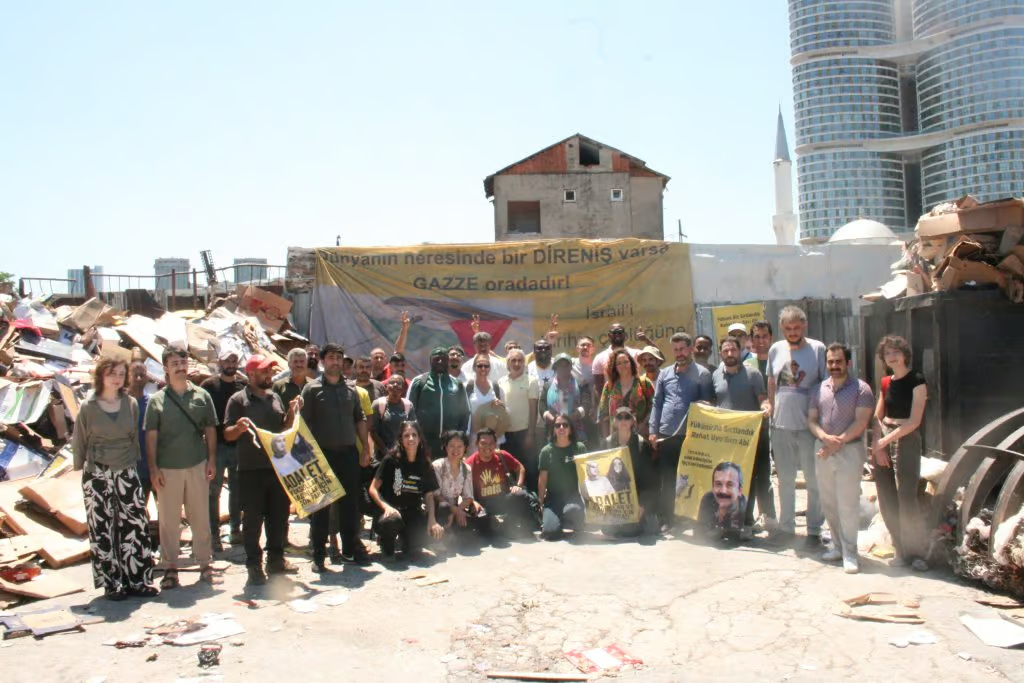
However, the lack of local civil society representatives among speakers and participants was obvious and regrettable. Many organizations and research groups are doing fantastic work on waste and climate change and should have been invited. Their participation would have enriched the panels with real-world experiences and knowledge, while also paving the way for zero waste implementation in Türkiye. After the Forum, many GAIA members and allies met with the İstanbul Geri Dönüşüm İşçileri Derneği (Istanbul’s Recycling Workers Association – ISGDIDER) at one of the materials recovery facilities they manage. We learned firsthand about the experience of those who sustain the country’s recycling system despite significant challenges and lack of recognition. These workers’ experience is central to advancing zero waste in Türkiye, and it would have been invaluable for Forum participants to learn about their work and hear their perspectives.

The Forum left many of us with a sense of hope, grounded in the right focus of the discussions: viewing zero waste as a way to drive systemic change and address climate change. Yet, important gaps remain: How does this translate into practice? How is Türkiye advancing zero waste implementation internally? As Lhermie Areja, a government official from Siquijor, Philippines, stated at the Forum: “Zero waste is not a dream. It is a decision.” And as noted in the declaration signed by over 120 civil society organizations, the zero waste agenda must reinforce, not replace, a binding global roadmap for fossil fuel phase-out.

The run-up to COP31 offers Türkiye an opportunity to build a zero waste legacy internally and demand greater consistency in taking action and creating pathways for implementing commitments. For instance, the target announced by the COP31 Presidency to “halve the growth in global waste by 2035” is directionally correct but lacks the clarity needed for policy credibility. If COP31 is serious about a zero waste agenda, success must be measured in concrete outcomes: absolute reductions in waste generation, measurable methane cuts from organic waste, reduced plastic production, a shift of climate finance toward zero waste implementation, and a just transition for waste pickers and waste workers.

Lanzamiento estudio de caso. ©RADA, Temuco.

La comuna impulsó una transformación de su sistema de gestión de residuos basada en compostaje, reciclaje, educación ambiental y participación ciudadana. Aplicando la estrategia “basura cero”, ha reducido la disposición final de residuos, pasando de 3.797 toneladas en 2021 a 1.318 toneladas en 2022, disminuyendo además en un 65% el gasto por la gestión de residuos enviados al relleno sanitario de Los Ángeles.

23 de junio, 2026

El nuevo estudio de caso “Melipeuco Cero Basura” elaborado por la Red de Acción por los Derechos Ambientales, documenta cómo esta comuna de La Araucanía logró avanzar hacia un modelo de gestión de residuos basado en la prevención, el reciclaje y el compostaje comunitario.

Antes de 2021, Melipeuco enfrentaba una serie de problemas asociados a la recolección y disposición de residuos. Cuando el único camión que había para la recolección domiciliaria fallaba, las bolsas de basura se acumulaban por días o semanas. Además, la comuna contaba con un vertedero municipal sin autorización sanitaria ubicado dentro de la comunidad mapuche Juan Meli, lo que llevó a que fuera uno de los casos denunciados por racismo ambiental ante el Comité para la Eliminación de la Discriminación Racial de la ONU el año 2007.

La situación cambió cuando el municipio impulsó una nueva estrategia, orientada a recuperar el control público de la gestión de residuos y avanzar hacia un modelo de basura cero. 

Entre las primeras medidas se incluyó la administración municipal directa de la recolección y transporte de residuos domiciliarios, lo que permitió reducir significativamente las cantidades enviadas a disposición final y disminuir los costos asociados para la comuna.

El mayor avance del programa se dio en el primer año, cuando la disposición final de residuos pasó de 3.797 toneladas en 2021 a 1.318 toneladas en 2022. El informe también muestra que el presupuesto destinado a esta gestión se redujo en un 65% entre 2021 a 2022, equivalente a un ahorro de más 90 millones de pesos chilenos (≈ USD 95.000) anuales por concepto de residuos enviados al vertedero de Los Ángeles. 

“Las cifras demuestran que con voluntad política y generando los espacios adecuados para la educación ambiental y la recolección diferenciada no se necesitan grandes periodos de tiempo para avanzar en la reducción de la basura. También se demuestra con esta experiencia que no se necesitan grandes inversiones y que la reducción de la disposición final se traduce inmediatamente en ahorro en ese mismo ítem, por lo que cualquier inversión inicial se compensa con ese ahorro y finalmente el gasto municipal se hace más eficiente. En vez de gastar dinero en trasladar y enterrar basura, se gasta en compostar, reciclar y educar a la ciudadanía”, señaló Alejandra Parra de la Red de Acción por los Derechos Ambientales. 

En mayo de 2025 el municipio firmó un decreto mediante el cual se aprobó el programa “Melipeuco cero basura” destinado a promover la reducción de la generación de residuos sólidos en la comuna, fomentar el uso de envases retornables, reforzar y ampliar la separación en origen mediante un sistema de recolección selectiva e involucrar a la comunidad en programas de reciclaje y compostaje comunitario, entre otras medidas.

Actualmente, Melipeuco cuenta con un centro de acopio que funciona como punto limpio comunal, una red de 30  puntos verdes urbanos y un punto limpio móvil para las zonas rurales. Para la recolección de residuos orgánicos, se cuenta además con un carro eléctrico que realiza recorridos casa por casa dos veces por semana. 

La estrategia ha involucrado a múltiples áreas municipales, incluyendo Medio Ambiente y Cambio Climático, Educación, Finanzas, Comunicaciones y SECPLAN. Además, se ha impartido educación ambiental en establecimientos educacionales y programas comunitarios.

Según el estudio, los habitantes participantes han observado una disminución significativa de los residuos que generan en sus hogares, valorando positivamente los cambios implementados por el municipio.

Finalmente, Enrique Pizarro de la RADA señaló que “con este estudio de caso queremos mostrar que implementar estrategias que apunten a Basura Cero no solo es posible en contextos de países desarrollados o comunas con mucho dinero, es posible en cualquier contexto siempre y cuando exista la voluntad y convicción”.

Sobre el estudio

El estudio de caso fue elaborado por la Red de Acción por los Derechos Ambientales (RADA), organización social que desde el 2006 promueve y defiende el medio ambiente como un derecho humano fundamental. Su trabajo se desarrolla principalmente en la región de La Araucanía.

Se insta a Turquía a adoptar políticas de «basura cero» más ambiciosas en materia climática

Se publica una declaración mientras los líderes mundiales se reúnen en la sesión entre períodos de la COP en Bonn

PARA SU PUBLICACIÓN INMEDIATA: 17 de junio de 2026

Estambul, Turquía– Mientras los líderes mundiales se reúnen en Bonn, Alemania, para sentar las bases de las negociaciones de la COP31, la Alianza Global por Alternativas a las Incineradoras (GAIA) ha publicado una declaración pública en colaboración con Greenpeace Turquía, el Fondo Mundial para la Naturaleza (WWF) Turquía, el Grupo de Investigación sobre Microplásticos y la Plataforma Turquía Libre de Plástico, y firmada por 124 organizaciones de casi 60 países que representan a profesionales del movimiento «basura cero», expertos en políticas y grupos comunitarios.

La declaración destaca la brecha entre la promoción que hace Turquía del modelo «basura cero» en el escenario internacional y las políticas nacionales que siguen respaldando prácticas incompatibles con una acción climática ambiciosa, la justicia ambiental y la salud pública.Los firmantes instan a Turquía, como anfitriona de la COP31, a establecer un nivel alto de ambición climática mediante el impulso de una agenda integral de «basura cero» que aborde las causas fundamentales de los residuos y las emisiones.

En una conferencia de prensa el pasado martes 9 de junio, antes de la reunión entre sesiones de Bonn, el presidente designado de la COP31, Murat Kurum, anunció el objetivo de reducir a la mitad los residuos globales para 2035. Si bien este objetivo es visionario, a los defensores del «basura cero» les sigue sin quedar claro cuál es la línea de base, el alcance y la implementación de dicho objetivo, y si incluirá la reducción de la producción de plástico y una transición justa para los recolectores de residuos y los trabajadores, así como otras estrategias clave.

Sedat Gündoğdu, del Grupo de Investigación sobre Microplásticos, afirma:

“Es positivo que Turquía haya priorizado el ‘basura cero’ en la agenda de la COP31; sin embargo, parece que la actual gestión de los residuos plásticos podría no ser del todo coherente con este ambicioso objetivo político. Específicamente, las nuevas inversiones en plantas petroquímicas, el comercio de residuos que sigue vigente y la exclusión de los recolectores de residuos del sistema parecen estar en contradicción con este objetivo. Para que la agenda de la COP31 se implemente con éxito, es necesaria una estrategia de eliminación gradual del plástico. El concepto de basura cero debe perseguirse genuinamente, no solo presentarse como una fachada».

Mariel Vilella, directora del Programa Global de Clima de GAIA, afirma:

«El basura cero es una de las soluciones climáticas más rápidas y efectivas disponibles hoy en día, pero debe ir más allá de la gestión de residuos. Una agenda creíble de basura cero implica reducir la producción de plástico en su origen, disminuir las emisiones de metano mediante el desvío de los residuos orgánicos y poner fin a la dependencia de tecnologías contaminantes como la incineración de residuos para generar energía y la pirólisis. Como anfitrión de la COP31, Turquía tiene la oportunidad de demostrar que el liderazgo climático significa abordar conjuntamente las crisis de los combustibles fósiles y los residuos, al tiempo que se garantiza una transición justa que proteja a los recolectores de residuos, a los trabajadores y a las comunidades más afectadas».

Tras la política «Espada Nacional» de China, que restringió la mayoría de las importaciones de residuos plásticos al país, Turquía se convirtió en uno de los principales destinos mundiales para los residuos plásticos importados. La declaración insta a Turquía a abordar su papel en el comercio mundial de residuos, poner fin al colonialismo de los residuos y priorizar la justicia ambiental para las comunidades afectadas de manera desproporcionada por la contaminación por residuos.

Berk Butan, activista de Greenpeace Turquía, afirma:

«El verdadero liderazgo climático en la COP31 comienza por reconocer que el 99 por ciento de los plásticos se fabrican a partir de combustibles fósiles. Una verdadera estrategia de basura cero requiere cerrar el grifo de la producción de plástico y poner fin a la injusticia del colonialismo de los residuos que convierte a Turquía en el vertedero de plástico de Europa».

La Declaración exige:

  • Estrategias de basura cero vinculadas a la eliminación gradual de los combustibles fósiles y a la reducción de la producción de plástico
  • Compromisos más sólidos de reducción de metano y medidas de rendición de cuentas, particularmente a través del desvío de residuos orgánicos y la prevención de la emisión de metano en los vertederos
  • El rechazo a las falsas soluciones, como la incineración para generar energía, la pirólisis y otras tecnologías intensivas en carbono
  • El fin del colonialismo de los residuos y un compromiso con la justicia ambiental para las comunidades afectadas
  • Una transición justa que reconozca, proteja e incluya a los recolectores y trabajadores de residuos en las políticas, el financiamiento y la implementación

Nota para el editor:

La Declaración Conjunta: Alineando el «basura cero» con una Acción Climática de Alto Nivel de Ambición para la COP31 se puede consultar en: https://www.no-burn.org/joint-declaration-zero-waste-climate-action-cop31/

Contacto de prensa:

Claire Arkin, Global Communications Lead

claire@no-burn.org | +1 510-604-7833

###

Turkiye Urged to Adopt More Climate-Ambitious Zero Waste Policies

Declaration Released As World Leaders Meet at Bonn Intersessional 

FOR IMMEDIATE RELEASE: June 17, 2026

Bonn, Germany– As world leaders gather in Bonn, Germany to lay the groundwork for negotiations at COP31, Global Alliance for Incinerator Alternatives (GAIA) has released a public declaration in collaboration with Greenpeace Türkiye, World Wildlife Fund Türkiye, the Microplastic Research Group, and the Plastic Free Türkiye Platform, and  signed on by 124 organizations in almost 60 countries representing zero waste practitioners, policy experts, and community groups. 

The declaration highlights the gap between Türkiye’s promotion of zero waste on the international stage and domestic policies that continue to support practices inconsistent with ambitious climate action, environmental justice, and public health.The signatories urge Türkiye, as host of COP31, to set a high bar for climate ambition by advancing a comprehensive zero waste agenda that addresses the root causes of waste and emissions.

At a press conference last Tuesday, June 9 ahead of the Bonn intersessional, COP31 President-Designate Murat Kurum announced a goal of halving global waste by 2035. While this target is visionary, zero waste advocates remain unclear on the baseline, scope, and implementation of such a goal, and whether it will include reducing plastic production and providing a just transition for waste pickers and workers, as well as other key strategies.

Sedat Gündoğdu of the Microplastic Research Group states:  

“It is good that Turkey has prioritized zero waste on the COP31 agenda; however, it appears that the current plastic waste governance may not be entirely consistent with this ambitious political objective. Specifically, new investments in petrochemical plants, the ongoing waste trade, and the exclusion of waste pickers from the system seem to be at odds with this goal. For the COP31 agenda to be successfully implemented, a phasing out strategy from plastic is necessary. The concept of zero waste should be genuinely pursued, not merely presented as a facade.”

Mariel Vilella, Global Climate Program Director at GAIA, states:

“Zero waste is one of the fastest and most effective climate solutions available today, but it must go beyond waste management. A credible zero waste agenda means reducing plastic production at its source, cutting methane emissions through organics diversion, and ending reliance on polluting technologies such as waste-to-energy incineration and pyrolysis. As COP31 host, Türkiye has an opportunity to show that climate leadership means tackling the fossil fuel and waste crises together while ensuring a just transition that protects waste pickers, workers, and frontline communities.”

Following China’s National Sword policy, which restricted most plastic waste imports into the country, Türkiye emerged as one of the world’s leading destinations for imported plastic waste.  The declaration calls on Türkiye to address its role in the global waste trade, end waste colonialism, and prioritize environmental justice for communities disproportionately affected by waste pollution. 

Berk Butan, Campaigner at Greenpeace Türkiye, states:

 “Real climate leadership at COP31 begins with acknowledging that 99 percent of plastics are made from fossil fuels. A true zero waste strategy requires turning off the tap on plastic production and ending the injustice of waste colonialism that turns Türkiye into Europe’s plastic dumping ground.”

The Declaration calls for: 

  • Zero waste strategies that are linked to fossil fuel phase-out and reduced plastic production
  • Stronger methane reduction commitments and accountability measures, particularly through organics diversion and landfill methane prevention
  • Rejection of false solutions such as waste-to-energy incineration, pyrolysis, and other carbon-intensive technologies
  • An end to waste colonialism and a commitment to environmental justice for affected communities
  • A just transition that recognizes, protects, and includes waste pickers and waste workers in policy, financing, and implementation

Note to the Editor:

The Joint Declaration: Aligning Zero Waste with High-Ambitious Climate Action for COP31 can be found at: https://www.no-burn.org/joint-declaration-zero-waste-climate-action-cop31/

Press contact:

Claire Arkin, Global Communications Lead

claire@no-burn.org | +1 510-604-7833

###

GAIA is a worldwide alliance of more than 1,000 grassroots groups, non-governmental organizations, and individuals in over 100 countries. With our work, we aim to catalyze a global shift towards environmental justice by strengthening grassroots social movements that advance solutions to waste and pollution. We envision a just, zero waste world built on respect for ecological limits and community rights, where people are free from the burden of toxic pollution, and resources are sustainably conserved, not burned or dumped. 

ENGLISH

As Türkiye prepares to host COP31, we, the undersigned civil society organizations, acknowledge the Turkish Presidency’s decision to elevate Zero Waste and waste-derived methane reduction as top priorities within the Action Agenda. We affirm that zero waste is an indispensable strategy for climate mitigation, adaptation, and co-benefits, given that approximately 70% of global greenhouse gas emissions are linked to the materials economy—the extraction, production, and disposal of “stuff.” However, we stress that this focus must reinforce, not replace, a binding global roadmap for fossil fuel phase-out. 

1. Zero Waste as a Fossil Fuel Phase-Out Strategy 

Zero Waste is one of the central actions for climate mitigation. It is a vision and roadmap for designing waste out of the system through strategies that change how we produce and consume goods and process discarded materials. This approach meets environmental justice and eventually ends the disposal of waste in landfills and incinerators, while keeping the materials economy within planetary boundaries. The production and disposal of materials—plastics, cement, steel, paper, and others—generate roughly 29% of all global greenhouse gas emissions, and 99% of plastics are made from fossil fuels. Therefore, zero waste and plastic reduction policies are, by definition, fossil fuel phase-out strategies. A high-ambition COP31 agenda must include binding targets to cap and reduce plastic production, aligned with the UN Global Plastic Treaty, to ensure that the “Zero Waste” narrative does not become a cover for continued petrochemical expansion. 

2. Closing the Methane Accountability Gap and Advancing ROW Commitments 

While we welcome Türkiye’s focus on waste-related methane, we note the contradiction in prioritizing this sector while the country remains one of the few major economies that has not signed the Global Methane Pledge—an important accountability gap. To lead a 

credible COP31 presidency, Türkiye must commit to the pledge and translate this commitment into concrete, high-impact actions. Its signature of the COP29 ROW Declaration on Reducing Methane from Organic Waste demonstrates initial commitment, but ambitious implementation is needed. 

In addition to acknowledging the ROW Declaration, Türkiye should:

● Set quantified methane reduction targets for the waste sector with clear interim milestones. 

● Integrate these targets into its NDC. 

● Legislate mandatory source separation and phase out landfilling of untreated organic waste. 

● Establish dedicated financing and MRV frameworks to support implementation and ensure accountability. 

● Ensure the social dimension of waste management is honored, including formal recognition, protections, and inclusion of waste pickers in policy design and delivery, with access to training, safety, and financial support. 

● Explicitly avoid high-carbon “false solutions” such as open burning or waste-to-energy incineration. 

3. Avoiding Counterproductive or Carbon-Intensive Pathways 

These measures can reduce waste-sector methane by up to 95%, far more effective than technological fixes, and ensure that Türkiye’s leadership at COP31 is credible, ambitious, and socially inclusive. 

We caution against policy approaches that favor high-carbon waste treatment technologies under the guise of climate solutions. Rebranding incineration (“waste-to-energy”), pyrolysis, or chemical recycling as mitigation strategies risks locking in emissions-intensive infrastructure, creating long-term dependence on fossil-fuel-derived energy, and diverting investment away from upstream solutions. Incineration is extremely expensive and represents an unsustainable use of both public and climate finance. It also generates toxic air pollutants, including dioxins, furans, and particulate matter, that disproportionately harm frontline and vulnerable communities, undermines local recycling and informal waste recovery economies, and produces hazardous residual ash. COP31 should instead prioritize upstream measures such as waste prevention, organic waste diversion, and inclusive management practices, which reduce emissions at the source while delivering social, economic, and environmental co-benefits. 

4. Ending Waste Colonialism 

Türkiye is uniquely positioned to lead globally in zero-waste solutions by ending its role as a top destination for plastic waste exports from the EU and UK. Imported plastic waste is not only largely unrecyclable – often up to 50% – but also represents an endless source of plastic pollution. When illegally burned, it produces black carbon, a super pollutant that accelerates global warming, along with other toxic emissions that disproportionately harm vulnerable communities. By implementing a comprehensive

ban on plastic waste imports, Türkiye can prioritize domestic reduction, strengthen national recycling systems, protect public health, and demonstrate leadership in environmental justice and climate action. 

5. Centering a Just Transition for Waste Pickers and Other Waste Workers 

COP30 delivered a breakthrough with the creation of a rights-based Just Transition Mechanism, a long-sought win for informal economy workers, communities, and movements across the Global South. Yet governments left unanswered the core question: who will pay for the transition. Without new, grant-based public finance and structural reform of the global financial system, the mechanism risks becoming another promise without the resources to deliver justice. Türkiye’s championing of zero waste should take the baton on this agenda and go further, advancing a transformation of the waste sector in line with UNFCCC and environmental justice principles. A genuine zero-waste approach means that waste pickers and other waste workers must be prioritized, formally recognized, and protected, as they are central actors in the country’s waste management system. This includes ensuring social security, occupational safety, fair employment and living income opportunities, and meaningful participation in decision-making for the new materials economy. 

Conclusion 

We call on the COP31 Presidency and Champion to present a unified climate roadmap that combines a robust fossil fuel phase-out with justice-centered zero-waste implementation. All Parties must ensure that the “Zero Waste” label does not mask low-ambition climate targets. Success at COP31 will depend on moving beyond showcase policies toward systemic shifts that protect both the planet and its people. 


Türkçe

Ortak Bildiri: Sıfır Atık Hedefi COP31’in İklim Eyleminde Yüksek Hedeflerle Uyumlu Olmalıdır

Türkiye, COP31’e ev sahipliği yapmaya hazırlanırken, aşağıda imzası bulunan sivil toplum kuruluşları olarak, Türkiye Başkanlığı’nın sıfır atık hedefini ve atıklardan kaynaklanan metan emisyonlarının azaltılmasını Eylem Gündemi’nin en önemli öncelikleri arasında konumlandırma kararını memnuniyetle karşılıyoruz. Küresel sera gazı emisyonlarının yaklaşık %70’inin kaynak çıkarımı, üretim ve bertaraf süreçlerini kapsayan malzeme ekonomisiyle bağlantılı olduğu göz önüne alındığında, sıfır atık yaklaşımının iklim değişikliğinin etkilerinin azaltılması, iklim değişikliğine uyum ve ortak faydalar için vazgeçilmez bir strateji olduğunu düşünüyoruz. Ancak, bu yaklaşımın fosil yakıtlardan aşamalı çıkışa  yönelik bağlayıcı bir küresel yol haritasının yerine geçmemesi, aksine bu yol haritasını  güçlendirmesi gerektiğini vurguluyoruz.

1. Sıfır Atık, Fosil Yakıtlardan Çıkışın Temel Stratejilerinden Biri Olmalıdır 

Sıfır atık, iklim değişikliğinin etkilerini azaltmaya yönelik en temel yaklaşımlardan biridir. Üretim ve tüketim biçimlerimizi dönüştüren, atık haline gelen materyallerin nasıl yönetildiğini yeniden tanımlayan stratejiler aracılığıyla, atığın sistemin dışına çıkarılmasını hedefleyen bir vizyon ve yol haritası sunar. Bu yaklaşım, çevresel adaleti gözetirken aynı zamanda atıkların depolama sahalarında ve yakma tesislerinde bertaraf edilmesine son verilmesini ve kaynak kullanımının gezegenin sınırları içinde tutulmasını amaçlar. Plastik, çimento, çelik, kağıt ve diğer malzemelerin üretimi ve bertarafı, küresel sera gazı emisyonlarının yaklaşık %29’unu oluşturmaktadır. Ayrıca plastiklerin %99’u fosil kaynaklardan üretilmektedir. Bu nedenle, sıfır atık ve plastik azaltım  politikaları, doğrudan fosil yakıtlardan aşamalı çıkış stratejilerinin bir parçasıdır.  “Sıfır atık” söyleminin petrokimya sektöründeki büyümeyi meşrulaştıran bir araca dönüşmemesi için, yüksek hedefli bir COP31 gündemi, BM Küresel Plastik Anlaşması ile uyumlu şekilde  plastik üretimini sınarlandıran ve azaltan  bağlayıcı hedefler içermelidir.

2. Metan Emisyonlarında Hesap Verebilirlik Güçlendirilmeli ve Organik Atıklardan Kaynaklanan Metanın Azaltımına Yönelik Taahhütler Hayata Geçirilmelidir 

Türkiye’nin atık kaynaklı metanları azaltmaya odaklanması memnuniyetle karşılıyoruz. Ankcak ülkenin hâlâ Küresel Metan Taahhüdünü imzalamamış birkaç büyük ekonomiden biri olması önemli bir çelişki ve hesap verebilirlik eksikliği yaratmaktadır. Türkiye’nin COP31 Başkanlığı’nı güvenilir ve güçlü bir şekilde yürütebilmesi için, Küresel Metan Taahhüdü’ne taraf olması ve bu taahhüdü somut, yüksek etkili politikalara dönüştürmesi gerekmektedir. Türkiye’nin COP29 kapsamında kabul edilen Organik Atıklardan Kaynaklanan Metanın Azaltılmasına İlişkin ROW Deklarasyonu’na imza atmış olması önemli bir başlangıç niteliği taşımaktadır. Ancak bu taahhüdün etkili olabilmesi için iddialı ve kapsamlı bir uygulama süreci gereklidir. 

Türkiye, ROW Deklarasyonu’nu kabul etmiş olmanın yanı sıra:

  • Atık sektörü için net ara hedefler içeren nicel metan azaltım hedefleri belirlemelidir.
  • Bu hedefleri Ulusal Katkı Beyanı’na (NDC) entegre etmelidir.
  • Kaynağında ayrıştırmayı zorunlu hale getirmeli ve işlenmemiş organik atıkların depolama alanlarına gönderilmesini aşamalı olarak sona erdirmelidir 
  • Uygulamayı desteklemek ve hesap verebilirliği sağlamak amacıyla özel finansman mekanizmaları ile Ölçme, Raporlama ve Doğrulama (MRV) sistemleri oluşturmalı, 
  • Atık yönetiminin sosyal boyutunu gözeterek; atık toplayıcıların resmi olarak tanınmasını, korunmasını ve politika geliştirme ile uygulama süreçlerine dahil edilmesini sağlamalı; eğitim, güvenlik ve finansal destek imkanlarına erişimlerini güvence altına almalı, 
  • Atık yakma veya atıktan enerji elde etme gibi yüksek karbon salımına yol açan “yanlış çözümlerden” açıkça kaçınmalı, buralara verilen teşvikleri sonlandırmalıdır.

Bu önlemler, atık sektöründen kaynaklanan metan emisyonlarını %95’e kadar azaltma potansiyeline sahip ve teknoloji yoğun çözümlerden çok daha etkilidir. Ayrıca teknoloji odaklı sınırlı çözümlere kıyasla çok daha etkili sonuçlar sağlayarak Türkiye’nin COP31 kapsamındaki liderliğinin güvenilir, iddialı ve sosyal açıdan kapsayıcı olmasına katkı sunacaktır. 

3. Karbon Yoğun Yanlış Çözüm Yaratan Atık Yönetimi Yöntemlerinden Kaçınılmalıdır

İklim çözümü adı altında yüksek karbon salımına yol açan atık işleme teknolojilerini teşvik eden politika yaklaşımlarına karşı dikkatli olunmalıdır.  Yakma tesislerinin (“atıktan enerji üretimi”), piroliz ve kimyasal geri dönüşüm uygulamalarının iklim değişikliğiyle mücadele aracı olarak sunulması; emisyon yoğun altyapıların uzun yıllar boyunca kalıcı hale gelmesine, fosil yakıt temelli enerji sistemlerine bağımlılığın sürmesine ve yatırımların kaynağında önleme çözümlerinden uzaklaşmasına neden olmaktadır. Atık yakma tesisleri son derece maliyetli olup hem kamu kaynaklarının hem de iklim finansmanının sürdürülemez biçimde kullanılmasına yol açmaktadır. Ayrıca dioksinler, furanlar ve partikül maddeler gibi toksik hava kirleticileri üreterek özellikle kırılgan topluluklar ile tesislerin etki alanında yaşayan kesimler üzerinde orantısız sağlık ve çevre yükleri yaratmaktadır. Bunun yanında yerel atık geri kazanım ekonomilerini baltalar ve bertarafı mümkün olmayan tehlikeli atık kül üretir. Dolayısıyla COP31 kapsamında öncelik verilmesi gereken yaklaşım; atık oluşumunun önlenmesi, organik atıkların düzenli depolama yerine kompost ve benzeri yöntemlerle değerlendirilmesi ve kapsayıcı atık yönetimi uygulamalarının yaygınlaştırılmasıdır. Bu tür politikalar emisyonları kaynağında azaltırken aynı zamanda sosyal, ekonomik ve çevresel faydalar da sağlamaktadır. 

4. AB’nin Atık Sığınağı Olmaya Neden Olan Politikalara ve Atık Sömürgeciliğine Son Verilmelidir

Türkiye, Avrupa Birliği ve Birleşik Krallık’tan gelen plastik atık ihracatının başlıca varış noktalarından biri olma rolünü sona erdirerek sıfır atık politikalarında küresel ölçekte öncü bir konuma gelebilir  Sıfır atık ancak sıfır atık ithalatıyla mümkün olur. Türkiye’ye ithal edilen plastik atıkların önemli bir bölümü düşük kaliteli ve geri dönüştürülemez niteliktedir; bazı durumlarda bu oran %50’ye kadar ulaşabilmektedir. Bu atıklar yalnızca sürekli büyüyen bir plastik ve mikroplastik kirliliği kaynağı yaratmakla kalmamakta, aynı zamanda açıkta ya da yasa dışı biçimde yakıldıklarında ciddi çevresel ve sağlık risklerine yol açmaktadır. Bu süreçlerde, küresel ısınmayı hızlandıran güçlü bir kirletici olan siyah karbonun yanı sıra, özellikle kırılgan toplulukları orantısız biçimde etkileyen toksik emisyonlar ortaya çıkmaktadır.  Türkiye plastik atık ithalatına kapsamlı bir yasak getirerek, yurt içindeki atık azaltım politikalarını güçlendirebilir, ulusal geri dönüşüm sistemlerini güçlendirebilir, halk sağlığını koruyabilir ve çevresel adalet ve iklim eylemi konusunda güçlü bir liderlik gösterebilir.

5. Atık İşçileri için Adil Geçişi Merkeze Almalıdır

COP30 kapsamında hak temelli bir Adil Geçiş Mekanizması’nın oluşturulması önemli bir dönüm noktası olmuştur.  Bu, Küresel Güney ülkelerindeki işçiler, topluluklar ve hareketler için uzun zamandır talep edilen önemli bir kazanımı temsil etmektedir. Ancak hükümetler, geçiş sürecinin finansmanının nasıl sağlanacağına ilişkin temel soruyu cevapsız bıraktı. Yeni ve hibe temelli kamu finansmanı sağlanmadan ve küresel finans sisteminde yapısal reformlar gerçekleştirilmeden, bu mekanizmanın gerekli kaynaklardan yoksun bir taahhüt olarak kalma riski bulunmaktadır. Türkiye, sıfır atık alanındaki öncü rolünü yalnızca atık azaltım politikalarıyla sınırlamamalı; aynı zamanda BM İklim Değişikliği Çerçeve Sözleşmesi (BMİDÇS) ve çevresel adalet ilkeleri doğrultusunda atık sektöründe adil bir dönüşümün ilerletilmesine de öncülük etmelidir.  Gerçek bir sıfır atık yaklaşımı, atık toplayıcılarının ülkenin atık yönetim sisteminde merkezi aktör haline getirilmesi ile mümkündür. Dolayısıyla sıfır atıkta öncü olmak ancak ve ancak atık toplayıcıların önceliklendirilmesi, resmi olarak tanınması ve korunması ile mümkündür. Bu aynı zamanda sosyal güvenlik, iş güvenliği, adil istihdam fırsatları, asgari yaşam ücreti ve yeni malzeme ekonomisi için karar alma süreçlerine anlamlı katılımın sağlanmasını da içerir.

Sonuç

COP31 Başkanlığı’nı ve İklim Şampiyonluğu mekanizmasını, fosil yakıtlardan aşamalı çıkışı adalet temelli sıfır atık politikalarıyla birleştiren bütüncül bir iklim yol haritası ortaya koymaya çağırıyoruz. Tüm taraflar, “Sıfır Atık” etiketinin yüksek hedefli iklim hedeflerini maskelemesinin önüne geçmelidir. COP31’in başarısı, vitrin niteliğindeki politikaların ötesine geçilerek; hem insanları hem de gezegeni koruyan yapısal dönüşümlerin hayata geçirilmesine bağlı olacaktır. 


ESPAÑOL

Declaración conjunta: Alinear la meta de «Basura Cero» con una acción climática ambiciosa rumbo a la COP 31

Mientras Turquía se prepara para acoger la COP 31, nosotros, las organizaciones de la sociedad civil abajo firmantes, reconocemos la decisión de la Presidencia turca de elevar el objetivo «Basura Cero» y la reducción del metano derivado de los residuos a la categoría de prioridades principales dentro de la Agenda de Acción. Afirmamos que «Basura Cero» es una estrategia indispensable para la mitigación y la adaptación climáticas, así como para obtener beneficios colaterales, dado que aproximadamente el 70 % de las emisiones globales de gases de efecto invernadero están vinculadas a la economía de los materiales: la extracción, la producción y la eliminación de «cosas». Sin embargo, hacemos hincapié en que este enfoque debe reforzar, y no sustituir, una hoja de ruta global vinculante para la eliminación gradual de los combustibles fósiles.

1. Basura Cero como estrategia para la eliminación gradual de los combustibles fósiles

Basura Cero es una de las acciones centrales para la mitigación climática. Es una visión y una hoja de ruta para eliminar los residuos del sistema mediante estrategias que cambian la forma en que producimos y consumimos bienes y procesamos los materiales desechados. Este enfoque cumple con la justicia ambiental y, a la larga, pone fin a la eliminación de residuos en vertederos e incineradoras, al tiempo que mantiene la economía de los materiales dentro de los límites planetarios. La producción y eliminación de materiales —plásticos, cemento, acero, papel y otros— generan aproximadamente el 29 % de todas las emisiones globales de gases de efecto invernadero, y el 99 % de los plásticos se fabrican a partir de combustibles fósiles. Por lo tanto, las políticas de basura cero y reducción de plásticos son, por definición, estrategias de eliminación gradual de los combustibles fósiles. Una agenda ambiciosa para la COP 31 debe incluir objetivos vinculantes para limitar y reducir la producción de plástico, en consonancia con el Tratado Global de las Naciones Unidas sobre el Plástico, a fin de garantizar que la narrativa de «basura cero» no se convierta en una excusa para la expansión petroquímica continua.

2. Cerrar la brecha de rendición de cuentas sobre el metano y avanzar en los compromisos del ROW

Si bien celebramos el enfoque de Turquía en el metano relacionado con los residuos, observamos la contradicción de priorizar este sector mientras el país sigue siendo una de las pocas economías importantes que no ha firmado el Compromiso Global sobre el Metano —una importante brecha de rendición de cuentas—. Para liderar una presidencia creíble de la COP 31, Turquía debe comprometerse con el Pacto y traducir este compromiso en acciones concretas y de gran impacto. Su firma de la Declaración ROW de la COP 29 sobre la reducción del metano procedente de residuos orgánicos demuestra un compromiso inicial, pero se necesita una implementación ambiciosa.

Además de reconocer la Declaración ROW, Turquía debería:

  • Establecer objetivos cuantificados de reducción de metano para el sector de los residuos con hitos intermedios claros.
  • Integrar estos objetivos en su NDC.
  • Legislar la separación obligatoria en origen y eliminar gradualmente el vertido de residuos orgánicos sin tratar.
  • Establecer marcos específicos de financiamiento y MRV para apoyar la implementación y garantizar la rendición de cuentas.
  • Asegurar que se respete la dimensión social de la gestión de residuos, incluyendo el reconocimiento formal, la protección y la inclusión de los recolectores de residuos en la economía informal en el diseño y la ejecución de las políticas, con acceso a capacitación, seguridad y apoyo financiero.
  • Evitar explícitamente las «falsas soluciones» con altas emisiones de carbono, como la quema al aire libre o la incineración para la generación de energía.

Estas medidas pueden reducir el metano del sector de los residuos hasta en un 95 %, lo que es mucho más eficaz que las soluciones tecnológicas, y garantizar que el liderazgo de Turquía en la COP 31 sea creíble, ambicioso y socialmente inclusivo.

3. Evitar vías contraproducentes o con altas emisiones de carbono

Advertimos contra los enfoques de políticas que favorecen tecnologías de tratamiento de residuos con altas emisiones de carbono bajo el pretexto de ser soluciones climáticas. Renombrar la incineración («energía a partir de residuos»), la pirólisis o el reciclaje químico como estrategias de mitigación corre el riesgo de consolidar una infraestructura intensiva en emisiones, creando una dependencia a largo plazo de la energía derivada de combustibles fósiles y desviando la inversión de las soluciones en las etapas iniciales. La incineración es extremadamente costosa y representa un uso insostenible tanto de los fondos públicos como de los fondos climáticos. Además, genera contaminantes atmosféricos tóxicos, como dioxinas, furanos y partículas, que perjudican de manera desproporcionada a las comunidades vulnerables y en primera línea, socava las economías locales de reciclaje y recuperación informal de residuos, y produce cenizas residuales peligrosas. La COP31 debería, en cambio, priorizar medidas en las etapas iniciales, como la prevención de residuos, el desvío de residuos orgánicos y las prácticas de gestión inclusivas, que reducen las emisiones en la fuente al tiempo que aportan beneficios sociales, económicos y ambientales.

4. Acabar con el colonialismo de los residuos

Turquía se encuentra en una posición única para liderar a nivel mundial las soluciones de basura cero al poner fin a su papel como principal destino de las exportaciones de residuos plásticos de la UE y el Reino Unido. Los residuos plásticos importados no solo son en gran medida no reciclables —a menudo hasta un 50 %—, sino que también representan una fuente inagotable de contaminación plástica. Cuando se queman ilegalmente, producen carbono negro, un supercontaminante que acelera el calentamiento global, junto con otras emisiones tóxicas que perjudican de manera desproporcionada a las comunidades vulnerables. Al implementar una prohibición integral de las importaciones de residuos plásticos, Turquía puede priorizar la reducción interna, fortalecer los sistemas nacionales de reciclaje, proteger la salud pública y demostrar liderazgo en justicia ambiental y acción climática.

5. Centrarse en una transición justa para los recolectores y trabajadores del sector de residuos

La COP30 logró un avance decisivo con la creación de un Mecanismo de Transición Justa basado en los derechos, una victoria largamente esperada para los trabajadores, las comunidades y los movimientos de todo el Sur Global. Sin embargo, los gobiernos dejaron sin respuesta la pregunta fundamental: ¿quién pagará por la transición? Sin una nueva financiación pública basada en donaciones y una reforma estructural del sistema financiero global, el mecanismo corre el riesgo de convertirse en otra promesa sin los recursos necesarios para hacer justicia. La defensa de la política de basura cero por parte de Turquía debería tomar el relevo en esta agenda e ir más allá, impulsando una transformación del sector de los residuos en consonancia con la CMNUCC y los principios de justicia ambiental. Un enfoque genuinamente de basura cero significa que los recolectores y recicladores de residuos en la economía informal deben ser priorizados, reconocidos formalmente y protegidos, ya que son actores centrales en el sistema de gestión de residuos del país. Esto incluye garantizar la seguridad social, la seguridad laboral, oportunidades de empleo justas, un ingreso digno, y una participación significativa en la toma de decisiones para la nueva economía de materiales.

Conclusión

Hacemos un llamado a la Presidencia y al Defensor de la COP 31 para que presenten una hoja de ruta climática unificada que combine una eliminación gradual sólida de los combustibles fósiles con una implementación de «basura cero» centrada en la justicia. Todas las Partes deben garantizar que la etiqueta «basura cero» no enmascare objetivos climáticos de baja ambición. El éxito de la COP 31 dependerá de ir más allá de las políticas de escaparate hacia cambios sistémicos que protejan tanto al planeta como a su gente.


FRANÇAIS

Déclaration commune : Aligner le « zéro déchet » sur une action climatique ambitieuse en vue de la COP 31

Alors que la Turquie s’apprête à accueillir la COP 31, nous, organisations de la société civile soussignées, saluons la décision de la présidence turque de faire du « zéro déchet » et de la réduction des émissions de méthane issues des déchets des priorités absolues du programme d’action. Nous affirmons que le zéro déchet est une stratégie indispensable pour l’atténuation et l’adaptation au changement climatique, ainsi que pour les avantages connexes, étant donné qu’environ 70 % des émissions mondiales de gaz à effet de serre sont liées à l’économie des matériaux — l’extraction, la production et l’élimination des « objets ». Cependant, nous soulignons que cette priorité doit renforcer, et non remplacer, une feuille de route mondiale contraignante pour l’élimination progressive des combustibles fossiles.

1. Le « zéro déchet » comme stratégie d’élimination progressive des combustibles fossiles

Le « zéro déchet » est l’une des actions centrales pour l’atténuation du changement climatique. Il s’agit d’une vision et d’une feuille de route visant à éliminer les déchets du système grâce à des stratégies qui modifient la manière dont nous produisons et consommons les biens et traitons les matériaux mis au rebut. Cette approche répond aux principes de justice environnementale et mettra fin à terme à l’élimination des déchets dans les décharges et les incinérateurs, tout en maintenant l’économie des matériaux dans les limites planétaires. La production et l’élimination des matériaux — plastiques, ciment, acier, papier et autres — génèrent environ 29 % de l’ensemble des émissions mondiales de gaz à effet de serre, et 99 % des plastiques sont fabriqués à partir de combustibles fossiles. Par conséquent, les politiques de zéro déchet et de réduction des plastiques sont, par définition, des stratégies d’élimination progressive des combustibles fossiles. Un programme ambitieux pour la COP 31 doit inclure des objectifs contraignants visant à plafonner et à réduire la production de plastique, en accord avec le Traité mondial des Nations unies sur les plastiques, afin de garantir que le discours du « zéro déchet » ne serve pas de prétexte à la poursuite de l’expansion pétrochimique.

2. Combler le déficit de responsabilité en matière de méthane et faire progresser les engagements ROW

Si nous saluons l’attention portée par la Turquie au méthane issu des déchets, nous relevons la contradiction qu’il y a à donner la priorité à ce secteur alors que le pays reste l’une des rares grandes économies à ne pas avoir signé le Global Methane Pledge — un déficit de responsabilité important. Pour assurer une présidence crédible de la COP 31, la Turquie doit s’engager à respecter cet engagement et le traduire en actions concrètes et à fort impact. Sa signature de la Déclaration ROW de la COP 29 sur la réduction du méthane issu des déchets organiques témoigne d’un engagement initial, mais une mise en œuvre ambitieuse est nécessaire.

En plus de reconnaître la Déclaration ROW, la Turquie devrait :

  • Fixer des objectifs chiffrés de réduction du méthane pour le secteur des déchets, assortis d’étapes intermédiaires claires.
  • Intégrer ces objectifs dans ses NDCs.
  • Légiférer pour rendre obligatoire le tri à la source et éliminer progressivement la mise en décharge des déchets organiques non traités.
  • Mettre en place des cadres de financement et de MRV (mesure, rapport et vérification) dédiés pour soutenir la mise en œuvre et garantir la responsabilité.
  • Veiller à ce que la dimension sociale de la gestion des déchets soit respectée, notamment par la reconnaissance officielle, la protection et l’inclusion des ramasseurs de déchets dans la conception et la mise en œuvre des politiques, avec un accès à la formation, à la sécurité et au soutien financier.
  • Éviter explicitement les « fausses solutions » à forte intensité carbone telles que le brûlage à l’air libre ou l’incinération des déchets à des fins énergétiques.

Ces mesures peuvent réduire les émissions de méthane du secteur des déchets jusqu’à 95 %, ce qui est bien plus efficace que les solutions technologiques, et garantir que le leadership de la Turquie lors de la COP 31 soit crédible, ambitieux et socialement inclusif.

3. Éviter les voies contre-productives ou à forte intensité carbone

Nous mettons en garde contre les approches politiques qui favorisent les technologies de traitement des déchets à forte intensité carbone sous le couvert de solutions climatiques. Présenter l’incinération (« valorisation énergétique des déchets »), la pyrolyse ou le recyclage chimique comme des stratégies d’atténuation risque de verrouiller des infrastructures à fortes émissions, de créer une dépendance à long terme à l’égard de l’énergie dérivée des combustibles fossiles et de détourner les investissements des solutions en amont. L’incinération est extrêmement coûteuse et représente une utilisation non durable des financements publics et climatiques. Elle génère également des polluants atmosphériques toxiques, notamment des dioxines, des furanes et des particules fines, qui nuisent de manière disproportionnée aux communautés de première ligne et vulnérables, sapent les économies locales de recyclage et de valorisation informelle des déchets, et produisent des cendres résiduelles dangereuses. La COP 31 devrait plutôt donner la priorité à des mesures en amont telles que la prévention des déchets, le détournement des déchets organiques et des pratiques de gestion inclusives, qui réduisent les émissions à la source tout en apportant des avantages sociaux, économiques et environnementaux.

4. Mettre fin au colonialisme des déchets

La Turquie est particulièrement bien placée pour jouer un rôle de premier plan au niveau mondial en matière de solutions « zéro déchet » en mettant fin à son statut de principale destination des exportations de déchets plastiques en provenance de l’UE et du Royaume-Uni. Les déchets plastiques importés sont non seulement en grande partie non recyclables – souvent jusqu’à 50 % –, mais constituent également une source inépuisable de pollution plastique. Lorsqu’ils sont brûlés illégalement, ils produisent du carbone noir, un super-polluant qui accélère le réchauffement climatique, ainsi que d’autres émissions toxiques qui nuisent de manière disproportionnée aux communautés vulnérables. En mettant en œuvre une interdiction totale des importations de déchets plastiques, la Turquie peut donner la priorité à la réduction des déchets au niveau national, renforcer les systèmes de recyclage nationaux, protéger la santé publique et faire preuve de leadership en matière de justice environnementale et d’action climatique.

5. Placer la transition juste au cœur des préoccupations pour les récupérateurs de déchets et autres travailleurs du secteur

La COP 30 a marqué un tournant décisif avec la création d’un mécanisme de transition juste fondé sur les droits, une victoire attendue de longue date pour les travailleurs de l’économie informelle, les communautés et les mouvements sociaux à travers le Sud global. Pourtant, les gouvernements ont laissé sans réponse la question centrale : qui financera la transition ? Sans nouveaux financements publics sous forme de subventions et sans réforme structurelle du système financier mondial, ce mécanisme risque de devenir une nouvelle promesse sans les ressources nécessaires pour rendre justice. L’engagement de la Turquie en faveur du zéro déchet devrait prendre le relais de cet agenda et aller plus loin, en faisant progresser une transformation du secteur des déchets conforme à la CCNUCC et aux principes de justice environnementale.Une véritable approche « zéro déchet » implique que les récupérateurs de déchets et autres travailleurs du secteur soient prioritaires, officiellement reconnus et protégés, car ils sont des acteurs centraux du système de gestion des déchets du pays. Cela passe par la garantie de la sécurité sociale, de la sécurité au travail, d’opportunités d’emploi équitables et d’un revenu décent, et d’une participation significative à la prise de décision pour la nouvelle économie des matériaux.

Conclusion

Nous appelons la présidence et le champion de la COP 31 à présenter une feuille de route climatique unifiée qui combine une élimination progressive et rigoureuse des combustibles fossiles avec une mise en œuvre du « zéro déchet » centrée sur la justice. Toutes les Parties doivent veiller à ce que le label « zéro déchet » ne masque pas des objectifs climatiques peu ambitieux. Le succès de la COP 31 dépendra de la capacité à aller au-delà des politiques de façade pour opérer des changements systémiques qui protègent à la fois la planète et ses habitants.


Signatories

1000 Grandmothers for Future Generations

Aama Nepal Foundation

AbibiNsroma Foundation 

Agency for Conservation and Development (ACD)

AGIR POUR LA SECURITE ET LA SOUVERAINETÉ ALIMENTAIRE (ASSA)

Allen+

APLOI (The Indonesian Organic Waste Management Association)

ASSOCIATION OF SCRAPS AND WASTEPICKERS OF LAGOS STATE ASWOL 

Association pour la protection de l’environnement banda bitsi 

Bio Vision Africa (BiVA)

Bioenzyme Entrepreneur Academy Of India 

Blue Dalian

Breathe Free Detroit 

CAB

Carbone Guinée 

Carrot Foundation

CEE Bankwatch Network

Centre for Citizens Conserving Environment & Management (CECIC)

Centre For Earth Works (CFEW)

Centre for Environment Justice and Development

Centre for financial accountability 

Centro de Estudios Superiores Universitarios – Universidad Mayor de San Simón (CESU-UMSS)

CESTA AT

Citizen consumer and civic Action Group

Climate Action Network Arab World

Climate Action Network Zimbabwe

Coaction Indonesia

COLECTIVO ACONTRAVIA

Colectivo Acontravia

Dalai Lama Foundation 

Društvo Ekologi brez meja

Ecosoum

Ecoteca NGO

Egyptian Foundation for Environmental Rights – EFER

End Plastic Pollution Uganda 

Environment and Social Development Organization – ESDO

Fair Resource Foundation

Faith and Hope Association

Family Tree Movement Namibia 

Flamingo Chap Chap CBO

Foundation for Environment and Development (FEDEV)

Foundation Milieukontakt Albania

Friends of the Earth – SPZ

Friends of the Earth Cyprus

Front commun pour la protection de l’environnement et des Espaces Protégés (FCPEEP-RDC)

Fundacion Basura

Fundación El Árbol

Fundación Entrejardines 

Future for Future 

GLOBAL 2000

Global Alliance for Incinerator Alternatives (GAIA) 

Grambangla Unnayan Committee

GRC

Green Knowledge Foundation 

Greenaction for Health and Environmental Justice

Greenpeace Türkiye

Health Environment and Climate Action Foundation (HECAF360)

Health service consumer Rights watch

Hnutí DUHA – Friends of the Earth Czech Republic

Humusz Szövetség

Instituto Pólis (Pólis Institute for Social Policy Studies, Training and Advisory Services)

International Alliance of Waste Pickers

Irrigation Training and Economic Empowerment Organization – IRTECO

Just Transition Alliance

Kalyani Rani Biswas 

KongoGreen 

Korea Zero Waste Movement Network

La Cuica Cósmica

Microplastic Research Group 

Mikroplastik Araştırma Grubu

Miya Ywech 

Mother Earth Foundation (MEF)

MT Plastic Free

NA

Nect Green Code (NGC)

Nipe Fagio

Pacific Environment Vietnam

Pan African Vision for the Environment(PAVE)

Plastic Free Future

Plastic Free Türkiye Platform

Pocasset Pokanoket Land Trust

Polish Zero Waste Association

Prakriti Sanrachna

Prowaste concepts pvt ltd 

Reach-Out Health Awareness Foundation 

Red de Acción por los Derechos Ambientales RADA

Retorna

Rezero

Sanggar Hijau Indonesia

Scuola Agraria del Parco di Monza

Slingshot

Solidarité pour la Protection des Droits de l’Enfant( SOPRODE)

Sustainable Environment Development Initiative 

Sustainable Research and Action for Environmental Development (SRADev Nigeria)

THANAL Trust

The Danish Society for Nsature Conservation

The UMI FUND

United Kingdom Without Incineration Network (UKWIN)

VOICE (Voice Of Irish Concern for the Environment)

VšĮ “Žiedinė ekonomika”

Vukani Environmental Movement 

WALHI

West Berkeley Alliance for Clean Air and Safe Jobs

WIEGO 

WWF-Türkiye

Xpozz India 

Youth Exploring Solutions

ZERO – Association for the Sustainability of the Earth System

Zero Waste Aotearoa

Zero Waste Association of South Africa

Zero Waste BC

Zero Waste Belgium

Zero Waste Canada

Zero Waste Detroit

Zero Waste Estonia SA

Zero Waste Europe

Zero Waste Italy

Zero Waste Ithaca

Zero Waste Lab

Zero Waste Latvija

Zero Waste Nederland

Zero Waste Senegal Association

Zero Waste Society

Zero Waste USA

© Camila Aguilera

A reciclagem de plásticos no Brasil segue sustentada por um mito perigoso: o de que todo material identificado como “reciclável” de fato retorna ao ciclo produtivo. A segunda edição da pesquisa “Catadores por Menos Plástico”, conduzida pelo Instituto de Direito Coletivo (IDC) em parceria com a Universidade Federal Fluminense (UFF), mostra que essa lógica não apenas persiste como aprofunda prejuízos sociais, ambientais e econômicos para os trabalhadores da reciclagem.

Realizado entre julho e dezembro de 2025, o novo levantamento acompanhou o trabalho de 20 associações e cooperativas de catadores, na capital e no interior do estado do Rio de Janeiro, mantendo o mesmo recorte territorial da primeira edição para permitir a comparação dos dados. Os resultados confirmam o cenário já identificado em 2024: os plásticos seguem como a principal categoria entre os rejeitos das cooperativas. Na segunda edição do estudo, eles representam cerca de 45% do material que não é reciclado e acaba destinado a aterros, lixões ou ao meio ambiente, mantendo-se como o maior componente do rejeito, apesar da redução em relação à edição anterior.

Além de confirmar a baixa reciclabilidade real das embalagens plásticas, a segunda edição da pesquisa aprofunda a mensuração dos danos econômicos e trabalhistas impostos aos catadores. O estudo aponta que cada catador perde, em média, 15,59 horas de trabalho por mês na triagem de plásticos que não têm valor de mercado — o equivalente a 9,38% do tempo mensal de trabalho, ou aproximadamente 2,08 dias de trabalho por mês dedicados a resíduos que não geram qualquer retorno financeiro

Em termos econômicos, a pesquisa estima que as 17 associações e cooperativas incluídas no cálculo deixam de arrecadar, mensalmente, entre R$ 1.179,03 e R$ 3.771,72, apenas considerando os tipos de plásticos que já possuem valor de mercado em pelo menos um dos territórios analisados. A variação decorre dos diferentes preços praticados na comercialização do PET Bandeja, que pode oscilar entre R$ 0,30 e R$ 3,70 por quilo, dependendo da forma de triagem e do comprador final

Segundo Tatiana Bastos, presidente do Instituto de Direito Coletivo (IDC), os dados escancaram uma distorção estrutural do sistema: “Estamos falando de quase 15 horas de trabalho desperdiçadas por catador todos os meses e de uma perda financeira recorrente para cooperativas que já operam no limite. Isso demonstra a falha do modelo de produção de embalagens e a ausência de responsabilidade real da indústria.”

Outro dado preocupante é o aumento da taxa geral de rejeitos nas amostras analisadas, especialmente nas cooperativas da capital, indicando uma piora na qualidade dos materiais encaminhados à coleta seletiva. “O que chamamos de reciclagem hoje transfere custo, tempo e desgaste físico para os catadores. Eles trabalham mais para ganhar menos, enquanto a indústria continua produzindo embalagens inviáveis do ponto de vista técnico ou econômico”, afirma Tatiana.

A pesquisa também realizou uma auditoria de marcas, identificando grupos empresariais responsáveis por grande parte das embalagens plásticas encontradas entre os rejeitos. Embora quase 200 empresas tenham sido identificadas, um número reduzido de grupos empresariais aparece de forma recorrente entre as embalagens encontradas nas cooperativas, reforçando a necessidade de responsabilização efetiva da indústria por meio da logística reversa e do redesenho de embalagens.

Os resultados da primeira edição do estudo já embasaram o Projeto de Lei nº 5.392/2025, em tramitação na Assembleia Legislativa do Estado do Rio de Janeiro (Alerj), que propõe a eliminação progressiva de embalagens não recicláveis, regras mais rígidas de rotulagem e o pagamento direto aos catadores pelos serviços ambientais prestados. A nova edição fortalece ainda mais essa agenda, ao demonstrar que o problema não é pontual, mas estrutural.

Para o IDC, combater o greenwashing e avançar rumo a uma economia circular justa exige mudanças urgentes na origem do problema. “Não existe reciclagem possível quando o produto já nasce como rejeito. Enquanto isso não mudar, o sistema continuará injusto com quem sustenta a reciclagem no Brasil”, conclui Tatiana Bastos.