Chemical recycling

In 2017-2020, the plastics and chemical industry, represented by the American Chemistry Council (ACC), led an effort to make legislative changes to statewide policies to promote pyrolysis or “plastic-to-fuel” (PTF). This strategy not only promotes a techno-fix with a history of technical and economic failures, it undermines the real solution to the plastic pollution crisis — not producing so much of it in the first place. This fact sheet includes details on why PTF is so problematic, profiles types of legislation that have been considered or passed in 15 US states thus far, and provides several brief case studies of existing PTF facilities and their failures and unknowns.

Last updated: July 28, 2020.

Amid overwhelming plastic pollution and an exponential rise in plastic production, the fossil fuel industry has touted chemical or “advanced” recycling as a solution to the plastic crisis. However, a new report by the Global Alliance for Incinerator Alternatives (GAIA) reveals that what industry in the U.S. calls “advanced recycling” is largely the opposite turning plastic into fuel to be burned. This network of waste and burn facilities overburden low-income communities and communities of color. The report finds other fatal inconsistencies in how the industry markets “chemical recycling” versus the reality: millions of dollars have been invested in “chemical recycling” projects, yet based on public information, out of the 37 facilities proposed in the U.S. since 2000, only 3 are currently operational and none have been proven to successfully recover plastic to make new plastics on a commercial scale.  Given the scale and urgency of the problem, the report concludes that we don’t have any more time to waste on greenwashing tech-fixes like “chemical recycling.” Cities and states must focus on what actually works: reducing the amount of plastic produced and transitioning to zero waste systems.

Report: “Chemical Recycling” Will Make the Plastic and Climate Crises Worse

July, 27, 8am EST, Berkeley, CA—Amid overwhelming plastic pollution and an exponential rise in plastic production, the fossil fuel industry has touted chemical or “advanced” recycling as a solution to the plastic crisis. “Solving the Climate Crisis: The Congressional Action Plan For a Clean Energy Economy and a Healthy, Resilient, and Just America” by the House of Representatives’ Select Committee on the Climate Crisis, unveiled on June 30th endorses “chemical recycling,” using much of the same language also pushed by the American Chemistry Council and other players. Similar language made it into the Federal RECOVER Act, and states across the country are passing or considering industry-backed bills that would pave the way for “advanced recycling” to take root.

However, a new report by the Global Alliance for Incinerator Alternatives (GAIA) reveals that what industry in the U.S. calls “advanced recycling” is largely the opposite turning plastic into fuel to be burned. This network of waste and burn facilities overburden low-income communities and communities of color. 

The report finds other fatal inconsistencies in how the industry markets “chemical recycling” versus the reality: millions of dollars have been invested in “chemical recycling” projects, yet based on public information, out of the 37 facilities proposed in the U.S. since 2000, only 3 are currently operational and none have been proven to successfully recover plastic to make new plastics on a commercial scale. The report follows a technical assessment of chemical recycling, which found the technology to be polluting, carbon intensive, and riddled with system failures, disqualifying it as a solution to the escalating plastic problem, especially at the scale needed. 

Denise Patel, GAIA US/Canada Program Director, states, “Plastics are the new villain of the climate fight, and elected officials can’t fall for industry’s claims that they have a silver bullet solution, especially when the evidence does not back up those claims. With the rising crises of climate change, pollution, and economic insecurity under the backdrop of a global pandemic, we have no more time or money to waste on dangerous tech-fixes. Policymakers need to fight climate change at the source, by pursuing policies that place limits on production and support zero waste systems.” 

Key Findings: 

  • Industry misuses the terms “chemical recycling” or “advanced recycling,” when in fact, most facilities are not operational, and the few that are are primarily Plastic-to-Fuel (PTF). Plastic-derived fuels are fossil fuels that spend a very small portion of their lifecycle as plastic. This is not recycling, it is an expensive and complicated way to burn fossil fuels. 
  • “Chemical Recycling” is an industry greenwashing tactic, undermining real solutions to the plastics crisis. The fossil fuel industry is investing over $164 billion in expanding plastic production in the U.S., 35 times the amount that they claimed to invest in “chemical recycling.”
  • “Chemical Recycling” is a bad investment. “Chemical recycling”(aka plastic-to-fuel) is competing against, and losing to, virgin plastic production. High likelihood of technical failure has also squandered investment. As of 2017, similar technologies have wasted at least $2 billion of investments with canceled or failed projects across the globe.
  • “Chemical recycling” has a large carbon footprint, and poses a climate risk. Over half of the plastic that is processed in these facilities is released as climate pollution (CO2). That’s on top of the emissions from burning the resulting fuel.
  • “Chemical Recycling” is an environmental health risk, particularly to already overburdened communities. Every step of the process produces toxicants, from the sites themselves, where the product is burned, and at the facilities where the waste from the process goes, oftentimes in environmental justice communities. The chemical recycling industry is looking to expand into the same neighborhoods suffering from fossil fuel industry pollution. 

Dr. Andrew Neil Rollinson, chemical reactor engineer, specialist in alternative thermal conversion technologies, and author of a Technical Assessment of chemical recycling states, “Sound engineering practice and common sense shows that chemical recycling is not the answer to society’s problem of plastic waste. It represents a dangerous distraction from the need for governments to ban single-use and unnecessary plastics, while simultaneously locking society into a ‘business as usual’ future of more oil and gas consumption.” 

“Industry-promoted ‘chemical recycling’ gives the false impression that we can chemically recycle our way out of this crisis, and detracts from what the US should be doing:  reducing the use of plastics. This technology has not worked in the past, cannot survive without significant taxpayer subsidies, creates few jobs and brushes aside the serious climate change and air toxics issues associated with plastic production. We urge the authors of the House report to remove the chemical recycling recommendation if they are serious about addressing climate change,”  said Judith Enck, President of Beyond Plastics and former EPA Regional Administrator.

According to the Association of Mission-Based Recyclers, “The fact that plastic-to-fuel is being labeled as “recycling” is just plain wrong, and threatens the legitimacy of the recycling industry. However, even if plastic-to-plastic chemical recycling was feasible, the sad truth is that 30 years of plastics recycling in the U.S. has failed to significantly stem the tide of plastic waste as more and more new plastics come onto the market. Chemical recycling is just another shiny new toy and is subject to failure for all the same reasons that plastics recycling has failed to scale to date.”

###

Resources:

Read the Report

Read the GAIA Technical Assessment of Chemical Recycling 

Read the US Legislative Alert: Chemical Recycling

For More Information, Please Contact: 

Claire Arkin, Communications Coordinator, GAIA

claire@no-burn.org

+1 973 444 4869

Por Claire Arkin, Coordinadora de comunicaciones 

Mientras las personas de todo el mundo piden que termine la contaminación plástica, la industria del plástico y la petroquímica han aprovechado una solución milagrosa: el reciclaje químico o el “reciclaje avanzado”. Esta tecnología antigua y fallida ha sido desempolvada y promovida enérgicamente en los círculos de la industria como la respuesta a la contaminación plástica, pero con una notable falta de evidencia que respalden estas afirmaciones.  ¿Qué es realmente el reciclaje químico y es todo lo que dice ser? En resumen, la respuesta es no. Una evaluación técnica y un documento publicado esta semana señalan que el reciclaje químico es contaminante, malo para el clima y tiene un historial de fallas técnicas. Lejos de ser una solución prometedora para los residuos plásticos, el reciclaje químico es es el mejor de los casos, una distracción. El reciclaje químico se refiere a un proceso que tiene como objetivo convertir los desechos plásticos nuevamente en plástico de calidad virgen (como nuevo) a través de una combinación de calor, presión, oxígeno reducido, catalizadores y / o solventes. Esto se diferencia del reciclaje mecánico, que básicamente derrite los residuos plásticos y luego los convierte en pellets o escamas para su posterior uso. Hasta ahora suena bien ¿cierto?

El reciclaje químico es contaminante, malo para el clima y tiene un historial de fallas técnicas. Lejos de ser una solución prometedora para los residuos plásticos, el reciclaje químico es es el mejor de los casos, una distracción.


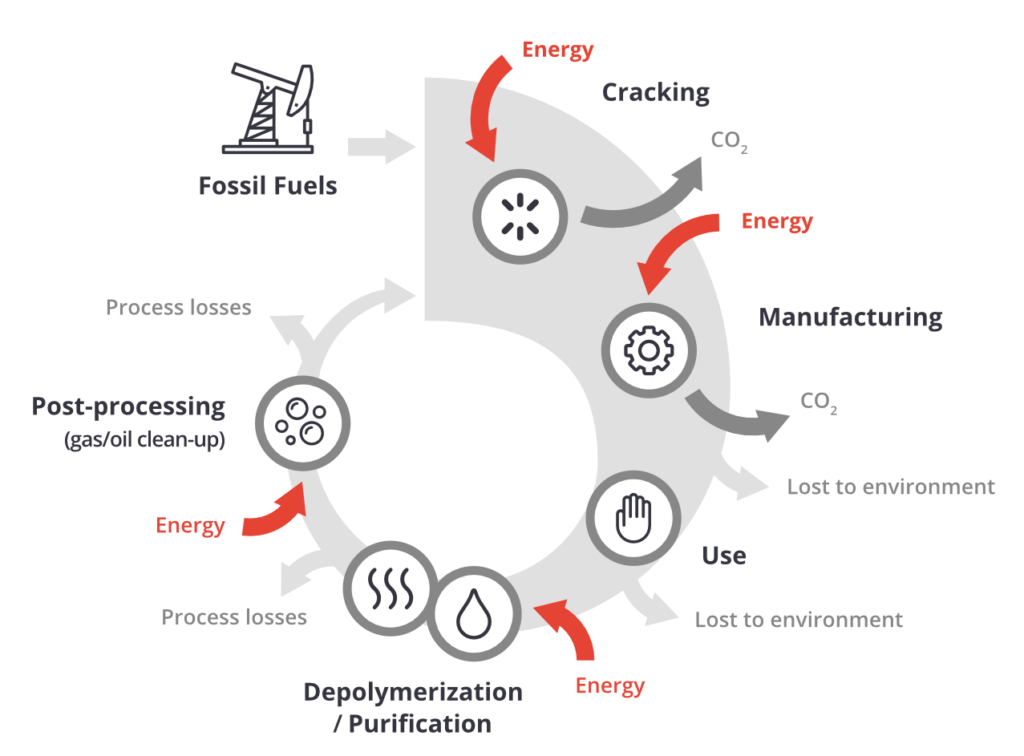
Este diagrama muestra las entradas y salidas del ciclo de vida del plástico cuando se recicla químicamente. Los gases de efecto invernadero se emiten en múltiples etapas, y gran parte del material termina por perderse o incinerarse.

Lamentablemente, con frecuencia lo que se llama “reciclaje químico” es, si se analiza con mayor detalle, una forma elegante de quemar plástico. Entonces ya no suena tan bien. La industria a menudo utilizará el término “reciclaje químico” o “reciclaje avanzado” para referirse en realidad al plástico como combustible, donde los residuos plásticos (hechos de combustibles fósiles) se convierten nuevamente en un combustible que luego se quema, liberando gases de efecto invernadero que nos acerca más al colapso climático. Como si eso fuera poco, estas plantas literalmente tienen que echar combustible al fuego: porque se necesita aún más combustible para impulsar el proceso, y el proceso en sí mismo conduce a generar más emisiones de gases de efecto invernadero. En resumen, más desechos plásticos se convierten en emisiones de gases de efecto invernadero que en plástico. En etapa del ciclo, el reciclaje químico es un contaminante del clima. No solo es eso, el reciclaje químico también es un riesgo para la salud ambiental. Los residuos plásticos contienen una gran cantidad de toxinas (los estudios muestran que un empaque de alimentos de un solo uso puede contener más de 100.000 productos químicos) y al aplicar temperatura, el plástico libera otra mezcla tóxica, como monóxido de carbono, CO2 y dioxinas. Todas esas sustancias tóxicas deben ir a algún lado: al aire, al agua y a los productos finales. Dado que gran parte del “reciclaje químico” en realidad está generando combustibles sucios en lugar de plástico nuevo, quemar estos combustibles no solo es un problema climático, también es un problema de salud. La crisis de COVID-19 ha hecho imposible ignorar cómo la contaminación del aire mata.

La industria petroquímica ha descrito durante mucho tiempo la viabilidad del reciclaje químico en términos optimistas. Sin embargo, la información actual indica que la perspectiva de la industria está muy lejos de las capacidades reales de la tecnología. De hecho, existe una preocupante falta de informes o investigaciones independientes sobre el tema del reciclaje químico: la mayor parte de lo que existe está financiado por la misma industria que tiene un interés particular en que la tecnología tenga éxito y se basa en estudios de laboratorio, no en las condiciones reales del mundo. De hecho, estas tecnologías tienen un historial abismal de fallas técnicas y fracasos económicos. A partir de 2017, las tecnologías centrales, conocidas como pirólisis y gasificación, han desperdiciado al menos $2 mil millones de inversiones en proyectos cancelados o fallidos. Después de todo eso, incluso si estos proyectos lograran producir algo de plástico, no hay mercado para ello, con los precios de plástico virgen por el suelo, tecnologías costosas con alto consumo de energía como el reciclaje químico, simplemente no pueden competir.

Como muestra este diagrama, cada paso del proceso de reciclaje de productos químicos presenta desafíos tecnológicos y económicos insuperables.

El reciclaje químico ha sido considerado como una solución técnica que resolverá nuestros problemas con el plástico, pero no lo hará. Resulta que incluso cuando una instalación de reciclaje de productos químicos realmente intenta convertir residuos plásticos en nuevo plástico, gran parte se quema o se pierde en el proceso. Mientras tanto, la misma industria que promueve el reciclaje de productos químicos está planeando cuadruplicar la cantidad de plástico en el planeta para 2050. No hay forma de que el reciclaje químico, o cualquier otro método de gestión de residuos, pueda evitar que nos ahoguemos en plástico. Nuestra sociedad necesita con urgencia la transición de una economía de combustibles fósiles a un futuro sostenible, y no tenemos más tiempo que perder en el reciclaje de productos químicos. Tenemos un camino difícil por delante. Una pandemia global nos está sumiendo en una depresión global. La contaminación plástica está aumentando a medida que la industria empuja falsamente el plástico de un solo uso como la opción más segura para la población, y los mercados de reciclaje vuelven a hundirse. A medida que nos recuperamos, debemos invertir sabiamente en soluciones probadas, de sentido común y ascendentes que respaldarán la salud pública y un entorno seguro, y no desperdiciarán fondos preciosos en sueños arriesgados de la industria. Los miembros de GAIA en todo el mundo han sido pioneros en sistemas basura cero que detienen el plástico en la fuente, crean buenos empleos y crean economías locales y resiliencia climática. Sigamos con lo que funciona.

GAIA has released a new technical analysis authored by chemical engineers Dr. Andrew Neil Rollinson and Dr. Jumoke Oladejo. The report reveals that chemical recycling is polluting, energy intensive, and has a track record of technical failures, and concludes that it is impossible for chemical recycling to be a viable solution in the short window of time left to solve the plastic problem, especially at the scale needed. 

As a companion to the technical assessment, GAIA has released a briefing summarizing the main findings from the technical assessment, as well as some further conclusions from previous GAIA and Zero Waste Europe publications.

GAIA has released a new technical analysis authored by chemical engineers Dr. Andrew Neil Rollinson and Dr. Jumoke Oladejo. The report reveals that chemical recycling is polluting, energy intensive, and has a track record of technical failures. The plastic pollution problem is getting out of control, with the plastic industry planning on drastically increasing production in the coming decades. We have no more time or money to waste on dysfunctional and potentially dangerous techno-fixes like chemical recycling. As we recover from the economic ravages of COVID-19, we must invest wisely in proven, common-sense solutions that will support public health and a safe environment. Unlike expensive and risky technologies like chemical recycling, investing in zero waste systems is a more cost-effective and efficient approach that addresses the problem at the source, creates good jobs, and builds community resilience for decades to come. 

By Claire Arkin, Communications Coordinator

As people around the world call for an end to plastic pollution, the plastic and petrochemical industry has seized upon a silver bullet solution: chemical recycling, or “advanced recycling.” This older, failed technology has been dusted off and breathlessly promoted in industry circles as the answer to plastic pollution, but the proof to back up these claims has been noticeably absent.  What really is chemical recycling, and is it all that it’s cracked up to be?  In short, the answer is no. A technical assessment and short briefing released today find that chemical recycling is polluting, bad for the climate, and has a track record of technical failures. Far from a promising solution to plastic waste, chemical recycling is a distraction, at best.  Chemical recycling refers to a process that aims to turn plastic waste back into virgin quality (like new) plastic through some combination of  heat, pressure, depleted oxygen, catalysts, and/or solvents. This differs from mechanical recycling, which essentially melts plastic waste and then turns it into pellets or flakes for further use.  Sounds good so far, right? 

chemical recycling is polluting, bad for the climate, and has a track record of technical failures. Far from a promising solution to plastic waste, chemical recycling is a distraction, at best.

This diagram shows the inputs and outputs of the plastic life cycle when it is chemically recycled. Greenhouse gases are emitted in multiple stages, and much of the material ends up getting lost or burned.

Unfortunately,  all too often what’s called “chemical recycling” is, on closer examination, a fancy way of burning plastic.  Not so good. Industry will often use the term “chemical recycling” or “advanced recycling” to actually mean plastic-to-fuel, where plastic waste (made of fossil fuels) is turned back into a fuel that is then burned, releasing greenhouse gases that bring us one step closer to climate breakdown. On top of that, these plants quite literally have to add fuel to the fire: it takes even more fuel to power the process, and the process itself leads to more greenhouse gas emissions. In short, more plastic waste is turned into greenhouse gas emissions than back into plastic. At every step of the way, chemical recycling is a climate polluter. Not only that, chemical recycling is also an environmental health risk.  Plastic waste contains a whole host of toxins (studies show that single-use food packaging can contain over 100,000 chemicals) and heating plastic releases a whole other toxic stew, like carbon monoxide, CO2, and dioxins. All of those toxic substances must go somewhere—into the air, the water, and the final products. Since much of “chemical recycling” is actually creating dirty fuels instead of new plastic, burning these fuels is not only a climate problem, it’s a health problem too. The COVID-19 crisis has made it impossible to ignore how air pollution kills. 

more plastic waste is turned into greenhouse gas emissions than back into plastic.

The petrochemical industry has long depicted the viability of chemical recycling in rosily optimistic terms.  However, current data suggests that this industry outlook is a far cry from the technology’s actual capabilities. In fact, there’s a disturbing lack of independent reporting or research on the subject of chemical recycling– most of what does exist is funded by the very industry that has a vested interest in the technology succeeding, and is based on lab studies, not real-world conditions.  In fact, these technologies  have an abysmal track record of technical and economic failures. As of 2017, the core technologies — known as pyrolysis and gasification — had wasted at least $2 billion of investments on canceled or failed projects. After all that, even if these projects do manage to produce some plastic, there is no market for it — with virgin plastic prices at rock bottom, expensive, energy-intensive technologies like chemical recycling just can’t compete.

As this diagram shows, every step of the chemical recycling process brings insurmountable technological and economic challenges.

Chemical recycling has been billed as a tech-fix that will solve our plastic problems. It won’t.  It turns out that even when a chemical recycling facility actually tries to turn plastic back into plastic, much of it gets burned or lost in the process anyway.  Meanwhile, the same industry that is promoting chemical recycling is planning on quadrupling the amount of plastic on the planet by 2050. There’s no way chemical recycling, or any other waste management approach, will be able to stop us from drowning in plastic. Our society urgently needs to transition from a fossil fuel economy to a sustainable future, and we have no more time to waste on chemical recycling.  We have a hard road ahead of us. A global pandemic is plunging us into a global depression. Plastic pollution is surging as industry falsely pushes single-use plastic as the safest option for the public, and recycling markets are once again tanking.  As we recover, we must invest wisely in proven, common-sense, upstream solutions that will support public health and a safe environment, and not waste precious funds on risky industry pipe dreams.   GAIA members around the world have been pioneering zero waste systems that stop plastic at the source, create good jobs, and build local economies and climate resilience. Let’s stick with what works. 

Questions and Answers: Chemical Recycling

 Industry is now pushing for a new technological fix for plastic waste, called “chemical recycling.” New proposals are popping up in Australia, the EU, Indonesia, Malaysia,Thailand, and the U.S., increasingly supported by favorable legislation. While plastics-to-plastics (P2P) and plastics-to-fuel (PTF) facilities are in principle different, industry increasingly touts certain facilities as “chemical recycling,” when in fact, these companies turn plastic back into a fossil fuel, which is later burned. This document makes the necessary distinctions between plastic-to-plastic repolymerisation and plastic-to-fuel. It debunks the industry’s greenwashing efforts to disguise PTF as “chemical recycling,” and calls into question the actual potential of P2P technology. The bottom line is this: neither of these techno-fixes are the right answer. The only real solution is to stop making so much plastic.