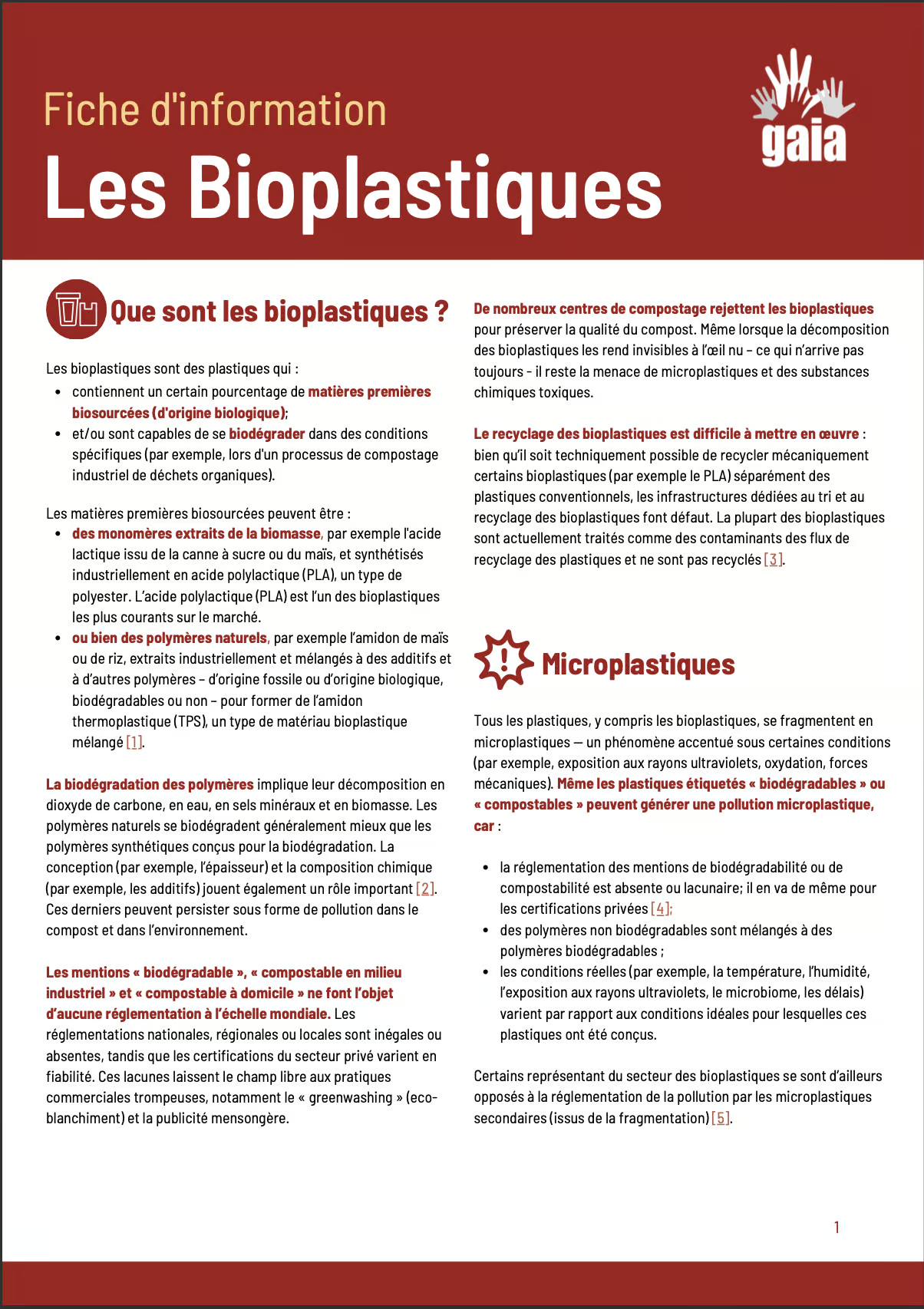
« Bio » ne signifie pas « bon » ou « sans danger ». Trop souvent, l’accent mis sur les bioplastiques sert à masquer la surproduction massive de plastiques jetables ou à usage unique. Les bioplastiques actuels sont, dans leur grande majorité, des substituts regrettables aux plastiques conventionnels, destinés à finir en décharge et à perpétuer la pollution microplastique.
Discussion Paper: Lithium Ion Overproduction
- Batteries -
Definitions, Drivers, and Strategies for Impact
In this discussion paper, GAIA and SOMO synthesise insights from our June 2026 virtual learning circle on lithium-ion battery overproduction. The session brought together more than twenty participants from industry, research, civil society, labour organisations, and affected community advocates — spanning China, Latin America, Europe, and the United States. Global manufacturing capacity for lithium-ion batteries is now estimated at two to five times greater than current demand — a structural gap expected to persist well into the 2030s. This paper asks: what is driving it, who pays the price, and what can we do about it?
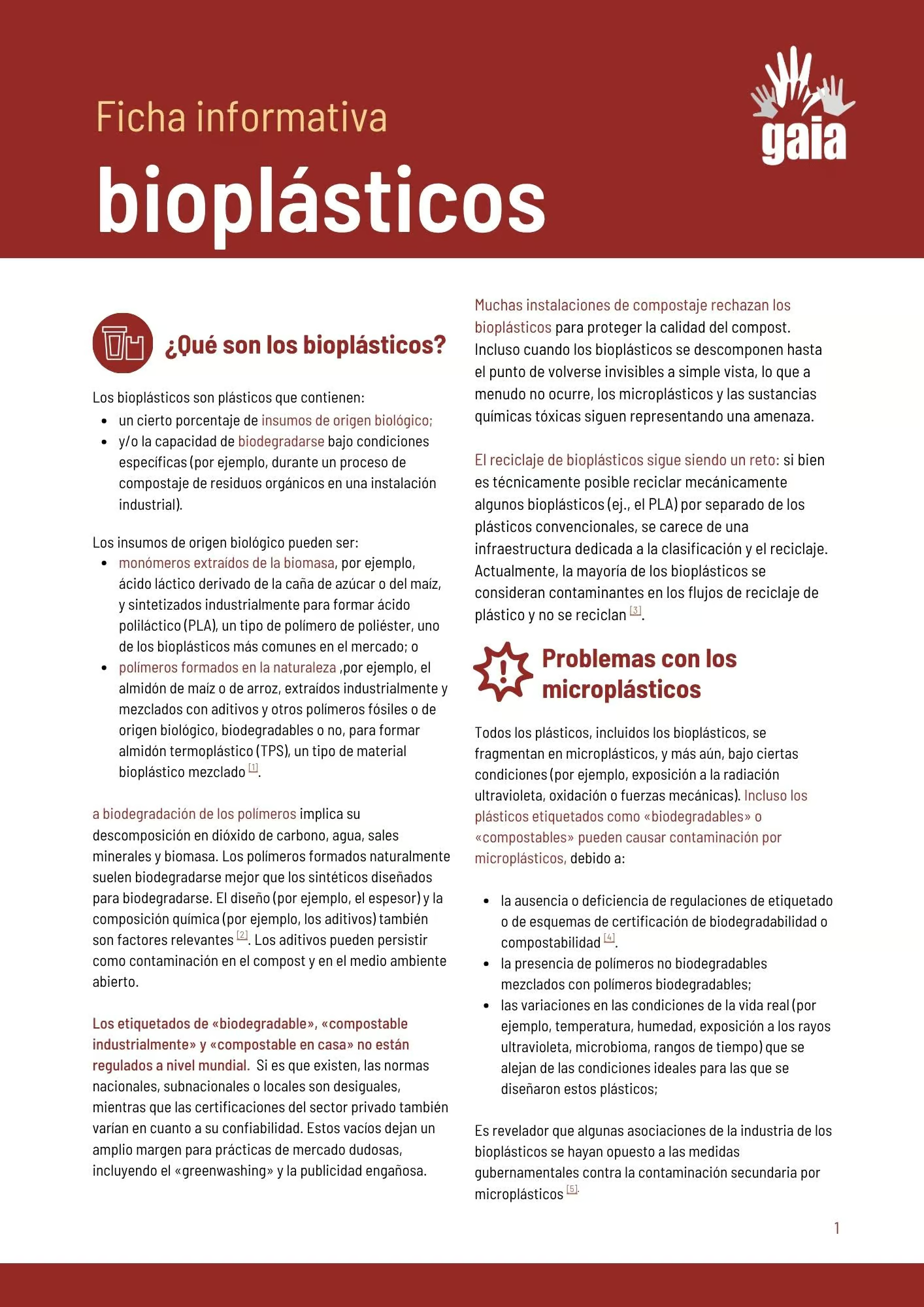
«Bio» no significa que sea bueno o seguro. Con demasiada frecuencia, el énfasis en el uso de los bioplásticos sirve sólo para encubrir con argumentos ecológicos la sobreproducción masiva de plásticos de un solo uso o de corta vida útil. Los bioplásticos actuales son, en su gran mayoría, sustitutos lamentables de los plásticos convencionales de un solo uso, que terminan en los vertederos y perpetúan la contaminación por microplásticos.
Green groups involved in an eight-day cleanup and waste and brand audit in the Philippines warned the top offending brands—mostly multinationals—against pushing incineration as a solution.
The warning came after one of the top offenders revealed that they view incineration as a solution to the waste crisis.
The groups said the companies should instead take responsibility for the waste they are generating by coming up with alternative systems that will benefit not just the company but the public’s health and the environment as well.
“It is already bad enough that these companies are pushing products and packaging that are polluting our oceans and waterways. It’s even worse that they and government officials tasked with protecting our natural resources and safeguarding public health are promoting wrong solutions to the waste crisis, particularly, incineration technologies,” said Anne Larracas, managing director for Asia Pacific of the Global Alliance for Incinerator Alternatives (GAIA).
The Philippines is the first and thus far the only country in the world with a national ban on incineration, following the passage of two landmark laws nearly 20 years ago: the Philippine Clean Air Act of 1999 and the Ecological Solid Waste Management Act of 2000. Unfortunately, the ban is currently under threat as a bill in congress seeking to repeal the ban is currently being heard.
“Incineration is not a short-term or long-term solution. You can’t solve this problem by building multi-million dollar facilities to be subsidized by public funds, that will just transform solid waste into another toxic pollution problem. Doing so will just create more problems,” Larracas added.
Recyclables, such as pet bottles, were among the trash recovered during the cleanup in Freedom Island. If segregation and recycling were done at source, these materials would not have found their way into the bay.
The groups are pushing for the strict implementation of the Ecological Solid Waste Management law which reinforces the ban on incineration, decentralizes waste management from the city to the barangay (village), requires waste separation at source, and door-to-door collection, and the creation of materials recovery facility in every barangay for composting and storage of residuals and recyclables.
“The reason we have a waste crisis is because many cities and barangays are not implementing the law,” said Sonia Mendoza, Chairman of Mother Earth Foundation (MEF).
MEF has been tirelessly working with communities and cities in the proper implementation of the solid waste law. Since 2016, the group has been working with other Asian countries in implementing Zero Waste.
“In cities and communities that strictly implement the law, compliance can be as high as 96%, resulting in waste diversion from landfills by more than 80 percent,” Mendoza said. “This shows that when cities own the responsibility to properly implement a waste program, people comply.”
From September 11 to 20, hundreds of volunteers collected and counted more than 50,000 pieces of plastic waste in Freedom Island, Manila. Six of the top 10 offending brands are multinationals. Nestle led the tally with over 9,000 various Nestle products counted, followed by Unilever and Indonesian brand PT Torabika. Also among the top 10 are Procter & Gamble, Monde Nissin, and Colgate-Palmolive.
Froilan Grate, GAIA’s regional coordinator for Asia Pacific, pointed out that the results are consistent with the results of the waste and brand audits that GAIA and MEF have been conducting in other cities in the Philippines and other countries. “The companies that pollute our seas are the very same companies that have burdened communities with waste that can neither be composted nor recycled,” he said.
This is how a materials recovery facility in communities in the Philippines that strictly implement the country’s Ecological Solid Waste Management law looks like: clean and green.
“We are calling on companies to use materials in their products and packaging that can be truly recovered, reused and recycled, and to invest in alternative delivery systems that will deliver their products to the public without the need for low-value, disposable packaging. Companies conveniently blame the public, their consumers, for plastic pollution, when their products are almost impossible to manage. Companies are only too happy to pass on to cities and the public the responsibility of addressing the waste that their products create,” he added.
The cleanup was co-organized by Greenpeace, GAIA, Ecowaste Coalition, Health Care Without Harm, and Mother Earth Foundation—all members of the the global movement #breakfreefromplastic—in partnership with several wastepicker and grassroots organizations.
NGO Statement on Fossil Fuels, Petrochemicals, and a Just Recovery from Hurricane Harvey
September 21, 2017
We, the undersigned organizations stand in support and solidarity with the thousands of Texans affected by Hurricane Harvey and the hazardous chemical releases that followed.
While the full extent of the damage to these communities will not be known for weeks or months, one troubling trend is clear: the dense concentration of oil, gas, and petrochemicals facilities in the region has dramatically compounded the already severe impacts of climate change on Gulf communities. As Harvey’s floodwaters shut down power grids and plants across Houston and the surrounding counties, we witnessed one petrochemical facility after another exposing communities and first responders to harmful levels of toxic pollutants.
In addition to damaging approximately 100,000 homes in the Houston area, Harvey caused the uncontrolled release of 4.6 million pounds of air pollution from refineries and chemical plants across 13 counties, including known carcinogens.[1] Testing by the New York Times has confirmed the extensive presence of toxic chemicals in floodwaters across the region.
In nearby Crosby, explosions at an Arkema chemical plant that makes feedstocks for plastics forced residents within 1.5 miles of the site to evacuate their homes.[2] Neither the government nor plant officials provided residents with meaningful information about the explosions, the safety risks, or how long homes would need to be evacuated, even though the organic peroxides released by the explosions posed known contact and inhalation risks to those exposed. Misrepresentations of those risks caused multiple first responders to be exposed to hazardous chemicals without adequate safety measures.[3] Like many other Houston communities, the people of Crosby have been left with the uncertainty of what was released in the air they breathe and the water they drink.
Similar impacts were witnessed across the Gulf region. In Point Comfort, for example, the Formosa Plastics facility released 1.3 million pounds of excess pollutants, including benzene and other toxic gases.
The intense concentration of petrochemicals plants in a low-lying, hurricane-prone region made these impacts a foreseeable, if regrettable, consequence of climate change.[4] This is an urgent social and environmental justice issue that should have been planned for and must be addressed now. Communities that have suffered ongoing exposure to chemical hazards for decades are now bearing the brunt of both climate change impacts and increased toxic risks, problems largely attributable to the same handful of companies in the fossil fuel and petrochemical industries.
Even before Hurricane Harvey, massive expansions in the petrochemical and plastics facilities in the Gulf region threatened to exacerbate this situation and further increase the risks to frontline communities. In fact, a new analysis released September 20th by the Center for International Environmental Law documents industry plans to invest up to $164 billion in new plastics infrastructure by 2023, primarily directed to new plastics production in the Gulf region.[5] The continued rapid expansion of plastics production and related natural gas production not only creates more toxic hazards, plastic-related pollution, and greenhouse gas emissions, but also ensures that continued climate change will make extreme weather events more likely and even more dangerous.
Billions of dollars in aid are urgently needed to help affected families and communities recover, rebuild, and redevelop in Harvey’s aftermath. This creates an opportunity, an urgent need, and a solemn responsibility to ensure these funds remedy the systemic failures that led to this disaster and prevent similar disasters in the future. Recovery efforts cannot and must not become a mere excuse to accelerate fossil fuel and plastics infrastructure in the Gulf. Funds that are critically needed for families harmed by this crisis must not be directed to the companies that caused the crisis.
These are not idle concerns. Following Hurricane Katrina, billions of dollars that were desperately needed to rebuild and revitalize communities were instead diverted to oil, gas, and petrochemicals companies. These companies received up to 65% of all Gulf Opportunity Zone bonds issued by the State of Louisiana in the six years following Katrina.[6]
The announcement that former Shell CEO Marvin Odum has been tasked to lead the recovery efforts raises serious risks that these mistakes will be repeated in the wake of Hurricane Harvey.[7] Avoiding these mistakes demands an immediate commitment to a better path by leaders at all levels. Taxpayer money should not be used to bail out the same corporate actors that caused or contributed to many of these problems in the first place.
It is imperative that efforts to recover and rebuild in the months and years ahead address the risks facing vulnerable frontline communities, rather than compound them, including the risks of pollution to their air, water, and soils, and the threat of catastrophic climate disruption.
We call on local leaders in Texas and Louisiana and elected leaders at every level of government, to support immediate, inclusive, and community-led dialogue on the recovery and development of Houston and similarly affected cities and counties across the Gulf region, and to use those dialogues to deliver a better, more sustainable future for themselves and for people everywhere. In order for these dialogues to begin in earnest and begin to yield results, federal and state recovery dollars must be directed to affected families and communities, not to oil, gas, and petrochemical companies.
Sincerely,
350.org
5 Gyres Institute
Air Alliance Houston
Alaska Climate Action Network (AK CAN)
Alaska Community Action on Toxics
Alliance for Appalachia
Another Gulf Is Possible
Asian Pacific Environmental Network
Athens County (OH) Fracking Action Network
Azul
Ballona Creek Renaissance
Bangladesh Krishok Federation
Bayou City Waterkeeper
Be Zero
Blue Mind Life
Breathe Easy Susquehanna County
California Communities Against Toxics
CCEJN
Center for Biological Diversity
Center for Environmental Health
Center for International Environmental Law
Charlotte’s Web Foundation
Citizens Coalition for a Safe Community
Clean Air Council
Clean Water Action
Clean Water for North Carolina
Cleaner Earth Project
Climate Hawks Vote
Climate Justice Program, Institute for Policy Studies
Climate Law & Policy Project
Coalition for Clean Air
Collectif Causse Méjean – Gaz de Schiste NON !
Coming Clean
Committee for Constitutional and Environmental Justice
Corporate Accountability International
Crude Accountability
Culver City Citizen Activists
Don’t Waste Arizona
Downwinders at Risk
Earth Action, Inc.
Earth Dancer School: Dance And Nature Centered Education
Earthjustice
Earthworks
ECHO Action NH: #FossilFree603
Ecology Center
Environics Trust
Environment and Human Rights Advisory
Environment and Social Development Organization-ESDO
Environmental Integrity Project
EPCF – Global Climate Disruption Fairmont, Minnesota Peace Group
Food & Water Europe
Food & Water Watch
Food Empowerment Project
Foundation for Environment and Agriculture
Frac Sand Sentinel
Fractivist.org
Franciscan Action Network
Franklin County Continuing the Political Revolution, Climate Change Task Force
FreshWater Accountability Project
Friends Committee on Legislation of California
Friends of the Earth – US
Global Alliance for Incinerator Alternatives (GAIA)
Global Witness
Grassroots Global Justice
Green Retirement, Inc.
Green Sangha
Greeners Action
Greenpeace USA
Guernsey County Citizens Support on Drilling Issues
Indivisible Denton
Inland Ocean Coalition
Irving Impact
ISF (Integrative Strategies Forum)
Life Without Plastic
Liveable Arlington
Livelihoods Knowledge Exchange Network (LiKEN)
Louisiana Bucket Brigade
Maryknoll Sisters Eastern Region
Mill Valley Community Action Network (mvcan.org)
Montana Environmental Information Center
National Toxics Network Australia
National Toxics Network Inc.
Nature Abounds
NC Climate Justice Summit
NC Environmental Justice Network
Neighbors for Clean Air
Nepal Friendship Society
Network in Solidarity with the People of Guatemala (NISGUA)
NH Energy Impacts on Health Study Group
NH Pipeline Resistance
No Fracked Gas in Mass
No Waste NOLA
Non Toxic Revolution
Norges Naturvernforbund – Friends of the Earth Norway
North American Climate, Conservation and Environment
Manila, Philippines (September 13, 2017) — Various organizations under the #breakfreefromplastic global movement are launching a series of coastal cleanup activities in Asia, Europe, and North America.
Philippines-based member organizations under the #breakfreefromplastic movement begin a 2 week-long coastal cleanup in Manila Bay this week particularly in the Freedom Island (Las Pinas Paranaque Critical Habitat Ecosystem Area or LPPCHEA). An estimated two-hundred participants will work for 10 days to conduct a massive cleanup of this stretch with the aim of pushing for greater accountability for corporations who are mainly responsible for single-use plastics ending up in oceans, roads, and waterways.
“Through the series of beach cleanup activities on Freedom Island and in other parts of the world, we hope to highlight the role of corporations responsible for the manufacture, distribution and proliferation of low-value, non-recyclable packaging and the single-use, disposable plastic products that often end up on the beaches and in the oceans. Whether they like it or not, the companies and brands associated with these products are already being associated with plastic pollution,” said Von Hernandez, Global Coordinator of the #breakfreefromplastic movement.
Mother Earth Foundation (MEF) staff doing waste audit. MEF is one of the #breakfreefromplastic member organizations taking part in the cleanup and waste and brand audit.
Fishing communities who live near and around Freedom Island also report that their fishing livelihoods have been dramatically impacted by plastic pollution. Sonny Malubag, once a fisherman and now a director of a local cooperative in the area, decries how plastic pollution has hurt their fishing livelihoods. “I have been a fisherman since 1992. Back then, the garbage problem in our seas was not yet rampant. Now, whenever fishermen cast their nets in Manila Bay, more than half of what they catch are plastic cutleries and wrappers,” he said.
In North America, three #breakfreefromplastic member organizations are collaborating to raise awareness about the problem of beach pollution on Venice Beach, Los Angeles, California on September 16. McDonald’s has been reported to be continuously using polystyrene and expanded polystyrene foam, a highly polluting form of plastic. To shine a spotlight on styrofoam, collected polystyrene will be sent to California state legislators with a call to ban polystyrene and expanded polystyrene for good!
In Europe, groups in France, Germany, Bulgaria, Croatia, Italy, and Macedonia are also preparing for a series of cleanup activities in the region also with the aim of influencing the outcome of the Our Oceans conference slated in Malta on October 5-6.
Sherma Benosa Communications Officer – Asia Pacific Global Alliance for Incinerator Alternatives (GAIA) sherma@no-burn.org +639178157570
ABOUT #breakfreefromplastic GLOBAL MOVEMENT
#breakfreefromplastic is a global movement envisioning a future free from plastic pollution. Since its launch in September 2016, over 900 non-governmental organizations from across the world have joined the movement to demand massive reductions in single-use plastics and to push for lasting solutions to the plastic pollution crisis. These organizations share the common values of environmental protection and social justice, which guide their work at the community level and represent a global, unified vision. www.breakfreefromplastic.org.
Members of #breakfreefromplastic in the Philippines
GREENPEACE
Greenpeace is an independent campaigning organisation which uses non-violent, creative confrontation to expose global environmental problems, and to force the solutions which are essential to a green and peaceful future. Greenpeace’s goal is to ensure the ability of the earth to nurture life in all its diversity. www.greenpeace.org/seasia/ph
GLOBAL ALLIANCE FOR INCINERATOR ALTERNATIVES (GAIA)
GAIA is a worldwide alliance of more than 800 grassroots groups, non-governmental organizations, and individuals in over 90 countries whose ultimate vision is a just, toxic-free world without incineration. www.no-burn.org
ECOWASTE COALITION
EcoWaste Coalition is a Philippine-based public interest network of community, church, school, environmental and health groups pursuing sustainable solutions to waste, climate change and chemical issues facing the Philippines and the world.
HEALTH CARE WITHOUT HARM
Health Care Without Harm is an international coalition that works to transform the healthcare sector worldwide, without compromising patient safety or care, so that it becomes ecologically sustainable and a leading advocate for environmental health and justice. www.noharm-global.org
MOTHER EARTH FOUNDATION
Mother Earth Foundation is a Philippine organization actively engaged in addressing waste and toxic pollution, climate change, and other health and environmental justice issues. It is best known for its advocacy of Zero Waste through the systematic reduction and proper management of waste.
Waste-to-energy. Zero waste. Incinerators. Words that I have encountered in my almost a month of working for the #breakfreefromplastic (BFFP) movement. These are also concepts which the communications team have been trying to explain to the public through stories, photos, press releases, and blogs.
My baptism of fire for this new position was during the Global Meeting held of the BFFP in Bali last July. A few days after I arrived from Europe, my first order of business was to jump into the plane and attend the meeting with almost a hundred activists from all over the world.
The four days was intense such that I got to know a lot of organizations and people working toward a plastic-free future. Despite the jet lag that I was experiencing that time and being new to the plastic pollution issue, I finished the meeting in Bali in high spirits and inspired and looking forward to working within a movement composed of dedicated people who aspire a more sustainable and equitable future.
Fast forward to the second day of August, together with my colleagues from GAIA, we visited sites of Mother Earth Foundation, a GAIA member in the Philippines wherein community mobilisers showed us around the villages of Potrero and Catmon in Malabon. The city has been known as one of the flood-prone areas in Metro Manila. Further, plastic pollution is a serious problem in rivers along the city.
We visited villages in Malabon and saw communities which have relatively been advancing in practicing zero waste at the household level by segregating waste. Trained by Mother Earth Foundation’s community mobilizers, waste pickers are then incorporated into the zero waste program as they routinely check each households’ waste segregation.
It was not that easy at first as residents are not used to segregating waste. However, little by little, I saw how the families living in these villages in Malabon change their practice. The success can also be attributed to the ground work that community organizers of Mother Earth Foundation are doing in coordination with the local village officials.
After visiting Malabon, I got to visit Fort Bonifacio in Taguig City and the city of San Fernando in Pampanga the following week. The city is adjudged as one of the Zero Waste Cities by Mother Earth and GAIA.
ZERO WASTE. A Materials Recovery Facility in Fort Bonifacio, Taguig City.
For these two sites, it took them only six months to achieve waste diversion – 92% for Fort Bonifacio and 78% for San Fernando. Fort Bonifacio has already been doing it for six years while San Fernando has been doing it for four years.
Their success stories are a combination of non-governmental organizations like GAIA and Mother Earth Foundation empowering communities to show that there is a way out of our waste problem particularly plastic pollution and working with local government units (LGUs) in implementing programs. It also takes political will for local leaders particularly city and town mayors to implement policies that are already in place.
My last field visit for BFFP for the month of August was in the Freedom Island in Las Pinas – where a big massive clean up will be held in the middle of the month in celebration of the International Coastal Cleanup Day on September 16.
PLASTIC POLLUTION. A creek in Malabon is literally swamped with single use-plastics.
As part of our ocular visit, I met Sonny Malubag, a fisherman from Bulungan in Paranaque. Having been a fisherman for more than two decades, he has seen the massive impact of plastic pollution to our marine resources. “I have been a fisherman since 1992. Back then, the garbage problem in our seas is not yet rampant. Now, whenever we go fishing and cast our nets, 60% of what we get are plastic cutleries, and wrappers. People blame us (informal communities) for this problem. But these plastics come from fast food chains. We don’t have the means to eat in these restaurants.”
Fisherfolks like Sonny bear the brunt of improper waste disposal and plastic consumption. BFFP hopes to bring ordinary people’s voices – fisherfolk and waste pickers to international conferences like the upcoming Oceans Conference in Malta in October. These events serve as platform where decisions and policies are being crafted by the world leaders and the voices of ordinary people are heard.
I left Bulungan that day disturbed. I was disturbed because of the realization that plastic pollution is a massive issue and it affects everyone. I used to campaign on food and climate justice issues in another organization. Hence, plastic pollution is something new to me. Looking at the bigger picture, these social problems are in fact interconnected. Going back to the story of Sonny, if fisherfolk like him won’t have enough catch for the day because of plastic pollution, it will directly affect their livelihoods and food security of the community.
Despite the feeling of being disturbed, I also felt inspired. I know that I am in a better place to change the status quo. It’s reassuring to know that I am part of a larger community composed of dedicated activists, enablers and thinkers, who are turning the tide on plastic pollution no matter what the cost is.
Jed Alegado is Regional Communications Officer for Asia Pacific of the #breakfreefromplastic movement.
AFFECTED COMMUNITIES. Fisherfolk like Sonny Malubag decries the decreasing catch because of plastics dumped in our oceans and seas.
By Sherma E. Benosa
Two weeks after its launch, the Zero Waste Academy, a project of the Mother Earth Foundation (MEF) and the Global Alliance for Incinerator Alternatives (GAIA), has produced its first batch of graduates.
The first batch of Zero Waste Academy graduates pose with the staff of Mother Earth Foundation and Global Alliance for Incinerator Alternatives. Photo by Froilan Grate.
The participants, composed of NGO and government representatives from Malaysia, Indonesia, India, and the Philippines, went through a two-week intensive workshop on implementing community Zero Waste program using the MEF methodology, or the 10 Steps to Establishing a Community Zero Waste Program developed by MEF.
Held from May 30 to June 13, 2017, the ZW workshop is rich with hands-on activities and interactions with communities, complemented with orientation before and deliberations after each activity, discussions on relevant issues such as waste-to-energy technologies and healthcare waste, and a skill-share on organic waste management technologies. The skill share was courtesy of practitioners and experts among the participants.
For the workshop, MEF phased the implementation of its ongoing Zero Waste program in select barangays in Malabon City, Philippines to make the workshop activities coincide with implementation schedules, thus allowing the participants to observe and take part in the actual implementation of each step on the ground.
“We cannot tell you what exactly will happen once you go to the communities because what you will be experiencing there will be the real thing,” Froilan Grate, MEF President and GAIA Asia Pacific Regional Coordinator, told the participants before they embarked on their first community work. Grate added that immersing the participants in the MEF Zero Waste methodology was not for them to copy it completely, but to allow them to see how things work in the Philippines and adopt what are suitable to their own contexts, and to make their own modifications as they see fit.
One group of participants pose with the trash they collected during their door-to-door waste collection. They were at step 7 of the process: “Dry-Run and Evaluation of Systems.”
“We do not expect you to copy how we do it in the Philippines,” he told the participants. “Your contexts will be different, and we cannot claim to be experts in implementing Zero Waste in your own countries. You are the experts in your own communities,” he added. Fictor Ferdinand, Deputy Executive Director of YPBB, an NGO based in Bandung, Indonesia, shared that taking part in the workshop was an immense help for him and his fellow Indonesians.
The Indonesian delegates are currently implementing Zero Waste activities in their respective communities. “Implementing an area-wide zero waste system has been a challenge in Indonesia,” Ferdinand said, adding that they have previously trained people and educated them on segregation, but were unsuccessful in making the people comply.
Hands-on. Waste Assessment and Characterization Survey. Photo by Theeban Gunasekaran.
“We believe that waste management should be decentralized down to the barangay (village, or kelurahan in Indonesia) level. But kelurahans do not have power like the barangays have here in the Philippines. Kelurahans cannot create ordinances. So, seeing how Zero Waste program is done in the Philippines is important. We have learned many things that we can try. Still, we also did not come here thinking that once we graduate, we will already be experts in implementing Zero Waste strategies. We still have a lot of questions, and we will still be doing a lot of modifications. It will be a continuous learning process for us,” he added.
Other delegates, although already experts in their own fields, expressed still having learned a lot from the workshop. “I came here not having full knowledge of what exactly I am going to learn. It is my first time to go house to house, and I learned the correct way of understanding the segregation of waste. I learned about waste segregation from books, but the severity of the problem, you won’t be able to understand from the book. I only realized after going house to house how difficult it is to [convince] people to segregate their own waste. [I saw] their reluctance, their indifference to their own waste,” Suseela Nagappan of the Consumers Association of Penang (Malaysia), shared.
What language barrier?
Malaysian delegate, Theeban Gunasekaran doing the survey using the local language. The survey questions are both in English and Filipino/Tagalog.
Like Suseela Nagappan, the other delegates underscored the hands-on nature of the workshop and the sharing of skills and expertise among the participants as among the things that make the workshop different.
“The workshop was satisfying because it’s different, it’s hands-on. I learned a lot from the program and from my fellow participants,” remarked Cresencia Caberia of the Guian Development Foundation, Inc. “I learned that without a system, merely having trash bins is useless,” she added.
Merci Ferrer, former Executive Director of Health Care Without Harm and one of the founders of War on Waste Dumaguete (WOW D), took note of the great camaraderie and willingness of the participants in sharing their expertise. “There was overflowing expertise and caring and love among the participants,” she said, adding that when they begin implementing Zero Waste Program in Dumaguete (Philippines), she will consult and update her classmates.
“The issue of waste requires all stakeholders to work together, and so we thought of sharing how we do it. Hence, the Zero Waste Academy. But while we endeavored to share our knowledge and expertise, we also learned a lot from the participants,” said Sonia Mendoza, Chairman of Mother Earth Foundation.
Sharing of Expertise. Tini Martini Tapran of Yayasan GSSI, Indonesia , shares with the group a unique organics waste management technology that they are using in Bandung, Indonesia, the biopori.
“It is during activities such as this that new ideas come to us,” added Suseela Nagappan: “Thank you for giving us the chance to think of new ideas that we can try when we get back to our country.”
The first batch of Zero Waste Academy graduates are:
From Indonesia: Fictor Ferdinand and Jessisca Fam (YPBB), Tini Mf Martini Tapran (Yayasan GSSI), and Pipin Rohana (PD Kebersihan Kota Bandung)
From India: Darwin Annadurai (Consumers Action Group)
From Malaysia: Theeban Gunasekaran and Suseela Nagappan (Consumers Association of Penang)
From the Philippines: Marito Barillo (CENRO, Tacloban City), Cresencia Abuda Caberio and Consesa Abuda (Guian Development Foundation), Ochie Tolentino (Ecowaste Coalition), Sherma Benosa and Veronica Michelle Moreno (GAIA), and Fidel Alborina and Elizabeth Biagcong (MEF).
__________
Sherma E. Benosa is GAIA’s Communication Officer for the Asia-Pacific region.
A demonstration setup of the vermi-wash, an organic waste management technique, put up by the participants at the Fort Bonifacio materials recovery facility.
By Sherma E. Benosa
Like in other countries in Asia, municipal solid waste (MSW) is a big challenge in India. But many Indian cities and communities have taken great strides in developing ecological and sustainable solutions to manage MSW, especially organic waste.
Earlier this year, 22 delegates from three Southeast Asian countries—the Philippines, Indonesia, and Malaysia—as well as some parts of India (Chennai and Mumbai) toured communities in South India known for their exemplary organic waste management.
Organized by the Global Alliance for Incinerator Alternatives (GAIA), the tour was for the participants to learn from the experiences of the host communities in implementing municipal solid waste management (MSWM), from choosing and designing appropriate technologies and systems to engaging communities, fostering partnership with stakeholders, and changing public behavior.
The participants with the Mayor of Thrivandrum, Kerala (center) for a courtesy call. Discussion revolved around how Thrivandrum overcame the challenges in implementing waste management. Throughout the tour, the participants met with government officials, NGO representatives, waste management service providers, and other stakeholders in waste management.
Different Models
The host communities—Trivandrum, Alappuzha, and Attingal (Kerala) and Bangalore (Karnataka)—have something in common: they all strictly implement organic waste management, resulting in huge diversion of waste ending up in landfills. Organics comprise the biggest waste fraction in India as well as in most Southeast Asian nations including the three aforementioned countries. Hence, proper organics management will have a huge impact in solving the problem of MSW.
With the exception of Attingal, decentralization has played a crucial role in the success of MSWM in the host communities. In Trivandrum, waste management is decentralized down to the household level; each household is required to compost. The government gives incentives, in the form of subsidies in composting bins, to households to manage their waste. In Alappuzha, the households bring their waste to a community composting facility.
In Bangalore, some wards (villages) have contracts with private companies to do the waste collection. Other wards work with waste pickers to collect and segregate waste.
Attingal, meanwhile, opted for centralized organic waste management. The municipality has a large facility with composting areas and a high-capacity biodigester unit for organic waste and shredder for plastic waste. Compared with the decentralized models, however, the centralized model emits unpleasant odor and is more challenging to manage because of the volume of waste.
Shibu Nair, Director of Thanal, shows the tour participants an example of layer composting bin, which is just one of the many composting equipment being used in households in Thrivandrum, Kerala. “The technology to use depends on the volume and composition of waste generated,” he tells them. “Vegetable and garden waste are better composted, whereas kitchen waste is better bio-digested.”
Beyond Technology
The tour participants visited households and communities that use different models of composting and bio-digestion—the two technologies widely used in India to manage organic waste—to see which models and systems would work in their respective countries. They visited different types of communities and sites: dry waste segregation facilities, community composting sites, households, and some bulk waste generators such as hospitals, hotels, apartment complexes, and companies, among others.
They also met with host community officials and NGO representatives to learn about the practices and systems employed to manage waste, the challenges they encountered in implementing MSWM, and how they overcame those challenges.
In their visit to various communities, the participants learned about the basics of organic waste management as well as different techniques they could use in their own homes or communities. But more importantly, they learned that although the use of appropriate technology is crucial, effective waste management is not just a function of technology, but more importantly, of governance and political will and clear and holistic understanding of the complex issue of waste.
“When we talk about waste management, governance plays a large part. If you don’t have good governance, the system will not work,” Shibu Nair, Director of Thanal, told the participants. Thanal is a long-time GAIA member and one of the local organizers of the tour.
Community heap composting in Kerala, India. The bars, made of cement, are removable. Colorful and aerated, this facility which can hold 20 tons of waste, does not only look pleasing to the eyes, but also does not smell. This is the heap composting model favored by many of the tour participants.
Good governance is one of the important keys in the successful organic waste management system in Kerala.
But having good governance does not happen overnight, the participants learned from the various Zero Waste practitioners they talked to during the tour.
Dr. Vasuki, Director of the Kerala Suchitwa Mission, an organization of the Government of Kerala responsible for evolving implementation strategy and providing technical inputs for sanitation and waste management projects, shared that their journey was met with a lot of challenges, among them trying to change the attitude of the people toward waste. By people, she meant those in the government, and the public.
“It was difficult to convince people that [the Green Protocol] is something doable. So we showed that an event without disposables can be done. But even after that, convincing people to do it was still a challenge. Making people understand that it can be replicated was also a challenge,” she said.
The Green Protocol is a government program that aims to reduce waste by, among others, banning the use of disposables.
Dr. Vasuki added that often, people think that concepts such as the 3Rs (reduce, reuse and recycle) are mere slogans and feel it can’t be done. “So, they just go to waste-to-energy and fanciful technologies. So, you want to make them understand that this thing [3Rs] is practical and if they do this there’s so much waste that they can reduce, and the need for processing can also be reduced,” she said.
The Mission built models and consistently educated the people. “Slowly, now the Green Protocol has become a reality. People now understand that it is the way forward and people are really embracing it. The public is aware. Business groups are coming forward and people are voluntarily implementing it. It is slowly becoming a cultural movement,” she shared.
Community heap composting facility in Alleppey, Kerala. In this municipality, households bring their garden waste to the facility and pour their waste into the composting heap. Some come on foot, others on their bicycles or motorbikes.
Speaking about the experience of Hasiru Dala, a volunteer group in Bangalore, Dr. Sandhya also highlighted how difficult it was to change people’s attitude and emphasized the importance of stakeholders getting involved in the issue of waste.
“Everyone has to do his part,” she said, saying that they were not experts in waste management when they started the volunteer group, but that they learned through time.
She added that among the lessons they learned was that solutions should be customized to fit the context of the community. “We wanted our strategy to work in different zones and in different types of communities (malls, schools, villages, households). But we learned that doesn’t work. You have to have different approaches to different types of communities,” she shared.
This household bio-digester in Kerala can accommodate 2 kgs of kitchen waste per day and produces fuel for cooking.
Customization
The participants themselves agreed there is a need to customize the strategies and models they saw to suit their country contexts.
“I have learned a lot, but the techniques will have to be customized and I have to work on that. For example, the concept of waste pickers. Malaysia hires foreigners to handle its waste collection. I am also not sure how to implement door-to door collection and need to work out a customized mechanism according to the local situation. There is less manpower in Malaysia and the middle class will be reluctant to do segregation,” said Saraswathi Odian of the Consumers Association of Penang, (Malaysia), adding that she plans to do a pilot project in an apartment and in schools.
Still, there are technologies and strategies that may be adopted with little modification. One such example is the heap composting in Kerala.
Waste pickers in Bangalore segregate solid waste.
“I think this will work very well in Tacloban,” shared Jonathan Hijada, Department Head of the City Environment and Natural Resources Office, Tacloban City, Philippines. “It does not smell, and it works well. But instead of using cement bars, I may explore using indigenous materials,” he added.
As of this writing, the participants are already back in their respective countries, and many of them have immediately started making models of the technologies and solutions they think might work in their countries.
But that’s for another story.
Sherma E. Benosa is the Communication Officer of GAIA Asia Pacific.
April 2017
Small community stands up to world’s largest cement company, wins Goldman Environmental Prize
Thanks to Uroš S. Macerl and Eko krog, the Zasavje region of Slovenia has a reason to celebrate. These grassroots leaders stopped the world’s largest cement company.Zasavje has the nation’s highest cancer rates, and the multinational cement company Lafarge had long polluted the area. When Lefarge began burning toxic waste in the Trbovlje cement kiln — a disastrous move for human health and the climate — Uroš and the others at Eko krog decided that enough was enough. They organized, and after 10 years of tireless battle, they won.
Today, Uroš is awarded the prestigious Goldman Environmental Prize for his commitment to grassroots organizing in defense of the human right to breathe clean air.
Burning waste in cement kilns is another form of incineration, and also wastes resources and results in emissions that are harmful to people’s health and the environment.
In order to make cement, high-temperature kilns are needed. Traditionally, coal is used in these kilns, but in the past two decades, many “alternative fuels” have been used. The term “alternative fuel” has often been used to disguise the fact that this “fuel” is actually waste, including tires, plastics, and petrochemical waste. Burning waste alongside coal allows cement kilns to use loopholes in emission regulations. In some instances, the kilns actually receive subsidies or carbon credits for replacing some coal with waste—in spite of the toxic impact.
GAIA supports cross-border organizing against cement kiln incineration, including working with national coalitions, helping organize annual international gatherings, and challenging the policies and subsidies that sustain and expand this dangerous practice. GAIA members in many countries have also worked to stop this dirty practice by protesting against individual facilities and securing bans on the burning of certain kinds of waste. In addition, some GAIA members are also working on alternative green building materials, as well as promoting zero waste solutions.
Impacted community members protest pollution from cement kilns in Mexico
LEARN MORE ABOUT COMMUNITY RESISTANCE AND VICTORIES:
Airelimpio.org/: Official website of the Spanish network against waste burning in cement kilns.
Funding Unsustainable Solutions: German Climate Finance to the Waste Sector in the Global South. Non-governmental organizations (NGOs) from the GAIA network around the world have flagged that German Development Cooperation has been involved in proposals for the waste sector that encourage the least environmentally friendly options, including technologies like co-incineration of waste and Refuse Derived Fuel (RDF) in cement kilns.
Cement’s pollution windfall from the EU ETS. This policy briefing interprets the findings for the cement sector of an updated CE Delft study that shows how industry in 20 European countries has massively profited from its pollution under the EU Emissions Trading System (EU ETS).
Bobby Peek, GroundWork. 1998 Goldman Environmental Prize recipient.
On April 14, 2017, as Sri Lanka was celebrating local New Year’s Day, Sri Lankan lives were unnecessarily lost when a massive garbage dump collapsed, burying more than a hundred people alive and killing at least 28 so far. The death toll is expected to rise.
It is horrifying that those killed had to die like this. No one deserves to die like this. No one deserved to suffer as the residents of Meethotamulla had suffered when they were forced to live next to a garbage dump for years despite their strong opposition, and when their families and houses were buried with garbage they did not even make.
Stories of hundreds of people getting buried alive under a mountain of rubbish are not new. Just in March of this year, a landfill in Addis Ababa in Ethiopia collapsed, killing more than 115 people. At least 20 people suffered the same fate in 2016 in Guatemala; and in the Philippines in 2000, another garbage slide claimed more than 300 lives.
Indeed, we have heard one too many stories like this horrifying event in Sri Lanka. It is high time that we say, “Enough!” and make those responsible for the creation of these monstrous mountains be accountable.
Let us push harder for solutions to the world’s garbage woes that do not involve using communities as dumping grounds, especially communities that are often disenfranchised and voiceless. Zero Waste solutions which are safe and sustainable and create jobs and opportunities for many already exist. Let us push governments to do a better job of taking care of their citizenry and managing garbage problems better. Let us ensure that something like this never happens again.
Signed by:
Pratibha Sharma, Global Alliance for Incinerator Alternatives India
Betty T. Cabazares, Kinaiyahan Foundation, Inc. Philippines
Fr. Max T. Abalos, SVD and Rhoy L. Dizon, ANCE, Inc. Philippines
Leah Primitiva G. Samaco-Paquiz, Representative, 16th Congress, ANG NARS Party-list, Philippines
Mi-Hwa KIM, Secretary General of Korea Zero Waste Movement Network, South Korea
Developing solutions for plastic pollution becomes more and more urgent with each new ton of plastics produced. At the same time, the increasing global spotlight on marine plastic pollution in particular has spurred growing interest in strategy development for the Asia Pacific region. This month, the Ocean Conservancy — a Washington D.C. based NGO — released their latest report The Next Wave, which lays out a blueprint for a collaborative approach to reduce leakage of plastic waste into the oceans by 50% by 2025. The report outlines the problem of plastic pollution in strong terms, and emphasizes the urgent need for solutions that reduce plastic pollution through improved waste management.
As a network of leading zero waste implementers and advocates for pollution prevention, we believe that effective strategies to combat plastic pollution must be about more than waste management. This is not to say that dealing with waste already in the system isn’t critically important, but it must be done in a way that encourages redesign and reduction efforts.
This document aims to contribute to an ongoing policy discussion and debate about the primary focus of efforts to reduce plastic pollution. Through it, we hope to share knowledge from the field, as well as to examine the implications of the models in The Next Wave and explain why we believe another investment path is necessary.
Common principles in the fight against plastic pollution
Like Ocean Conservancy, we echo the urgent need for plastic pollution solutions. We agree with many of the priorities outlined in the report’s introduction and opening letter from Ocean Conservancy CEO Andreas Merkl, including the statement: “we believe that we must focus on a long-term, systemic and global strategy to combat the rising tide of plastic waste before it enters the ocean. Clearly, that long-term strategy is an economy designed to eliminate waste and pollution.” We also believe that working with cities on immediate solutions to plastic pollution is critically important, although we believe that this needs to go beyond waste management to zero waste systems that send messages up the supply chain, reduce plastics production, and encourage responsible design.
On specifics, we are heartened by a number of the principles that Ocean Conservancy committed to, including: environmental and social responsibility, minimization of lock-in, emphasis on principles of circularity, and respect for national and local laws and conditions. Finally, the report states that “incinerators and landfills are rarely the solution,” and emphasizes inclusion of waste pickers as well as other solutions models that organizers in the Asia Pacific region have successfully implemented. We appreciate the Ocean Conservancy’s effort to highlight these approaches.
Going beyond waste management: The need for plastic reduction
At the same time, however, the report’s specific strategies and recommendations to investors and governments fail to meet Ocean Conservancy’s stated commitments on a variety of levels.
After describing the need for “an economy designed to eliminate waste and pollution,”The Next Wave states “This report is principally concerned with only the waste management aspect of the solution set. This is because it is written from an ocean perspective, and we need fast action to keep plastic waste out of the ocean.” For the bulk of the remainder of the report, there is a principal focus on waste management strategies, and the core financial model of the report is based on investment in waste management technologies.
While we agree that working with cities on waste systems is a critical and urgent need, it is imperative that these systems move beyond a focus on management to send the right signals up the value chain. Zero waste models — including improved collection, recycling, composting, reuse, bans, and limited landfilling or containment of residual plastics when necessary — quickly reduce the amount of plastic entering the ocean. These are “fast acting” solutions, and the fact that they are cost-effective also makes them timely. Yet the ultimate goal of a zero waste system is not just to responsibly manage waste — rather, it is to understand our waste streams, identify problematic materials, and eliminate those products which do not fit into this system.
Because the discards with highest potential to leak into the oceans are flimsy and without value in recycling markets, there are virtually no responsible management options for them. These cheap plastics and packaging will either create air pollution (through burning), land pollution (through dumping), or marine pollution (through “leakage” into waterways). Zero waste systems are designed to gather data about poorly designed packaging and products, making them visible so they can be redesigned and phased out to reduce the likelihood that they will become pollution. Plastic bag bans and tariffs, as well as expanded polystyrene and other material and product bans, have also shown to be particularly effective in some countries and cities. These solutions can have an immediate impact.
Specific Technology Concerns
In contrast, two of the three waste treatment models highlighted in The Next Wave— both of which are based on gasification technology— aim to create systems that would give marketplace “value” to cheap, non-recyclable plastics. Because gasification systems would need this feedstock to function, investments in this technology could create perverse incentives for the continued production and use of materials that would better be redesigned or phased out. Gasification also has a track record of repeated failures, even after three decades of investment and experimentation.
The Next Wave calls for investments that increase the value of the waste stream, but gasification has not proven itself to be a technology that creates value from waste. Instead it has high costs, and generally does not produce the expected energy. There are numerous examples of plants that have been forced to shut down through technical failures, economic failures, or local resistance, and as a result there is little operational data available. Existing evidence shows that gasification projects regularly fail to meet projected targets for energy generation, revenue generation, and emissions limits. On the flip side, recycling and composting conserve 3-5 times the energy that incinerators generate [1].
Investment and budget implications of gasification
Because The Next Wave is a report about investment, its financial modeling is particularly important. Unfortunately, two of the three modeled scenarios assume that the public is going to pay an enormous amount of money for a highly inefficient, operationally problematic, and polluting form of energy generation.
In order for the gasification facilities in these scenarios to be profitable, governments would need to commit to buying energy from such facilities for 20 years. Yet as Waste Gasification & Pyrolysis shows, gasification facilities notoriously fail to meet projected energy targets and numerous facilities have shut down due to technical failures, creating an uncertain situation for cities and risking public debt.
Taking the Philippines as a case in point, the deployment of gasification technology would cause major financial burdens for cities and residents. According to the financial assumptions and cost data included in The Next Wave, if gasification infrastructure was applied more generally in population dense areas of the Philippines, the total upfront capital costs nationally would be over USD $2 billion. These costs would need to be paid by someone, either through loans, city contracts, or external investment.
In order to pay back these capital costs, the report assumes that energy generation from the facilities would create income. Using data provided in the report, at current energy rates without feed-in-tariffs the total energy purchasing cost to the public for this plastic-to-energy scheme would be over USD $600 million per year.
In addition, because gasification is a high-cost, low-yield technology, there have been calls to provide additional subsidies for this technology. Feed-in tariffs, a type of energy subsidy designed to support renewable energy sources, are ultimately paid for by the public through higher electricity costs or contributions from the national budget.
Gasification is a perverse interpretation of the purpose of feed-in-tariffs, and a global coalition of environmental organizations has released a sign-on statement opposing this practice. Burning or heating plastics for energy is the equivalent of burning a fossil fuel, and the opposite of renewable energy. Almost all plastics, especially in developing countries, are derived from oil, gas, or coal, and burning them releases pollutants and greenhouse gases. Feed-in tariffs should support low-carbon, healthy sources of energy, not the combustion of fossil-derived resources.
Both The Next Wave and the company whose data is modeled in the report claim that feed-in-tariffs can be applied to subsidize municipal “waste-to-energy” in the Philippines. However, according to Philippines law, gasification of plastics is not eligible for feed-in-tariff subsidies. Hence the use of these subsidies would not only undermine progress on renewable energy, but would also violate national law.
Despite this fact, one of the scenarios highlighted in The Next Wave models applying feed-in-tariff subsidies to further support gasification-generated energy and may encourage high risk investment. This would cost an additional USD $550 million per year, taken from funds designated for renewable energy. Adding this feed-in-tariff expense to the baseline electricity costs noted above would require people of the Philippines to spend a total of over $1.15 billion annually for widespread use of waste gasification.
It is irresponsible to ask the public to pay billions of dollars for gasification as an energy source.
A Sea of Opportunity
Encourage Capital, an impact investment firm, also released a report this month titled A Sea of Opportunity, which identifies investment opportunities to reduce marine plastic pollution. The report covers a variety of intervention strategies across the lifecycle of plastics from source through use and waste management.
We recognize the necessity of many of these strategies, including investments in better materials, product redesign, and circular business models, as well as in zero waste systems and the informal waste sector. It also describes an important role for non-investor stakeholders, including government policy makers, philanthropy, and civil society groups. Finally, the report states that “for some products and packaging, the best option may be to move away from plastic completely.” When A Sea of Opportunity describes gasification and pyrolysis, it provides thoughtful cautions, and suggests that due to operating conditions, gasification and pyrolysis for waste are “best-suited for deployment in OECD countries, at least initially, or until there are further technology developments.”
At the same time, two of the investment strategies outlined in A Sea of Opportunity include data and thinking that is also in The Next Wave and is critiqued here. The report highlights a gasification model from The Next Wave as a potential investment opportunity in the Philippines, which is clearly not an OECD country. In addition, investing research and development funding into waste-to-energy technologies could increase pollution and divert much-needed resources from solving the problem of plastic pollution no matter where plants are built. The recent risk analysis in Waste Gasification and Pyrolysis describes decades of failed efforts to control emissions even in optimal regulatory environments.
Investors should also note that while the report suggests gasification could contribute revenue to local systems, GAIA’s research into system track records has found that there is a high risk that gasification systems would continue to cost more than they would bring in from revenue sources. Finally, as the report mentions expansion of ‘waste-to-energy’ incinerator capacity in China and also calls for high environmental standards, investors should note that a 2015 report on China’s 160 existing and operating MSW incinerators found that 40% have incomplete air emission data and only 8% have dioxin emission data available to the public. Among those that have incomplete data, 69% have a record of violating current environmental standards.
In sum, readers should focus on A Sea of Opportunity’s is ideas for investment in upstream interventions, and read carefully the report’s warnings about investments in waste to energy.
Conclusion
With plastic production predicted to double in the next 10 years, we should not be steering investors toward spending billions of much-needed dollars on non-functioning waste management schemes. Deploying an expensive and dysfunctional technology to imbue value to no-value plastic waste is a losing proposition. To encourage continued investments in this concept is a distraction from the real solutions we need.
Our common goal must be reducing production of plastics, and providing opportunities for investment in this. Redesigning and phasing out the cheap, non-recyclable plastic entering the system is absolutely the best thing we can do to protect our oceans. At the same time, if we are serious about reducing plastic leakage in the short-term while simultaneously advocating for responsible design, we should immediately scale up investments in effective and innovative zero waste solutions.
The Next Wave’s models do count value from materials collected by waste pickers for recycling, a step that is already happening in many places. With scaled up investment in these systems and in city-level zero waste programs, we could dramatically reduce plastic pollution at a fraction of the cost of building gasification facilities across Asia, with major benefits for public health, the environment, and our oceans.
We simply cannot be constantly searching for new ways to manage an ever-increasing amount of waste— if we do, we will never be able to truly protect our communities and our oceans.
[1] Morris, Jeffrey, Comparative LCAs for Curbside Recycling Versus Either Landfilling or Incineration with Energy Recovery, The International Journal of Life Cycle Assessment, July 2005. Available at: http://www.springerlink.com/content/m423181w2hh036n4