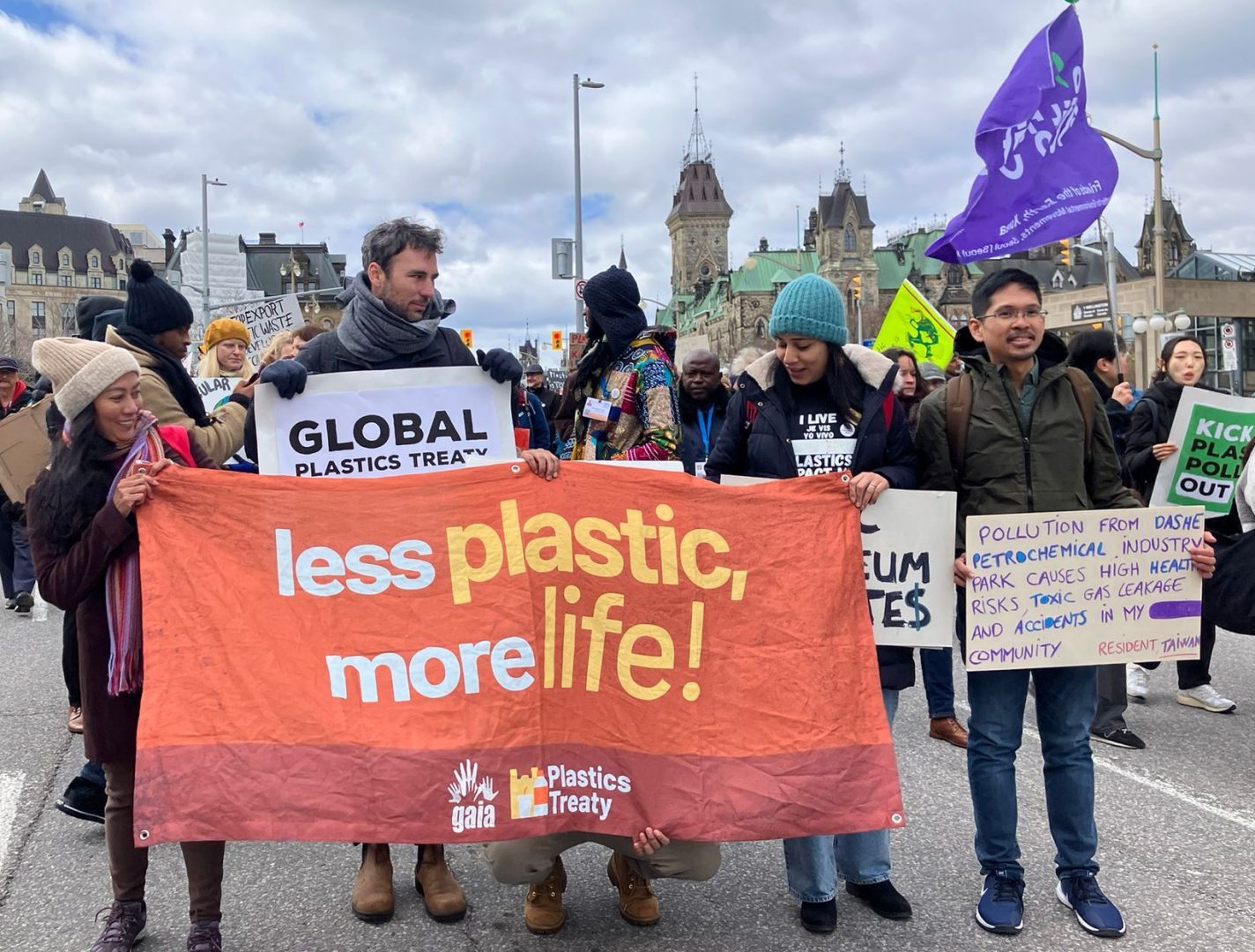
Environmental leaders, community advocates, and policy experts from across the Asia Pacific convened on January 22 for Fire or Ice: Growth of Bioplastics in the Asia Pacific, an online discussion examining regulatory, policy, and investment trends driving the expansion of bioplastics and their implications for communities, climate, and human health.

Panelists warned that the unchecked growth of bioplastics risks repeating the environmental and social harms of conventional plastics, particularly when promoted as a quick fix rather than part of a broader system change.

Arpita Bhagat, Plastic Policy Officer at GAIA Asia Pacific and moderator of the panel, stressed the need to move beyond material substitution. “Bioplastics are often framed as sustainable by default, whereas the material combinations keep evolving without minimum design standards or safe safeguards. Without chemical transparency, strong regulations, and a clear focus on the reduction of single-use material, they are another false narrative that wastes precious resources and delays real action. Therefore, our governments must reevaluate their policy incentives for bioplastics promotion,” she said.

Participants examined the scale of bioplastics production in the region, noting that Asia has already become the largest producer and exporter. Panelists cautioned that this rapid growth is being driven more by market incentives than by environmental safeguards.

Pichmol Rugrod, Plastic-Free Future Project Lead of Greenpeace Thailand, highlighted how national policies can unintentionally reinforce harmful narratives. “Thailand is promoting itself as a biodegradable hub through investment incentives and policy frameworks like the bio-circular-green economy. But this does not address plastic pollution at its root. Plastic packaging, even when labeled biodegradable, does not truly biodegrade in real-world conditions and therefore is not the real solution. Reuse and refill systems are,” she said. 

The discussion also centered on Indigenous and frontline community perspectives. Rufino Varea, Director of the Pacific Indigenous Climate Action Network (PICAN) in Fiji, said, “Bioplastics are a regrettable solution that only creates a false sense of security about addressing the plastic crisis. They do not fit our Global South realities. We already face disproportionate waste burdens threatening our ecosystems, affecting marine food webs, and causing toxicity to our waters. Our Indigenous knowledge systems have the heritage of organic materials that are inherently circular, regenerative, and in harmony with the  economy.”

Chemical safety and environmental health risks were raised as major concerns. Jam Lorenzo, Deputy Executive Director of BAN Toxics, emphasized that bioplastics are not inherently safer. “Studies show that more than half of tested bioplastics contain toxic chemicals similar to those found in conventional plastics, including substances like lead and cadmium when production is poorly regulated,” he said. “Our position is simple. No data, no market.”

Experts also flagged agricultural and food safety impacts. Mageswari Sangaralingam, Chief Executive of the Consumers Association of Penang (CAP) in Malaysia, pointed to growing evidence of harm to soils and crops. “Bioplastics are marketed as eco-friendly, but they fragment, break down into microplastics, and release chemical additives that contaminate soil and enter food systems. A 2025 study by Jing Liu found that starch-based plastic is potentially as toxic as petroleum-based plastic. We must put a blanket ban on using bioplastics for mulching films,” she said.

Doun Moon, Policy and Research Officer of the Global Alliance for Incinerator Alternatives (GAIA), cautioned against assuming bioplastics are a climate solution. “Switching from petroleum-based plastics to bioplastics does not automatically cut emissions, as there is a large amount of GHG emissions associated with land use, material production, and end-of-life treatments,” she said. She cited South Korea’s experience, where the bioplastics industry is growing slowly despite the government’s encouragement and attempts to pass a promotional bill. 

Legal and regulatory gaps were also highlighted. Madhuvanthi Rajkumar, an independent consultant working at the intersection of law, public policy, and rights-based advocacy from India, mentioned, “While we are seeing unprecedented policy momentum (in India and Asia) in favour of bioplastics, the primary risk is substituting one set of problems for another while believing we’ve solved the crisis. Bioplastics come with the same array of negative environmental, social, and health impacts as conventional fossil-fuel-based plastics, in some ways even worse, while giving a false sense of sustainability that increases consumption and waste generation. It’s not even old wine in a new bottle; It’s old wine in an old bottle but with a “green” label!”

The panel concluded with a shared call for action. Speakers emphasized that the Global Plastics Treaty must prioritize binding measures on plastic production reduction, toxic chemicals, and real reuse-based systems, rather than legitimizing alternative single-use materials. The focus must remain on reuse and refill systems rather than new single-use materials.

###

Watch the recording here.

——-

Press contacts:

Asia Pacific: Robi Kate Miranda, Communications Officer for Campaigns, robi@no-burn.org  

GAIAis a worldwide alliance of more than 1,000 grassroots groups, non-governmental organizations, and individuals in over 90 countries. With our work we aim to catalyze a global shift towards environmental justice by strengthening grassroots social movements that advance solutions to waste and pollution. We envision a just, zero waste world built on respect for ecological limits and community rights, where people are free from the burden of toxic pollution, and resources are sustainably conserved, not burned or dumped.

Manila, Philippines – Environmental network Global Alliance for Incinerator Alternatives (GAIA) and Break Free From Plastic (BFFP) in Asia Pacific representing thousands of organizations across over 93 countries, express strong disappointment over the Ramon Magsaysay Award Foundation’s panel on November 5, 2025 during the 67th Ramon Magsaysay Awards Festival Season in cahoots with the Asian Development Bank (ADB) which further peddle false solutions to the pollution crisis

In a letter addressed to the foundation, the giant environmental network said that this year’s Ramon Magsaysay Awards, which used to be a space for celebrating environmentally sustainable and just solutions, served as a dagger struck into the hearts of communities fighting for their rights to clean air, soil, water, health, and the environment. These communities have firsthand experience of the toxic impacts of waste-to-energy (WtE) plants, and are fighting to have these removed.

During the event, awardee Ms. Shaahina Ali described incineration as a “transitional solution” to plastic pollution. Ali also said that newer WtE technologies address pollution concerns and that these facilities offer the best option for the Maldives. These messages are promoted by international financial institutions (IFIs), such as the ADB, to legitimize incineration as a formal waste management method in the region. WtE releases high levels of greenhouse gases that worsen the climate crisis. It also threatens food and water systems, damages ecosystems, and exposes communities to rising sea levels and more extreme weather.

The civil society organizations emphasize that ADB remains one of the largest financiers and policy architects promoting WtE incineration in the Asia Pacific. Since the Paris Agreement was adopted by countries in 2015, ADB provided USD 15.3 billion to 49 projects with incineration components and policy reforms institutionalizing false solutions such as plastic credits through loans, grants, equity investments, and technical assistance. ADB’s financing for plastic pollution locks countries into a linear and unsustainable model of plastic production.

“In a world where urgent actions are needed to address plastic pollution, debt burdens, and limiting the rise in global temperatures to 1.5 degrees Celsius, we urge the Ramon Magsaysay Award Foundation to inhibit from staging unethical, inappropriate, and unjust development alternatives,” said Mayang Azurin, Deputy Director for Campaigns at GAIA Asia Pacific. “RMAF must instead set the development discussions toward empowering community solutions moving toward transformative shifts instead of echoing the agenda of international financial institutions like the ADB and World Bank.”

Civil society organizations also urged the award-giving body to seriously rethink the narratives of what sustainable and just solutions are celebrated in the region by recognizing community voices, and respecting science-based facts and policy directions against what is peddled as solutions by IFIs such as the ADB. International groups offered cross-learning with the award-giving body to navigate complex but solvable problems without resorting to false solutions.

Civil society leaders from the region have this to say:

Marian Ledesma, Zero Waste Campaigner, Greenpeace Philippines, said:

“It is disappointing to see a prestigious award for ethical leadership promote waste-to-energy. This is a false solution that harms communities and distracts from real action on plastic pollution. RMAF must widen its understanding of the crisis. Downstream fixes are outdated, and burning waste is dangerous. Communities and institutions across Asia have already shown that upstream solutions, such as reduction and reuse systems, not only work, but bring benefits to communities.”

Arpita Bhagat, Plastic Policy Officer, GAIA Asia Pacific, said:

“Asian values call for living in balance with nature. Incineration, plastic credits, and offsets do the opposite. They let industries keep polluting while communities bear the cost. These approaches echo a colonial mindset that treats Asia as a dumping ground. By elevating ideas that fuel toxic pollution and the linear take-make-waste model, RMAF undermines the grassroots fight for environmental justice.”

Wahyu Eka Styawan, Campaigner of WALHI Jawa Timur:

“WALHI regrets RMAF’s collaboration with the Asian Development Bank, which is funding waste-to-energy projects in the region. With air quality monitoring support from GAIA, we found PM2.5 spikes around the Benowo WtE plant that exceeded WHO guidelines. This matches Surabaya’s high respiratory infection rates. WtE has worsened environmental and health risks, and ADB’s role in RMAF indirectly reinforces a harmful project.”

Atty. Zelda Soriano, Founder and Executive Director, Community Legal Help and Public Interest Centre (C-HELP), said:

“RMAF has long honored leaders tackling environmental challenges through community-driven, sustainable solutions. This legacy reflects its core mission. Endorsing waste-to-energy technologies promoted by institutions like the ADB would break from that tradition. It would signal a shift away from genuine, people-centered efforts toward approaches that do not advance real sustainability.”

Shey Levita, Campaigner for False Solutions, Ecowaste Coalition:

“It is troubling that RMAF would even consider waste-to-energy incineration as a solution to the plastics crisis. It is the old habit of hiding the problem instead of confronting its root causes. If RMAF wants to honor true Asian excellence, it should uplift community-led, Filipino-driven zero waste solutions, not props that enable shortcut thinking and more environmental harm.”

###

Note to Editors

  • Full letter to the Ramon Magsaysay Awards Foundation with the full list of signatories is available here.

Press contacts:

GAIA is a worldwide alliance of more than 1,000 grassroots groups, non-governmental organizations, and individuals in over 90 countries. With our work, we aim to catalyze a global shift towards environmental justice by strengthening grassroots social movements that advance solutions to waste and pollution. We envision a just, zero waste world built on respect for ecological limits and community rights, where people are free from the burden of toxic pollution, and resources are sustainably conserved, not burned or dumped.

#BreakFreeFromPlastic is a global movement envisioning a future free from plastic pollution. Since its launch in 2016, more than 3,500 organizations representing millions of individual supporters around the world, have joined the movement to demand massive reductions in single-use plastics and push for lasting solutions to the plastic pollution crisis. BFFP member organizations and individuals share the values of environmental protection and social justice, and work together through a holistic approach to bring about systemic change. This means tackling plastic pollution across the whole plastics value chain—from extraction to disposal—focusing on prevention rather than cure and providing effective solutions. www.breakfreefromplastic.org

Quezon City, Philippines – The Global Alliance for Incinerator Alternatives (GAIA) Asia Pacific joined civil society allies in a press briefing on the Asian Development Bank (ADB) Climate Scorecard to raise concern over the bank’s continued support for harmful waste-to-energy (WtE) incineration. Groups called out the Bank for failing to align its energy policy with real climate solutions and community needs.

In GAIA’s monitoring, ADB remains the biggest backer of incineration in the region. Since the Paris Agreement in 2015, the Bank has financed 49 projects with incineration or co-incineration components. These projects amount to USD 15.3 billion. Climate Policy Initiative also reports that more than 94 percent of climate finance for methane abatement in the waste sector still goes to incineration. This reflects a troubling pattern. Money intended for climate action is being diverted to technologies that worsen pollution and drain public resources.

Brex Arevalo, Climate and Anti-Incineration Campaigner of GAIA Asia Pacific, underscored the urgency. “Incinerators remain polluters no matter the technology. While incineration reduces waste volume, the remaining ash, wastewater, and emissions are hazardous and must still be disposed of in landfills. This exposes the myth that incineration eliminates the need for dumpsites. It does not. It creates even more toxic byproducts. WtE is also a poor choice for energy generation. It is among the most expensive technologies today, and it is more polluting than coal per unit of energy produced.”

Across the region, communities are already living with the consequences of ADB-backed incineration. Thilafushi in the Maldives is also being pushed toward an expensive incinerator. This concern was reinforced by Afrah Ismail of Zero Waste Maldives, who stressed, “ADB has backed waste-to-energy incineration through loans and grants for a major WtE plant in the Maldives, a climate-vulnerable archipelago whose public debt now exceeds 120% of GDP and which international financial institutions classify as being at high risk of debt distress.”

Chythenyen Kulasekaran of Centre for Financial Accountability further pointed to the broader regional failures. “The ADB should not be funding waste-to-energy incineration, which has a massive track record of failure across South Asia. All 21 waste-to-energy plants in India are highly polluting and do not comply with the environmental policy standards, as reported by the government itself.”

GAIA and its allies urged the ADB to shift course. The Bank must stop financing WtE incineration, refuse-derived fuel, chemical recycling, and co-incineration in any form. Its energy policy should uphold the waste hierarchy by supporting reduction, reuse, recycling, composting, and other proven zero waste systems.

This call was echoed by Mageswari Sangaralingam of Consumers’ Association of Penang (Malaysia), who emphasised, “By prioritising waste-to-energy incineration and critical minerals mining, the ADB’s Energy Policy thrusts clearly go against the tenets of circular economics and a real clean and just energy transition. These approaches have very high rates of material intensity use and rely heavily on resource extraction activities that result in permanent impacts to the environment and communities. No actions can offset or compensate for these damages.”

Wahyu Eka Setyawan of WALHI Jawa Timur closed with a warning drawn from Indonesia’s experience. “The Asian Development Bank (ADB) has significantly pushed waste-to-energy (WtE) incineration in Indonesia through policy influence and financing, yet evidence shows these projects harm communities and the environment. We urge the ADB to change course, as WTE incineration is not, and should not be, part of any country’s development and waste management plans.”

Press contacts:

Robi Kate Miranda, robi@no-burn.org, Communications Officer for Campaigns 

###

GAIA is a worldwide alliance of more than 1,000 grassroots groups, non-governmental organizations, and individuals in over 90 countries. With our work, we aim to catalyze a global shift towards environmental justice by strengthening grassroots social movements that advance solutions to waste and pollution. We envision a just, zero waste world built on respect for ecological limits and community rights, where people are free from the burden of toxic pollution, and resources are sustainably conserved, not burned or dumped.