In this discussion paper, GAIA and SOMO synthesise insights from our June 2026 virtual learning circle on lithium-ion battery overproduction. The session brought together more than twenty participants from industry, research, civil society, labour organisations, and affected community advocates — spanning China, Latin America, Europe, and the United States. Global manufacturing capacity for lithium-ion batteries is now estimated at two to five times greater than current demand — a structural gap expected to persist well into the 2030s. This paper asks: what is driving it, who pays the price, and what can we do about it?
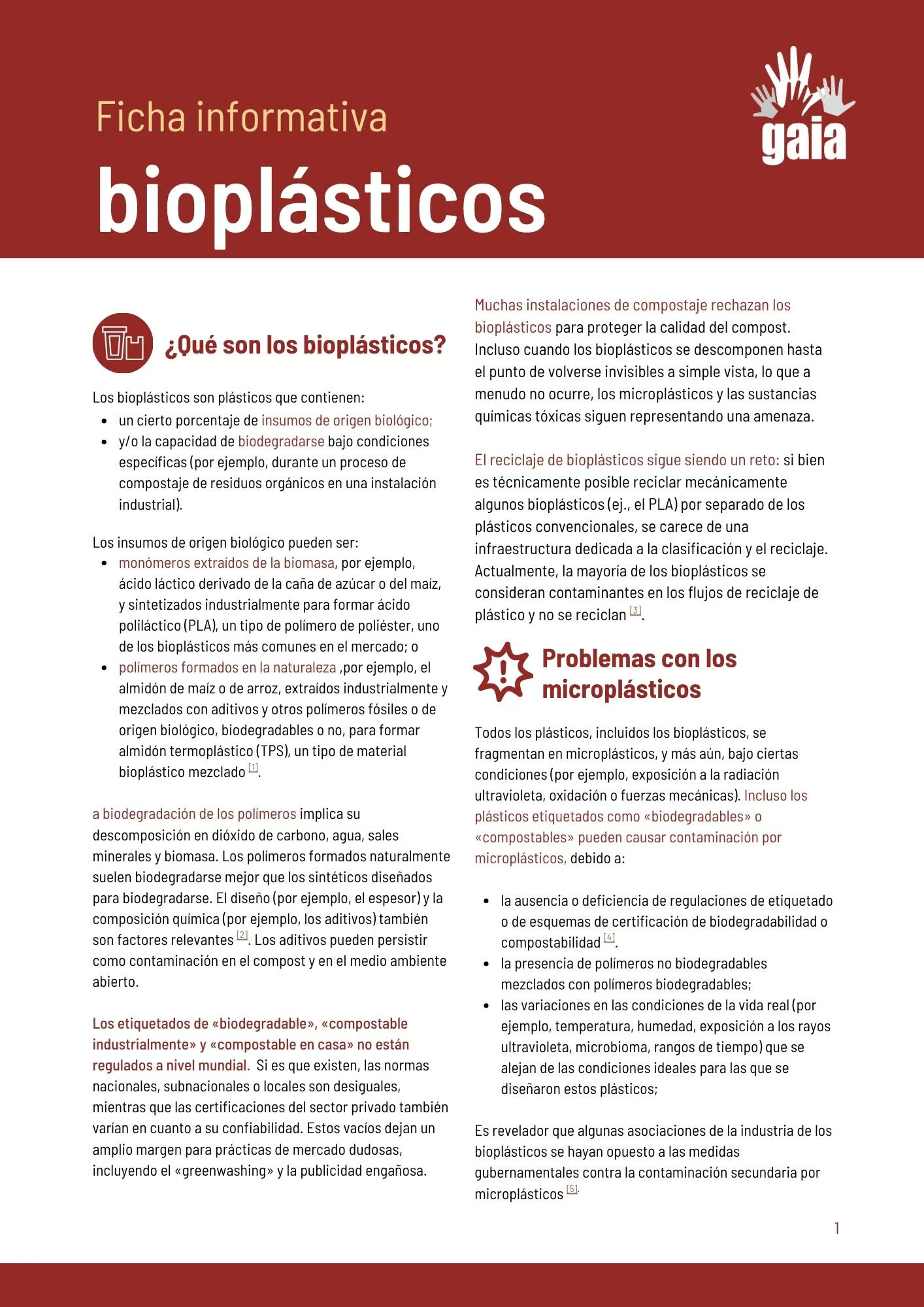
«Bio» no significa que sea bueno o seguro. Con demasiada frecuencia, el énfasis en el uso de los bioplásticos sirve sólo para encubrir con argumentos ecológicos la sobreproducción masiva de plásticos de un solo uso o de corta vida útil. Los bioplásticos actuales son, en su gran mayoría, sustitutos lamentables de los plásticos convencionales de un solo uso, que terminan en los vertederos y perpetúan la contaminación por microplásticos.
Related Resources
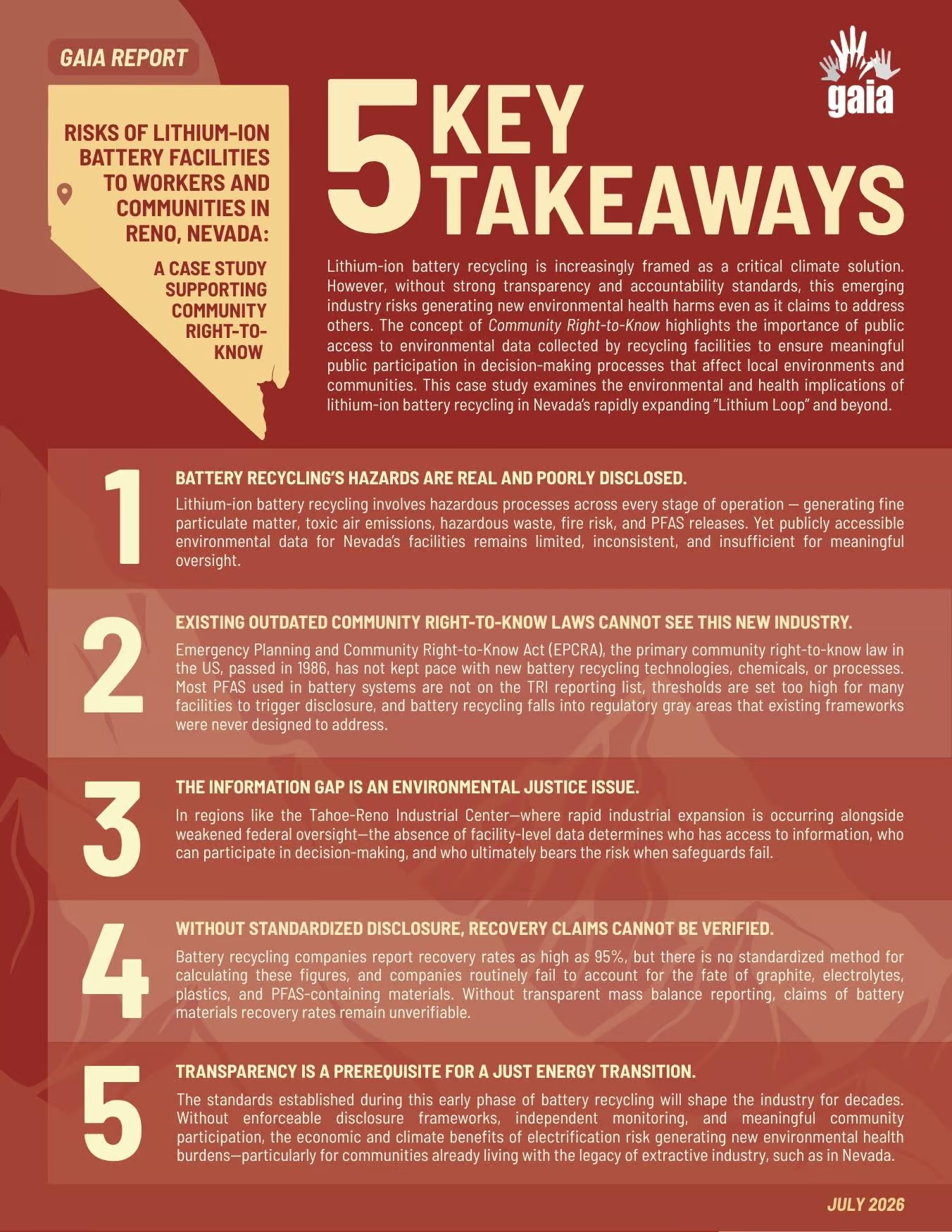
5 Key Takeaways of Case Study: Risks of Lithium-ion Battery Facilities to Workers and Communities in Reno, NV
United States & Canada - Batteries -
The concept of Community Right-to-Know underscores the importance of public access to environmental data collected by recycling facilities to ensure meaningful public participation in decision-making processes that affect local environments and communities. This fact sheet highlights the five key takeaways of the report, Risks of Lithium-ion Battery Facilities to Workers and Communities in Reno, which examines the environmental and health implications of lithium-ion battery recycling in Nevada’s rapidly expanding “Lithium Loop” and beyond.
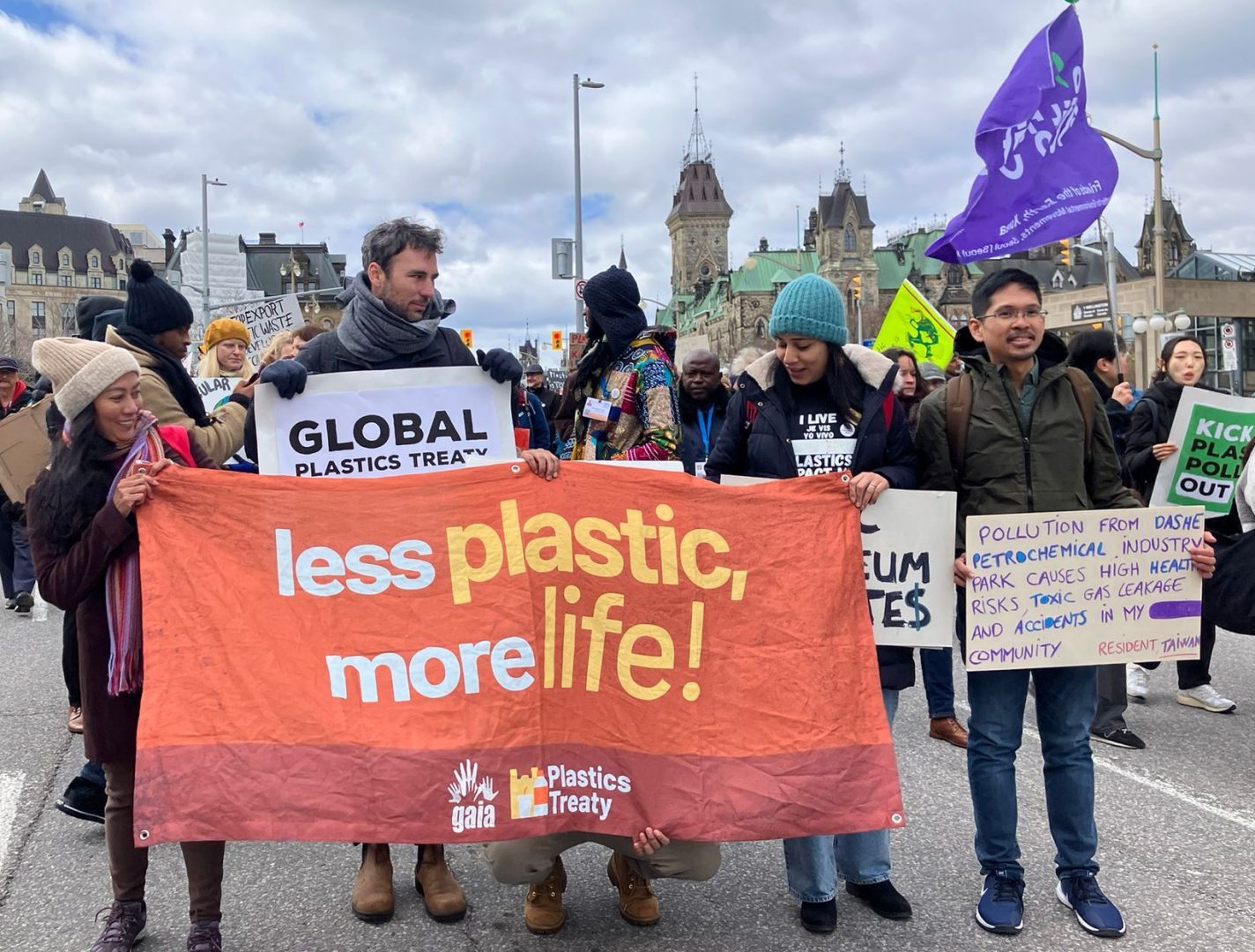
Ottawa, Canada– Global South leaders–including a Member State Delegate, frontline community leader, policy expert, and youth activist– will share their perspectives on the lastics treaty negotiations thus far. The stakes could not be higher–what happens in the rooms of the Shaw Center will have a direct and profound impact on our lives and the lives of our families and communities.
The imbalanced power dynamics between the Global North and Global South in the plastics treaty negotiations mirror the circumstances of the plastics crisis itself. The Global South has long been wrongfully accused as the source of plastic pollution, despite the fact that most plastic production and consumption is centered in the Global North. Furthermore, we have been the target of choice for illegal traffic and dumping of plastic waste, and are made to suffer its most severe impacts to our health, and natural environments.
29 April, 1 PM Room 203, Shaw Centre Ottawa, Canada Register for zoom livestream HERE.
Panelists
Santos Virgilio, Delegate of Member State Angola: Experience Negotiating for the Global South
Ana Rocha, Global Plastics Policy Director, GAIA (Tanzania): Policy Update on the Negotiations and What it Means for the Global South
GAIA is a worldwide alliance of more than 1,000 grassroots groups, non-governmental organizations, and individuals in over 90 countries. With our work we aim to catalyze a global shift towards environmental justice by strengthening grassroots social movements that advance solutions to waste and pollution. We envision a just, zero waste world built on respect for ecological limits and community rights, where people are free from the burden of toxic pollution, and resources are sustainably conserved, not burned or dumped.
Ottawa, April 25, 2024 – Currently, countries around the world are gathering in Ottawa, Canada for the fourth Intergovernmental Negotiating Committee (INC) meeting to discuss the international agreement on plastics from April 23-29, 2024. In this session, AZWI highlights the presence of the plastic and chemical industries in the negotiation process as it poses a risk to achieving the objectives of the agreement, which is to regulate the entire life cycle of plastics to protect human health and the environment
On Tuesday, April 23, 2024, coinciding with the opening of INC-4, the INC Secretariat released a provisional list of conference participants distributed via email. According to this list, INC-4 is attended by about 4,000 people consisting of delegations from member states and observer participants from environmental organizations, scientists, to business entities such as petroleum, gas, petrochemical corporations, chemical industry associations, alternative plastic industries, and FMCGs (Fast Moving Consumer Goods).
From the provisional participant list released by the INC Secretariat, the 44 members of the Indonesian Delegation (DELRI) consist of representatives from the Coordinating Ministry for Maritime Affairs and Investment, the Ministry of Environment and Forestry, the Ministry of Foreign Affairs, the Ministry of Industry, the Ministry of Marine Affairs and Fisheries, the Ministry of National Development Planning, the Indonesian Embassy in Canada, and the National Coordination Team to Tackle Marine Debris.
Based on a quick analysis from Aliansi Zero Waste Indonesia (AZWI), at least four members of the Indonesian Delegation come from the plastic industry, such as Chandra Asri Petrochemical and bioplastic producer Greenhope. These plastic manufacturers’ representatives were registered as officials and experts from the Ministry of Industry to become official members of DELRI. The presence of these two plastic producers in the Indonesian Delegation could potentially weaken the Indonesian Government’s positions in negotiations regarding plastic production restrictions.
“The presence of plastic industry representatives in the negotiation room of the international plastic agreement, especially as part of a country’s delegation, clearly shows a conflict of interest in achieving a strong and binding agreement. Negotiators, including the Indonesian government, must learn from the WHO-supported UN Framework Convention on Tobacco Control (UNFCTC), which has successfully blocked commercial interests and tobacco industry involvement in the negotiation process,” said Abdul Ghofar, Urban Pollution and Campaign Manager at The Indonesian Forum for Environment (WALHI).
“The Involvement of industry in plastic negotiation meetings could weaken the negotiation position of Indonesia in making decisions related to the elimination of hazardous chemical additives in plastics that affect public health,” said Yuyun Ismawati, Senior Advisor at Nexus3.
Instead of involving representatives from the plastic and chemical industries in the delegation, the Indonesian government should involve the Ministry of Health, Ministry of Labor, and scientific representatives who can provide substantive support in the process of negotiating the international agreement on plastics.
In response to the conflict of interests between the plastic and chemical industries and the Indonesian delegates, Aliansi Zero Waste Indonesia (AZWI), raised several points as follow:
Condemn the Ministry of Industry of the Republic of Indonesia for incorporating representatives of the plastic and chemical industries into the Indonesia Delegation (DELRI) in the International Agreement on Plastics.
Demand the Indonesian Government to remove industry representatives from the official Indonesian delegation in plastic treaty negotiation meetings.
Demand the Indonesian Government to include representatives from the Ministry of Health, Ministry of Manpower, and scientists in the composition of DELRI.
Ensure that the Indonesian Government’s position in the negotiation of the International Agreement on Plastics is not influenced by the interests of the plastic and chemical industries.
Demand the Indonesian government not to accommodate representatives of the plastic and chemical industries in the DELRI membership during the negotiation of the International Agreement of Plastic, diplomatic conferences, and other formal meetings.
Demand the Indonesian Government to give careful assessment to the economic, environmental, and public health cost caused by plastic pollution, and to consider regulatory changes that provide relief and subsidies to polluting industries.
Ahead of the ADB’s Annual Meeting next month, civil society groups are firmly calling on the Asian Development Bank (ADB) to go back to the drawing board and overhaul the draft Environmental and Social Framework (ESF) as written in its current form. To demonstrate their grave concerns that the policy provisions will undermine project-affected people and their allies abilities to hold ADB to account when social and environmental harms and damages occur, they intend to deliver a statement to the ADB Headquarters in Manila this morning.
The draft ESF, aimed at updating ADB’s safeguards policies, is being met with opposition from civil society groups due to a wide range of critical shortcomings, including:
Lack of Clear Lines of Accountability
Lack of Clarity Related to the Stakeholder Engagement
Lack of Human Rights Approach
Weakened Environmental and Social Protections
Gender Consideration Dilution
Climate Change standards that fail to stand up to climate science
Opaque Financial Intermediary Lending
In light of these grave concerns, the NGO Forum on ADB and the Asian Peoples Movement on Debt and Development (APMDD) together with the Philippine Movement for Climate Justice (PMCJ), 350.org, Bukluran ng Manggagawang Pilipino (BMP), Freedom from Debt Coalition, Sanlakas, Oriang, K4K-QC, Zone One Tondo Organization (ZOTO), Center for Energy, Ecology and Development (CEED), Global Alliance for Incinerator Alternatives (GAIA), Legal Rights and Natural Resources Center (LRC-KSK), EcoWaste Coalition, Coalition for Human Rights in Development (CHRD), Recourse and International Accountability Project (IAP) urge the ADB to overhaul the draft ESF, revising the language to instead reflect a set of forward-looking safeguards applicable to its entire portfolio, grounded in international human rights and environmental standards.
Quotes from Civil Society Organizations (CSOs)
”The ADB’s safeguards should be the backbone of the bank’s commitment to people and the ecosystem’s well-being. Prioritizing community consultation and consent in all energy projects is paramount, ensuring that local communities are empowered in decision-making, safeguarding their rights and livelihoods. For us, the well-being of people and planet are non-negotiable.”
– Chuck Baclagon, Finance Campaigner 350.org Asia
The ADB continues to subject people and planet to further harm. The latest draft of ADB’s Environmental and Social Framework (ESF) further dilutes already weak safeguards provisions for affected communities. Even worse, the Bank continues to ignore opposition by communities and persists in pushing climate-exacerbating programs and policies and debt-creating finance in many Asian countries.
The ADB should walk the talk of eradicating poverty. Heed peoples’ demand for debt cancellation, reparations for past and continuing harms, an end to financing of planet-warming fossil fuels, and a rapid, equitable, and just energy transition.
Lidy Nacpil, Coordinator, Asian Peoples Movement on Debt and Development (APMDD)
As a bank with a legacy of dirty energy and harm, the least that ADB could do in the face of worsening climate crisis and environmental degradation is to produce and implement a most stringent ESF. Instead, the draft allows financing of projects whose risks are not yet fully assessed, problematically allows offsets, and neglects the need to fully stop new financing for coal or gas with no exceptions. Glaring loopholes essentially render the ESF useless in truly responding to climate and environmental imperatives. We are one in calling on ADB to thoroughly improve the ESF draft, and ensure that finance is instead channeled to genuine solutions such as distributed renewables.
Avril De Torres, Deputy Executive Director, Center for Energy, Ecology and Development (CEED)
“The EcoWaste Coalition is troubled by the provision of the ESF that allows borrowers or clients to propose less stringent measures. This opens a door to potential abuses, where economic or political pressures could dilute the rigor of environmental and social protections.
If ADB is genuine in their stance to promote sustainable and responsible development, they should put stronger oversight, clearer criteria for exceptions, and more robust accountability in the ESF to uphold rigorous environmental and social standards.”
-Glory Rose Manatad, Legal and Policy Officer
Ecowaste Coalition
“The failure of the ADB to accept any semblance of accountability for its past role in pushing policies that dismantled mechanisms and structures that protected people from corporate abuse or anti-people projects has again reared its ugly head.
The weakening and dilution of existing safeguards is proof that ADB has not learned any lesson and remains more concerned with ensuring the profitability of the private sector rather than protecting the welfare of people or the future of the planet.”
-Rovik Obanil, Secretary General, Freedom from Debt Coalition (FDC)
ADB has to recognize that we are already feeling the impacts of climate change, biodiversity loss and pollution. It has to stop giving corporations continued license to pollute and to burn our planet through hideous carbon and pollution offsets. The false solutions they promote trapping us into dirty debts and are severely impacting the environment and communities – most especially the poor and marginalized. It’s time for the Bank to wake up to the facts and finally align with international socio-environmental and human rights instruments!
-Brex Arevalo, GAIA AP Climate and Anti-Incineration Campaigner
“The ADB has an opportunity to ensure that governments uphold the right to self-determination of indigenous peoples. It should mandate the securing of the free, prior and informed consent (FPIC) of indigenous peoples within their ancestral domains. More importantly, the ADB must begin to subscribe to the framework of the “Right to Say No” of indigenous peoples and move beyond “meaningful consultation,” which the FPIC process has sadly become. The reverse of the Right to Say No is the community’s Right to Say Yes to their own model of development.”
-Maya Quirino, Advocacy Coordinator, Legal Rights and Natural Resources Center-Kasama sa Kalikasan/Friends of the Earth Philippines (LRC-KsK/FoE Phils.)
The ESF W Paper, after two years of consultations, regrettably fails to integrate any of the comments provided by civil society, which have consistently demanded stringent requirements for ADB borrowers to adhere to environmental and social compliance principles, committed to “Do No Harm.” The mitigating hierarchy approach promoted by the ADB in this draft ESF poses a direct threat to communities and the environment globally. It undermines all prerequisites for environmental and social risk assessment and compliance prior to loan approval, granting borrowers absolute freedom to disregard environmental and social risks. This constitutes a dismantling of the fundamental notion of safeguards.
We strongly condemn the ADB’s current ESF draft at its 57th annual meeting and demand a complete overhaul to ensure mandatory risk assessment requirements before loan approval, with language compliant with independent investigations for all ADB borrowers. Anything less than this poses a direct threat to communities and the environment.
-Rayyan Hassan, Executive Director, NGO Forum on ADB
“As it stands, the ESF allows for the continuation of projects that worsen climate change. Fossil fuel use should have stopped by 2025. This should be reflected by the ESF, with stringent policies barring the financing of any more fossil fuel projects. If not, it fails to safeguard the environment or any community.”
-Ian Rivera, National Coordinator of the Philippine Movement for Climate Justice
“This draft safeguards policy does little to rectify the black hole that is ADB’s financial intermediary lending. Communities harmed by ADB investments have a right to seek remedy, but there can be no accountability if we can’t see where the money is really coming from. The Bank’s safeguards for intermediary lending need drastic improvement, to ensure full transparency about its involvement in all projects it funds – including clear disclosure of ADB financing at project sites and in community consultations.”
-Kate Geary, Co-Director, Recourse
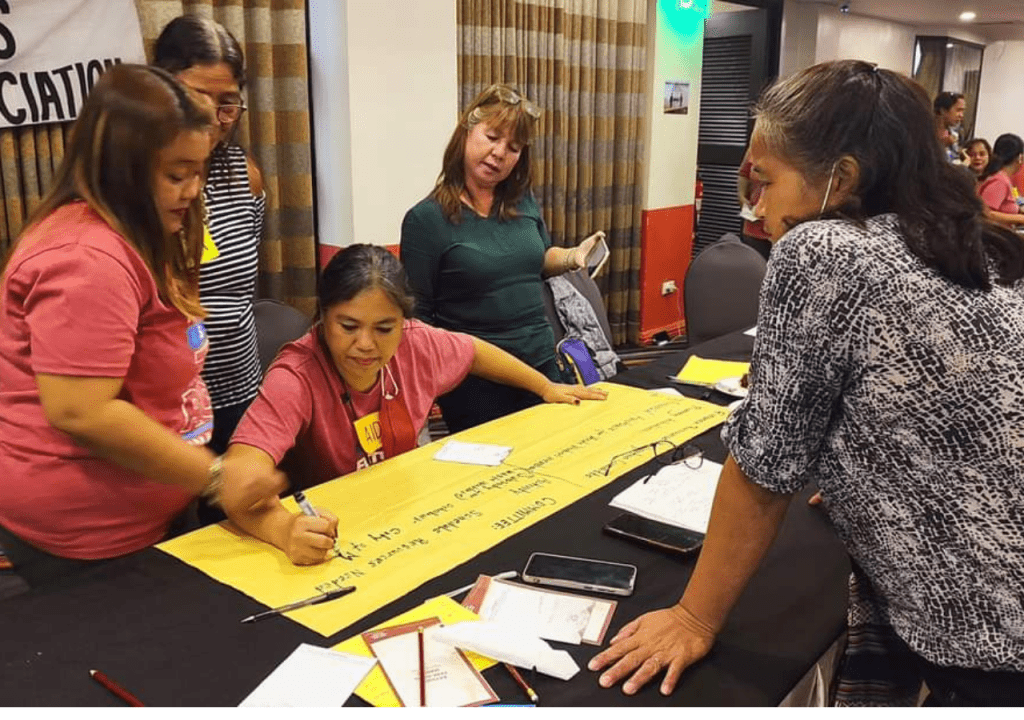
PHILIPPINES, Quezon City, 21 March 2024 – In a significant move for labor rights and environmental justice, waste workers and waste pickers from diverse regions across the Philippines gathered for a national consultation, forming a national alliance and demanding a Magna Carta for Waste Workers — marking a historic and unified call for the recognition of their rights.
From Manila to Siquijor, representatives of various waste picker and waste worker groups voiced concerns regarding their social conditions, ranging from job insecurity to exposure to health hazards to the imperative need for humane working conditions, better pay, health benefits, and protection against discrimination. The delegates, representing over 1,000 waste workers and waste pickers from across the country, determined that despite their diversity, they have similar and resounding aspirations, all of them having faced a form of marginalization and discrimination in their line of work.
Following their emotional sharing of experiences and visions, Marina Cuyugan, Treasurer of Women Waste Warrior (Manila), persuaded her colleagues to form a national alliance. “Everything we discussed today will not become a reality if we don’t organize ourselves. We need to form a national organization. If we don’t, who will listen to us?” she told her fellow participants.
Thus, the establishment of the Philippine National Waste Workers Alliance (PNWWA) — the first-ever national alliance of such kind in the country — as a unified front to advocate for their demands and their rights. Aloja Santos, president of Dumaguete Women Waste Workers Association and founding president of the newly-formed alliance, vowed to lobby for the adoption of a magna carta for waste workers embodying their demands and aspirations. “If there is one thing we must accomplish, it is having a law that is grounded on our realities and responsive to our needs,” she said.
“We must be given social benefits and protection because we provide essential services to society. We are as deserving of such benefits and protection as any other worker. Perhaps even more so. Without us, society will not function efficiently. People just need to recognize our contributions to see that,” she added. For Wilhelmina Magdaluyo, President of the Malabon-Navotas Waste Workers Association (MaNaWWA), benefits due to waste workers should not be subject to the whims of local politicians. “Many of our peers have been removed from work when there is a change of leadership after an election, despite doing hard work for more than 10 or 20 years. We need to ensure that every waste worker in the country gets the same protection,” she said. As a first step, the delegates formulated 10 demands which will be embodied in a draft magna carta that they plan to submit to the senate.
Enforcement of Labor Standards (Pagpapatupad ng mga Pamantayan ng Trabaho) Enforcement of labor standards protects waste workers from being exploited, ensuring proper compensation and protection of rights.
Hazard Pay (Bayad sa Panganib) Given the waste workers’ unsafe working conditions and exposure to health risks such as hazardous materials, the provision of hazard pay is a concrete demonstration of the recognition of waste workers’ rights.
Health Insurance and Services (Seguro at Serbisyong Pangkalusugan) Access to health benefits and provision of essential medical care and support ensures waste workers’ safety and security.
Humane and Safe Working Conditions (Makatao at Ligtas na Kalagayan sa Pagtatrabaho) The health and safety risks that waste workers face should be a thing of the past. It is imperative upon the government to ensure safe working conditions for all workers, especially those managing waste. Provision of personal protective equipment (PPE) is just one of the basic actions that must be carried out to ensure waste workers’ safety.
Job Security (Seguridad sa Trabaho) Waste workers lack job security. Many face the risk of layoffs or contract terminations, resulting in financial instability and economic vulnerability. Providing job security not only allows for financial stability and security but also promotes commitment and reliability in the long term.
Just Compensation (Tamang Pasahod) Fair wages for waste workers not only ensure economic security, it also recognizes the essential role of waste workers in communities as frontliners.
Meaningful participation in policy spaces (Makabuluhang Pakikilahok sa mga Espasyo ng Patakaran) Waste workers have the experience and expertise that can meaningfully contribute to our communities’ waste management policies. Waste workers’ voices should be at the front and center of policy discussions for just, informed, and effective policies.
Right to Organize (Karapatang Mag-organisa) The formation of the Philippine National Waste Workers Association (PNWWA) allows waste workers to have proper representation in policy spaces. An organized group is better equipped at advocating for basic rights and better working conditions. This also grants an opportunity for collective action and empowerment of waste workers in the Philippines.
Social Benefits and Protection (Kapakinabangan at Proteksyong Panlipunan) Waste workers are among the most vulnerable sectors in society, facing security and health risks, economic instability, and even social discrimination. Access to social benefits and protection is critical in addressing these issues, allowing for dignified labor and more humane living conditions.
Training (Pagsasanay) Since waste pickers and waste workers deal with hazardous materials, training for safe-handling is essential to ensure safe working conditions. Skills training will also be useful for work outside the waste sector.
Mother Earth Foundation (MEF) Chairman Sonia Mendoza lauded the waste workers for organizing themselves. “Despite being praised as environmental heroes for their contributions to society, waste workers face numerous challenges. Being an organized group provides them advantages such as collective bargaining power, better sectoral representation and recognition, and access to capacity training,” she said.
She added, “MEF’s Zero Waste City models would not be successful without the hard work, commitment, and dedication of waste workers. Yet the invaluable help of these unsung heroes in our Zero Waste work is often ignored and not given importance, especially by the government. The significant strides that the Zero Waste movement has achieved would not have been possible in the Philippines and around the world without waste workers.”
Various estimates place the number of waste workers and waste pickers in the Philippines at over 100,000 under the informal waste sector, but waste worker groups and their partner NGOs believe this is a gross underestimation. Waste workers and waste pickers often work in open dumpsites and wander around cities collecting trash on-foot or with carts, thus their numbers are mostly unrecorded. And while considered essential workers, waste workers are underpaid and overworked, with only 4,000 (.04%) waste workers nationwide reported to receive annual wages at around P250,000 in materials recovery, waste collection, and waste treatment and disposal.
“We call on the government to ensure a just transition for informal workers in the waste sector by once and for all listening to their voices and immediately acting on improving their working and living conditions. The waste workers and waste pickers are not asking for far too much. All they are demanding is that they be accorded their fundamental rights as Filipinos, and as workers whose contributions greatly benefit society,” said Sherma Benosa, lead of the Just Transition work of GAIA Asia Pacific.
“They are not only the backbone of efficient resource and waste management, they also play a central role in climate change mitigation. If we are to succeed in our fight against plastic pollution and climate change, we need to support our frontliners — the waste workers and waste pickers,” she added.
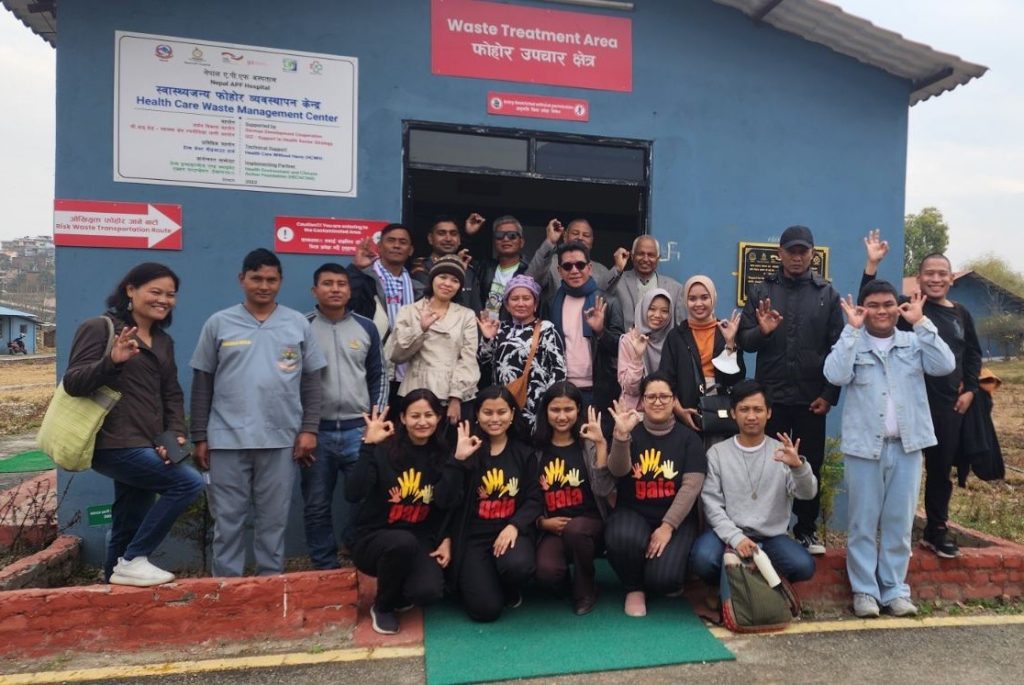
Waste pickers and waste workers pose with hospital administrators, and HECAF 360, GAIA, and WALHI staff in front of the waste management facility.
On March 3, waste workers and waste pickers from Indonesia and the Philippines visited a Zero Waste hospital in Kathmandu, Nepal, days after they staged a march together with other representatives from various countries in the Asia Pacific region to celebrate International Waste Pickers Day on March 1.
The Armed Police Force Hospital is one of the 22 Zero Waste hospitals in Nepal that proudly implement waste management and recovery programs through the assistance of GAIA member, HECAF360.
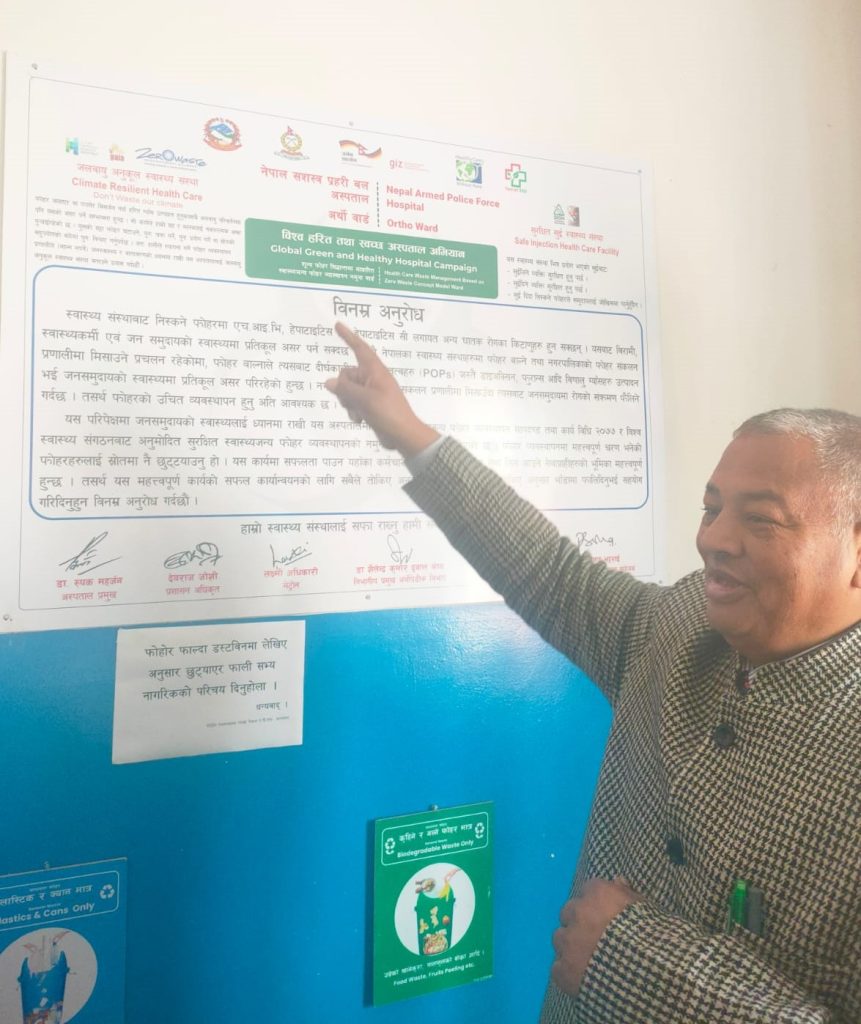
Prerana Dangol, Senior Program Officer at HECAF 360, explains the stringent treatment and testing process of infectious waste
During the visit, HECAF360’s Executive Director Mahesh Nakarmi and Senior Program Officer, Prerana Dangol, showed the visitors their comprehensive waste management process, from the consistent use of color-coded bins to at-source waste segregation to the treatment of infectious waste to the recovery of recyclables, all the while emphasizing the importance of good governance in the success of the program.
“Not many people understand the link between hospitals and waste pickers, but the reason we’re working on hospital waste management is to ensure the safety of waste pickers. A huge percentage of hospital waste is infectious. Anything that has had contact with body fluids – syringes, blood bags, ampules – is infectious. This type of waste must be treated before they are discarded or recovered,” Nakarmi told the visitors.
Mahesh Nakarmi, Executive Director, HECAF 360
“Without proper hospital waste management, the infectious waste may end up in landfills untreated, causing harm to waste pickers who recover these resources. I tell the doctors: ‘We say, do no harm, but if you do not have good waste management in your hospitals, you may be saving your patients’ lives, but you might be [unwittingly] harming the life of others — the people who are forced to manage improperly disposed of hospital waste,” he added.
Accompanied by GAIA and Wahana Lingkungan Hidup Indonesia (WALHI) staff, the Filipino and Indonesian contingents were in the Nepali capital to attend the first regional congress of the International Alliance of Waste Pickers-Asia Pacific, of which many of them are members.
Interview with MaNaWWA President Wilhelmina Magdaluyo by Dan Abril
Photo courtesy of MaNaWWA
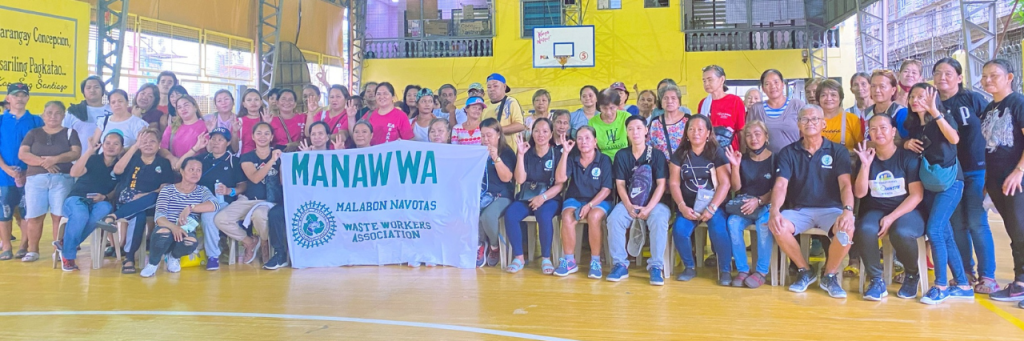
Emerging from the zero waste initiatives pioneered by Mother Earth Foundation (MEF) Philippines in the cities of Malabon and Navotas in the Philippines, the Malabon-Navotas Waste Workers Association (MaNaWWA) was established in November 2021 as a means to boost the morale of waste workers.
Comprising collectors, drivers of waste collection vehicles, palero (shoveller), dispatchers, caretakers of Materials Recovery Facilities (MRF), composters, estero (creek) rangers, canal decloggers, street sweepers, waste pickers, monitoring officers, environmental police, and more, MaNaWWA is dedicated to improving the working conditions of waste workers and spotlighting their crucial role in combating plastic pollution.
Initially, MaNaWWA had a modest membership. However, this increased significantly after collaborating with Sagip Kapamilya of the ABS-CBN Foundation in June 2022. MANAWWA currently boasts a membership of 355 individuals from Malabon and Navotas. The organization is also registered under the Philippine Department of Labor and Employment (DOLE), making it eligible to receive government assistance and benefits, such as livelihood assistance, trainings, and financial resources.
Our talk with current MaNaWWA President Wilma Magdaluyo offered insights into their work and their campaign to reduce the impact of waste and to bring recognition to waste workers.
Photo courtesy of MaNaWWA
What are MaNaWWA’s main ongoing campaigns?
MaNaWWA’s ongoing campaigns focus on garnering support from barangay members, emphasizing waste reduction and recycling. We have informational drives that span barangays (villages), schools, and non-government organizations (NGOs). However, our initiatives are not limited to waste segregation but are extended to livelihood programs for waste workers such as dishwashing liquid production and rug-making from discarded textiles recovered during waste collection.
What are MaNaWWA’s biggest accomplishments/achievements?
Our foremost achievement lies in fostering community awareness about proper waste segregation. Overcoming initial obstacles, our campaign has significantly boosted waste diversion. This means a substantial portion of waste, including PET bottles, cardboard, and plastic cups, now reaches recycling centers instead of landfills. Further, kitchen waste is processed into compost for urban gardens managed by MaNaWWA members. Vegetables from the garden are then distributed among association members, creating a sustainable cycle. Today, households, armed with information on proper waste segregation, voluntarily segregate their waste before handing it over to our waste workers.
In 2023, we spearheaded the Waste Workers Appreciation Day, a significant event that aimed to acknowledge the tireless efforts of waste workers, with valuable assistance from MEF. MaNaWWA is also a member of the Malabon and Navotas’ Solid Waste Management Board, an administrative body tasked with coordinating and overseeing solid waste management activities of the city. There, we contribute our expertise to enhance waste management strategies in these areas. Further, we were one of the delegates at the GAIA Asia Pacific Regional Meeting held in 2023 in Hoi An, Vietnam. That meeting gathered GAIA members from all over Asia Pacific and it was a great platform to discuss the waste crisis and celebrate our zero waste initiatives.
Earlier this year, we participated in the launch of the Philippine National Waste Workers Alliance (PNWWA), an association advocating for the rights of Filipino waste workers. I am proud to serve on the board, contributing to the collective efforts aimed at championing the rights of waste workers.
What challenges are you facing? How does the COVID crisis impact your work?
The pandemic posed considerable risks for our waste workers. Our profession already exposes us to occupational hazards, and the pandemic exacerbated this by limiting access to personal protection equipment (PPE). The improper disposal of health-related waste, such as used face masks and plastic shields, further complicated the situation.
Presently, our primary concern is the lack of funds. We wish to provide financial and medical assistance to needy members, but our resources, sadly, are constrained.
What are the main environmental issues that your country/region is facing?
A significant issue is the prevalence of sachets in our waste collection. These items contribute to sewage blockages and floods, escalating disease rates. In the past, refill options were commonplace in small neighborhood retail shops, reducing the need for sachets. However, sachets are everywhere, especially in low-income areas.
We have made strides in mitigating the problems caused by sachets with our waste collection initiatives but we call on companies to stop producing sachets for the sake of communities and the environment.
Photo courtesy of Mother Earth Foundation (MEF)
How do you see your organization’s work evolving in the next few years?
What we envision is more and strengthened collaboration with other NGOs and government bodies. We also look forward to conducting more seminars on enhancing community awareness on waste reduction.
What are your thoughts on the waste crisis that many countries in your region (and in the world) are living in right now?
The waste crisis demands a collaborative effort from all sectors to minimize its impact. Sachets, particularly in the Philippines, contribute significantly to this crisis, needing urgent attention.
Do you collaborate with partners in other regions? If so, how?
Currently, we collaborate with MEF on diverse initiatives, including seminars and information dissemination on waste segregation. MEF has provided valuable training on occupational safety and basic computer skills, which we aim to pass on to other members.
Photo courtesy of MaNaWWA
Who do you admire most in environmental work (in your country or the world)?
We admire MEF for its commitment to zero waste and its sincere efforts in educating and reaching out to schools and barangays.
Call for funding
MaNaWWA urgently requires funding to provide financial support for waste workers, covering medical expenses and livelihood programs. Additionally, they seek support for seminars focusing on self-care and occupational safety. Supporting MANAWWA directly contributes to the betterment of waste workers’ lives and the community’s environmental well-being. You can email them at manawasteworkersassociation@gmail.com or check out MANAWWA’s work in Malabon and Navotas on their Facebook page: Malabon-Navotas Waste Workers Association (MaNaWWA).
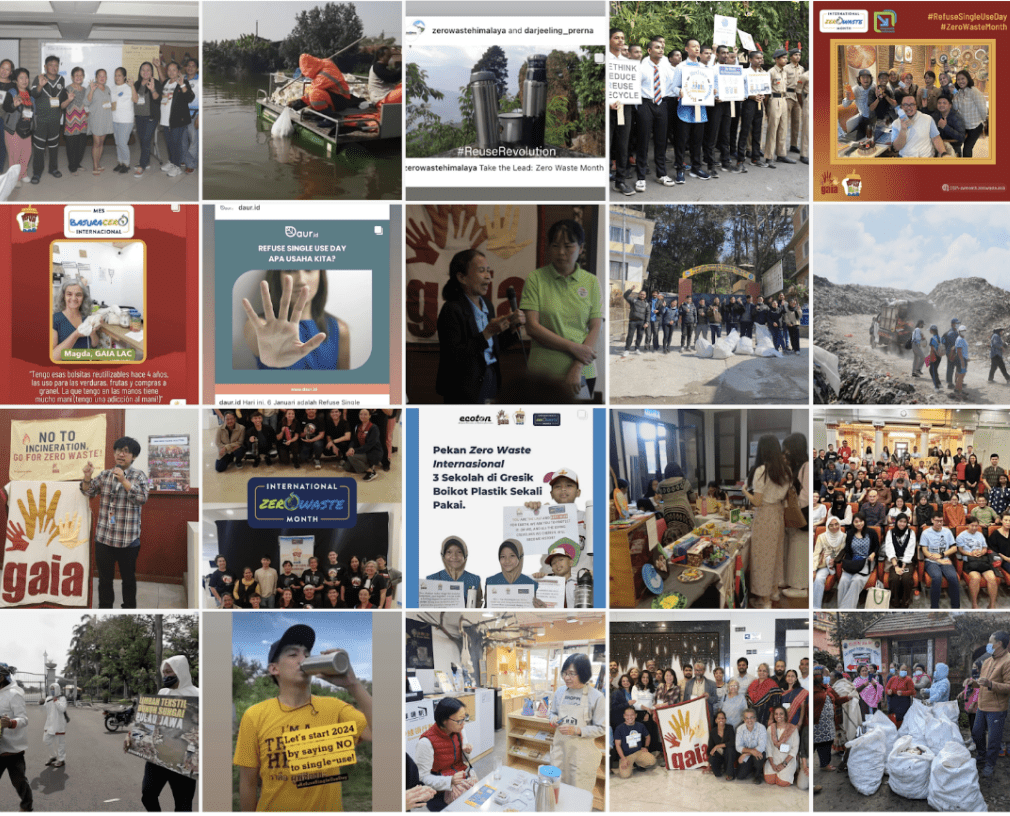
Last January 2024, over 200 GAIA members and allies took part in the International Zero Waste Month reaching a total of 300 events in 22 countries. The participants from grassroots groups, national and regional alliances, zero waste cities from different parts of the world, waste pickers and waste workers, scientists, researchers, policymakers, youth, the academe, and leading implementers of zero waste, organized a wide range of events such as workshops and webinars, flashmobs, campaign caravans, Reuse Tours, film screenings, and public discussions. All these events upheld the principles of zero waste and working together towards a sustainable future.
The month-long events featured different weekly themes:
WEEK 1: Launch (Jan 1-5)
WEEK 2: BARRIERS TO ZERO WASTE (Jan 6-12): #RefuseSingleUse
WEEK 5: HUMANS OF ZERO WASTE (Jan 27-31): #JustTransition
The weekly themes were selected based on its critical importance in our collective effort to promote zero waste as a viable solution to the waste crisis. Our call is clear: to mainstream Zero Waste as a solution to waste issues and connect it to bigger climate discussions, the IZWM gathered members across the regions to showcase both the work and the vision.
The Cornerstone of Environmental Work
The GAIA Asia Pacific team extends heartfelt gratitude for members and allies’ year-round commitment to zero waste efforts and advocacy, transforming the International Zero Waste Month into a celebration that resonates across the region and beyond.
It’s definitely reinvigorating to witness zero waste initiatives making waves across different platforms and people from diverse cultural backgrounds who have the courage, ambition, drive, and big hearts to make this world a better place. This month-long celebration showcased the strength of the GAIA network and highlighted the collective effort to shape a zero waste world, even in the face of challenges. Click here to read more.
IZWM Highlights
In case you missed it! Here’s a rundown of some of the key events during the International Zero Waste Month.
The Zero Waste Film screenings 2024 featured inspiring documentaries produced by GAIA Asia Pacific members. Link here
Hundreds worldwide joined Refuse Single-Use Day! See how everyone got creative on their posts onFacebook | RSU Facebook | Instagram
Financing Plastic Pollution webinar: The Financing Plastic Pollution webinar conducted last January 25, amassed 166 registered participants, 77 in live attendance, and 53 views on the recording. Impressively, 81 participants joined from outside the Asia-Pacific region, and 41 AP members. The webinar is the first of its kind on the plastic pollution financing ecosystem, fostering collaboration among diverse actors and regions on the plastic crisis discussions. It is the first webinar that addressed the role of financing subsidies in plastic pollution. The event received high registration, and demonstrated substantial interest from members and allies on the issue, and the significance of the topic within the network. Link to recording
Let’s support our waste pickers and waste workers. Click the link and explore GAIA members working towards a just transition. Link here.
East Asia
HONG KONG: Greeners Fusion Chinese New Year Refill Shopping Tasting Event, launched on January 21, is a public education campaign encouraging public members to enjoy zero packaging shopping spree as well as educational sharing at Greeners Fusion- GA’s first refill shopping concept store in Sha Tin. It allowed participants to have their first taste of package-free shopping before Chinese New Year. Another event on January 22, was organized for members only with the same purpose. Link here
Pacific
AUSTRALIA: Compost Carpool reminds everyone that there are tons of things you can do to reduce waste! Link here
NEW ZEALAND: Together with GAIA, Zero Waste Network Aotearoa declared January 6 as REFUSE SINGLE USE DAY with tips to incorporate simple steps into your life to avoid single-use items, carry a refillable water bottle, coffee cup, and takeaway container, commit to avoiding single-use takeaways without reusable containers, and advocate for SUC-free cities by encouraging local councils to establish easy and affordable reuse and refill systems. Link here
South Asia
INDIA: Eco Circular India Foundation, Cummins India Foundation, Mudhoji College, Phaltan Nagar Parishad, and Forest Division, Phaltan have jointly kicked off the International Zero Waste Month celebration in Phaltan with a musical show at Forest Garden! The event emphasized the importance of zero waste, composting, and combating plastic pollution. Energizing street plays also took place at key public locations like the city bus stand, market, and Mudhoji College campus, ensuring the message resonates throughout Phaltan. 🎉link here
BANGLADESH: Documentary showcasing ESDO’s Initiative on Zero Waste Village (ZWV), complemented by a workshop on combating plastic pollution. During the workshop, participants actively engaged in collaborative discussions and generated ideas to address plastic pollution in their respective communities. Link here
SRI LANKA: The Centre for Environmental Justice invited everyone to share their efforts in reducing single-use plastics. The event, which took place in the Colombo district, specifically in Borella, Nugegoda, and Colombo Fort, targeted the general public, including students and youth. As part of the event, CEJ screened movies related to plastic pollution and distributed educational leaflets on plastic alternatives, encouraging the adoption of refill and reuse systems. Link here
NEPAL. Health Environment and Climate Action Foundation (HECAF360) has successfully organized the Zero Waste Clinic during International Zero Waste Month 2024. Link here
Southeast Asia
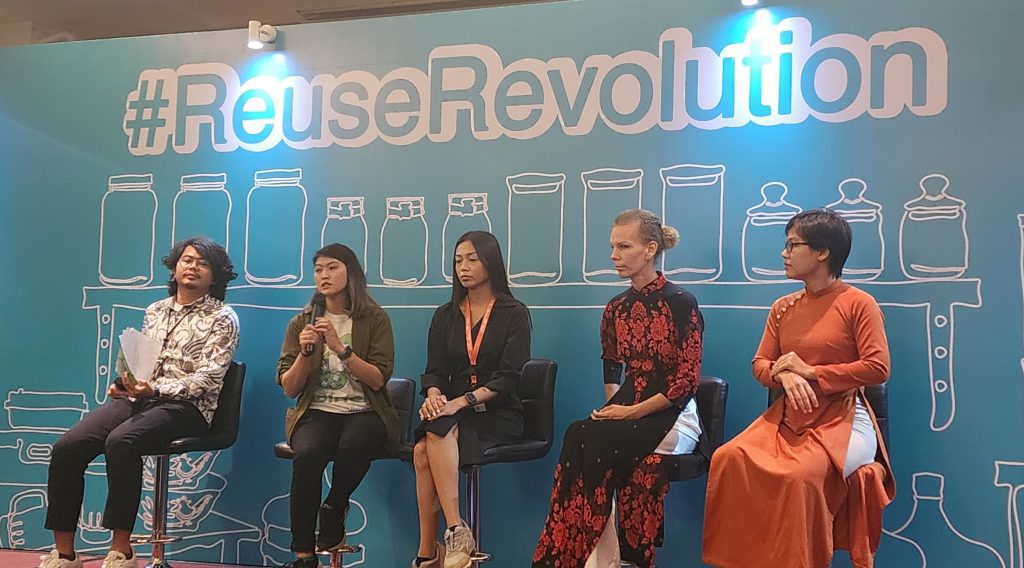
INDONESIA: Reuse Study Tour & Conference: Co-organized with Dietplastik Indonesia, The Reuse Tour in Jakarta, Indonesia, from January 8-12, witnessed the participation of 38 individuals in the study tour and around 60 in the conference with participants from outside the Asia Pacific region. The diverse cohort comprised representatives from the Philippines, Vietnam, and Thailand, and members of the Aliansi Zero Waste Indonesia. Local government officials from the region and social enterprises were also present. Other than insightful site visits delving into reuse practices across different products and services, with a particular focus on daily essentials and the food and beverage industry, this event also launched the Asia Reuse Consortium, a groundbreaking initiative comprising 18 individuals from civil society organizations, businesses, and government officials from 13 countries, including Indonesia, the Philippines, and Vietnam united by a mission to champion reuse as a practical, sustainable, and effective solution to SUPs. Ripples of a Revolution | Study Tour link | Conference link | Asia Reuse Consortium link | Link to conference recording
MALAYSIA: The Symposium co-organized by GAIA and Friends of the Earth Malaysia presented situational analysis and updated knowledge on waste-to-energy (WtE) incineration from speakers from key Asia Pacific countries and experiences of Zero Waste Europe. The main aim is to debunk waste-to-energy incineration and promote zero-waste. Link to recording | Learn more here I Link to the News Release
PHILIPPINES: Southeast Asia Regional Consultation on Just Transition: The SEA Regional Consultation on Just Transition, held in Manila, Philippines last February 2-3, gained the active participation of 35 attendees, including 2 participants from Ocean Conservancy who are outside the Asia-Pacific region serving as observers. The consultation featured insights from 11 waste pickers and waste workers who engaged in meaningful discussions about their conditions, and contributions to society, and outlined the support they require. This provided a comprehensive understanding of the diverse needs and perspectives within the community. Despite using different terms, the articulated needs and aspirations of the waste pickers and waste workers are closely aligned, reflecting a collective vision for a just transition in the region. This will inform further refinement of the vision and principles for the SEA Regional Consultation on Just Transition. Link here.
THAILAND: Catch Environmental Justice Foundation’s series of articles inspiring stories of people behind zero waste initiatives in Thailand! Link here
VIETNAM: Reuse Station – Gian hàng Tái sử dụng is a communication event to bring local residents’ attention to reuse as an effective solution for waste reduction, particularly plastic waste in the environment. Link here
Other regions
CHILE: Conversatorio “La crisis de los plásticos y el proceso del tratado global. Conversation open to the general public that will address how plastics have created a crisis on our planet, and the opportunity that the global treaty process gives us to stop plastic pollution and to take global measures to reduce the production of this toxic material. Link here
GHANA: GAYO launches Anti Plastic Earth! This event is fullpacked with a series of activities, including education, clean-ups, brand audits, and recycling workshops to curb plastic pollution in the Northern region of Ghana through community sensitization and engagement. The event was launched in January with media publicity through TV/ radio interviews and social media campaigns.
HUNGARY: Debunking myths about disposable packaging. Learn more here
KENYA: Triple Planetary Crisis Symposium: Uniting for Sustainable Solutions. This public knowledge-sharing event, held at Multimedia University, aimed to address environmental challenges and was attended by students and youth from various universities in Nairobi. The symposium featured panel discussions led by experts from various sectors, focusing on pollution, climate change, and biodiversity loss. Link here
NIGERIA: The Environmental Rights Action / Friends of the Earth, the Zero Waste Ambassadors engaged in a radio discussion across three Nigerian cities: Benin City, Uyo, and Yenagua. The conversation revolved around the crucial role of brands in tackling plastic pollution. Link here
Zero Waste Europe highlighting the critical importance of reuse systems that will bring us closer to a zero waste world. Learn more here
You can catch up on all IZWM2024 activities by checking out GAIA Asia Pacific’s Facebook | Instagram and social media channels of our members. Plus, you can find them right here on the IZWM website too!
A significant step to comply with the Global Methane Pledge
Contributed by YPBB
In a significant and forward-thinking move, the West Java provincial government officially prohibited the disposal of organic waste in the Sarimukti landfill, located in the West Bandung Regency, effective January 1, 2024. This comes as a response to the August 2023 Sarimukti landfill fires. The policy has the potential to divert 228,855 tons of organic waste per year from Bandung alone — preventing 575,428 tonnes CO2eq of methane emissions per year from the landfill. The West Java Provincial government has targeted a reduction of 754,154 tonnes CO2eq from all the landfills in West Java by 2030. This means that Bandung, the capital of the province, can contribute 75% of the set target.
Apart from reducing methane, this policy has the potential to contribute to environmental justice by significantly reducing river pollution caused by the landfill’s leachate, which is a water source for more than 6,000 people. If implemented in parallel with separate organic waste collection and treatment, cities could save significant costs, particularly on transportation, and it could also contribute to the local economy, creating 6 jobs per tonnes of waste managed, double the current system.
The Sarimukti Landfill catches fire. source: Sindonews
Methane, a greenhouse gas 86 times more potent than carbon dioxide, is an increasingly significant global concern to deliver climate action. According to the UNEP’s Global Methane Assessment, reducing methane is a crucial step to keep global warming under 1´5ºC, the threshold established by the Paris Agreement. Interestingly, the Climate Transparency Report (2022) highlights that Indonesia’s waste sector is the country’s largest methane emitter.
In 2023, Sarimukti landfill, a regional landfill serving four cities in West Java, was projected to surpass its capacity. Landfill fires got out of control – AZWI reported 38 landfill fire occurrences in 2023, attributing methane from organic waste as its root cause. Responding to this critical situation, the Bandung Zero Waste Forum and grassroots groups, particularly Friends of The Earth Indonesia (WALHI) and Yaksa Pelestari Bumi Berkelanjutan (YPBB) —members of Alliance for Zero Waste Indonesia (AZWI)— initiated intensive advocacy efforts, targeting the ban of organic waste landfilling and incineration, emphasizing how the air pollution was affecting waste pickers and the community around the landfill. By August 2023, provincial and local governments declared a waste emergency status, and soon after, the organic waste ban to landfill was sealed.
An informal waste collector conducts separate collection in a neighborhood in Bandung. source: YPBB
Incinerator Threat Looms
However, while this policy is a critical milestone for the Metro Bandung area, the provincial government is risking this achievement with a Waste-to-Energy incinerator project proposal in Legok Nangka, a newly built regional landfill to replace Sarimukti. In opposition, WALHI has continuously warned the government about the hidden risks of incineration, emphasizing the risk of methane-to-carbon swapping, the obstacle it will pose to cities to achieve its climate and waste reduction targets, and its adverse impacts to local communities. Accordingly, YPBB and Bandung Zero Waste Forum advocate for coherent policies through alternative policy scenarios that do not rely on incineration.
Furthermore, the organic waste ban to landfill should be implemented carefully. The government must not allow pitfalls as experienced by the European “zero waste to landfill” policy, which has resulted in an excess of incineration capacity in this region. The policy should be more ambitious by including a mandatory source separation, separate collection, and treatment of organic waste, and a ban on landfilling ‘untreated organic waste’.
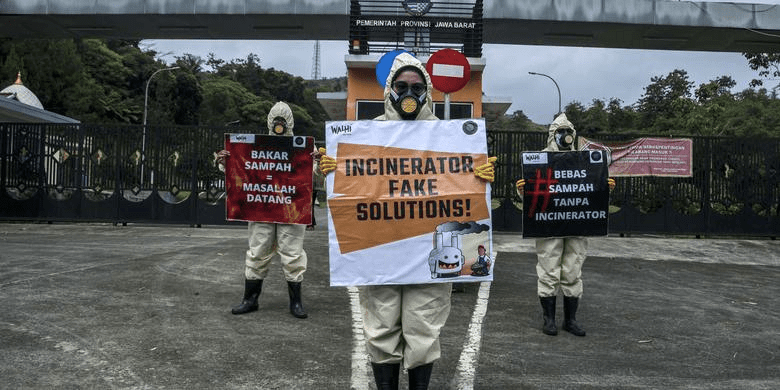
Local groups protest incinerator plans in Indonesia. source: WALHI
Zero Waste is Already Happening
It is critical that the organic waste ban to landfill policy drives and scales up the existing zero waste models. Nine zero-waste city models throughout Indonesia (Bandung City, Bandung Regency, Cimahi, Sumedang, Purwakarta, Karawang, Gresik, Denpasar and Gianyar) organized by AZWI cover a population of more than 478,000 people with an average of 40% waste segregation compliance rate, up to an 88% in the best cases, which is by far the highest in the country. In total, these zero waste models have the potential to reduce organic waste sent to landfill by 6,500 tons per year. In a recent report, YPBB and GAIA found that a city-scale zero waste implementation in Bandung is four times more climate-effective than incineration. The success of these zero waste initiatives has relied on two strategic pillars:
implementation of waste prevention measures, source separation and separate collection of various waste streams, including organic waste; and
strong community engagement with a clear priority for inclusion of informal waste collectors. Ultimately, local stakeholders have played a pivotal role in implementing the zero waste models that started with minimal government support.
Aliansi Zero Waste Indonesia (AZWI) and Dyan Prasetyangningtyas (DLH Kota Surabaya) conduct a stakeholders meeting in Bandung. source: YPBB
In conclusion, the level of ambition required in achieving Indonesia’s climate commitments, and the political momentum in West Java should be harnessed to drive systemic change. This can happen now thanks to decades of collective and dedicated work of local groups like YPBB, Bandung Zero Waste Forum, WALHI, and AZWI. To make the most of this, governments and financial institutions must create the right flow of resources and capacity — aligned with Environmental Justice principles — making the inclusion of local organizations a clear priority for a lasting impact.
25 January 2024– The International Zero Waste Month (IZWM) marks a critical juncture in the global fight against single-use plastics (SUPs). The Asia Reuse Consortium, a groundbreaking initiative, was established in Jakarta, Indonesia on January 11, comprising 18 individuals from 13 countries, including Indonesia, the Philippines, and Vietnam. This diverse network includes Civil Society Organizations (CSOs), businesses, and government officials, united by a mission to champion reuse as a practical, sustainable, and effective solution to SUPs.
In stark contrast to the linear nature of SUPs, the reuse model is designed for multiple lifecycles, offering economic benefits to communities while mitigating environmental impact. Approximately one-third of plastic packaging currently finds its way into the environment, highlighting the urgent necessity of transitioning to reuse. Embracing reuse systems presents an opportunity to reduce plastic pollution by 30 percent by 2040 and potentially decrease greenhouse gas emissions from packaging production by a staggering 80 percent.
Addressing this need, the Asia Reuse Consortium, initially convened by advocacy group Dietplastik Indonesia, with support from the Global Alliance for Incinerator Alternatives (GAIA) Asia Pacific, aims to spearhead the shift by advocating for the widespread adoption of reusable solutions across industries. With a specific focus on minimizing the impacts of SUPs, the consortium seeks to create a positive ripple effect by fostering collaboration among stakeholders, influencing business strategies, and advocating for supportive policies.
Tiza Mafira, Executive Director of Dietplastik Indonesia, highlights the benefits of choosing reusable items, stating, “Choosing reusable items not only helps the environment but also reduces emissions. By using less plastic in production and recycling, we cut down on waste. It’s a win-win for both sustainability and our planet.”
However, the success of reuse systems hinges on collective effort. The Consortium underscores the need for initiatives from forward-looking businesses and the support of local and national governments. This collaborative effort, with businesses and government units as active members, aims to actively promote the adoption of reusable packaging solutions. The approach involves emphasizing the benefits of sustainability and environmental protection, fostering collaboration among CSOs, businesses, and government bodies to facilitate knowledge exchange and initiatives supporting the advancement of reuse systems.
Froilan Grate, Regional Coordinator of GAIA Asia Pacific, summarizes the significance of the consortium’s emphasis on reuse. He states, “We promote reuse because reuse systems are accessible, affordable, and enhance people’s lives. We acknowledge that transitioning away from SUPs requires time but the process should be transparent, fair, and rooted in shared principles, cross-sector collaboration, and, most importantly, community-based solutions.”
The significance of the Asia Reuse Consortium extends beyond Indonesia, holding immense importance for the entire Asia Pacific region. Contrary to the blame often placed on the Global South for plastic pollution, the Asia Reuse Consortium stands at the forefront, paving the way for the reuse revolution.
###
The Reuse Consortium is a collaborative network of CSOs, businesses, and government officials dedicated to promoting reuse as a sustainable alternative to single-use packaging.