Asia Pacific

August 8, 2025 | Friday

Keep Your Promise, Fix the Process, End Plastic Pollution

Four days into the final Global Plastics Treaty negotiations, we are not on track to deliver a treaty that will protect people and nature. Enough is enough; something must change. We are joining the voices of waste pickers, frontline communities, scientists, healthcare professionals, children and youth, women, businesses, and non-governmental organisations around the world, calling on governments to step up. Fix the process, keep your promise, and finalise a meaningful treaty to end plastic pollution. 

After five rounds of negotiations over two years, and a repeat performance of obstruction from minority countries over the past four days, tensions are at a boiling point.  The “stocktake” plenary is scheduled for Saturday August 9, 2025 where co-chairs will give an update on the progress–or lack thereof– in negotiations thus far. This is the opportunity for ambitious countries to finally break through the consensus deadlock and call for a vote. 

See GAIA’s press release for details. 

Ambitious Proposals Gaining Momentum 

As we approach the mid-way point of negotiations, several ambitious Conference Room Papers (CRPs) have gained significant support amongst Member States. 

One is the Swiss/Mexico Proposal on Article 3: Plastic Products that we discussed in our daily recap on August 6. At the time of writing, 130 countries are in support. The proposal calls for a global ban on the production & trade of a list of harmful plastic products, including those containing some chemicals of concern. 

Another is the UK/Chile Proposal on Article 5: Product Design. To date 111 have signed on in support. This proposal recognizes the role of reuse in redesigning products. If we land a strong treaty that cuts plastic production, we will need to transition to toxic-free reuse practices and systems that are safe and sustainable. 

A key CRP to watch is the proposal for a standalone article on health, with 128 countries in support. The science is clear: plastic poses a serious and growing threat to our health and the health of future generations. Plastic has been found in our food, water, blood, stool, brain, placentas, breastmilk, and digestive systems. A plastics treaty must recognize the urgency of this issue and address it aggressively and decisively. 

Civil Society in Action

Today, the International Indigenous Peoples’ Forum on Plastics held a press conference, where panelists shared how Indigenous communities are on the frontlines of the plastics crisis. Pangunnaaq Vi Waghiyi of Alaska Community Action on Toxics stated, “The Arctic has the most microplastics of all the oceans. Our elders call our ocean our farm. It has sustained my people for millenia…to learn that our main food, our waters and seals during our long winters are loaded with microplastics… These are burdens we didn’t create.” 

Aakaluk Adrienne Blatchford of the Indigenous Environmental Network stated“[With] colonization throughout the world we’re seeing that it’s harder and harder to maintain not only our food security but our identity as Indigenous People, because without the food and what the land provides, we can’t survive. There is no us.”

For more information: 

PHOTOS


Get daily updates on-the-ground at plastics treaty negotiations INC 5.2

Available in English and Spanish.

QR code that leads to a whatsapp channel for daily updates

Media Contacts

Global Press Contact: 

Regional Press Contacts: 

About GAIA 

GAIA is a worldwide alliance of more than 1,000 grassroots groups, non-governmental organizations, and individuals in over 90 countries. With our work we aim to catalyze a global shift towards environmental justice by strengthening grassroots social movements that advance solutions to waste and pollution. We envision a just, zero waste world built on respect for ecological limits and community rights, where people are free from the burden of toxic pollution, and resources are sustainably conserved, not burned or dumped. 

Follow us on YouTube, Twitter, Facebook, Instagram, BlueSky, and LinkedIn for live updates during INC-5, and our regional accounts:

GAIA Africa: Instagram, Facebook

GAIA LAC: Instagram, Facebook, Twitter, LinkedIn

GAIA Asia Pacific: Instagram, Facebook, LinkedInGAIA US Canada: Instagram, Facebook, Twitter

Jueves, 7 de agosto de 2025

Dando vueltas en círculos

Es apenas el tercer día (de diez) de negociaciones del tratado de plásticos, y ya empiezan a notarse los nervios. Aunque múltiples documentos de sala (CRPs) y declaraciones muestran una increíble convergencia entre la mayoría de los países, sus propuestas —desarrolladas cuidadosamente durante meses de trabajo para construir apoyo entre los Estados Miembros— están recibiendo el mismo tiempo de exposición que las propuestas apresuradas presentadas por una ruidosa  minoría en cuestión de días. Este pequeño grupo de países se niega a ceder, pero afortunadamente, las naciones con ambición han mantenido hasta ahora su posición en temas clave como la reducción de la producción, las sustancias químicas preocupantes y un mecanismo financiero sólido.

La pregunta que todos se hacen es: ¿algún país pondrá fin a esta situación de consenso implacable, que se repite una y otra vez, y restablecerá la democracia? La sesión plenaria de balance (en la que los presidentes de los grupos de contacto informarán sobre los progresos realizados hasta ahora en los grupos de contacto) tendrá lugar el sábado si todo va según lo previsto. Si se convoca una votación, podría tener lugar entonces. Preparen las palomitas.

Negociaciones sobre el artículo 5: Diseño de productos

En el segundo día de negociaciones, los miembros de GAIA se sintieron alentados por el creciente apoyo de los Estados miembros a la inclusión de la «reutilización no tóxica» en el artículo 5 sobre el diseño de productos. La inclusión de este término fomentará la reutilización a escala mundial como alternativa al modelo de un solo uso y garantizará que las iniciativas de reutilización eviten el plástico y otros materiales que contienen sustancias químicas peligrosas. Algunos Estados miembros también defienden firmemente que se mantenga en el texto la referencia al Convenio de Basilea, ya que este regula el comercio de residuos peligrosos, incluidos algunos tipos de plásticos, pero no todos. El comercio de residuos plásticos ha demostrado ser un colonialismo de los residuos: los países más ricos envían sus residuos plásticos de bajo valor a los países de menores ingresos para que los gestionen. El tratado de plásticos debe cerrar cualquier laguna jurídica en el Convenio de Basilea, garantizando que todo comercio de residuos plásticos sea ambientalmente seguro y se realice previa notificación y consentimiento de los países receptores.

La transición justa en peligro

Hasta ahora, la referencia a la transición justa en el texto del tratado ha sido un punto de convergencia decidido, incluso entre los países menos entusiastas con otras propuestas progresistas. Sin embargo, un país aboga ahora por eliminar la transición justa de cualquier parte del texto. La transición justa es esencial para los recicladores y trabajadores, los Pueblos Indígenas y las comunidades de primera línea más afectadas por la contaminación plástica. Lea la declaración conjunta de los Pueblos Indígenas, los recicladores y los trabajadores sindicalizados para obtener más información sobre sus demandas.

La injerencia de EE. UU. en el mecanismo financiero (artículo 11)

Estados Unidos ha presentado un CRP en el que promueve una «red de coordinación público-privada» para el artículo 11 sobre el mecanismo financiero, como alternativa a un impuesto global a los contaminadores. Estas asociaciones «innovadoras» podrían fomentar enfoques contaminantes en las fases posteriores del proceso, como el «reciclaje químico» y los créditos de plástico, y no estarían sujetas a la supervisión de los Estados miembros a través de la COP (el órgano encargado de la aplicación del tratado). En esencia, esto podría dar lugar a una oleada de inversión privada que arrebataría el poder y los recursos a los Estados miembros, que son quienes deberían controlar cómo se gasta el dinero. La privatización de la financiación del desarrollo ha demostrado históricamente que perpetúa las desigualdades en lugar de resolver los problemas mundiales.

Infiltración de la industria

Según un análisis de CIEL, un número récord de 234 lobistas de la industria química y de los combustibles fósiles se han inscrito para asistir al INC-5.2. Los lobistas de la industria química y de los combustibles fósiles superan en número a la Coalición de Científicos por un Tratado Eficaz sobre los Plásticos (60) en una proporción de casi cuatro a uno, y al Caucus de los Pueblos Indígenas (36) en una proporción de casi siete a uno.

Créditos de plástico, desacreditados

En los últimos dos días se han publicado dos investigaciones contundentes que exponen el impacto negativo que los créditos de plástico están teniendo en los recicladores de África (Kenia y Ghana). Ambas revelaron que, aunque estos proyectos de créditos afirman apoyar el sustento de las y los recicladores, estos a menudo compiten con los programas en lugar de beneficiarse de ellos. Además, los proyectos probablemente ni siquiera estén logrando su objetivo de incentivar la recolección y el reciclaje de plásticos, ya que los recicladores ya lo venían haciendo mucho antes de que existieran estos créditos. Los miembros de GAIA han expresado su preocupación por la inclusión del término “financiamiento innovador” en el Artículo 11, ya que podría abrir la puerta a más proyectos de créditos plásticos como una supuesta forma de financiar la implementación del tratado, una vez más poniendo el poder en manos del sector privado en lugar de los gobiernos, y enfocándose en la gestión ineficaz de residuos en lugar de su reducción. Con la industria del plástico detrás de estos proyectos, una se pregunta: ¿quién se está beneficiando realmente de la ficción de los créditos plásticos?

La sociedad civil en acción

Más de 48 millones de profesionales de la salud de todo el mundo, entre ellos la Asociación Médica Mundial y el Consejo Internacional de Enfermeras, piden a los líderes mundiales que pongan fin a la contaminación por plásticos, impulsando un Tratado Global de Plásticos justo, equitativo y centrado en la salud.

Greenpeace organizó una acción de protesta a las puertas del Palacio de las Naciones para exigir que se expulse a las grandes petroleras de las negociaciones.

Para más información:

GAIA webpage

Break Free From Plastic POPLite

Dr. Miguel Rivas en CPS Noticias informa sobre el Tratado de plásticos


Recibe noticias diarias del tratado de plasticos desde el inc 5.2

Media Contacts

Global Press Contact: 

Regional Press Contacts: 

About GAIA 

GAIA is a worldwide alliance of more than 1,000 grassroots groups, non-governmental organizations, and individuals in over 90 countries. With our work we aim to catalyze a global shift towards environmental justice by strengthening grassroots social movements that advance solutions to waste and pollution. We envision a just, zero waste world built on respect for ecological limits and community rights, where people are free from the burden of toxic pollution, and resources are sustainably conserved, not burned or dumped. 

Follow us on YouTube, Twitter, Facebook, Instagram, BlueSky, and LinkedIn for live updates during INC-5, and our regional accounts:

GAIA Africa: Instagram, Facebook

GAIA LAC: Instagram, Facebook, Twitter, LinkedIn

GAIA Asia Pacific: Instagram, Facebook, LinkedInGAIA US Canada: Instagram, Facebook, Twitter

August 7, 2025 | Thursday

Going around in Circles

It’s only Day 3 (out of 10) of the plastics treaty negotiations, and already nerves are starting to fray. While multiple conference room papers (CRPs) and statements show an incredible amount of convergence between the majority of countries, their proposals—which have been carefully developed in a months-long effort to build support amongst the Member States— are given the same amount of airtime as proposals dashed off and submitted by the vocal minority in a matter of days. This small group of nations refuses to budge, and fortunately ambitious countries have so far held the line on critical issues like production reduction, chemicals of concern, and a strong financial mechanism. With this stubborn minority trying to prevent any substantial progress in contact groups, once again Member States are faced with long days and profound uncertainty. 

The question on everyone’s mind is: will any country put a stop to this relentless consensus-based, groundhog day situation and reestablish democracy? The stocktake plenary (where contact group chairs will report progress–or lack thereof– made in contact groups thus far) will take place on Saturday if all goes according to plan. If a call for a vote happens, it might happen then. Grab your popcorn.  

Negotiations on Article 5: Product Design 

On day 2 of negotiations, GAIA members were encouraged by the growing Member State support to add “non-toxic reuse” to Article 5 on product design. The inclusion of such a term will encourage the scaling of reuse globally as an alternative to the single-use model, and ensure that those reuse initiatives avoid plastic and other materials that contain hazardous chemicals. Some Member States are also strongly advocating that reference to the Basel Convention be retained in the text– the reasoning for this is that the Basel Convention regulates the trade of hazardous waste, including some, but not all types of plastics. The plastic waste trade has shown itself to be waste colonialism: wealthier countries shipping off their low-value plastic waste for lower-income countries to manage. The plastics treaty must close any loopholes in the Basel Convention by ensuring that any plastic waste trade is environmentally sound and follows prior notification and consent from receiving countries. 

Just Transition Under Threat

Up until now, reference to Just Transition in the treaty text has been a decided point of convergence, even amongst countries less enthusiastic about other progressive proposals. However, one country is now advocating to remove Just Transition from any part of the text. A Just Transition is essential for waste pickers and workers, Indigenous Peoples, and frontline communities most impacted by plastic pollution. Read the day’s joint statement from  Indigenous Peoples, Waste Pickers, and Unionized Workers to learn more about their demands. 

US Meddling with the Financial Mechanism (Article 11)

The United States has submitted a CRP promoting a “Public-Private Coordination Network” for article 11 on the financial mechanism, as an alternative to a global tax on polluters. These “innovative” partnerships could encourage polluting downstream approaches like “chemical recycling” and plastic credits, and would have no oversight from Member States through the COP (the body in charge of treaty implementation). Essentially, this could open a Wild West of private investment that wrests power and resources away from Member States, who should be the ones to control how money is being spent. The privatization of development finance has been shown historically to perpetuate inequities instead of solving global problems.  

Industry Infiltration 

According to a CIEL analysis, a record number 234 fossil fuel and chemical industry lobbyists are registered to attend INC-5.2. Chemical and fossil fuel industry lobbyists outnumber the Scientists’ Coalition for an Effective Plastic Treaty (60) by nearly four to one, and the Indigenous Peoples’ Caucus (36) by nearly seven to one.

Plastic Credits, Discredited 

Two hard-hitting investigations have come out over the past two days exposing the negative impact that plastic credits are having on waste pickers in Africa (Kenya and Ghana). Both revealed that while these credit projects claim to support waste picker livelihoods, waste pickers are often competing with instead of benefiting from these programs. In both cases, it was clear that the plastic credit projects were likely not even fulfilling their purpose of incentivizing more plastic collection and recycling— waste pickers were already doing that long before plastic credits came along. GAIA members have raised concerns about the inclusion of the term “innovative financing” in Article 11, which could open the door for further plastic credit projects as a supposed way of financing the treaty implementation, once again placing the power in the hands of private actors instead of governments, and focusing on ineffective waste management instead of waste reduction. With plastic industry groups behind these projects, one wonders who is really benefiting from the fiction of plastic credits… 

Civil Society in Action

Over 48 million health professionals from all over the globe, including the World Medical Association and the International Council of Nurses, are calling on world leaders to end plastic pollution—pushing for a just, equitable, and health-centered Global Plastics Treaty.

Greenpeace on staged a protest action at the gates to the Palais de Nations demanding big oil to be kicked out from the negotiations. 

For more information: 

PHOTOS


Get daily updates on-the-ground at plastics treaty negotiations INC 5.2

Available in English and Spanish.

QR code that leads to a whatsapp channel for daily updates

Media Contacts

Global Press Contact: 

Regional Press Contacts: 

About GAIA 

GAIA is a worldwide alliance of more than 1,000 grassroots groups, non-governmental organizations, and individuals in over 90 countries. With our work we aim to catalyze a global shift towards environmental justice by strengthening grassroots social movements that advance solutions to waste and pollution. We envision a just, zero waste world built on respect for ecological limits and community rights, where people are free from the burden of toxic pollution, and resources are sustainably conserved, not burned or dumped. 

Follow us on YouTube, Twitter, Facebook, Instagram, BlueSky, and LinkedIn for live updates during INC-5, and our regional accounts:

GAIA Africa: Instagram, Facebook

GAIA LAC: Instagram, Facebook, Twitter, LinkedIn

GAIA Asia Pacific: Instagram, Facebook, LinkedInGAIA US Canada: Instagram, Facebook, Twitter

Miércoles, 6 de agosto de 2025

Los Estados miembros dedicaron la jornada a reuniones en grupos de contacto (un término que designa los espacios de negociación). Estos espacios se rigen por las reglas de Chatham House, por lo que, aunque no podemos revelar explícitamente qué país dijo qué, podemos ofrecer algunos aspectos destacados de lo que se debatió y cuáles son las líneas divisorias. En general, hubo intentos por parte de un grupo minoritario de redefinir qué disposiciones están dentro de los límites de un tratado de plásticos, en contra del mandato central que los países acordaron al inicio de las negociaciones: un instrumento jurídicamente vinculante que abarque todo el ciclo de vida del plástico, desde su extracción hasta su eliminación, entendiendo que el plástico es contaminante en todas las etapas de su existencia.

Artículo 3: Productos plásticos y sustancias químicas preocupantes

El Grupo de Contacto 1 pasó horas debatiendo el Artículo 3, que busca abordar los productos plásticos más problemáticos y la infinidad de sustancias químicas presentes en el propio plástico. Hablar de “químicos preocupantes” es quedarse corto: un estudio reciente reveló que más de 4.200 sustancias químicas en los plásticos son persistentes, bioacumulativas, móviles o tóxicas. Además, la Organización Mundial de la Salud (OMS) estima que aproximadamente una cuarta parte de todas las muertes a nivel mundial se deben a daños ambientales, incluidos químicos, contaminación y desechos, afectando de manera desproporcionada a los países de ingresos bajos y medios.

Suiza y México presentaron un documento de sala (CRP, por sus siglas en inglés),* que ha ganado un apoyo significativo con la adhesión de 77 países. El CRP propone una prohibición global del comercio de productos plásticos peligrosos y sustancias químicas preocupantes, además de establecer la obligación de reducir (y prohibir cuando sea posible) los productos plásticos dañinos.

A pesar del amplio apoyo recibido, varios países intentaron debilitar el artículo 3, alegando que las normas mundiales amenazarían el desarrollo económico nacional, que los productos químicos ya están regulados por otros tratados medioambientales y que estas cuestiones deberían abordarse en posteriores COP tras la firma de un tratado (lo que cerraría efectivamente la puerta a una eliminación gradual jurídicamente vinculante de los productos químicos nocivos en los plásticos).

Por el contrario, Brasil y Corea del Sur facilitaron un CRP que no contiene ningún lenguaje jurídicamente vinculante para eliminar gradualmente los productos plásticos y los productos químicos preocupantes. Esto no es ninguna sorpresa, dado que Brasil ha sido denunciado por dar marcha atrás en sus posiciones debido a conflictos internos y a la influencia de la industria petroquímica.

Rechazo de la recuperación de energía en el artículo 8

El borrador del texto del presidente que sirve de base para las negociaciones en la INC-5.2 contiene una referencia a la conversión de residuos en energía en el artículo 8, que trata de la gestión de los residuos plásticos. Se ha demostrado que la quema de residuos en incineradoras de «conversión de residuos en energía» genera emisiones tóxicas y climáticas, lo que esencialmente convierte una forma de contaminación plástica en otra. Si se mantiene en el texto, podría fomentar nuevas inversiones y la construcción de incineradoras en todo el mundo. Afortunadamente, varios países han intervenido para pedir que se elimine la conversión de residuos en energía del texto final. Cruzamos los dedos.

Artículo 11: La necesidad de un mecanismo financiero específico

El Grupo Africano de Negociadores logró una fuerte convergencia en torno a su CRP presentado en el INC-5, que pide un mecanismo financiero específico que incluya contribuciones obligatorias de los países ricos y los principales productores de plástico para ayudar a los países de bajos ingresos a cumplir el acuerdo, especialmente a los pequeños Estados insulares en desarrollo del Pacífico. Sin embargo, a pesar de este nivel de acuerdo entre los Estados miembros, el presidente no incluyó el texto propuesto en su borrador para el INC-5.2. Sigue siendo una incógnita si los países donantes aceptarán sentarse a la mesa y pagar por la contaminación que causan en otros países. Esperamos que el debate sobre las finanzas impulse el acuerdo a finales de esta semana.

Otros documentos de sala que cabe destacar

  • Artículo 20: Colombia y Perú han propuesto que se someta a votación en la COP si no se alcanza un consenso. Esto es fundamental para evitar el estancamiento a la hora de añadir nuevos anexos al tratado tras su firma.
  • Artículo 7: El Reino Unido y Panamá han propuesto que el artículo sobre las fugas abarque todo el ciclo de vida del plástico, reconociendo que este es una fuente de contaminación por residuos desde su extracción hasta su eliminación, incluidos los microplásticos.

*Los grupos de contacto están animando a los Estados miembros a presentar documentos de sala de conferencias (CRP) con sugerencias de adiciones al texto, y los CRP que tengan mayor convergencia entre los Estados miembros se integrarán en el borrador de la Presidencia, que sigue siendo la base de las negociaciones. Ya se han presentado muchos documentos, que pueden consultarse en el sitio web del PNUMA aquí.

Para más información:

GAIA webpage

Break Free From Plastic POPLite

Se retoman las negociaciones del Tratado de plásticos en Ginebra, una oportunidad histórica para hacer frente a la contaminación por plásticos


Recibe noticias diarias del tratado de plasticos desde el inc 5.2

Media Contacts

Global Press Contact: 

Regional Press Contacts: 

About GAIA 

GAIA is a worldwide alliance of more than 1,000 grassroots groups, non-governmental organizations, and individuals in over 90 countries. With our work we aim to catalyze a global shift towards environmental justice by strengthening grassroots social movements that advance solutions to waste and pollution. We envision a just, zero waste world built on respect for ecological limits and community rights, where people are free from the burden of toxic pollution, and resources are sustainably conserved, not burned or dumped. 

Follow us on YouTube, Twitter, Facebook, Instagram, BlueSky, and LinkedIn for live updates during INC-5, and our regional accounts:

GAIA Africa: Instagram, Facebook

GAIA LAC: Instagram, Facebook, Twitter, LinkedIn

GAIA Asia Pacific: Instagram, Facebook, LinkedInGAIA US Canada: Instagram, Facebook, Twitter

August 6, 2025 | Wednesday

Member States spent the day in Contact Groups (a term for negotiating spaces). These spaces fall under Chatham House Rules, so while we cannot say explicitly which country said what, we can give some highlights of what was discussed and what the fault lines are. Across the board, there were attempts by a minority group to redefine what provisions are within the bounds of a plastics treaty, going against the central mandate that countries agreed upon at the inception of the plastics treaty negotiations— a legally binding instrument covering the entire life-cycle of plastic, from extraction to disposal, understanding that plastic is pollution at every stage of its existence. 

Article 3: Plastic Products and Chemicals of Concern

Contact Group 1 spent hours hashing it out on Article 3, which is meant to address the most problematic plastic products, and the myriad chemicals in plastic itself. Chemicals of “concern” is an understatement–a recent study showed that more than 4,200 chemicals in plastic were persistent, bioaccumulative, mobile or toxic, and The World Health Organization (WHO) estimates that approximately one quarter of all global deaths are attributable to environmental harm including chemicals, pollution and waste, disproportionately affecting low- and middle-income countries.

Switzerland and Mexico submitted a Conference Room Paper (CRP),* which has gained significant traction with 77 countries signing on. The CRP calls for a global ban on trade of hazardous plastic products and chemicals of concern, and a requirement to reduce (and ban where feasible) harmful plastic products.

Despite its widespread support, several countries sought to weaken article 3, suggesting that global rules would threaten national economic development, that chemicals are covered by other environmental treaties, and that these issues should be addressed in subsequent COPs after a treaty is signed (which would effectively close the door to a legally-binding phase-out of harmful chemicals in plastics). 

In contrast, Brazil and South Korea facilitated a CRP that has no legally binding language to phase out plastic products and chemicals of concern. This comes as no surprise given that Brazil has been exposed for backtracking on its positions due to internal conflict and influence from the petrochemical industry. 

Rejecting Energy Recovery in Article 8

The Chair’s draft text that forms the basis of negotiations in INC-5.2 contains a reference to waste-to-energy in article 8, which covers plastic waste management. Burning  waste in “waste-to-energy” incinerators has been shown to create toxic and climate emissions, essentially turning one form of plastic pollution into another. If it remains in the text, this could encourage further investment and build-out of incinerators worldwide. Fortunately, several countries made interventions asking for waste-to-energy to be removed from the final text. We’re crossing our fingers. 

Article 11: The Need for a Dedicated Financial Mechanism 

The African Group of Negotiators created a strong convergence around its CRP introduced at INC-5, which calls for a dedicated financial mechanism that includes mandatory contributions from high-wealth and top-plastic producing countries to support lower income countries to meet the agreement, especially Pacific Small Island Developing States. However despite this level of agreement between Member States, the Chair did not take up the proposed language in his draft text for INC-5.2. Whether donor countries can agree to come to the table and pay for the pollution they cause in other countries remains a question. We hope to see the discussion on finances driving agreement later this week.

Other Conference Room Papers to Note

  • Article 20: Colombia and Peru have proposed COP voting if consensus cannot be reached. This is critical for preventing deadlock when adding further annexes to the treaty after its signed.
  • Article 7: UK and Panama have proposed that the article on leakages cover the entire life cycle of plastic, recognizing that plastic is a source of waste pollution from extraction to disposal, including microplastics. 

*Contact Groups are encouraging Member States to submit Conference Room Papers (CRPs)  with suggested text additions, and whichever CRPs have the most convergence amongst the Member States will be integrated into the Chair’s draft, which still forms the basis for negotiations. There have been many submissions already, which can all be found on the UNEP website here

For more information: 

For more information, visit GAIA’s webpage 
GAIA Asia Pacific Newsroom

GAIA Africa Daily Update

Break Free From Plastic POPLite

Plastics: The New and Final Colonizer

Se retoman las negociaciones del Tratado de plásticos en Ginebra, una oportunidad histórica para hacer frente a la contaminación por plásticos

Pollution plastique: les États africains en première ligne à Genève pour tenter de limiter la catastrophe


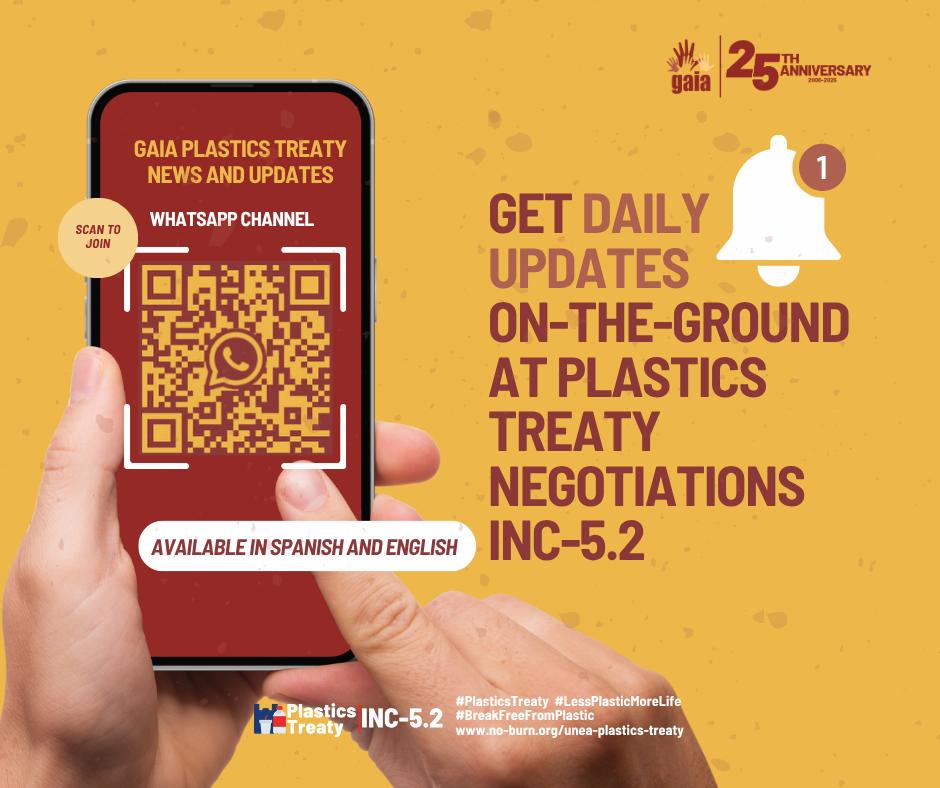
Get daily updates on-the-ground at plastics treaty negotiations INC 5.2

Available in English and Spanish.

QR code that leads to a whatsapp channel for daily updates

Media Contacts

Global Press Contact: 

Regional Press Contacts: 

About GAIA 

GAIA is a worldwide alliance of more than 1,000 grassroots groups, non-governmental organizations, and individuals in over 90 countries. With our work we aim to catalyze a global shift towards environmental justice by strengthening grassroots social movements that advance solutions to waste and pollution. We envision a just, zero waste world built on respect for ecological limits and community rights, where people are free from the burden of toxic pollution, and resources are sustainably conserved, not burned or dumped. 

Follow us on YouTube, Twitter, Facebook, Instagram, BlueSky, and LinkedIn for live updates during INC-5, and our regional accounts:

GAIA Africa: Instagram, Facebook

GAIA LAC: Instagram, Facebook, Twitter, LinkedIn

GAIA Asia Pacific: Instagram, Facebook, LinkedInGAIA US Canada: Instagram, Facebook, Twitter

Martes, 5 de agosto de 2025

En la mañana del primer día del INC-5.2, la sala plenaria estaba llena y cargada de expectativa. La gran pregunta al comenzar las negociaciones es si la mayoría de los países se mantendrán firmes frente al pequeño grupo de Estados petroleros que intenta debilitar el tratado, especialmente en lo relacionado con la necesidad de establecer recortes obligatorios a la producción.

El presidente abrió las negociaciones en sesión plenaria reconociendo la importancia de los conocimientos especializados de la sociedad civil y recordó a los Estados miembros que todos ellos habían adoptado el mandato de la UNEA-5.2 para un tratado jurídicamente vinculante sobre los plásticos que abarcara todo el ciclo de vida de los plásticos. Este recordatorio puede haber sido deliberado, ya que el pequeño pero ruidoso grupo de países que se oponen al tratado han cuestionado su alcance, insistiendo en que se centre únicamente en la gestión de los residuos.

Tan pronto como el presidente presentó la organización del trabajo, el primer Estado Miembro en tomar la palabra fue (¡sorpresa, sorpresa!) Arabia Saudita, en nombre del Grupo Árabe. Expresaron su decepción por el hecho de que el Artículo 6 —que aborda la posibilidad de reducir la producción de polímeros plásticos— siga incluido en las negociaciones. Irak apoyó esa postura. El presidente respondió que todos los artículos deben tener la oportunidad de ser negociados. Esta intervención temprana, justo al comenzar, marca el tono de las negociaciones: el Artículo 6 será un campo de batalla clave.

Con un espacio limitado para los observadores de la sociedad civil, sólo 15 de las 618 organizaciones observadoras tuvieron tiempo para intervenir en la sesión plenaria de apertura de hoy. Sin embargo, esas intervenciones mostraron la amplia gama de actores que engloba la amplia definición de «observadores». Por un lado, la Alianza Internacional de Recicladores, el Foro de Pueblos Indígenas sobre Plásticos, la Coalición de Científicos y Break Free From Plastic realizaron intervenciones contundentes. John Beard Jr., en nombre de Break Free From Plastic, afirmó: «Seamos claros: estas negociaciones han sido secuestradas por las industrias de los combustibles fósiles y petroquímicos».

Al otro lado de la «observadores», el Consejo Internacional de Asociaciones Químicas y la Sociedad de Ingenieros del Plástico mencionaron la «circularidad», código de la industria para centrarse en la gestión de residuos en lugar de en su reducción, y promovieron el «reciclaje químico», un proceso de incineración de residuos tóxicos.

Aunque GAIA no pudo intervenir en la sala, hemos grabado nuestra intervención para que pueda verse y leerse. En ella afirmamos: «El multilateralismo está en peligro, no por desacuerdo, sino porque la unanimidad se ha convertido en un arma para bloquear el progreso. Votar no es dividir, es democracia. Permite a los países actuar en función de sus capacidades nacionales, tan a menudo invocadas en esta sala, sin paralizar la ambición colectiva. Si la soberanía no es negociable, tampoco lo es el derecho de los demás a avanzar».

Para más información:

Para más información, visite la página web de GAIA.

Animal Político, México – Una segunda oportunidad para poner freno a la producción de plástico a nivel mundial

Sala de prensa de GAIA Asia-Pacífico

Actualización diaria de GAIA África

Artículo de opinión en Rappler: La contaminación plástica no esperará a que se alcance un consenso

Investigación: El nuevo mercado mundial de «créditos plásticos» amenaza los medios de vida en un vertedero de Kenia


Recibe noticias diarias del tratado de plasticos desde el inc 5.2

Media Contacts

Global Press Contact: 

Regional Press Contacts: 

About GAIA 

GAIA is a worldwide alliance of more than 1,000 grassroots groups, non-governmental organizations, and individuals in over 90 countries. With our work we aim to catalyze a global shift towards environmental justice by strengthening grassroots social movements that advance solutions to waste and pollution. We envision a just, zero waste world built on respect for ecological limits and community rights, where people are free from the burden of toxic pollution, and resources are sustainably conserved, not burned or dumped. 

Follow us on YouTube, Twitter, Facebook, Instagram, BlueSky, and LinkedIn for live updates during INC-5, and our regional accounts:

GAIA Africa: Instagram, Facebook

GAIA LAC: Instagram, Facebook, Twitter, LinkedIn

GAIA Asia Pacific: Instagram, Facebook, LinkedInGAIA US Canada: Instagram, Facebook, Twitter

August 5, 2025 | Tuesday

The morning of the first day of INC-5.2, the plenary room was jammed and buzzing with anticipation. The main question going into negotiations is whether the majority of countries will stand strong against the small group of petro-states attempting to weaken the treaty, especially on the question of mandatory production cuts.

The Chair opened the negotiations in plenary by acknowledging the vital expertise of civil society, and he reminded Member States that they all adopted the UNEA-5.2 mandate for a legally binding plastics treaty that covers the full life-cycle of plastic. This reminder may have been pointed, as the small but vocal group of obstructing countries have questioned the scope of the treaty, insisting that it be focused on waste management alone. 

As soon as he laid out the organization of work, the first Member State to speak was (surprise, surprise) Saudi Arabia, on behalf of the Arab Group. They expressed disappointment that Article 6 (which covers the option for plastic polymer production reduction) is still included in the negotiations. Iraq echoed that sentiment. The Chair responded that all articles must be given a chance to be negotiated. This early intervention right out of the gate sets the tone for the negotiations– article 6 is going to be a key battleground. 

With limited space for civil society observers, just under 15 of the 618 observer organizations were given the time to speak at today’s opening plenary. However, those interventions showed the wide range of actors under the broad definition of “observers.” On one side, the International Alliance of Waste Pickers, Indigenous Peoples’ Forum on Plastics, Scientists Coalition, and Break Free From Plastic all made powerful interventions. John Beard Jr. on behalf of Break Free From Plastic stated, “Let’s be clear: these negotiations have been captured by the fossil fuel and petrochemical industries.” 

On the other side of “observers,” the International Council of Chemical Associations and the  Society of Plastics Engineers spoke, mentioning “circularity,” industry code for focusing on waste management instead of reduction, and promoting “chemical recycling,” a toxic waste-burning process. 

While GAIA was not able to make an intervention on the floor, we have recorded it for viewing and reading. In it we state, “Multilateralism is at risk, not because of disagreement, but because unanimity has been weaponized to block progress. Voting is not division; it is democracy. It allows countries to act on their national capacities, so often invoked in this room, without paralyzing collective ambition. If sovereignty is non-negotiable, then so too is the right of others to move forward.” 

For more information: 

For more information, visit GAIA’s webpage 

GAIA Asia Pacific Newsroom

GAIA Africa Daily Update

Op-ed in the Rappler: Plastic Pollution Won’t Wait for Consensus 

Investigation: New Global Market for “Plastic Credits” Threatens Livelihoods at Kenyan Dump


Get daily updates on-the-ground at plastics treaty negotiations INC 5.2

Available in English and Spanish.

QR code that leads to a whatsapp channel for daily updates

Media Contacts

Global Press Contact: 

Regional Press Contacts: 

About GAIA 

GAIA is a worldwide alliance of more than 1,000 grassroots groups, non-governmental organizations, and individuals in over 90 countries. With our work we aim to catalyze a global shift towards environmental justice by strengthening grassroots social movements that advance solutions to waste and pollution. We envision a just, zero waste world built on respect for ecological limits and community rights, where people are free from the burden of toxic pollution, and resources are sustainably conserved, not burned or dumped. 

Follow us on YouTube, Twitter, Facebook, Instagram, BlueSky, and LinkedIn for live updates during INC-5, and our regional accounts:

GAIA Africa: Instagram, Facebook

GAIA LAC: Instagram, Facebook, Twitter, LinkedIn

GAIA Asia Pacific: Instagram, Facebook, LinkedInGAIA US Canada: Instagram, Facebook, Twitter

Distinguished Delegates,

My name is Rafael Eudes, representing Aliança Resíduo Zero Brasil and GAIA, a network of over 1,000 organisations advancing real-world solutions to end plastic pollution.

We reaffirm our unwavering commitment to a legally binding treaty that protects health, upholds human rights, ensures a just transition for vulnerable communities, workers in the plastics chain and explicitly recognizes the indispensable role of waste pickers. This treaty must cover the entire plastics lifecycle, from extraction to disposal, as clearly mandated by UNEA Resolution 5/14.

Let’s be clear: plastic was never essential to development. It accounts for just 0.6% of global GDP, concentrated in ten countries. Yet it causes up to $4.4 trillion in harm annually, including $1.5 trillion in health-related costs. The numbers expose a misconstrued system that rewards destruction over wellbeing. It is indefensible.

A treaty without a moral compass is just ink on paper. Justice must be the direction, and dignity the destination. We therefore support the 100+ countries demanding bold, science-based limits on plastic production. Without this, we cannot keep global heating below 1.5°C or build resilient economies.

Multilateralism is at risk, not because of disagreement, but because unanimity has been weaponized to block progress. Voting is not division; it is democracy. It allows countries to act on their national capacities, so often invoked in this room, without paralyzing collective ambition. If sovereignty is non-negotiable, then so too is the right of others to move forward.

We, civil society, though repeatedly denied meaningful participation, remain united in purpose. We are not asking for charity, we are demanding courage. The path to agreement must remain open, even if unanimity is not. A treaty that fails to deliver impact is far more dangerous than one that fails to please everyone.

We urge all Parties: listen, not just to each other, but to your people. Across the world, citizens have reached a remarkable convergence in demanding an ambitious treaty. That clarity is yet to be matched in this process.

There is still time to rise to the moment and write a legacy that future generations will celebrate, not regret. History will judge the choices made in this room. The time to act is now.

Declaración plenaria inaugural de GAIA

Distinguidos delegados:

Mi nombre es Rafael Eudes, en representación de Aliança Resíduo Zero Brasil y GAIA, una red de más de 1000 organizaciones que promueven soluciones reales para poner fin a la contaminación por plásticos.

Reafirmamos nuestro compromiso inquebrantable con un tratado jurídicamente vinculante que proteja la salud, defienda los derechos humanos, garantice una transición justa para las comunidades vulnerables y los trabajadores de la cadena del plástico, y reconozca explícitamente el papel indispensable de los recicladores. Este tratado debe abarcar todo el ciclo de vida del plástico, desde la extracción hasta la eliminación, tal como establece claramente la Resolución 5/14 de la UNEA.

Seamos claros: el plástico nunca ha sido esencial para el desarrollo. Solo representa el 0,6 % del PIB mundial, concentrado en diez países. Sin embargo, causa hasta 4,4 billones de dólares de daños al año, incluidos 1,5 billones en costes relacionados con la salud. Las cifras ponen de manifiesto un sistema erróneo que premia la destrucción por encima del bienestar. Es indefendible.

Un tratado sin brújula moral no es más que tinta sobre papel. La justicia debe ser la dirección y la dignidad el destino. Por lo tanto, apoyamos a los más de 100 países que exigen límites ambiciosos y basados en la ciencia a la producción de plásticos. Sin ello, no podremos mantener el calentamiento global por debajo de los 1,5°C ni construir economías resilientes.

El multilateralismo está en peligro, no por desacuerdo, sino porque la unanimidad se ha convertido en un arma para bloquear el progreso. Votar no es dividir, es democracia. Permite a los países actuar en función de sus capacidades nacionales, tan a menudo invocadas en esta sala, sin paralizar la ambición colectiva. Si la soberanía no es negociable, tampoco lo es el derecho de los demás a avanzar.

Nosotros, la sociedad civil, aunque se nos ha negado repetidamente una participación significativa, seguimos unidos en nuestro propósito. No pedimos caridad, exigimos valentía. El camino hacia el acuerdo debe permanecer abierto, aunque no lo esté la unanimidad. Un tratado que no tenga impacto es mucho más peligroso que uno que no satisfaga a todos.

Instamos a todas las Partes a que escuchen, no solo entre ustedes, sino también a sus ciudadanos. En todo el mundo, los ciudadanos han alcanzado una notable convergencia en la exigencia de un tratado ambicioso. Esa claridad aún no se ha reflejado en este proceso.

Aún estamos a tiempo de estar a la altura de las circunstancias y escribir un legado que las generaciones futuras celebrarán, en lugar de lamentar. La historia juzgará las decisiones que se tomen en esta sala. Es hora de actuar.

Les doy las gracias.

###

GAIA is a worldwide alliance of more than 1,000 grassroots groups, non-governmental organizations, and individuals in over 90 countries. With our work we aim to catalyze a global shift towards environmental justice by strengthening grassroots social movements that advance solutions to waste and pollution. We envision a just, zero waste world built on respect for ecological limits and community rights, where people are free from the burden of toxic pollution, and resources are sustainably conserved, not burned or dumped. 

Study: Particulate Matter Levels in Communities Hosting Waste Incinerators Up to 8 Times Higher than World Health Organization Guidelines

First of Its Kind Cross-Regional Citizen Science Air Quality Monitoring Project in Surabaya, Indonesia; Ogijo, Nigeria; Dumaguete, Philippines 

FOR IMMEDIATE RELEASE: 2 July, 2025

A citizen-science study monitoring the air quality nearby waste incineration facilities in three cities in the Global South found high levels of particulate matter (PM); PM2.5 levels were 5-8 times higher and PM 10 were between 3-5 times higher than the guidelines set by the World Health Organization. The study comes as a response to local governments and regulatory agencies’ failure to monitor these facilities’ pollution levels, allowing them to continue unchecked. Community groups are calling on their local governments to enforce stricter environmental regulations and monitoring for polluting facilities, if not shut them down altogether. 

“The air pollution from these incinerators are not just a distant threat—they’re already affecting our health and daily lives,” states Wahyu Eka Styawan of WALHI East Java, Indonesia. “People are coughing, struggling to breathe, and living in fear of what they can’t see but can certainly feel. What’s worse, we’ve been kept in the dark. There’s no transparency, no real space for public participation in decisions that affect our future. This is not just unfair—it’s dangerous. We urgently call on governments to cancel these waste-to-energy projects and start listening to the people who are paying the price with their lungs.”

Three members of the Global Alliance for Incinerator Alternatives (GAIA)War on Waste (WOW) Negros Oriental in Dumaguete, Philippines; Green Knowledge Foundation in Ogijo, Nigeria; and Indonesian Environmental Forum (WALHI) in Surabaya, Indonesia organized community volunteers to wear portable air-quality monitors near the polluting facility, in addition to stationary air monitoring equipment. 

The monitors measured two kinds of particulate matter (PM)– PM 2.5 and PM 10. The study found: 

  • In Dumaguete, citizens monitored the area nearby a pyrolysis-gasification unit at a Central Materials Recovery Facility. The PM2.5 concentration level was unhealthy for a portion of the population 24 out of 27 days (88%), and was up to 7 times higher than WHO guidelines, as a result of the facility’s emissions. Researchers estimated that up to 179 premature deaths could be avoided annually by shutting down the pyrolysis plant.
  • In Surabaya, citizens monitored the area nearby a gasification facility called Benowo Waste-to-Energy Power Plant. Maximum daily average PM2.5 levels were up to 8 times higher than WHO guidelines, exceeding the threshold 100% of the monitoring days. Throughout the entire mobile monitoring period (31 days in total), the air quality was not considered healthy for a single day. 
  • In Ogijo, citizens monitored the area around a facility claiming to recycle tires called Tec High Profile Nigeria Limited. The maximum daily average PM2.5 level was up to 5 times higher than WHO guidelines, exceeding the threshold 100% of the monitoring days.Throughout the entire monitoring period (23 days in total), the air quality was unhealthy for a portion of the population. 

PM is a known carcinogen. Because it is so small, particulate matter can easily permeate every organ in the body, with disastrous consequences on human health. PM can cause asthma, bronchitis, chronic obstructive pulmonary disease, and cancers, among others.

Many of the readings were taken at nearby schools, retirement homes, residential areas, local stores, and farmland, showing how the pollution can affect everyday life of community members, and that those most vulnerable in our society–children, the elderly, and those with pre-existing health issues– are particularly exposed.

“Often, the burden of proving that industrial pollutants could cause harm are unjustly placed on poor communities, but new technologies such as the one used in our study allow citizens to present incontrovertible evidence of exposures to toxic pollutants and demand greater transparency and accountability,” explained Dr. Jorge Emmanuel, a member of the scientific team supporting the communities.

Waste-burning projects in the Global South are often presented as a sophisticated way to solve municipal waste problems, especially increasing volumes of plastic waste– which are primarily produced by Global North companies and countries and shipped to the Global South, either as single-use plastic items for sale or in the waste trade. Even in Global North countries with strong environmental safeguards, waste incineration has shown to be hazardous. 

Despite this, international financial institutions like the ADB and World Bank continue to recommend and support incineration in policy frameworks and projects, particularly in the Global South, despite the industry’s poor reputation. 

“Global climate financing for waste management should should avoid funding these false solutions and prioritise solutions at the top of the waste hierarchy, which not only reduce climate emissions but also deliver co-benefits like local job creation, soil restoration, and improved livelihoods,” said Weyinmi Okotie, GAIA Africa, Clean Air Program Manager and Executive Director of Green Knowledge Foundation.  

Press contacts:

Global: Claire Arkin | claire@no-burn.org

Africa: Carisa Marnce | carissa@no-burn.org

Asia Pacific: Robi Kate Miranda | robi@no-burn.org 

###

GAIA is a worldwide alliance of more than 1,000 grassroots groups, non-governmental organizations, and individuals in over 90 countries. With our work we aim to catalyze a global shift towards environmental justice by strengthening grassroots social movements that advance solutions to waste and pollution. We envision a just, zero waste world built on respect for ecological limits and community rights, where people are free from the burden of toxic pollution, and resources are sustainably conserved, not burned or dumped.