Asia Pacific

Contributed by Jyoti Mhapsekar (Stree Mukti Sanghatana)

The issue of urban poverty is intricately linked with solid waste. Although not generally recognized, self-employed workers or the informal sector make a major contribution to the economy, public health, and a sustainable environment, as well as provide cost-effective raw materials to the industry. In most cities in the world, women form the major part of this informal sector. Women waste pickers contribution to the city includes: 

  • Reduction in municipal waste-handling and transport costs
  • Supply of raw material to recycling factories
  • Space saving at the dumping grounds 
  • Resource recovery in the form of valuable compost and conservation of the environment when trained in these alternate skills 

Stree Mukti Sanghatana (SMS- ‘Women’s Liberation Organisation’) was established in 1975. Since then, it has directed its efforts towards the upliftment of women’s position in the society by creating awareness on  women’s issues and issues related to equality, peace, and development through various activities like theater, Family Counseling Centers, and Adolescent sensitization programs, to mention a few.

SMS started work for the Parisar Bhagini (women waste pickers) of Mumbai in 1998.  The Parisar Vikas programme aims at addressing the problems of rag picking women engaged in the ‘menial’ tasks of ‘cleaning waste’ and also the problem of waste management engulfing current urban existence.

Studies in  some cities of India documented that: (a) In India waste picking is a caste and gender-based activity, (b) 90% of all waste pickers are the primary breadwinners for their families, (c) Waste pickers carry heavy loads and lack the facility of transport or storage, (d) Waste pickers suffer serious health hazards resulting from unhygienic work conditions. The life of a waste picker is totally insecure, (e) Middlemen exploit waste pickers, leading to further degradation of their condition, and (f) Most of the waste pickers are caught in the moneylender’s trap (many times a middleman himself) and pay heavy interest.

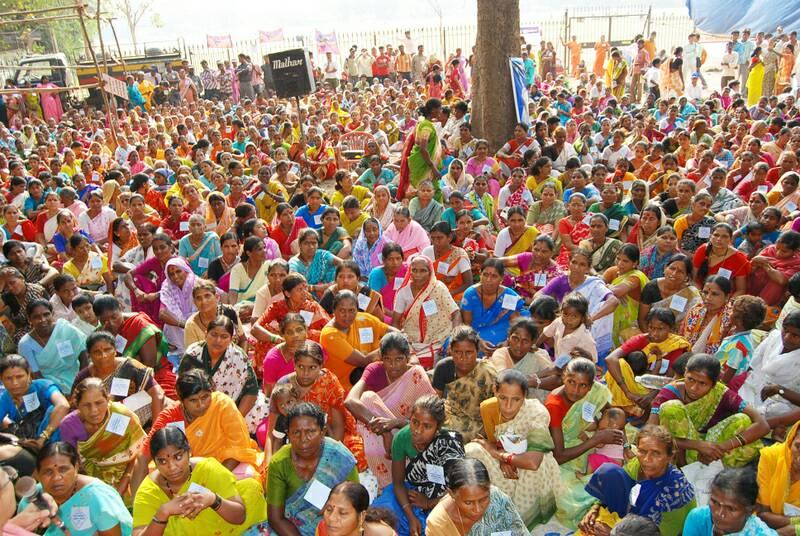
With this knowledge, SMS organized waste pickers in self help groups (SHGs) and initiated a federation of SHGs. Mumbai Municipal Corporation handed over a few dry waste centers to this federation. SMS also organized massive training programs in composting, Biomethanation, gardening, and fine sorting of dry waste to add value to the waste pickers’ work. This led to more than a hundred Zero Waste projects being implemented in housing complexes of Mumbai. Later in 2004, a few cooperatives of waste pickers were formed to sign contracts with these housing complexes as their designated waste workers. The approach adopted by SMS was found to be most sustainable as it imparts the beneficiaries with knowledge and skills, advocates for their rights, and helps them to get organised. It combines Economy, Empowerment, and Environment. This helps waste pickers to have increased bargaining power, better social organisation, increased income, and self-sufficiency. The experience of Parisar Vikas, the initiative of involving waste pickers in the mainstream of the Solid Waste Management system highlights the reality that women from marginalized groups need not be passive victims of poverty and human rights violations; they can successfully participate in the struggle to survive, to gain control over economic, social and political resources, and lead a life of dignity.
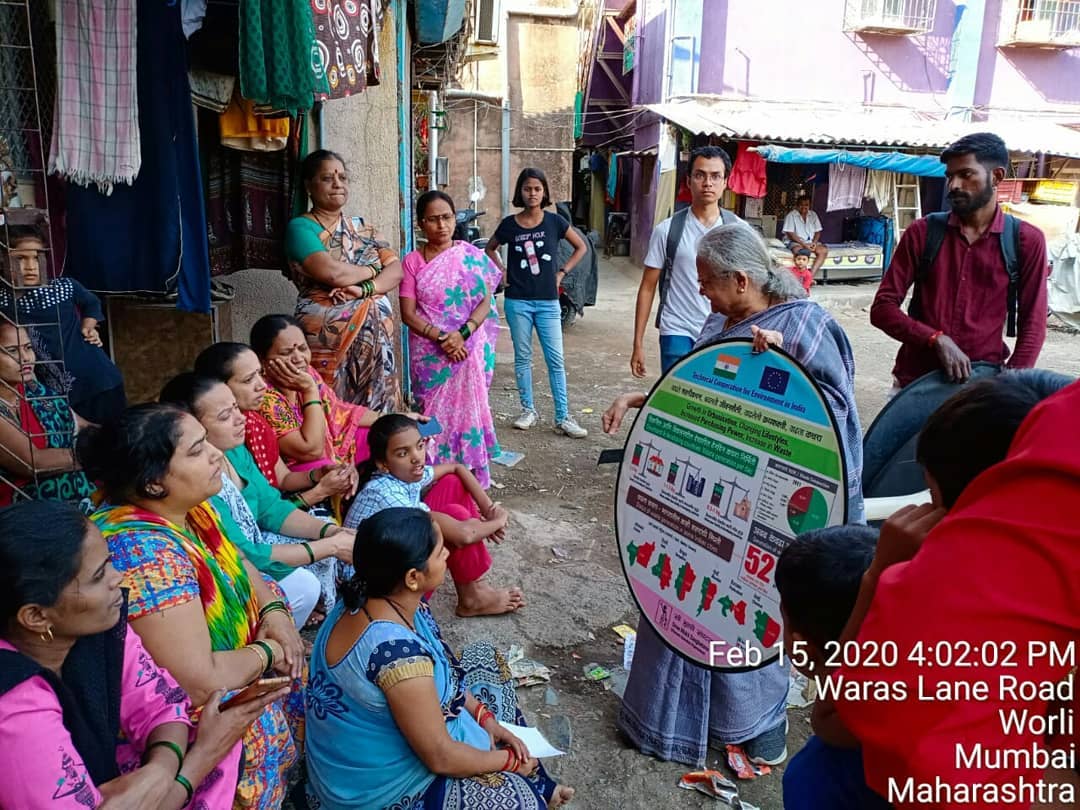
Photo from SMS Facebook.

However due to community lockdowns and the COVID-19 pandemic, this invisible army of waste pickers are once again faced with more difficulties. Lockdown resulted in the closure of public life and reduction in consumerism, making collection of dry waste almost impossible which led to loss of livelihood putting them in a difficult situation as they survive only on daily wages. The waste pickers cannot afford gloves, masks, and other safety gear required for the hazardous work they do. With no access to waste as housing societies shut their gates to visitors and no malls, restaurants, shops, or tourist spots open, they are left with nothing. People too almost stopped segregating waste at source. As a result of this, all the non-segregated  waste collected from the city by Municipal corporations are brought directly to the dumping ground.  As most of the scrap business is in the hands of migrants who left for their hometowns for the lockdown, it was difficult for waste pickers to sell their  waste. Non availability of  local transport resulted in loss of livelihood for most of the daily wage earners in the cities. 

We realized that our immediate need is to help waste pickers get access to essential food  items so that they don’t sleep hungry. In the fourth week of March, we started fundraising to start providing assistance to waste pickers members. We reached out to potential donors and through our social media channels we received many donations. GAIA, along with other foundations, helped SMS to raise additional funds. As a result of this, SMS was able to provide 5,000 families of waste pickers with grain and other essential items, safety kits, and few medicines for five consecutive months starting March 2020. SMS is now starting training courses for women waste pickers in alternative skills. Once school gates open in October 2020, SMS is planning to distribute essential education items to the children of waste picker members. 

Photo courtesy of SMS.

In the beginning we considered switching to a coupon system by tying up with local vendors near communities to ease the burden on our community workers and making follow-up and monitoring of distribution easier, as we believe providing help in kind is wiser than cash donations, as money is usually not in the control of women and could lead to selective deprivation and abuse by husbands and other family members. 

Our Parisar Bhaginis live in diverse communities, among other vulnerable communities, thus, distribution for only our Parisar Bhaginis were met with questions as to why only them and not all of the needy families in the areas. Therefore, objections and issues of dispersal of crowd to maintain social distance arose in 1/2 communities, despite the presence of local police.  In spite of these difficulties in logistics, we monitored and completed phase one of distribution while maintaining safe distance thanks to our dedicated staff and volunteers. Zomato, A T E Chandra Foundation, Rotary Club of Queen’s Necklace, J M Baxi, and Tetra Pak are some of the organisations which donated relief kits to us. Our members were really very happy to receive this material as it was the first such kit given to them after 3 weeks of lock down.  

We also provided  safety gears to our volunteers along with sanitizers with the help of Cipla. HDFC, GAIA, PHF, and Galaxy are some of our donors who asked us to purchase relief kits for our members. 

While sourcing, packing and distributing relief kits, we faced numerous difficulties. But with the help of Stree Mukti Sanghatana activists and volunteers, Parisar Bhagini Vikas Sangh and Parisar Sakhi Vikas Sangh community workers and office bearers, we managed to reach out to waste pickers in Mumbai, Thane, Dombivli, Navi Mumbai, Panvel, Wardha, and Yavatmal. We are happy to share that with the help of donors we could reach out to over 40-42  communities, covering 4,000 families by providing relief kits to them in three distribution drives in three months. SMS-run Family Counseling Centers also distributed relief kits to women in distress. We were also fortunate to facilitate monetary assistance for 40 waste picker in extremely vulnerable condition with the generous donation of Give India. 

Photo from SMS Facebook.

We would also like to share that our members employed as Biogas plant and Composting Unit operators in BARC were given special transport arrangement to ferry them to work from their community. In TIFR and Makrand Society, the residents made arrangements for our members to stay in their premises and work there. 

Even now, ration shops are the only ones providing help as the Central Government has not provided other grains and pulses.   With the increasing number of cases in the city, the situation is nowhere near normal. We are afraid that the situation today is highly unsafe for waste pickers to work on the streets of Mumbai. Whatever efforts we had taken to encourage citizens to segregate their waste have now come undone as people are not segregating their waste and all the waste is ending up in the dumping ground. The municipal corporation is also not able to devote time to enforce waste management rules in earnest. We therefore feel that:

  1. Segregation should be strictly enforced, and hazardous waste such as used masks and gloves should always be segregated by the citizens. 
  2. Though there is a ban on plastic in our state, the amount of single use plastics has considerably increased, and some serious measures are essential with immediate effect.
  3. Municipal waste collection vehicles should take hazardous waste to dumping grounds. 
  4. Waste pickers should be formalised by the municipal corporations, and schemes and policies meant to guide their livelihood, protection, and well-being should be made a priority by the municipal corporation. 
  5. The municipal corporation should also revitalize the recycling industry to be able to support the informal economy that relies on selling their recyclable scraps to earn a living. 
  6. Waste pickers should be encouraged to take up green jobs, and the municipal corporation should take the lead in facilitating the creation and formalization of such jobs for them with the help of waste picker organisations
  7. Waste pickers should also be involved in sustainable businesses

We believe that the issue of waste deserves special attention in light of this pandemic. We wish that citizens take the environment and the conditions of waste pickers seriously.  Our volunteers and activists have also conducted webinars, and we have been writing about the need for creating Zero Waste areas to combat pollution through multiple forums. We are hopeful that we will create more awareness among citizens and government officials through our efforts in the days to come. 

Photo from SMS Facebook.

—————————-

GAIA is grateful for the contributions from SMS. This feature is made possible through the Zero Waste Cities project — an initiative coordinated by GAIA Asia Pacific and funded by the Plastic Solutions Fund (PSF). The views expressed in this feature do not necessarily reflect that of its funders.

Darjeeling Ladenla Road (DLR) Prerna

Inspiring people to go beyond the broom and the dustbin

Interview with Roshan Rai by Sonia G. Astudillo

Prerna means inspiration.  Established in 1993, DLR Prerna sought to figure out what autonomy means for the marginalized within the context of Darjeeling’s regional autonomy demands.  Darjeeling is a Himalayan district in the state of West Bengal, India.  The group consisting of academics, social activists, and educators believe in a world that sees the need to live as one family where the environment is preserved and protected, where conscious efforts are made to remove unjust structures while striving to build a just and humane society.  

DLR Prerna took it as their mission to build sustainable human communities in the Darjeeling hills and the adjoining areas by promoting people’s participation, gender equality, and living in harmony with the environment.

GAIA sat down with Roshan Rai, DLR Prerna’s Program Manager who is with the organization since 1996 to talk about how their organization has evolved through the years, their work with the Zero Waste Himalaya (ZWH), and how they continue to inspire the people in the mountains.

“DLR Prerna looks at what the voice of the marginalized means in the Darjeeling Himalaya and evolving sustainable strategies specifically in the local context,” said Roshan.  In 1996, they started working with small farmers on organic farming and doing environment education in schools.  But later realized “we can’t work on organic farming only when waste from just above the hill flows through the community.”  From there, they started working on community-based conservation with forest villagers and water and sanitation with tea plantations workers.  “Once we started working with tea plantation workers, we realized there is a need to look into the access to clean water and sanitation.  Then we realized further that this is connected to sustainable waste and menstrual waste.”  DLR Prerna partners with small farmers, forest villagers, tea plantation workers, and network partners with the ZWH. 

What are DLR Prerna’s top priorities?

Sustainable agroecology, water and sanitation, health and hygiene education, and Zero Waste.  Sustainable agroecology describes and defines our involvement with small farmers.  We are trying to evolve agricultural practices based on principles of organic farming, permaculture, and resilience to climate change impacts with the small farmers in Darjeeling and Sikkim Himalaya.  We are now experimenting on nutrition in agriculture and this is not just on cooking and growing food but also looking at the packaging of processed food, nutrition, and Zero Waste.  We also work on fair trade.  Our intervention looks at the whole system.      

What are your ongoing campaigns?

DLR Prerna works as a core team member of  Zero Waste Himalaya in shifting the narrative on waste away from just the dustbin and broom.  We have facilitated workshops with students, teachers, and government offices on Zero Waste principles and practices.  Currently there is a plastic ban in Darjeeling and Sikkim and we are working on the inclusion of non-woven plastic bags in the ban.  We observe international days like Plastic Straw/Bag Free Days.

Every year from August 8 to 15, Zero Waste Himalaya calls on individuals and organisations to undertake the Plastic Freedom Challenge (#PFC).  This is significant with Zero Waste Himalaya Day celebrated on August 8 and India’s Independence Day on August 15.  We do online social media campaigns and also go to education institutions and government offices to get pledges.  Through this challenge, some schools have continued plastic bans, stopped junk packaged food, and promoted cooked unpackaged food in the campus.  Some have started composting and growing projects and celebrated local food cultures.  #PFC has evolved through the years and now include menstrual health and promotion of reusable masks.  When we started the #PFC, we were not aware about Plastic Free July, but we decided to stay with #PFC to bring a mountain focus to the movement.

In 2017, Maasika Mahotsav, a weeklong festival to celebrate and break taboo around menstruation, was launched by Muse Foundation.  The aim is to break the silence and promote sustainable menstrual health.  Along with ZWH, we host the event in Darjeeling and Sikkim  and have taken conversations and workshops to schools and public spaces too.

On May 26, 2018, we launched The Himalayan Cleanup with Integrated Mountain Initiative.  For the World Environment Day with the theme, Beat Plastic Pollution, we wanted to go beyond Sikkim and Darjeeling borders and so the Himalayan Cleanup was born.  We partnered with GAIA to include waste assessment and brand audit (WABA).  We had the Gangtok workshop, from May 10-11, 2018, and called on participants from the 12 Himalayan mountains states of India.  We came out with a statement to focus on the waste issue in the mountains and push back against waste burning.  The Cleanup brought about a lot of synergy with over 200 organizations and 15,000 volunteers across the Indian Himalaya participating using their own resources. 

On June 1 of the same year, we presented the result of the cleanup at the workshop organised by the Government of India for World Environment Day in Delhi.  With GAIA, the report was presented on June 4 at the Press Club, Delhi with the larger national results.  There was a huge change in narrative when we named the top polluters of the mountains.  It included international and national corporations. 

Over time our waste narrative evolved.  #PFC allows people to experience how it is to go plastic-free while the WABA helps us identify and call up the top corporate polluters.  

With the COVID, we transitioned online and conducted online sessions some of which are available in our Facebook page Zero Waste Himalaya.  We also anchored comments on the Extended Producers Responsibility (EPR) with a mountain lens.  EPR should have the understanding that we should stop plastic pollution.

We are also trying to broaden our base across the mountains. 

What are DLR Prerna’s biggest accomplishments and achievements?

We are contributing to changing the narrative beyond dustbin, broom, rolling down the hill, and burning and building a pool of like-minded people as years go by.  We are doing an important job.  There have been small but particularly important stories like schools who banned plastic and communities in Sikkim deciding to ban bottled water because of the cleanups and campaigns undertaken.

We are part of a growing movement which is very inspiring.  We are continuously evolving.  The fact that we (ZWH) is here as a platform is a big achievement.  It takes a lot of time and energy but through the ZWH, we have expanded our reach.

What challenges are you facing and how is your work impacted by the COVID crisis?

On one side there is the additional COVID waste from disposable masks and other medical waste.  On the other it has also affected our programs.  We now must transition everything to online.  As part of our awareness program, we bring people to the landfills but we are unable to do that now.  For the Himalayan Cleanup Day, we did an online workshop on COVID and waste.

What are the main environmental issues that your country/region is facing?

It is definitely the dramatic increase of plastic waste.  There is a tremendous increase in plastic food packaging and they are getting packaged in smaller and smaller containers which manifest not just as a waste issue but also a health issue for the communities.  All these are intersecting issues.

How do you see your organization’s work evolving in the next years?  How do you envision a just and equitable recovery from COVID?

It is going to be challenging.  Darjeeling is regionally marginalized.  We will still be looking at sustainable livelihood and investing in small farmers agroecology, and fair trade.  We will be working on clean and unpackaged healthy nutritious food.

In the next few years, I envision companies taking responsibility for the waste they produce and investing in sustainable packaging and products.  There will be sustainability in waste management and investment in local products which will help promote equity and well-being.

As an organization, we will continue strengthening our work with ZWH with interventions on school health, agroecology, water and sanitation, local food production, local composting, use of local seeds, and addressing issues of people living next to protected areas and forests.  These may seem a lot but when you are working with the community, these issues will manifest as one.

What are your thoughts on the waste crisis that many countries in your region and in the world are living in right now?

The waste crisis is something that must be brought into more focus.  Waste crisis should be an everyday language of people.  We need to consider the entire lifecycle of a product.  It should be an issue for everyone.

How does your work on waste relate to social justice?

Our work is extremely linked to social justice.  The physicality of our location means there are people who are more affluent and powerful who tend to roll down their waste to communities below them.  Then there are the people working directly on waste whose lives are not acknowledged and reflected for their contribution to society. 

By Le Thi Trang, GreenViet Biodiversity Conservation Centre (GreenViet)

Hoi An City and Cu Lao Cham Island have  been well known for starting the first plastic-free movement in VietNam in 2009. Its slogans such as “Cu Lao Cham Says No to Plastic Bags” and Carrying Basket to Market is in Style” have inspired neighboring provinces, which have adopted similar slogans as part of their own plastic reduction campaigns.

Photo by GAIA/Miko Alino.

Provincial authorities, however, have also been receiving offers to consider building incinerators as a quick fix to the growing amount of waste in urban areas. Such expensive distractions are likely to undermine decade-long efforts to raise awareness and introduce behavior change interventions, aimed at reducing household and plastic waste. For supporters of incinerators, they believe that these machines provide an all-in-one solution to waste problems, without worrying about risks and responsibilities tied to waste sorting and air pollution.

Photo by GAIA/Miko Alino.

In 2019, GreenViet, Cu Lao Cham MPA Management Board, and GAIA Asia Pacific have launched the project “Building and Sharing Zero Waste Models in Selected Asian Communities” to develop Zero Waste models in Hoi An City. Supported by the United States Agency for International Development (USAID), through the Municipal Waste Recycling Program (MWRP), the project presents an opportunity for Hoi An City to re-ignite its plastic-free movement and become the first Zero Waste City in VietNam.

The project started with conducting baseline research activities in the Hoi An communes of Cam Thanh and Tan Hiep. Findings from the waste perception survey showed that households were aware of the importance of segregation at source. However, it seems to be a different story when a lot of household waste collected from the waste audit was mixed together. Nonetheless, these initial observations have served as a challenging motivation for the multi-sector team. Joining GreenViet in this project are the Cu Lao Cham MPA Management Board, the People’s Committee of 2 communes, the Environment Office of Hoi An City, the Hoi An Public Construction Company, Vietnam Zero Waste Alliance, and Pacific Environment.

Photo courtesy of GreenViet.

COVID-19 has again disrupted project activities in Hoi An, with the virus spreading again in Central Vietnam, particularly in Da Nang. Despite the new COVID-19 wave, the project team has mobilized the IEC (Information and Education Campaign) and Monitoring units to work with the communities in the next six months. These units will be in charge of teaching residents about the ways of Zero Waste, including waste sorting and community composting. 

Photo courtesy of GreenViet.

Together with project partners, GreenViet and the Cu Lao Cham MPA Management Board will help develop a 5-year strategic Solid Waste Management (SWM) Plan next year, to institutionalize lessons and strategies for waste management. 

Photo courtesy of GreenViet.

With all efforts and willingness, local communities and partners will be proud of Hoi An as the first Zero Waste model in VietNam.

Photo by GAIA/Miko Alino.

—————————-

GAIA is grateful for the contributions from GreenViet and Hoi An City. This feature is made possible through the Zero Waste Cities project — an initiative coordinated by GAIA Asia Pacific and funded by the United States Agency for International Development (USAID). The views expressed in this feature do not necessarily reflect that of its funders.

Photo blog contributed by Merci Ferrer, War or Waste (WOW) Negros Oriental

Preventing the creation of waste is first and foremost in waste management.  In 2018, War on Waste (WOW) Negros Oriental mobilized groups and submitted petitions, urging the city government of Dumaguete to enforce its nine-year-old ban on plastic bags. The Dumaguete City Council approved Ordinance No. 231 on 10 August 2011, prohibiting businesses to use or sell plastic shopping bags and styrofoam packaging. However, enforcement of the ban remains to be seen in the city.

To complement local campaigns for a functional plastic bag ban, WOW Negros Oriental has adopted three coastal barangays – Looc, Piapi, and Bantayan – to demonstrate that Zero Waste strategies work in Dumaguete City. Under the Zero Waste Cities Project, we later expanded our work in two more barangays in Dumaguete City, as well as the island province of Siquijor.

Volunteers from various sectors including the youth took part in the Dumaguete at-source waste assessment and brand audit (WABA). Photo by Natasha Kunesch.

The local government, unfortunately, has turned a blind eye to ongoing Zero Waste efforts in five barangays in Dumaguete City, deciding to invest in a centralized Materials Recovery Facility, as well as to continue collecting mixed waste from households and businesses. Such actions have undermined initiatives to segregate waste at source and compost kitchen waste, as observed in WOW Negros Oriental’s five pilot barangays. To make matters worse, the local government is exploring pyrolysis and gasification technologies as a quick fix, ignoring impacts to public health and the environment.

Our war on waste continues.  We need to raise questions, demand the full implementation of existing laws, expose false solutions that create serious toxic problems, and advocate for Zero Waste systems and approaches. 

This August, WOW Negros Oriental volunteers are sailing to Apo Island to bring the Zero Waste Cities Project in this protected landscape and seascape in Negros Oriental. To realize a Zero Waste Apo Island, we have signed a partnership agreement with the island’s local government leaders. WOW volunteers have also started initial activities, such as training community members in doing waste assessment and brand audits, informing households about proper waste segregation at source, and building decentralized MRFs.

One day before Apo Island’s first Waste Assessment & Brand Audit. 

Nestle, Unilever, and Mondelez are topping the list of single use plastics (sachets) in Apo island – Apo Island Brand Audit,  August 2, 2020.

Apo island Waste Assessment & Brand Audit (WABA), August 2, 2020.

Just to give you a glimpse of the life in Apo Island.

 Let’s #GoForZeroWaste. Let’s create toxic a free future for our children!

—————————-

This feature is made possible through the Zero Waste Cities project — an initiative coordinated by GAIA Asia Pacific and funded by the Plastic Solutions Fund (PSF). The views expressed in this feature do not necessarily reflect that of its funders.

Greeners Action, Hong Kong

From a school organization to a national environment frontliner

Interview with Angus Ho by Sonia G. Astudillo

Hong Kong has been on the news of late due to the political unrest happening in the city and most recently the COVID-19 pandemic.  GAIA Asia Pacific sat down with Angus Ho, Executive Director of Greeners Action, to talk about the environment campaign in Hong Kong and how the work has evolved from school campuses to the national sphere.

Established in August 1993, Greeners Action was formed by a group of secondary students who participated in the Green Hope Programme by Friends of the Earth (HK).  From Green Secondary Student Council they became Green Student Council with university students and young professionals members, and then to Greeners Action.

Lai See reuse and recycling program held since 2010. Photo courtesy of Greeners Action.

“After the Green Hope Programme and the students moved on to universities, we continue to do environment work,” shared Angus who was 20 years old when he joined the group.  “Some of the members were much younger.  We organized green camps for eight years and in 1998 made the decision to step up and organize a social movement outside the campus educational trainings.”   

It was at a time when Hong Kong didn’t care about environmental protection and people were focused on economic growth.  “The Green Camp gave us a lot of information and allowed us to have critical thinking and like a wake up call: to see the consequences of economic development, how human beings are cheating or playing gods to the environment, and people’s place in the economic-environment debate.”

“Prior to the camp, I didn’t know what environmental science is but I was interested in environmental protection and recycling,” said Angus.  From a green camper, Angus pursued Environmental Science in the university and then took on the leadership role at Greeners Action.

Mr. Angus Ho joined Greeners Action since secondary school. Photo courtesy of Greeners Action.

What are Greeners Action’s top priorities?

Waste reduction.  We educate people to have a more environment-friendly lifestyle and we focus on single-use plastics (SUP) and food waste policies.

Greeners Action is the first organization in Hong Kong to push for waste reduction through waste charging policy 11 years ago. 

For a decade, we have also pushed for the solid waste charging policy.  This proposed policy mandates payment for each garbage bag that you dispose of and applies to both domestic and commercial waste.  With this, we encourage people to reduce their waste.  We also educate the government to increase recycling programs so that we reduce the volume of waste sent to landfills.  The policy is cancelled for now because the legislative councilors claimed they do not have enough time to discuss the bill before the change in council membership.  But Greeners Action will continue to push for it and I have confidence the government will push the legislation with the new set of members in September. 

Greeners Action donates fresh vegetable and bread to elderly. Photo courtesy of Greeners Action.

What are Greeners Action’s ongoing campaigns?

Single-use plastics use in restaurants.  We encourage people not to use straws and takeaway boxes and to bring their own cups and water bottles.  We encourage people not to use SUPs when they go to takeaway shops.  

Waste charging is not implemented so they don’t have an incentive to reduce their use of single-use items.   But the response I’d say is 50-50.  Others think it is not convenient and the shops feel it is not easy to implement.  But we continue to work with restaurants, chain shops, coffee shops, and small stalls.  We educate them to encourage their customers.  We also do some seminars for students but we are more focused now in educating the society. 

Greeners Action promotes less packaging waste in supermarkets. Photo courtesy of Greeners Action.

Education is important but if we keep doing it in schools, we won’t have a chance to do it in society.  Students will only know the theory from the seminar but once they go out and dine in restaurants, they will still use SUPs.  We try to focus on influencing the bigger world.   

We also connect with celebrities and invite them to do videos, promotional campaigns, or we invite them in events.  Over the years, we have worked 20 to 40 times with celebrities.

What are the organizations biggest accomplishments/achievements?

Plastics lobbying.  We started 20 years ago when the government did not have plans on how to deal with plastic waste.  In 2006, we successfully urged two biggest supermarkets in Hong Kong to stop using plastics bags and charge for plastics use.  When the government saw this, the Plastic Shopping Bag Charging bill was signed into law in 2009.  Supermarkets obey the law and people now bring their own shopping bags.

Tetrapak recycling is the latest recycling project. Photo courtesy of Greeners Action.

What are the challenges faced by Greeners Action and how is your work impacted by the COVID crisis?

With the COVID crisis, people care more about health issues rather than environment issues.  The social unrest in Hong Kong also forced people to shift their focus from the environment because they have a lot of worry with the social and political situation.  It is more difficult for us now to push for environmental policies to the general public.  And with the economic situation, people are more concerned about their survival rather than their environmental impact.

What are the main environmental issues that Hong Kong or the region is facing?

I still think consumerism in Hong Kong is a very serious problem along with SUPs use.  In shopping malls, we see umbrella plastics bags not just plastic cutleries.  There are many examples of SUPs in Hong Kong and it is quite a challenge.  Its convenience to the people is a narrative we want to change yet not many people think it should be changed.  Many are unaware of SUPs ban happening in other countries in Asia.  People are not so concerned about the environment and that applies to consumers and producers of products wrapped in single-use.  Our challenge is how to shift that mindset and make them see the value of both economics and environment.

What are your thoughts on the waste crisis that many countries in your region are living in right now?

There are no incinerators in Hong Kong.  We only have landfill.  The current problem is the single-use masks.  Most people use masks and replace those every two days.  With 7 million people, we have as much as 6 million masks (i.e 10-15 tons) sent to the landfill everyday.  We encourage people to use refillable filters.

How does your work on waste relate to social justice?

During the pandemic, we encourage the government to provide enough protection for the cleaners (waste workers and waste pickers).  We also encourage people and commercial spaces to have a special container when disposing their masks.    

Prior to the pandemic, we have an on-going food waste collection and donation program for 8 years now where we collect vegetables and distribute it to the elderly and underprivileged.  What we are doing here is not just diverting food from the landfill but we are providing to the underprivileged.   

How do you see your organization’s work evolving in the next few years?

I think in the future, people will be more aware of environmental protection.  Even though I mentioned COVID and the Hong Kong situation and how that’s making it difficult to push for environmental protection, I still think that quite a lot of people are concerned with the environment and they understand the situation.  I think there will be progress.  The global trends will let the people know that SUP is not a solution, that it is a very big problem and we need to stop using it.  The global trend will influence people in Hong Kong and even the businesses and commercial establishments will reference to and copy the good things happening globally.

Clean recycling promotion in a large scale event. Photo courtesy of Greeners Action.

By Sherma E Benosa

In his essay, “A Heritage of Smallness,” National Artist for Literature, Nick Joaquin, wrote:

“Enterprise for the Filipino is small stall: the sari-sari… Commerce for the Filipino is the smallest degree of retail: the tingi. What most astonishes foreigners in the Philippines is that this is a country, perhaps the only one in the world, where people buy and sell one stick of cigarette, half a head of garlic, a dab of pomade, parts of the content of a can or bottle, one single egg, one single banana.”

Indeed, we have a tingi culture, and it is being blamed for the proliferation of sachets in the country. Having understood this culture so well, big business gave us the sachets, promoting them as “pro-poor.” They peddled the narrative that by making their products available in small packets, people who would otherwise be unable to afford them can now enjoy them. And because it’s been part of our culture to buy small, these sachets were welcomed without much thought. If we think about it, buying things in sachets is also buying in tingi, only made more convenient.

I remember that when I was a young kid, whenever I was sent to the sari-sari store to buy something in tingi, say ¼ of a bottle of vinegar, my mother would make me bring a container with me. The tindera (store owner/manager) would pour the vinegar into the container.

Today, people still buy about the same quantity of vinegar. But unlike before, they no longer bring a container with them because the same quantity of vinegar (perhaps even smaller) now comes in sachets and they are not only available in sari-sari stores but also in big groceries.

If I didn’t fully understand the problem with sachets, I would have called it “parehong sistema, pinasosyal lang” (the same system, just made hipper). But because I know a bit better, I say, “the same system, just made dirty.”

Yes, dirty because sachets, particularly plastic sachets, are made of fuel. Just think of the chemicals they contain, and how many of those chemicals might be harmful to you. But more importantly, dirty because these sachets are designed for the landfill. They don’t have recycling value—once we’re done with them, we toss them into the garbage bin and give them to the waste collector, who would then bring them to a landfill to sit for decades, producing leachate that are harmful to the environment. That is, if they don’t get released into the environment or washed out to the sea, where they harm marine lives. But I digress.

Because it is part of our culture to buy small, big business would make us believe that giving us the sachets was simply a response to an important need. But the thing is, we never asked for sachets! The system of bringing our containers to the sari-sari store was working well! Until of course, big business introduced another narrative: Convenience is king!

I also remember from my childhood that bringing reusable containers was not confined when going to the sari-sari store. Whenever my mom and I went to the public market, we always brought with us a basket which we used to carry the goods we purchased. Plastic already existed at the time, but they were not free. If you wanted a plastic bag, you’d have to buy them. Just a few decades ago, this practice of bringing reusable containers to the public market was the norm.

Sadly, that practice was lost over time. Now, even in the province, I no longer see people bringing containers when they go to the market, much less to the grocery. Not even to the sari-sari store. Because now, plastic bags are everywhere and are free. It is only of late, due to years of pressure from environmental activists, that single-use bags are slowly being banned in various parts of the world.

As governments are banning single-use plastic bags with the gradual mainstreaming of Zero Waste, stores hailed as Zero Waste are now sprouting. But if you’d really look at it, many of the Zero Waste establishments are actually just stores that mimic our old way of shopping—stores that don’t use problematic packaging and require their customers to bring their own containers. These stores are showing the big business how to do it—how they should have done it.

Let’s stop buying big business’ pro-poor narrative. It is not that we are poor and that we buy tingi style that plastic sachets came to be; it is that companies were focused solely on profit. Instead of developing a sustainable system that would support our tingi culture, they capitalized on it wantonly and without regard to the damage their packaging would cause to the environment and to our health. It is their greed, not their supposed concern for the poor, that made them package their products in problematic materials.

Buying tingi is not the problem. In fact, as many practitioners of Zero Waste now say, by buying only the things we can consume, we prevent wastage.

As an adult, I no longer buy ¼ bottle of vinegar (I now buy by the bottle), but I also don’t buy perishables in bulk or very large bags. The idea is that we buy only the amount that makes sense, and that is, what we can actually consume—not too much so that we don’t waste them, and not too little for our actual need so that we don’t buy things in sachet.

I wish Zero Waste stores would become the norm in the country. Or shall I say, I wish our culture of bringing our own container would make a full comeback, because actually, we used to do things the Zero Waste way).

I hope more and more people will pick up that old practice. Because indeed, sometimes, the way forward is going back to our old ways of doing.


Sherma Benosa is the Knowledge Management Officer of GAIA Asia Pacific. She may be reached at sherma@no-burn.org.

Multinational companies have been flooding the Philippines with plastic sachets, uprooting traditional packaging and delivery systems. It’s time to go back to what works. 

By Sherma Benosa, Knowledge Management Officer, GAIA Asia Pacific

Glaiza Lee, a writer in her mid-30s, still remembers her family owning and managing a sari-sari store in their home in Caloocan City, Philippines during the early 1990s. Glaiza’s mother used to buy goods from the market in bulk—cooking oil by the gallon, bagoong (fish paste) by the gatang, vinegar by the liter, and salt and sugar by the kilo—which they would then resell in their store tingi-style. Tingi is simply retail, but in the context of sari-sari stores (neighborhood stores selling household essentials, usually food and personal care products), it is reselling items in much smaller quantities, usually enough for one-time use, depending on the item.  Sixty-five-year-old Mario Tejada, a retired government employee in Piddig, Ilocos Norte, also fondly recalls his family’s sari-sari store. The containers that the customers brought depended on the items they were buying. “If they wanted gas for their gasera (gas/kerosene lamp), they would bring the gasera itself and we’d pour the gas directly into it,” said Mario. “If they wanted a shot of alcoholic drink, they would bring their drinking glass and they’d drink from it immediately!”  Little did Mario or Glaiza’s family know that all this would change in a matter of a few years as the Philippines became flooded with the scourge of plastic sachets from multinational companies.

Sachets and the Narrative of Convenience

In just over a few decades since they were introduced in the Philippine market, sachets and other single-use plastics have become ubiquitous, so much so that a 2019 study by the Global Alliance for Incinerator Alternatives showed that Filipinos generate as much as 164 million sachets in a year—enough to cover the whole of Metro Manila in a foot of plastic sachets. Fast-moving consumer goods companies have been using the “pro-poor” narrative to push sachets in the market. They claim that by making their products available in small packets, people are able to afford branded shampoo, toothpaste, conditioner, albeit in small quantities, thanks to their low price points. But with the convenience that sachets brought were bigger problems that outweighed their supposed benefits. Sachets, together with other single-use plastics, are big contributors to the growing issue of plastic waste problem and are hindering cities with good solid waste management programs from becoming completely Zero Waste. Unlike the other single-use plastics such as plastic bags and straws, sachets are yet to be the subject of regulations and bans.

Ripe for Regulation

According to the same GAIA report, sachets—both single-layer and multi-layers—make up 52% of the country’s plastic residual waste stream. The good news is that a 2019 report by the Social Weather Stations commissioned by GAIA found that Filipinos are for regulating problematic plastics; 7 of 10 Filipinos believed that single-use plastics should be regulated, while 5 of 10 are for regulating sachets. Policy, if enforced, is an effective instrument in regulating single-use plastics. To illustrate, since Quezon City banned single-use plastics, even fast-food chains in the city were forced to shift to reusable plates, cups, and cutlery. COVID-19 may have disrupted the implementation of the single-use plastic ban in the city, but with experts saying that reusables are safe to use even during the pandemic, the city government should have no hindrance in imposing the ban.

Going Back to Take Steps Forward 

With the increasing public awareness on the negative impacts of plastics on health and on the environment, more businesses are embracing the environmentally sustainable route, and revisiting the traditional ways that had served the community so well in the past. In the past two years, more and more Zero Waste stores—refill stores, stores that sell packaging-free organic products—are opening not only in the Philippines, but all over the world.   What’s clear is that no one, whether they be in the Philippines or anywhere else, should have to keep paying for the packaging they didn’t need, and didn’t ask for.  Sometimes, the way forward is going back to what works. Maybe these multinational corporations can learn a thing or two from Glaiza and Mario’s family business.

Want to learn more? Read GAIA Asia Pacific’s new report, Sachet Economy: Big Problems in Small Packets

New GAIA report exposes big problems in small packets 

Quezon City, Philippines (July 14, 2020) —New findings and recommendations for companies and policymakers to address the onslaught of plastic sachet waste were revealed in a new report, SACHET ECONOMY: Big Problems in Small Packets released today by environmental organization Global Alliance for Incinerator Alternatives (GAIA) and the global movement Break Free From Plastic.

The report commissioned by GAIA uses data from University of Santo Tomas’ Research Center for Social Sciences and Education (RCSSEd) for their research on Filipinos’ sachet consumption habits.  According to the report, single-use plastics, specifically sachets, are a growing concern in the Philippines because of the affordability and  convenience they give to users. What is also striking is that while certain local governments have gone beyond the usual plastic bag bans by passing ordinances, the exclusion of sachets from local laws is alarming.

“Sachets are perceived as inexpensive, and convenient because of their small and durable packaging, but in reality, they are expensive for cities to manage, difficult to effectively recycle, and cannot be reused, ” quipped Miko Aliño, GAIA Asia Pacific program manager. 

 The findings in the report further show how corporations have managed to evade responsibility for sachet waste, which leaves local governments and communities struggling with this non-recyclable waste to address the imminent sachet pollution crisis.

“Corporations have greatly benefited from these products by marketing them for their low cost and convenience but they are not made accountable for the pollution that comes along with its production and disposal,” he said.

Moreover, the report says that  sachet purchase and use tend to be higher among lower socioeconomic brackets. This is because multinational companies advertised them as affordable for daily-wage earners for them to be able to purchase branded quality products in small quantities. It is based on the premise that sachets help consumers ration their use of a product better than big containers, thereby reducing product wasting.

“Sachets may have brought better quality products to poor communities but the problem is that they have become a waste nightmare. When sachets are discarded indiscriminately, these clog drains and contribute to flooding or even pollute our oceans. With this data, we can really see that companies are really the ones to be blamed. We can also use this report’s findings to pursue regulations that would compel companies to acknowledge their liability for plastic pollution” he added .

With the lack of an integrated national policy on sachet use, the report cited efforts of local government units and the need to step up to address a large part of the country’s plastic waste problem including production of throwaway plastic packaging and the actions that companies must do to reverse plastic-related problems and pollution.   

“There is this crucial necessity to craft regulations that would include sachets in the big picture, and to demand accountability from the companies that manufacture them. The government and members of our communities need to clamor for extended producer responsibility (EPR) policies for corporations to become fully responsible for their products,” said Beau Baconguis, Asia Pacific coordinator of #breakfreefromplastic. 

“EPR is just one solution which is a policy principle that extends the responsibility of product manufacturers to the entire life cycle of a product.  Even after these have been sold, EPR shifts back the obligation for the life cycle impacts of products to the manufacturers, including the managing of their waste,” she added.

The report also presents the attitude of Filipinos towards plastics such as how our culture is continuously redefined and assimilated in the tactics of big businesses in perpetuating decades of plastic pollution. Furthermore, the report discusses public attitudes towards plastic pollution and lays out several recommendations and initiatives from the environmental organizations, private sector, and social enterprises towards efforts to address the situation.

Filipinos had done very well without sachets in the past. We bought cooking oil and condiments in small portions or tingi in our community sari-sari stores with our own reusable containers and mugs. Wet goods such as fish and meat were usually wrapped in used paper or banana leaves,” said Rei Panaligan, National Coordinator of Break Free From Plastic Philippines.  

“With this, we want to encourage again our businesses and retailers to adopt alternative delivery systems by putting refilling stations and encouraging customers to bring their own reusable bags and containers. Moreover, this should be part of a better normal way forward in a post-COVID scenario wherein alternative delivery systems and refill stations are part of the plan. As shown by the latest statements of scientists worldwide, reusable is still safe to be used  during this pandemic, ” he added.

# # #

For more info, the report can be downloaded at: https://www.no-burn.org/Sachet-Economy 

Statement of 120 experts and scientists assuring the safety of reusables during this  pandemic: https://www.breakfreefromplastic.org/2020/06/23/reusables-can-be-used-safely-over-115-health-experts-fire-back-at-the-plastic-industry/

Contact: 

Sonia Astudillo, GAIA Asia Pacific Communications Officer, +63 9175969286

Jed Alegado, BFFP Asia Pacific Senior Communications Officer, +63 917 6070248

Geri Matthew Carretero, BFFP Philippines Communications Officer, +63 917 6216901

____________________________________________________________________________

About GAIA – Global Alliance for Incinerator Alternatives is a worldwide alliance of more than 800 grassroots groups, non-governmental organizations, and individuals in over 90 countries whose ultimate vision is a just, toxic-free world without incineration. www.no-burn.org

About BFFP –  #breakfreefromplastic Movement is a global movement envisioning a future free from plastic pollution. Since its launch in 2016, more than 8,000 organizations and individual supporters from across the world have joined the movement to demand massive reductions in single-use plastics and to push for lasting solutions to the plastic pollution crisis.These organizations share the common values of environmental protection and social justice, which guide their work at the community level and represent a global, unified vision. www.breakfreefromplastic.org 

About BFFP Philippines Project–  The #breakfreefromplastic Philippines project is a collaboration of #breakfreefromplastic members EcoWaste Coalition, GAIA Asia Pacific, Greenpeace Southeast Asia, Health Care Without Harm Southeast Asia and Mother Earth Foundation working towards a future free from plastic pollution.

Community Sanitation and Recycling Organization (CSARO) Cambodia

Bringing waste pickers and the community together

Interview with Heng Yonkora by Sonia G. Astudillo

When we think of Cambodia, we think of temples, old civilizations, and Tomb Raider.  Unknown to many, right in the heart of Phnom Penh is an organization committed to bringing our almost magical picture of the country to life.  Meet our member, Community Sanitation and Recycling Organization (CSARO). 

GAIA Asia Pacific sat down with Heng Yonkora, CSARO Founder and Director, to talk about their beginnings, their successes, and their struggles.

February 1997 –

CSARO was established in February 1997 by a group of development workers committed to improving the environment and living conditions of urban poor in Cambodia.  They give a special focus on improving the living and working conditions of adult and child waste pickers in the city.  They envision an urban community where residents and waste pickers work together to transform slum areas while waste pickers work together to improve their social and economic conditions.

Kora was one of those development workers.  Having worked for the International Labor Organization and World Health Organizations providing health training in the villages, he saw many slum areas, bad sanitation, and lots of waste picking without recycling and proper sanitation.  Along with friends from the US and India who supported his vision to work directly on the grounds, they did a baseline study on waste pickers in Phnom Penh.  “What we found is they are living in bad conditions, there are a lot of waste around the community, and they don’t know recycling.  We knew we needed to give them information on how to protect themselves.”  And so, CSARO was born.

From an initial 3 year (1998 to 2001) funding from the Norwegian government and US$20,000 per year from the Asian Development Bank, CSARO established a waste pickers development program.  The program trained 50 people on waste collection and segregation, composting, and managing their income.  A self-help group was set-up that provided a space for the waste pickers to meet, get to know each other, and talk.    

How was the first few years of CSARO?

Other than the waste pickers program, we also had a waste management program where we organized waste collection in the slum areas and taught composting.  We had an outreach program focused on children collecting waste from private clinics – we brought them snacks, taught them proper waste collection, and we organized the children’s club that allowed them to help each other. 

What are CSARO’s top priorities and ongoing projects?

Our focus is how to reduce urban waste and improve the livelihood of waste pickers.  From 2017, we received a 3-year funding from the Plastic Solutions Fund so we work with different city governments to conduct plastic forums in different cities participated in by the community.  We are also involved in the Clean City Campaign organized by the government where 400 people join clean-ups on National Environment Day. 

An ongoing project is the compost plant in our land where we compost 4 tonnes of organic waste daily, collected by the government from a small market in the city.  There are five waste workers there earning US$5 a day.  The plant started in 2010 but until now it is a struggle to find a market for the compost that we produce. 

Awareness campaign against plastics pollution.

What are CSARO’s biggest accomplishments and achievements?

The country has a policy on waste management signed by the Prime Minister in 2017 and a sub decree on plastics pollution in 2018.  CSARO provides support to the Department of Environment of three cities in organizing plastics forum.  We work with the local government, communities, and other NGOs on how to improve sanitation and how people in the community can live in good health.  Currently we work on plastics and provide trainings to government and community.  After giving them the training, they – the government and the community – can run on their own.  

Educating crabs fishermen about plastics pollution in sea and finding solutions to replace the plastics bag at Koh Po Island in Kep province.


What challenges are you facing?  How is your work impacted by the crisis?

With the COVID crisis, it is difficult to organize people.  Instead of organizing meetings and gatherings, we designed posters and billboards (mostly on plastics issue) for the government.  These are posted in tourist areas and in the city. 

Funding for projects is a major challenge too.  We are not allowed to do in-person meetings so looking for new funding is more difficult than ever.  There are no funding agency focused on waste management in Cambodia.

Sustaining projects success is also a challenge.  Once the project is terminated, the local governments (Sangkats) and the community often do not have their own money to run on their own.

What are the main environmental issues that Cambodia is facing?

Management of waste from Phnom Penh.  Right now the dumpsite is full.  We cannot and we do not want to build more dumpsites, we want people to move towards Zero Waste but households are not encouraged to get involved, the government just collects the waste and dump, and corporations who produce plastics waste are not willing to redesign their packaging or provide alternative delivery systems that are not polluting to the environment.

How do you see your organization’s work evolving in the next years?

Everything is uncertain at this point.  After October, we are not sure if we can continue to run the compost plant or not.  If we get our funding, we want to focus on Zero Waste in two villages.  We remain hopeful that funding will come and we can continue with our work.

—————————–  

Be part of the solution.  Check out CSARO’s work in Cambodia or visit their website to know how you can get involved.