In this discussion paper, GAIA and SOMO synthesise insights from our June 2026 virtual learning circle on lithium-ion battery overproduction. The session brought together more than twenty participants from industry, research, civil society, labour organisations, and affected community advocates — spanning China, Latin America, Europe, and the United States. Global manufacturing capacity for lithium-ion batteries is now estimated at two to five times greater than current demand — a structural gap expected to persist well into the 2030s. This paper asks: what is driving it, who pays the price, and what can we do about it?
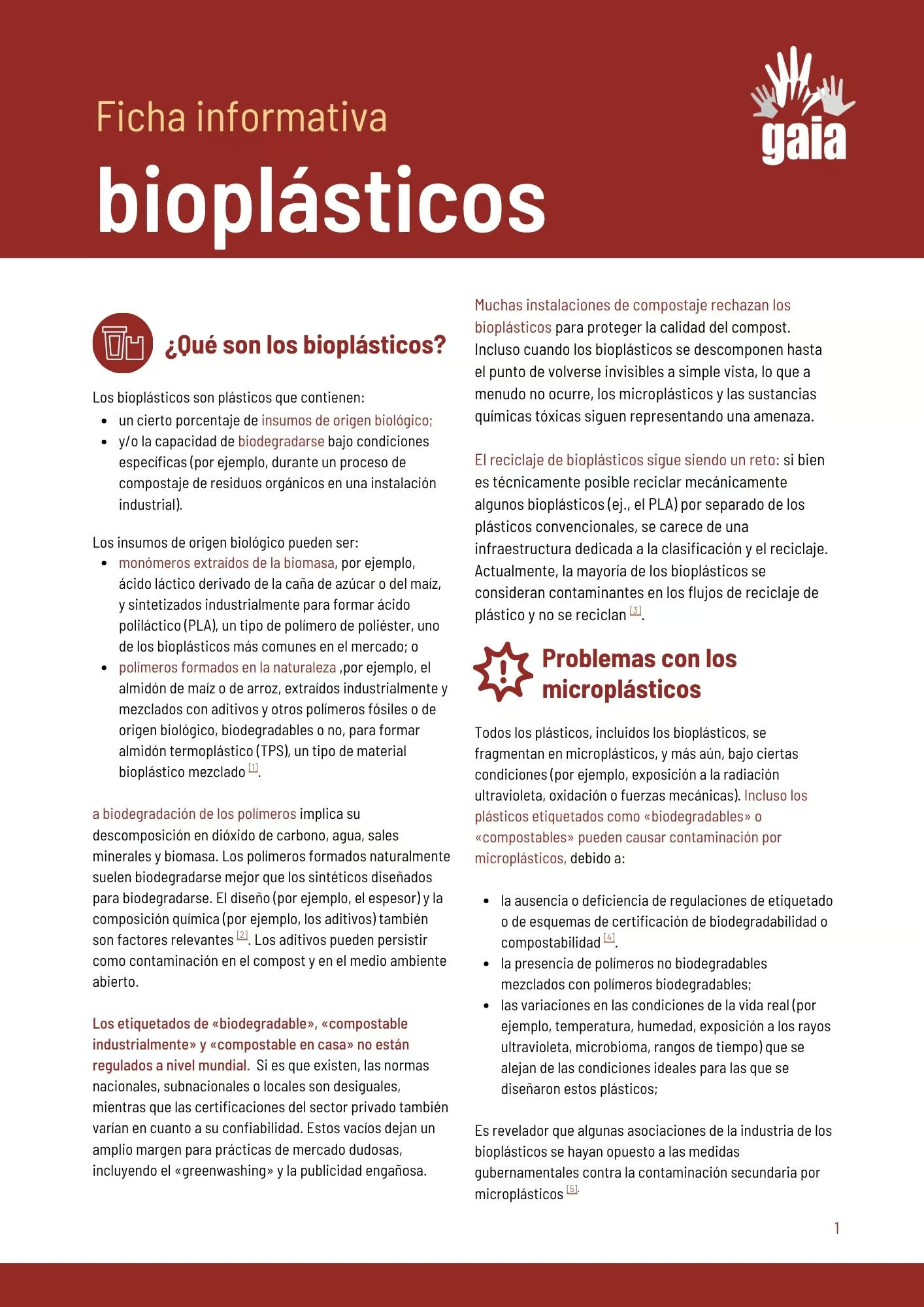
«Bio» no significa que sea bueno o seguro. Con demasiada frecuencia, el énfasis en el uso de los bioplásticos sirve sólo para encubrir con argumentos ecológicos la sobreproducción masiva de plásticos de un solo uso o de corta vida útil. Los bioplásticos actuales son, en su gran mayoría, sustitutos lamentables de los plásticos convencionales de un solo uso, que terminan en los vertederos y perpetúan la contaminación por microplásticos.
Related Resources
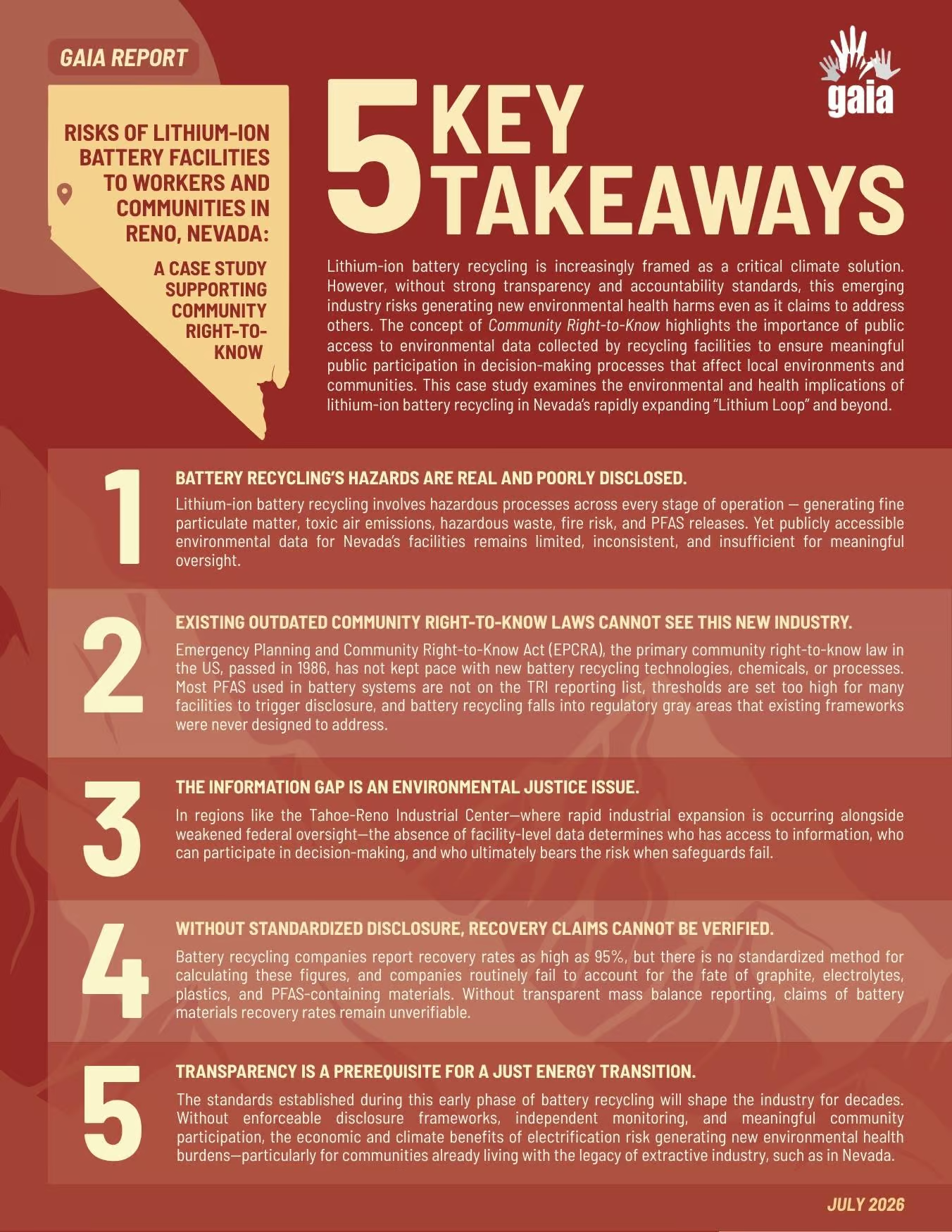
5 Key Takeaways of Case Study: Risks of Lithium-ion Battery Facilities to Workers and Communities in Reno, NV
United States & Canada - Batteries -
The concept of Community Right-to-Know underscores the importance of public access to environmental data collected by recycling facilities to ensure meaningful public participation in decision-making processes that affect local environments and communities. This fact sheet highlights the five key takeaways of the report, Risks of Lithium-ion Battery Facilities to Workers and Communities in Reno, which examines the environmental and health implications of lithium-ion battery recycling in Nevada’s rapidly expanding “Lithium Loop” and beyond.
This joint paper presents key findings from a review of some of the most commonly cited chemical recycling and recovery LCAs, which reveal major flaws and weaknesses regarding scientific rigour, data quality, calculation methods, and interpretations of the results.
Contributed by Maricon Alvarez, Raphaelo Villavicencio, and Mary Jane Banglos (Mother Earth Foundation, Philippines)
At the height of the pandemic in April this year, the entire population of the Philippines was advised to stay home. Frontliners, however, were exempted from this advisory as they are considered essential workers needed in the fight against COVID-19. Frontliners include medical practitioners, policemen, bank employees, grocery employees, food delivery crew, and other essential workers in the non-medical field. One of the many frontliners, often not given much importance, are the waste pickers and waste workers who play a vital role in preventing the spread of the virus.
At present, the majority of the waste pickers and workers continue to do their job by collecting segregated wastes from the households and maintaining proper hygiene and cleanliness in the community. Being one of the frontliners, the daily task of waste pickers and workers’ has become riskier because of the threat of COVID-19.
In solidarity with the significant contribution of the frontliners like the waste pickers and workers, Mother Earth Foundation (MEF) targeted to raise funds to provide food relief to 1,677 partner waste workers on duty in all of MEF’s Zero Waste sites.
Project Tuloy
As part of MEF’s support and recognition for the efforts done by waste workers, they launched Project Tuloy to help the waste workers through two initiatives: Kusina ni Juan, a community kitchen that provides fresh and healthy home-cooked meals and Zero Waste relief goods to avoid further waste generation and plastic pollution in the environment.
Sample of of Kusina Ni Juan (Food) for Distribution in the selected barangays of Malabon City; and Face Masks and Vitamins for the Waste Workers (Photo by Mother Earth Foundation, 2020)
As a result of this initiative, MEF was able to provide personal protective equipment (PPEs), health care kits, and food packs to over 554 waste workers from four project sites in Malabon, Batangas City, City of San Fernando, Pampanga, Brgy. Fort Bonifacio, and Taguig City. 104 waste workers were also given cash aids. In addition to this, we are aiming to reach 1,200 more from the remaining sites in the Philippines.
In the midst of challenges facing the Philippines due to COVID-19, I thank and pay tribute to all people who continue to perform their roles; and to all frontliners who continue to fight this pandemic… and wholeheartedly embrace their duties. I salute you. It is a great blessing to have people from Mother Earth Foundation who have big hearts and care for each other. Thank you MEF for your love and care for us waste workers. Your help has given us strength everyday. – Jonalie Manalo Brgy. San Jose, Navotas City
In the middle of this nationwide problem caused by COVID-19,
We, the waste workers of Barangay Magliman in San Fernando, are sincerely grateful to Mother Earth Foundation for providing assistance during these difficult times. The (relief and sanitation kits) are of great help to us. Thank you very much! – Waste Workers of Brgy. Magliman (City of San Fernando, Pampanga
While the Philippines is still under the threat of COVID-19, Project Tuloy is still ongoing and accepting donations. MEF is targeting to provide relief packs to all waste workers in all of MEF’s project sites across the country.
Definitely, there is still a huge need for any kind of support (in kind or monetary) for our Project Tuloy. We are planning to expand Project Tuloy’s Kusina Ni Juan and Zero Waste Relief where there is still a concept of avoiding the use of unnecessary packaging and being true to the organization’s advocacy of promoting Zero Waste. The additional support will help us promote and execute this initiative. We make sure to buy directly from the local farmers (for ZW Relief) to also help them earn in these trying times. We cook nutritious food for the waste workers packed only in reusable containers to avoid the use of single-use plastic.”
As most of our waste workers are still continuing their jobs during this crisis, we are also aiming to allocate funds for their health and security. We aim to provide HEALTH INSURANCE (Affordable Health Insurance) for the waste workers of MEF in all of our project sites.”
—————————-
GAIA is grateful for the contributions from Mother Earth Foundation. This feature is made possible through the Zero Waste Cities project — an initiative coordinated by GAIA Asia Pacific and funded by the Plastic Solutions Fund (PSF). The views expressed in this feature do not necessarily reflect that of its funders.
The new Zero Waste group on the block
Interview with Mitsuhisa Okuno by Sonia G. Astudillo
When we hear of Japan, we envision clean cities, picturesque scenery, and disciplined citizens. Not much has been said about the Zero Waste movement happening there except for a few great articles on Kamikatsu Town. GAIA sat down with Mitsuhisa Okuno, one of the founding members of Zero Waste Japan to talk about their plans and visions.
Barely one year old, this group promises to be the new group to watch out for with Akira Sakano and Masato Iseki leading the organization. Akira and Masato met early in 2019 in a conference on circular economy and waste reduction practices within corporations. Both share the view that Zero Waste reduction is strongly tied to climate change and other environmental and social issues. That conversation led to a shared vision and optimism to create several Zero Waste case studies around Japan.
“What they noticed is that international organizations have a key purpose with global goals and mobilizing politicians and corporations,” said Mitsuhisa, “but when it comes to creating models or alternative society, these organizations stop short because there are just too many stakeholders involved.”
“Zero Waste Japan believes that we can break that barrier by creating small models in the community. Through a bottom up approach, we hope to make changes in the national and international policies,” added Mitsuhisa. Currently Zero Waste Japan has 2 full time staff (Akira and Mitsuhisa) and 2 part-time staff who specialize in forest conservation and climate and energy policies.
While established in November 2019, the group started to operate just this July and already they are looking at three key stakeholders: (1) local residents – for community engagement, community building, and education, (2) municipalities –to achieve Zero Waste, implementing policies and plans within the municipality, and (3) businesses to bring them in as much as possible.
What are Zero Waste Japan’s top priorities?
It is to create more Zero Waste case studies in Japan, beyond Kamikatsu. Currently we are working with two communities: one is closely tied to a municipality government and the other with a local community foundation with a population of 30,000 and 10,000.
Due to COVID-19, a lot of the project has been delayed and as much as we are committed to the work, there is a lot of thinking that needs to happen. At present the community is also trying to identify what kind of change they want: there is a potential that it may not be Zero Waste only but closer to circular economy and more emphasis on materials circulation which obviously involves waste reduction. We are open to also being involved in projects with focus on other issues or topics but incorporates Zero Waste and other socio-economic issues.
The structure is that we identify the waste situation (where it comes from, who produces it, and where it goes), then depending on their social needs we try to come up with solutions, and then consider the feasibility of the solution based on the budget restraint of the municipality or the foundation, then we try to identify and co-create solutions that fit the narrative that may help other issues of the community.
The most successful waste reduction model in Japan took 10 years to achieve. So we try to get things going and ignite the momentum. Our strength is that we have a very strong knowledge on Japan policy but we also like to be a player in the community to educate and to develop new leaders who will take on the Zero Waste reduction movement. Our work is a combination of developing policies and partnership with communities.
What are the other issues you work with along with the Zero Waste goal?
People continue to leave to go to big cities to make money. Even if we talk about waste, what the municipality officers have in mind is even if we reduce waste people are still leaving this town and can we stop that somehow. In addition to that, the population is ageing. Those are the social challenges that a lot of these communities have all over in Japan. We can’t just bring in Zero Waste by itself because that will not incentivize the community to do waste reduction or any environmental kind of thinking. We like to include other social entrepreneurs to discuss with them how Zero Waste can benefit and support them in various contexts.
It is important that we match what kind of vision they have for the community. We want to make sure that Zero Waste matches with the kind of community that they want to establish. A lot of the Zero Waste practices that are implemented in Japan are issue based. Example is replacing an old incinerator with Zero Waste activities. It is usually the issue that drove the movement. We don’t want to rely on issues. We want to create models that have economic and social benefits to the community. We want to be able to say we don’t want incinerators because there are better options.
What are your ongoing campaigns?
We don’t run campaigns but projects and provide consultations. One of such is the Zero Waste Accreditation that we organize.
How do you see your organization’s work evolving in the next few years?
We are hoping to hire more people. This year is preparation and trying to establish ways to communicate online. We are also finding effective ways to sell the message to the community and to educate them. We are also learning more about waste issues, collection information, and understanding the situation in different regions and contexts.
For next year, we will launch several programs that will help waste reduction within the community. We want to test it to see how effective it is toward achieving Zero Waste.
How can Zero Waste Japan be part of the economic recovery post-COVID?
We don’t have specific solutions. Achieving Zero Waste has economic benefit but sustainability action is not the top priority for businesses. We want to bring conversation onward within citizens, policy makers and businesses.
Contributed by Anilawati Nurwakhidin, YPBB – Indonesia
The COVID-19 pandemic has restricted movements in Bandung City and many other places in Indonesia, as local governments impose community lockdowns to control the spread of the virus. The lockdowns have affected the conduct of the Zero Waste Cities program, which relies heavily on face-to-face interaction with community leaders and households. YPBB has made adjustments to ensure that the program, particularly education and collection activities, keeps running smoothly, while keeping staff, waste collectors and households safe from possible infection.
When doing their rounds in RWs (village subdivisions), field officers make sure they’re wearing personal protective equipment (PPEs), maintaining physical distance, and observing proper hygiene. They also monitor RWs in Coblong and other Bandung districts regarding possible spikes in COVID-19. When an area is under a “red zone” status, or someone in the community has tested positive for COVID-19, field activities are automatically postponed. The Zero Waste Cities staff then move to low-risk RWs until the red zone status in those RWs has been lifted.
Screening of DTDe and DTDC video at the ZWC (Kang Pisman) cadre meeting in Cihaurgeulis Village in this morning (23 Nov).
Physical distancing: Preparation for the roadshow for the ZWC cadre meeting (Kang Pisman) for the Cihaurgeulis Village.
Physical distancing: Distribution of PPE to garbage collectors in Cihaurgeulis Village.
Field officers maximize the use of phone calls and Whatsapp groups to reduce the need for in-person meetings. They also use their social media accounts to post updates, based on a landing page prepared by the Zero Waste Cities project team. Internal training and briefing activities, meanwhile, are conducted online using Google Meet.
An example of a discussion in a community group when there is a complaint about waste that has not been transported and the field officer informs that he has coordinated with the garbage collector while inviting residents to continue sorting waste from the house.
An example of a discussion at the sub-district level Karang Taruna group (youth organization) when a field officer motivates a village that has not started a waste management program from the area and is informed that another village has started.
Field Officer training with the theme of the benefits of DTDC data with the aim that field officers understand the importance of data collection at the DTDC stage and its relation to city waste reduction.
Field Officer Training with the theme False Solutions. It aims to provide the participants an understanding of the basic principles of Zero Waste Cities and various false solutions.
Field Officer Training on Excellence in the Waste Reduction Movement. The training aims to impart to the field officers the advantages of the waste reduction movement carried out by YPBB. One of these advantages include influencing through the system and not relying solely on public awareness. The training also aims to inform the field officers on similar waste reduction movements carried out by many cities and countries.
In community meetings, YPBB ensures that these are held in well-ventilated spaces and physical distancing among participants. In some cases, kelurahan-level meetings are held in batches to limit the number of people in a room.
Video for Door-to-Door Education
In addition to Whatsapp groups and online calls, YPBB has developed an instructional video in October this year on door-to-door education (DTDE) and door-to-door waste collection (DTDC), serving as an alternative medium for educating residents, as well as minimizing physical contact. The video shows the various activities done during DTDE and DTDC, especially during a pandemic.
Thumbs-up for a well done video. Residents show appreciation to the videos on door-to-door collection and door-to-door education featuring some of the waste collectors and field officers. The videos allow members of the community to meet their Zero Waste partners.
This video has been shared with community groups (kelurahan to RT level), and with several cadres and RW leaders. Residents responded to the video with positive emoticons and thumbs-up stickers. The video also featured actual waste collectors and field officers to familiarize residents with these Zero Waste partners.
The video, which was also distributed in larger Whatsapp groups, helped generate discussions about providing better social benefits and financial incentives for waste collectors.
Outside Whatsapp groups, YPBB plans to screen the video during RW-level socialization meetings, DTDE briefings with RW cardres, and garbage collection trainings. While it is too early to tell if the video has been effective, YPBB is hopeful that it can help improve Zero Waste practices not only in RWs in Bandung, but also in other cities and communities in Indonesia.
—————————-
GAIA is grateful for the contributions from YPBB and Bandung City. This feature is made possible through the Zero Waste Cities project — an initiative coordinated by GAIA Asia Pacific and funded by the Plastic Solutions Fund (PSF) and the United States Agency for International Development (USAID). The views expressed in this feature do not necessarily reflect that of its funders.
The Australian Governments Recycling and Waste Reduction Bill is progressing through the Australian Parliament.
The bill is designed to strengthen product stewardship laws and prevent the export of Australian waste in response to the international condemnation of waste dumping by OECD countries like Australia in the Asia Pacific region and to support a much needed Australian recycling sector.
Yet the bill is supported by a range of national policy documents that enshrine Australia’s plans to reprocess waste, particularly plastic wastes for use as fuel in Australia and overseas. In effect, the Australian government’s response to China’s National Sword Policy and similar action by other South East Asian countries, is to continue to export mixed waste by reprocessing it into a fuel product for incineration in cement kilns and waste incinerators.
This raises serious questions about Australia’s commitment to the Basel Convention an international convention to ban the export of hazardous wastes.
Australia’s residual waste stream is one of the largest in the world and stagnates at roughly 20 million tonnes per year. This waste contains many complex mixtures and materials including non-recyclable plastic waste. This waste stream is problematic because of the inherent chemical mixtures embedded in our materials production which include multi-layered and composite material products such as nappies, sanitary products, plastic packaging and all the products and materials that cannot be recycled or reused that end up in this highly complex hazardous waste stream. When residual waste is simply compressed into pellets or shredded and packaged in plastic bales as a fuel, the combustion of this material can cause highly toxic air emissions and associated hazardous ash which is a serious public health threat.
When the Australian government announced its waste export ban, no one thought that this would mean our waste would simply be repackaged as a fuel product. We are deeply disappointed that the Australian government will continue to export our waste as a fuel product. This will pollute other more vulnerable communities in South East Asia while fuelling the many waste to energy incinerators planned for Australia, scandalously as clean and renewable energy projects with public funds, states Jane Bremmer Zero Waste Campaign Coordinator for the National Toxics Network Australia.
“The new bill emerges at the crossroads of the global discourse on the circular economy, global efforts to reduce the greenhouse gases, and the upcoming Basel Amendments on plastic wastes. The bill could become a barrier for Australia to achieve all targets related to the global commitments,” says Yuyun Ismawati from Nexus3 Foundation, Indonesia.
“In the last couple of years, a significant percentage of mixed waste from Australia that entered Indonesia, could not be recycled. Instead Australia should redesign the packaging, improve waste separation, collection and recycling for new products should be improved to meet the circular economy goal. Converting waste into RDF is not compatible with the circular economy principles and still pollutes the neighbouring countries,” added Yuyun.
“In the past, like Indonesia, Malaysia has had bad experience from the exports of Australian waste to our country in the pretext of recycling and for use as fuel in cement kilns. Some of these wastes that were processed and repackaged as “fuel” such as Processed Engineered Fuels (PEFs) were found to be contaminated with hazardous waste,” states Mageswari Sangaralingam from the Consumers’ Association Penang (CAP), Malaysia.
Mageswari added, Why should we, the recipient communities in the developing country suffer the adverse impacts from dumping of residual wastes, toxics from the combustion of these wastes that are disguised as “fuels”? Australia should stop the exports and dumping, take responsibility for your own waste. Do not export harm.”
Aileen Lucero from EcoWaste Coalition, Philippines states; “Allowing plastic wastes to be exported for co-incineration in cement kilns in developing countries is garbage disposal by another name. This is a deceptive scheme for Australia to get rid of its plastic residuals, combined with other materials, in the guise of replacing fossil fuels in cement production as if these wastes are not petroleum-based to begin with. We reject this gaping loophole in Australia’s plastic export ban and ask the federal government to reconsider this scheme rebranding their garbage as fuel.”
“While we laud the move to ban and phase-out single use plastic production and consumption, we are not buying Australia’s plan to ship all those plastic waste to other countries,” said Yobel Novian Putra, GAIA Asia Pacific Climate and Clean Energy Associate. “Repackaging plastic waste into fuel for burning in cement kilns in other countries does not address the problem at source. Feeding plastic in-disguise as fuel to cement kilns only shifts the environmental impact and promotes the usage of dirty incineration technologies.”
“It does not help that we make it so easy for the plastic industry to get away with their waste and just ship it to other countries with less stringent policies,” said Putra. This plastic ban along with its loopholes goes against the Prime Minister’s support for a ban on waste export which he announced August last year.”
Satyarupa Shekhar, Break Free From Plastic Asia Pacific Coordinator, sees the move as industry supported. “For years we have asked people to stop littering, segregate waste, recycle… while the plastic industry who manufactures these single-use plastic sit on their comfortable corporate offices probably thanking us for doing the work for them. It is high time we make them accountable, ask them to clean up their mess, or change their old ways, and offer genuine solutions.”
For more information and interviews:
Jane Bremmer, Zero Waste Australia, Campaign Coordinator, National Toxics Network, Australia, M: (618) 0432 041 397 Skype: westtox E: acejane@bigpond.com
As the global plastic pollution crisis continues to grow, so does industry hype around techno-fixes, including waste-to-energy incineration and chemical processing of plastic waste. Such downstream approaches create more problems and distract from the real imperatives, however, by emitting more pollutants and perpetuating overproduction of plastic. Real solutions to the plastic pollution crisis lie in:
Producing less plastic. The petrochemical industry will not voluntarily scale back production, so public policies are required. These can include bans on single-use and other unnecessary plastics; a ban on constructing new or expanded plastic production facilities; a quantitative cap on plastic production; and a tax on plastic production.
Encouraging alternative service delivery models. A growing number of zero waste businesses aim to displace plastic with reusable packaging or providing services that eliminate the need for plastics.
Supporting recycling. To revitalize recycling, eliminate additives, mixed-polymer and mixed material plastics (e.g. sachets); mandate recycled content standards; require producer financial responsibility for post-consumer plastics; and integrate the informal sector.
Check out GAIA AP’s 1st virtual exhibit, This is how we roll: waste collection vehicles in Asia. It highlights decentralized waste collection systems in India, Indonesia, Philippines, and Vietnam.
This collection will be included in the UN Economic and Social Commission for Asia and the Pacific (UNESCAP) training module on marine waste, specifically under the module on informal sector prepared by WIEGO to showcase examples of locally appropriate technology.
Contributed by Ni Putu Bella Yuliana Dewi and Catur Yudha Hariani, PPLH Bali (Denpasar, Indonesia)
We live in a time where people are encouraged to buy and consume goods wrapped in disposable single-use plastics in the name of convenience. In this “convenient” life, without us realizing it, we have caused damage to our immediate environment and the whole planet. The culture of convenience makes it difficult to solve the waste problem especially in urban areas where people consume more than average Indonesians and where there is limited area for residual waste.
The problem is worsening. Some people who are aware of this try to reduce their plastic waste. Plastic bags take decades to decompose and often fragment into microplastic. Worse, they pose harm to our ecosystems and human health when disposed of into the environment. This condition is one of the triggers for Indonesia to call for a waste emergency. However, not everyone is aware of how serious the situation has become. Indonesia ranks second to China as the world’s biggest plastic waste producer, an award that Indonesians are not proud of.
The waste management infrastructure and systems remain lacking in Indonesia. We need a solution in order to save the surrounding environment and our earth from the damage that we have done. Now is the time for all of us to take Zero Waste action to save the environment and our earth for the next generations.
If the society or the younger generations do not act, there will be chain losses. The Bali government has issued Governor Regulation No. 47 of 2019 concerning Source-Based Waste Management. We, PPLH Bali, started the first Zero Waste Cities in Kesiman Kertalangu Village in Banjar Tohpati. This Zero Waste Cities activity received support from the Denpasar City DLHK government, Kesiman Kertalangu Village Workshop, and Kelian Dusun Banjar Tohpati. In addition, we also get support from friends GAIA (Global Alliance For Incinerator Alternatives), AZWI (Zero Waste Indonesia Alliance), and YPBB Bandung.
The first Zero Waste Cities project in Denpasar started in October 2019. The goal is to reduce municipal waste brought to the landfill (TPA). The stages of implementing Zero Waste Cities in an area or village consists of conducting baseline data collection (including waste management practices and waste generated by households), translating this data into a localized waste management program, training relevant stakeholders on the village waste management program, disseminating information about this program to households, and continuous monitoring of this program. These steps are broken down as follows:
Profiling
APP Survey (Awareness Perception and Practices)
Survey WACS (Waste Analysis and Characterization Studies)
Survey WABA (Waste Analysis and Brand Audit)
System design
System Consultation and Training
Preparation of composting facilities and collection facilities
Training for Officers
Door to door education
Testing and implementation of door to door collection
Monitoring and Evaluation
The pilot project of Zero Waste Cities in Banjar Tohpati, Kesiman Kertalangu Village has been running for a year. During the activity process, there was a clear division of roles. DLHK Denpasar City carries out transportation of waste from the households and oversees the waste management at TPST 3R. The community sorts their waste into 5 categories: soft organic waste, hard organic waste, sanitary napkin tissue, valuable inorganic (recyclables), and residual waste (other waste). The community processes as much organic waste as possible into compost and then becomes a waste bank customer to sell recyclable materials. The role of PPLH Bali is to coordinate all activities, provide door-to-door education, prepare the work equipment, find volunteers, and oversee flow of the project implementation.
Meanwhile, the role of the village government is to organize the community, prepare assistance for facilities, provide honorarium for garbage officers, and supervise the project.
During the project implementation, we encountered a few resistance from the residents: from residents refusing to sort their waste to residents closing the gates of their houses because they do not see the importance of waste sorting and instead see it as an additional burden to the family. Several times we heard complaints such as, “I am busy so I don’t have time to sort waste at home”. Even so, the PPLH Bali Team and volunteers continued to educate the community.
Running the Zero Waste Cities program in the village is challenging. Our team at PPLH put a lot of effort in educating residents, but many still refuse to sort their waste. Official and customary village governments do not have regulations that require households to sort their waste. Nonetheless, PPLH Bali, with the help from YPBB Bandung, is coordinating with the local government to develop a technical plan mandating residents to practice waste segregation and composting.
In the following months from March 2020 to October 2020, Zero Waste Cities activities were hampered and the door-to-door education stopped halfway due to the COVID-19 pandemic. This however did not dampen the enthusiasm of the PPLH Bali Team to continue monitoring with waste transport officers via Whatsapp or sometimes we ourselves went to the field and visited TPST 3R Kesiman Kertalangu. Despite the COVID 19 pandemic, garbage collection officers continue to carry out their duties to transport garbage from residents of the Tohpati banjar every day.
The speed of response to a pandemic situation is very important. Therefore, the PPLH Bali Team is grateful to get the support from GAIA and the Green Lengis Foundation (a local NGO) who helped collect donations to help waste workers with PPE such as gloves, boat shoes, masks, hand sanitizers, vitamins, and food ingredients. There are 71 garbage officers who received the package. They are not only in Denpasar (the location of the Zero Waste City pilot project) but also in Gianyar district in 6 villages.
We hope that waste workers never underestimate any health protocols that we have provided and will use them in the field. We take extra precaution in household garbage collection by urging the public to separate disposable mask waste, and if possible, to use a disinfectant spray to keep the masks virus-free.
We hope that the COVID19 pandemic will end soon so that the Zero Waste Cities pilot project can run again optimally.
—————————-
GAIA is grateful for the contributions from PPLH Bali. This feature is made possible through the Zero Waste Cities project — an initiative coordinated by GAIA Asia Pacific and funded by the Plastic Solutions Fund (PSF). The views expressed in this feature do not necessarily reflect that of its funders.
Tapping its members expertise for a good cause,
always for a good cause
Interview with Nindhita Proboretno and A. Vancher Dipatiukur by Sonia G. Astudillo
Whenever we meet our members from Indonesia, I am always in awe. At first, I thought it was my fascination with Indonesian books and authors like Pulang by Leila Chudori and Vengeance is Mine by Eka Kurniawan but the more I got to know them, the more I know the reasons behind it.
Nindhita Proboretno and Vancher Dipatiukur, Aliansi Zero Waste Indonesia (AZWI) Co-Coordinator and Communication Officer, respectively, share my view, “Every member organization of AZWI has their expertise and our role as the secretariat is to amplify that. AZWI is a very good resource because for every environment issue, we have someone to refer it to.” They said emphasizing that YPBB Bandung takes the lead on Zero Waste modeling, Nexus 3 on waste trade, incineration, and research, ICEL on regulations and advocacies related to law, Gerakan Indonesia Diet Kantong Plastik on plastic bag regulation, PPLH Bali on school education, ECOTON on research and advocacy, Greenpeace Indonesia and Walhi (Friends of the Earth) on people movement, and Komunitas Nol Sampah Surabaya on advocacy and education and public campaign. “Our role is to connect all the pieces of the puzzle,” said Nindhita.
These organizations harmonize their efforts in mainstreaming Zero Waste strategies, with emphasis on the waste management hierarchy, material life cycle, circular economy, and correct use of the Zero Waste approach.
AZWI was first conceptualized in 2016 after the Break Free From Plastic movement meeting in Tagaytay, Philippines. In 2017, Indonesia was faced with plans from the government to build incinerators in seven cities. CSOs got together and filed for a judicial review of waste-to-energy incineration. “The members decided to build an alliance to make the campaign stronger. At that time, it was really hard to fight against WtE especially since it is backed by the government,” said Nindhita.” The campaign was successful because the review ordered a stop to the project. We received support from GAIA who wrote support letters stating the dangers of incineration. However, currently we are again faced with more proposals, this time in 12 cities.”
What are AZWI’s top priorities?
Our top priority is to amplify the work of our members in promoting Zero Waste solutions and rejecting false solutions. We work on six issues: Countering false solutions (e.g. waste-to-energy incineration, chemical recycling, ecobrick, plastic asphalt, oxo-degradable plastic etc.), waste trade, single-use plastic reduction, Zero Waste Cities, upstream advocacy, and fair transition.
The way we work is we look at what our members have done, and we amplify that and also look at the gaps that need to be filled.
What are AZWI’s ongoing campaigns?
There is Project BøOST under the Plastic Solutions Fund. It stands for Ban the big 5, ø waste, pOlicy advocacy, and STop false solutions. This is a 3-year project and all nine organizations are involved in the project. As the Secretariat, we look at how we can collaborate with each other. We want all organizations to achieve the desired outcome. So far, everything is working well.
What is AZWI’s biggest accomplishment or achievement?
It is the judicial review wherein civil society filed a petition for review to the Supreme Court demanding a revoke of Presidential Regulation No. 18 of 2016 on the Acceleration of Waste-to-Energy (WtE) Power Plants in seven cities. It was the tipping point of AZWI. We succeeded in rejecting the presidential regulation promoting waste-to-energy incineration in the country.
What challenges are you facing? How is your work impacted by the COVID crisis?
The main challenge currently is in implementing the projects in the proposal. With COVID, we had to reschedule activities and meeting events shifted to webinars. The outcome is not the same because there are things that are easier to achieve in a face-to-face meeting. With everything online now, coordination is more challenging. Communication between each other is handled slowly and it is mostly because of the pandemic.
What are the challenges working as an alliance?
All the members have their own expertise and uniqueness. The challenge is how to make them work as one or come out with one voice. When campaigning, we make sure that the campaign is aligned with the work of all the other members.
Time too is another factor. Members are busy with the work of their organizations. Decision-making takes a while. We managed though. For anything urgent, we approach them individually.
What about the benefits of being in an alliance?
As an alliance, the work has more impact. If you are campaigning alone, the impact is not that strong. But if you bring in AZWI and all the members, with its pool of expertise, the campaign will have more weight and chances of success is much higher. Add to that is the feeling of being part of a bigger community.
How do you see your organization’s work evolving in the next years?
After the new secretariat was formed, it is much better than before. We are still developing. We want to make it bigger and for people to know about us. We are running towards the target. We will continue to contribute and address environmental issues. Our projects such as expanding Zero Waste City model, promoting Zero Waste policies and solutions, and Ban the Big 5 (5 single-use plastic: plastic bag, plastic straw, sachet, styrofoam, microbeads) will become huge.
Globally, for now the secretariat is formalizing how everything works. Hopefully in the next year, we want AZWI to be involved in global platforms.
With regards to membership expansion, we have been receiving proposals from organizations to join. There is an ongoing discussion on what are the requirements and the process. That is the direction we want to go to if we want to amplify the work and combat plastic.
How do you envision a just and equitable recovery from COVID-19? How can your organization’s work be part of the solution?
Even during the COVID-19 pandemic, we continued our work on waste issues. To counter the government’s push for incinerators, AZWI has developed communication materials and hosted webinars to inform the public about the dangers of these burning machines. Meanwhile, YPBB Bandung has initiated conversations about improving the welfare of waste pickers and collectors.
What are your thoughts on the waste crisis that many countries in your region (and in the world) are living right now?
The waste crisis is not yet over – and it will not be solved by burning waste. The Indonesian government still continues to push for WTE incinerator proposals in 12 cities in the country, even though it’s not the real answer to our waste problems. Many waste pickers and collectors – our frontliners in this waste crisis – meanwhile remain excluded from the formal work sector, thus not getting enough livelihood support. In Indonesia, for example, many collectors still rely on voluntary fees paid by households, which are not enough to support their families.
How does your work on waste relate to social justice?
Just transition is one of our strategic issues. We know that there are people working and living near the landfill. The question is, if they do not work as waste pickers, what will they do? In AZWI, we try to address that by supporting communities and the local people.