Lutter contre les émissions de méthane des décharges grâce à la justice environnementale
- Climate -
Le présent rapport décrit les risques liés aux approches habituelles (« Business As Usual » ou BAU) en matière de réduction des émissions de méthane provenant des décharges et plaide en faveur d'une réponse durable et axée sur la justice. Il s'appuie sur des données internationales, sur les tendances politiques actuelles et sur l'expérience des communautés pour identifier les solutions efficaces et inefficaces en matière de fermeture des décharges et de gestion des déchets organiques.
Le zéro déchet comme stratégie climatique efficace : éviter les compromis de réchauffement liés à l’incinération
- Climate -
Le présent rapport évalue les impacts à long terme sur le réchauffement climatique de trois stratégies de gestion des déchets : les pratiques basées sur l’élimination classique (« Business As Usual » ou BAU) comme la mise en dépotoir ou en décharge, l’incinération et les pratiques zéro déchet comme le tri à la source ou le traitement des déchets organiques et des déchets recyclables. L’analyse se concentre sur trois contextes urbains, à savoir Lagos (Nigeria), Barueri (Brésil) et Quezon City (Philippines), et calcule les impacts prévus sur la température pour chacune des stratégies jusqu’en 2060 à l’aide de l’outil d’estimation des émissions des déchets solides (SWEET) et du modèle climatique FaIR (Finite Amplitude Impulse Response).
Zero Waste Europe, together with Slow Food created a briefing, aimed at providing support to local municipalities to help reduce food waste through a holistic approach enabling the transition towards a sustainable food system.
The guidance outlines the various actions that a municipality can implement to influence food waste reduction and stimulate its sustainable local food system. The guidance highlights examples of how similar policies have been successfully implemented throughout Europe.
06 January 2026– #RefuseSingleUseDay shines a light on a simple idea that feels almost old-fashioned: stop treating things as throwaways in the first place. From plastic sachets to paper cups to misleading bio-based packaging, single-use items continue to strain ecosystems and local budgets. The campaign demands a systemic shift away from the “take-make-waste” economy that has led us into the throes of a triple planetary crisis of pollution, biodiversity loss, and climate change.
Reuse offers a far more grounded approach, and many communities are proving that it works. Reuse systems rely on durable products and toxic-free packaging designed for repeated cycles of use. This cuts waste at the source, reduces reliance on costly disposal systems, preserves natural resources, and supports the local economy with green jobs. Around the world, local initiatives show how reuse can work in practice. In Asia, the Kuha sa Tingi (take by small amounts) refill system in the Philippines, crockery rental banks in India, reusable tableware services in Hong Kong, and Vietnam’s Refillables Dong Day demonstrate that reuse can fit many cultural and economic contexts.
In much of the Global South, reuse and refill are hardly radical ideas. Not long before companies brought single-use to our homes, people topped up their containers at neighborhood shops, borrowed shared items for gatherings, and passed along used objects for generations. These long-standing habits prove that reuse is practical, shaped by local knowledge, and protects cultural identity. The recent influx of investment and policy support is simply helping scale models that have worked for generations.
While these practices never disappeared in many parts of the world, Europe is now showing how policy and investment can bring reuse to a city-wide scale: municipal policies, shared infrastructure, and programs like the Elevating Reuse in Cities (ERIC) and the RSVP Reuse Blueprint are turning pilots into city-wide solutions with deposit-and-return schemes and public procurement strategies that create local green jobs.
Reports such as The Economics of Reuse Systems and Unpacking Reuse in Asia outline the social and economic case for reuse. Citing business initiatives, the reports recommend stronger policies that include Extended Producer Responsibility fees that help fund reuse infrastructure and place clear responsibility on producers and public authorities.
” Reuse cannot be treated merely as a pilot—it must become the new norm within production and consumption systems. Moreover, several Southeast Asian countries have already established national roadmaps, which can serve as a strong foundation aligned with the waste-reduction ambitions of the Global Plastic Treaty,” stresses Rahyang Nusantara of Dietplastik Indonesia, a co-convenor of the Asia Reuse Consortium – a collaborative network of CSOs, businesses, and government officials dedicated to promoting reuse as a sustainable alternative to single-use packaging.
This January 6 marks Refuse Single-Use Day, a global initiative launched in 2023 to push back against our throwaway culture. The campaign unites businesses, governments, civil society organizations, and young people to challenge the norms of disposability. Rather than swapping one waste stream for another, it calls for reducing reliance on all single-use materials, whether plastic, paper, or bio-based alternatives. By championing real, scalable reuse systems, the movement advocates for a shift from the ‘take-make-waste’ economy to a future built on genuine reuse and zero waste. This year also marks a milestone: the second anniversary of the Asia Reuse Consortium, a key force in driving reuse collaboration across the region.
A cleaner path forward starts with funding reuse infrastructure, aligning on shared standards, and scaling local solutions that are already proving their worth. Done well, reuse doesn’t just trim waste; it protects ecosystems and creates green jobs with actual staying power. A healthier future isn’t wishful thinking; it’s practical, it’s doable, and it’s sitting in a tote bag near you. Remember—always #ChooseReuse.
Media Contacts:
Dan Abril, Communications Officer for Programs, GAIA Asia Pacific | dan@no-burn.org | +639174194426
Robi Kate Miranda, Communications Officer for Campaigns, GAIA Asia Pacific | robi@no-burn.org | +63927 585 4157
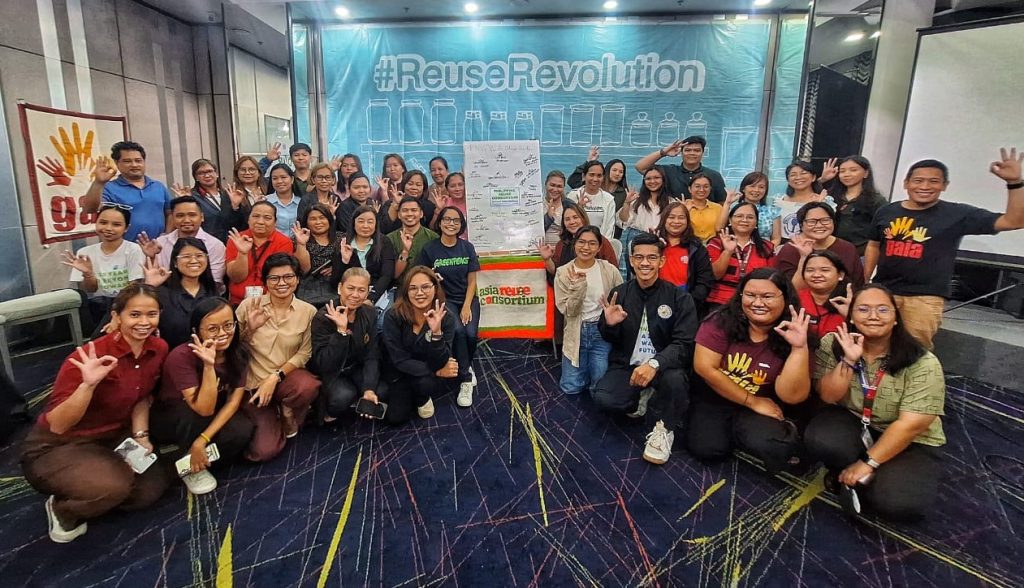
The Philippine Reuse Consortium. (Photo by Albert Lozada, Greenpeace Philippines)
Quezon City, 27 January 2025 – In celebration of International Zero Waste Month, the Philippine Reuse Consortium, the Philippine Chapter of the Asia Reuse Consortium, was officially launched this month. This marks a significant step forward in the fight against single-use plastics (SUPs) through innovative reuse solutions. The Consortium unites representatives from civil society organizations (CSOs), government agencies, and businesses in a shared mission to develop sustainable, community-driven solutions to plastic pollution.
The launch culminates the three-day workshop and stakeholder consultations on mainstreaming reuse and refill solutions in the country. The event which was organized by Greenpeace Philippines and the Mother Earth Foundation, with the support of Plasticdiet Indonesia, GAIA Asia Pacific, and the Break Free From Plastic movement, highlights scalable local initiatives, including zero waste sari-sari stores (small-scale convenience stores) carinderias (neighborhood eateries), and local reuse-and-refill stores such as Back-to-Basics and Sabon Express. These case studies offer valuable insights into adapting reuse systems to the Philippine context.
The consortium’s launch paves the way for developing a Philippine reuse roadmap, inspired by other examples in the country such as those initiated by Back-to-Basics and Sabon Express. Such a roadmap could chart a path on transitioning away from SUPs and towards scaling reuse and refill models designed to extend product life cycles, significantly reducing the environmental and social harms caused by SUPs. Research shows that reuse systems have the potential to cut plastic pollution by 30% and lower greenhouse gas emissions from packaging production by up to 80% by 2040.
As part of its efforts, the Consortium emphasizes collaboration among policymakers, businesses, and communities to institutionalize reuse systems and drive lasting environmental and economic benefits. By fostering partnerships and advancing reuse innovations, the PRC and the Asia Reuse Consortium are paving the way for a sustainable transformation in the Asia Pacific region.
The Consortium unveiled a five-year roadmap to mainstream and prioritize reuse, anchored on 10 key action points:
Advocating for progressive laws and policies. Prioritize lobbying efforts to establish and strengthen laws that support reuse systems with clear and measurable targets.
Strategic communications and public engagement. Amplify messages through media partnerships and public campaigns by disseminating PSAs and Information, Education, and Communication (IEC) materials.
Championing Role Models to Develop Champions. Identify and spotlight the work of individuals, communities, and organizations that successfully implement reuse systems.
Build Capacities of Stakeholders. Develop and offer training and resources to stakeholders, including government units, grassroots organizations, and businesses to implement effective reuse systems. The focus will be given to capacitating/empowering waste workers through education and skill-building opportunities
Promoting a Just Transition for Waste Workers and Waste Pickers. Advocate and implement frameworks that ensure waste workers are not left behind in the shift toward reuse systems.
Scaling Reuse Models. Expand and replicate reuse models, and encourage businesses to integrate reuse systems into their operations.
Expand and Strengthen Networks. Reach out and build partnerships with other sectors to foster a robust, multi-sectoral network.
Drive Innovation through Research and Development. Invest in research and development to develop reuse systems.
Secure Financial Support and Investments. Advocate for financial mechanisms to support local initiatives and ensure resources are available for scaling reuse systems.
Establish Standards and Guidelines. Develop clear guidelines for reuse systems to ensure safety and environmental integrity.
These action points address critical gaps in policies and mechanisms supporting local initiatives, ensure the inclusion of waste workers, and push big businesses to integrate reuse systems into their operations.
Quotes from consortium convenors:
“A reuse-based economy in which every Filipino has access to reuse systems and affordable alternatives to single-use plastics is possible. Communities and cities are leading the shift to reuse, but we also need businesses and the national government to act to mainstream reuse and refill solutions. Businesses must transition to reuse, while policymakers must enact a law setting targets and driving a shift to reuse and a fair regulatory framework for these systems. With the launch of the Philippine Reuse Consortium, we hope to make reuse the norm again for all socioeconomic sectors.” – Marian Ledesma, Zero Waste Campaigner, Greenpeace Philippines
“The reintroduction and mainstreaming of Zero Waste businesses, such as sari-sari stores and carinderias, have shown potential in driving a sociocultural shift toward reuse. However, achieving systemic change requires strong support through enabling policies and technologies. Engaging more sectors—such as key government agencies, waste workers and pickers, fast-moving consumer goods (FMCGs), and NGOs—will be crucial in advancing reuse practices and systems in the Philippines.” – Rap Villavicencio, Deputy Director for Programs, Mother Earth Foundation
“Local initiatives and small businesses in the Philippines—from carinderia, to sari-sari stores and reuse-and-refill zero waste stores— have shown that reuse and refill practices are still very much alive in our communities and with the right and adequate support, it is possible to scale these reuse and refill solutions not only to end plastic pollution but also to address climate concerns. It is high time that different sectors come together to play a part in creating enabling environments for these solutions and zero waste systems to thrive and become the norm again. Sound policies, standards, investments, and corporate accountability could pave the way for a complete shift from single-use throw-away plastics to a reuse economy that benefits all sectors.” –Faye Ferrer, Network Organizer, Break Free From Plastic
“Frontline communities and waste workers are crucial to building effective reuse systems. The Philippine Reuse Consortium’s 10-point action plan integrates training and fair compensation for these groups, while also drawing from local reuse models that are already working. By leveraging these existing solutions, we can reduce plastic waste and scale up sustainable practices.” – Froilan Grate, Regional Coordinator, GAIA Asia Pacific
“Malaking tulong ang reuse saming mga waste workers, mababawasan ang mga kalat na walang pakinabang saming mga waste workers tulad ng single use plastics at mga sachets. Sa pagsali sa PRC, madami kaming matututunan at maitutulong. Kami ang mag sisilbing modelo sa mga komunidad sa pamamagitan ng IEC at paghikayat sa kanila sa Reuse system. Makakatulong din kami sa pag aaral dahil kami din ang unang makakakita at maapektuhan kapag nabawasan na ang mga plastic.” (“Reuse is a great help for us waste workers, as it reduces useless trash like single-use plastics and sachets. By joining the PRC, we will gain knowledge and be able to contribute more. We will serve as models in our communities through information and education campaigns (IEC) and encourage them to adopt reuse systems. We can also contribute to research, as we are the first to see and be affected by the reduction in plastic waste.”) – Aloja Santos, President, Philippine National Waste Workers Association
“Back to Basics Ecostore is honored to be a member of the newly-formed Philippine Reuse Consortium. We look forward to contributing to the development of the Philippine Reuse Roadmap. The collective actions of diverse stakeholders bring hope that we can make real and attainable solutions readily accessible to the public to help address the plastic pollution problem at its core.” –Laarni Cancio, Owner, Back-to-Basics (BTB) Ecostore
“It was amazing to see the different reuse and refill solutions that are already existing and working in the Philippines. It helped me think of ways to apply it in our own barangay. Especially if you are a sari-sari store/carinderia owner, REUSE IS POSSIBLE. Government officials can make this happen if we support the transition of these businesses while creating and implementing policies that would ban single-use plastics.” – Khate Nolasco, Barangay Kagawad Potrero, Philippine Zero Waste Cities Network
About the Asia Reuse Consortium— Launched in 2024, the Asia Reuse Consortium (ARC) is composed of civil society organizations, businesses, and local governments from Indonesia, the Philippines, Vietnam, Thailand, and India whose aim is to encourage the development of reuse ecosystems as a solution to tackle plastic pollution in Asia. The consortium aims to promote reuse systems through joint development of reuse standards, capacity building for reuse entrepreneurs, and strengthening countries’ stance on reuse systems in the Global Plastic Treaty. Asia Reuse Consortium was initiated by Plastic Diet Indonesia, GAIA Asia Pacific, and Break Free From Plastic, with the support of PR3-The Global Alliance To Advance Reuse.
GAIA Asia Pacific: Dan Abril, Communications Officer for Programs, dan@no-burn.org | +639174194426
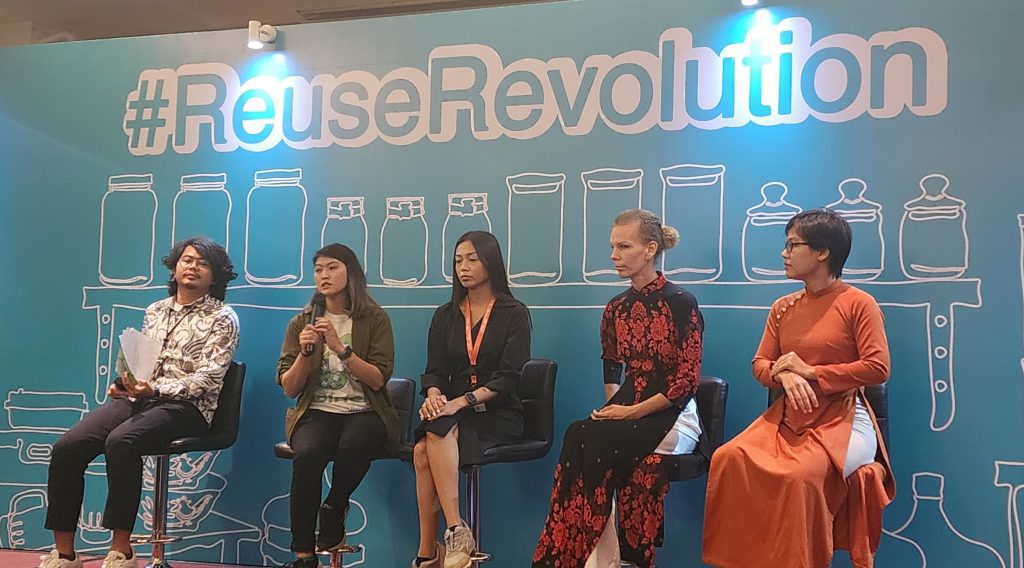
25 January 2024– The International Zero Waste Month (IZWM) marks a critical juncture in the global fight against single-use plastics (SUPs). The Asia Reuse Consortium, a groundbreaking initiative, was established in Jakarta, Indonesia on January 11, comprising 18 individuals from 13 countries, including Indonesia, the Philippines, and Vietnam. This diverse network includes Civil Society Organizations (CSOs), businesses, and government officials, united by a mission to champion reuse as a practical, sustainable, and effective solution to SUPs.
In stark contrast to the linear nature of SUPs, the reuse model is designed for multiple lifecycles, offering economic benefits to communities while mitigating environmental impact. Approximately one-third of plastic packaging currently finds its way into the environment, highlighting the urgent necessity of transitioning to reuse. Embracing reuse systems presents an opportunity to reduce plastic pollution by 30 percent by 2040 and potentially decrease greenhouse gas emissions from packaging production by a staggering 80 percent.
Addressing this need, the Asia Reuse Consortium, initially convened by advocacy group Dietplastik Indonesia, with support from the Global Alliance for Incinerator Alternatives (GAIA) Asia Pacific, aims to spearhead the shift by advocating for the widespread adoption of reusable solutions across industries. With a specific focus on minimizing the impacts of SUPs, the consortium seeks to create a positive ripple effect by fostering collaboration among stakeholders, influencing business strategies, and advocating for supportive policies.
Tiza Mafira, Executive Director of Dietplastik Indonesia, highlights the benefits of choosing reusable items, stating, “Choosing reusable items not only helps the environment but also reduces emissions. By using less plastic in production and recycling, we cut down on waste. It’s a win-win for both sustainability and our planet.”
However, the success of reuse systems hinges on collective effort. The Consortium underscores the need for initiatives from forward-looking businesses and the support of local and national governments. This collaborative effort, with businesses and government units as active members, aims to actively promote the adoption of reusable packaging solutions. The approach involves emphasizing the benefits of sustainability and environmental protection, fostering collaboration among CSOs, businesses, and government bodies to facilitate knowledge exchange and initiatives supporting the advancement of reuse systems.
Froilan Grate, Regional Coordinator of GAIA Asia Pacific, summarizes the significance of the consortium’s emphasis on reuse. He states, “We promote reuse because reuse systems are accessible, affordable, and enhance people’s lives. We acknowledge that transitioning away from SUPs requires time but the process should be transparent, fair, and rooted in shared principles, cross-sector collaboration, and, most importantly, community-based solutions.”
The significance of the Asia Reuse Consortium extends beyond Indonesia, holding immense importance for the entire Asia Pacific region. Contrary to the blame often placed on the Global South for plastic pollution, the Asia Reuse Consortium stands at the forefront, paving the way for the reuse revolution.
###
The Reuse Consortium is a collaborative network of CSOs, businesses, and government officials dedicated to promoting reuse as a sustainable alternative to single-use packaging.