







Contributed by Trivandrum Municipal Corporation (TMC)
The Zero Waste Story of Trivandrum, India
Trivandrum is the capital city of Kerala, the southernmost state of India. In 2011, the city was hit hard by the shutdown of its only municipal landfill at Vilappilsala (in the city outskirts) after locals protested the mismanagement of waste at the site. It was then that the city’s local body decided to shift its waste management practices to a decentralized system. The Trivandrum Municipal Corporation (TMC) is the largest local self-government institution with 100 wards, about 1 million in population, and an area of 214.86 sq. km. Being the capital city, there is also a floating population of 200 thousand per day. The city produces around 423 tons of waste per day out of which more than 70 percent is organic waste.
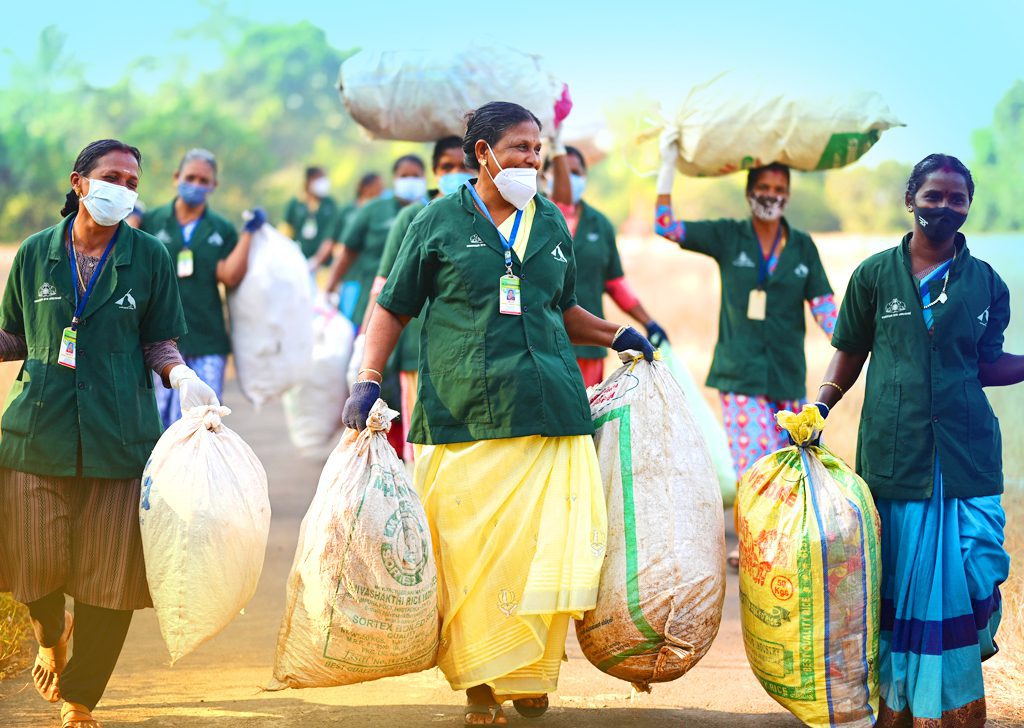
The decentralized waste management system of TMC introduced segregated collection of waste ensuring source-level composting and decentralized resource recovery. This is done with the help of 1,139 ‘Haritha Karma Sena’ (Green Action Force) members who are tasked to collect non-biodegradable waste materials from each household. For this, they earn a user fee of Rs.100 per month from each house that they visit. The Haritha Karma Sena (HKS) members, 90 percent of whom are women, visit every house twice a month for plastic collection. The municipal corporation also has a calendar made for non-biodegradable waste collection according to which the people should hand over different types of waste material to HKS in allotted months (for example, old cloth, bags, and sandals in October). The collected non-biodegradables are then sent to authorized recyclers.

The city follows source-level composting for organic waste. Each household has access to bio-waste management facilities provided by the local body, such as composting bins or kitchen bins, pipe compost, biogas plants, etc. which are provided at a highly subsidized cost. Communities or households who do not have enough space to plant such source-level composting facilities can drop their bio-waste at the nearby aerobic bins. There are close to 60 aerobic bins distributed to the 100 wards in the city. These aerobic bins have trained staff who process the waste to convert it to compost that is used for urban farming. Bulk generators like hotels, restaurants, commercial establishments, community halls, and institutions are also responsible for segregating their waste at source. They then have to hand over their non-bio waste to the HKS and wet waste to authorized pig farmers or plant owners who process and use it for animal feed.
The city also introduced a ‘Green Protocol,’ (a set of measures to reduce waste generation), the first in India to do so. A large group of youth leaders called the Green Army volunteers assist the city corporation to enforce the Green Protocol at all major events and festivals, raise awareness against littering, promote alternative products, and many more vital activities.

This formalization of decentralized resource recovery, source-level segregation, and composting are examples of zero waste solutions that are based on the principles of environmental justice:
- The Green Protocol measures and promotion of alternative products through Green Army youth volunteers’ awareness campaigns are meant to advance the commitments of governments, the public, and private institutions to reducing consumption, thereby reducing their carbon footprint. This is a major step towards respecting planetary boundaries and ensuring intergenerational equity.
- The HKS helps to keep the city clean and aids every household to manage their waste responsibly. The mandatory user fee payment to HKS, forming the HKS consortium, pays for green uniforms, necessary equipment for safe waste collection, and training sessions to HKS to convert them to Green Technicians who can provide technical assistance to every household and institution in using source-level composting technologies. These initiatives show how the city corporation ensures and promotes respect for workers in the field of waste management. They are not seen as waste pickers but as a part of the city corporation’s enforcement force.
- Trivandrum’s decentralized waste management infrastructure also enhances inclusion– many HKS members and Green Army volunteers are from different social backgrounds. The city corporation also makes sure that all communities in the city have access to the facilities and technologies for waste management.
- The officials of the corporation’s health wing have a day and night patrolling squad to prevent littering. The squad acts as an enforcement agency that imposes a fine for non-compliance. The state has introduced a new scheme that rewards 10 percent of the punishment fine to responsible individuals who report such violations, with evidence, to the squad. These measures ensure that there is accountability for environmental harm.
- These practices’ combined yields generate income for waste management facilitators or HKS, leading to a just transition. It ensures a sense of responsibility among the public, especially the youth, in managing waste. The program also promotes a critical narrative shift amongst the general populous– that what we see as trash is actually a resource. This systemic point of view has led to increased adoption of holistic solutions for zero waste.

The TMC has ensured stakeholder participation in solid waste management and has adopted creative and scientific methods for methane reduction, which undoubtedly make the city a model in solid waste management that can be followed by other states and nations through necessary modifications that suit their local characteristics.
References
https://haritham.kerala.gov.in/wp-content/uploads/2020/01/Thiruvananthapuram-1.pdf