In this discussion paper, GAIA and SOMO synthesise insights from our June 2026 virtual learning circle on lithium-ion battery overproduction. The session brought together more than twenty participants from industry, research, civil society, labour organisations, and affected community advocates — spanning China, Latin America, Europe, and the United States. Global manufacturing capacity for lithium-ion batteries is now estimated at two to five times greater than current demand — a structural gap expected to persist well into the 2030s. This paper asks: what is driving it, who pays the price, and what can we do about it?
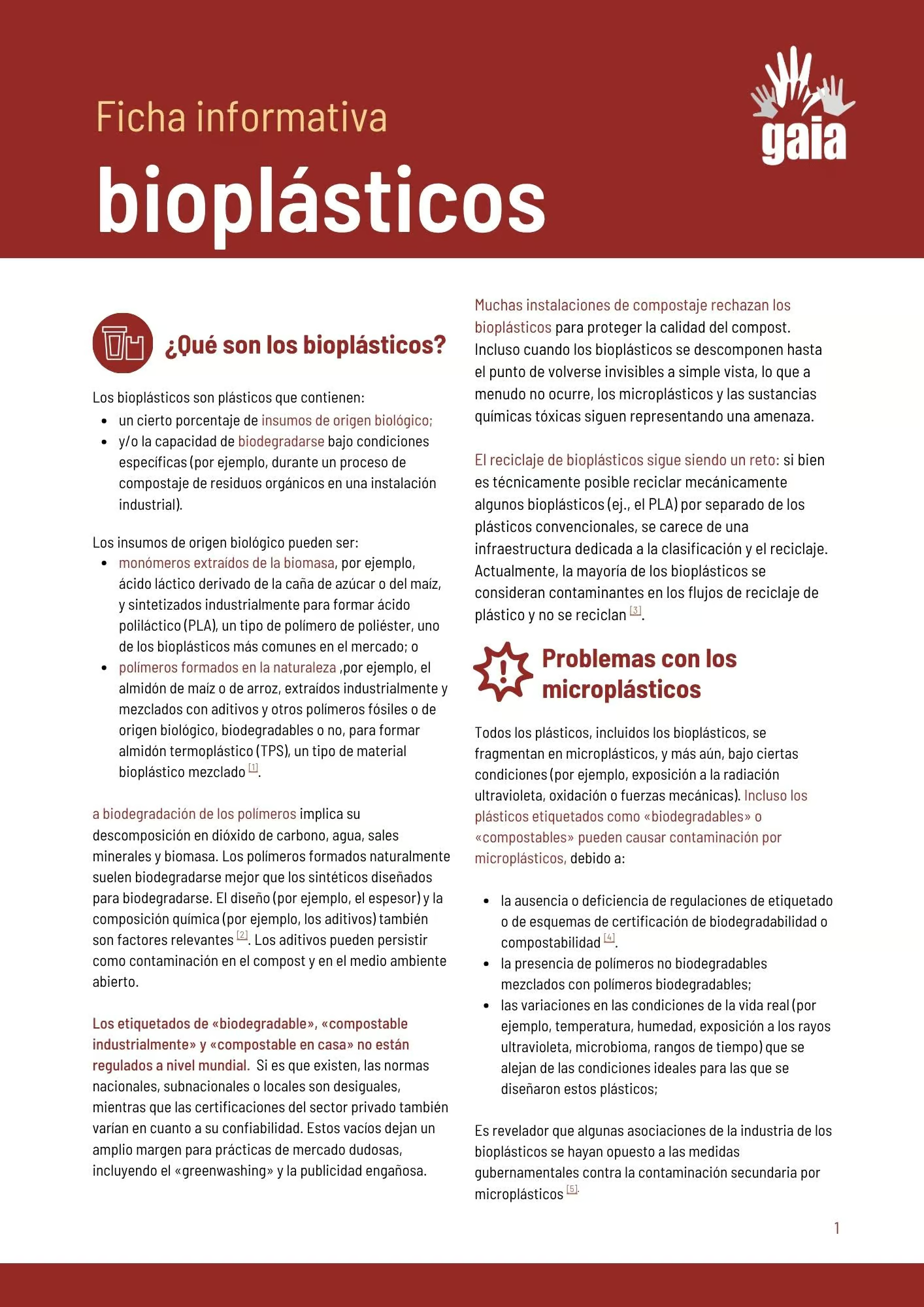
«Bio» no significa que sea bueno o seguro. Con demasiada frecuencia, el énfasis en el uso de los bioplásticos sirve sólo para encubrir con argumentos ecológicos la sobreproducción masiva de plásticos de un solo uso o de corta vida útil. Los bioplásticos actuales son, en su gran mayoría, sustitutos lamentables de los plásticos convencionales de un solo uso, que terminan en los vertederos y perpetúan la contaminación por microplásticos.
Related Resources
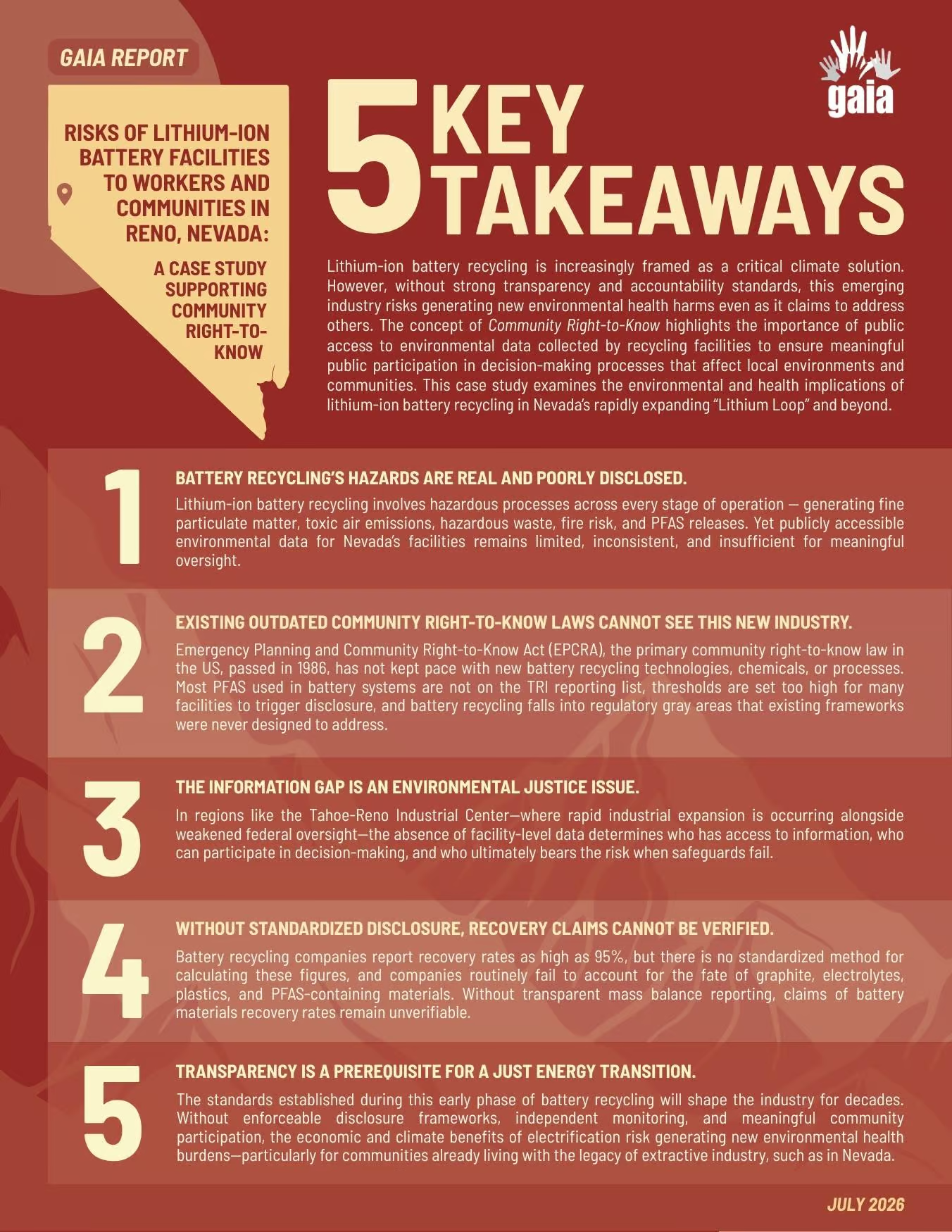
5 Key Takeaways of Case Study: Risks of Lithium-ion Battery Facilities to Workers and Communities in Reno, NV
United States & Canada - Batteries -
The concept of Community Right-to-Know underscores the importance of public access to environmental data collected by recycling facilities to ensure meaningful public participation in decision-making processes that affect local environments and communities. This fact sheet highlights the five key takeaways of the report, Risks of Lithium-ion Battery Facilities to Workers and Communities in Reno, which examines the environmental and health implications of lithium-ion battery recycling in Nevada’s rapidly expanding “Lithium Loop” and beyond.
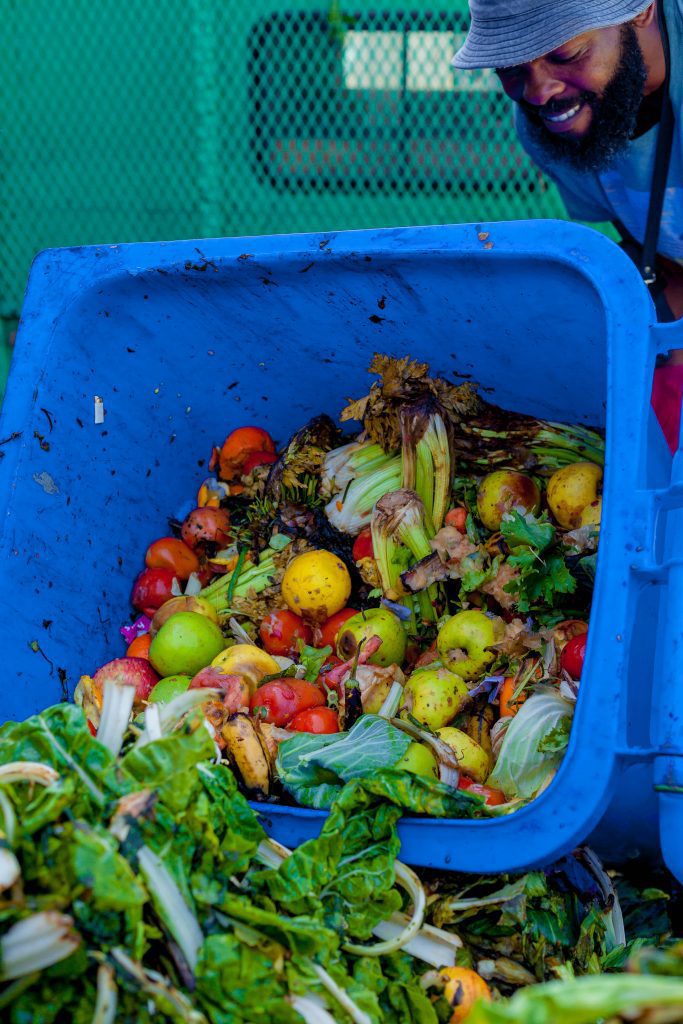
Over the past two years, our Warwick Zero Waste project team and partners have been implementing an innovative composting pilot – taking organic fruit and vegetable waste from the Early Morning Market (EMM) (Markets of Warwick, inner-City Durban, South Africa) and composting this with garden waste at the Durban Botanic Gardens. Starting small and growing incrementally, the pilot is now composting over 2 tonnes of organic waste weekly with plans to scale up further and replicate this local closed loop model across the city. Composting organic waste as opposed to landfilling reduces methane emissions is an important step for mitigating climate change!
Over the course of 2022 and 2023 (end September), the pilot project has diverted over 44 tonnes (44852,34kgs) of organic waste from landfill to produce nutrient rich compost. In 2022, we diverted 2680,25kgs of organic waste from the EMM (608,4kgs equivalent of CH4 per wet ton of organic waste using 227kg CH4 (Methane) per wet tonne organic waste (Zhao et al. 2019 in GAIA, 2022). In 2023, as scaling up commenced, we have thus far diverted 31132kgs of EMM organic waste (7066,96kgs equivalent of CH4 per wet ton of organic waste using 227kg CH4 (Methane) per wet tonne organic waste (Zhao et al. 2019 in GAIA, 2022). Samples of the compost undergo regular testing to refine our ‘recipe’ as we compost larger volumes to ensure a quality end product.
In addition, the Warwick Zero Waste Project offers various other co-benefits, including the opportunities to create jobs, to foster transversal partnerships for municipalities, to improve capacity building and skills development, and of course, to enrich our soils to grow healthy food. We have completed a cost benefit analysis on the pilot which shows significant savings for the municipality if they were to divert all organic waste from the city-managed markets instead of sending them to landfills. The model shows further how savings from this diversion may be reinvested to improve the working conditions for informal traders in the market spaces – crucial to ensuring that social and environmental justice are realized as we move to a zero-waste future.
The composting pilot is a partnership project involving the Urban Futures Centre and the Department of Horticulture at the Durban University of Technology, local non-governmental organizations groundWork and Asiye eTafuleni, and city partners: the eThekwini Municipality’s Parks Recreation and Culture Department, the Business Support, Tourism and Markets Unit, and the Cleansing and Solid Waste Unit.
The composting pilot is also one component of what is a much bigger zero-waste project. You can get a sense of the bigger project from our website: https://africazerowastehub.org.za/
Here are two short videos on our composting pilot:
First video from last year when we were just starting to scale up
Second video produced for us by eThekwini this year, showing some of the scaled up operations
The Alianza Basura Cero Ecuador (ABCE) coordinates more than 41 social and environmental organizations that collectively promote the implementation of zero waste models at the local, regional and national levels, favoring processes to reduce the amount of solid waste generated and buried, as well as to promote social, environmental and gender justice.
At the ABCE, we promote the efforts of civil society organizations, academia and the recycling movement. To this end, we frame our work in five main axes:
Zero waste advocacy in public policy: promoting the implementation of zero waste policies at the local and national level.
Inclusive recycling and closed-loop systems: acknowledging the struggles of the recycling movement and promoting zero waste citizen initiatives.
Prevention and management of organic waste: promoting the reduction of food production volume, food recovery, home and small-scale composting.
Sacrifice zones: demanding the integral reparation of communities affected by massive waste burial: landfills, incinerators, co-processing plants.
Rejection of plastic pollution, co-processing, incineration and importation of waste: rejecting and denouncing the impacts of these harmful practices.
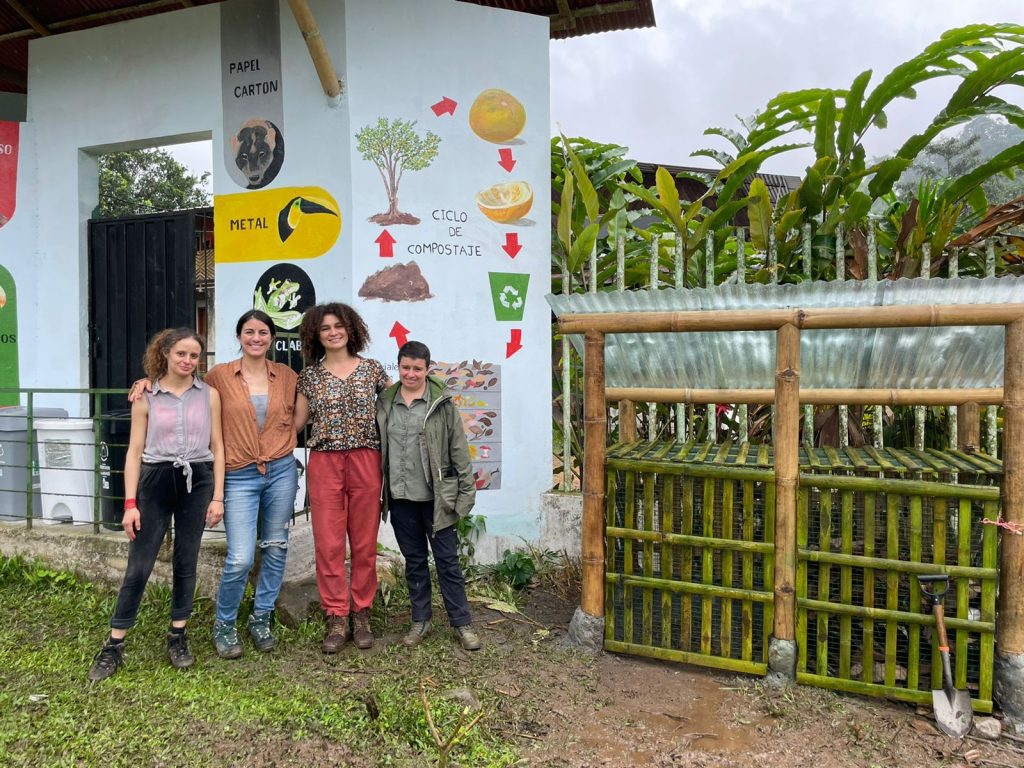
In 2022, the Composting Network of Ecuador was founded as part of the ABCE. Since then, we have been working closely with grassroots and non-profit organizations involved in the prevention and management of organic waste. The network is focused on education and advocacy in public policies that favor waste management from a zero waste perspective.
Currently, ABCE and the Composting Network of Ecuador organize our work in three components:
Academic research
We conduct academic and scientific research in coordination with the National Institute of Statistics and Census, as well as with the Association of Municipalities of Ecuador. We generate updated socio-environmental information that analyzes, from a political ecology perspective, the impacts of the inadequate management of urban solid waste. We produce academic and popular reports, cartographies and maps that make the national environmental impacts of the 221 municipalities visible in terms of: leachate generated, carbon dioxide and methane emissions, occupation and contamination of territory, as well as socio-environmental conflict.
Furthermore, we document the positive impacts of reduction, recovery and decentralized management of organic waste. All the experiences of food banks, organizations, foundations, services, family, community, neighborhood and municipal composting experiences have been mapped. The positive impacts of these initiatives have been calculated in terms of methane emissions avoided, leachates avoided and unused land area.
Mapped initiatives
Number of initiatives
Ton/month
Food bank
9
475
Animal food managers
150
261
Decentralized composting
139
87,92
Composting services
15
1294
Municipalities
65
2531,27
TOTAL
4649,19
Training
We promote participatory training and exchange processes with the recycling movement, the state, civil society, agroecology networks and environmental organizations. We foster the exchange of knowledge and practical experiences, the dissemination of research results and the response to specific demands and training needs for the prevention and decentralized management of organic waste.
Implementation
Through ABCE members and the Composting Network, we implement pilot programs and projects at the household, school, community, neighborhood and municipal levels. To date, 13 pilot programs are in operation, in addition to the initiatives developed by our members. One of the programs, for example, is the Zero Garbage Schools Network of the Andean Chocó, in which 7 schools participate.
Contributed by Rohini Malur, Kumuda C.S. and Anil Kumar
Zero Waste as a Pathway to Methane Mitigation
Environmentally sustainable waste work is useless without the integration of the informal sector and the opening of opportunities for the marginalized communities who bear the brunt of climate change.
For Hasiru Dala, this broadly means that we work with waste pickers, the people who “make a living collecting, sorting, recycling, and selling materials that someone else has thrown away” outside of a formal and recognized economy. In rural areas, this means working with waste pickers or with self-organized groups comprising women (who historically provide most of the informal and undocumented labor, and then are shunted out of formalization efforts when men are given more access to entrepreneurial roles).
Hasiru Dala works with local governments to issue occupational identity cards to waste pickers and also ways for them to be included in government schemes and benefits, as well as access to other public services. Our efforts to achieve environmental and social justice include multiple zero waste implementations across Mysore, Bengaluru and other smaller cities.
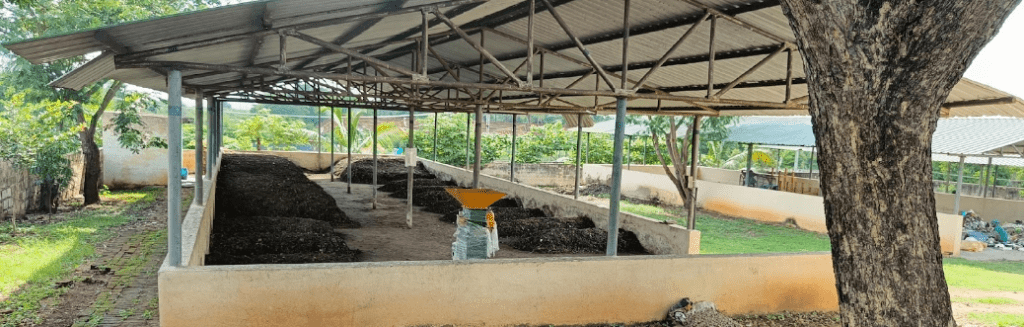
In Mysore, the waste collected from six wards of Zone 8 is brought to our zero waste management plant, comprising 3.5 MT of food/organic waste and 0.5 tonnes of dry/inorganic waste. Largely, the highly valuable dry waste is sold to nearby scrap dealers by the waste collectors. We compost the wet waste to create high-nutrition compost using windrows as a cost- and space-effective methodology, and sell to nearby farms at INR 2/- per kilogram.
Composting food waste from homes is a significant mitigator for methane and other greenhouse gases from landfills, since food waste contributes about 39% of methane emissions from landfills.
Windrow composting in Kesari Zero Waste Plant, Mysore
The plant is also functioning as a learning center for visitors, members of gram panchayats (village councils), and sanitary workers to replicate the same in their respective villages.
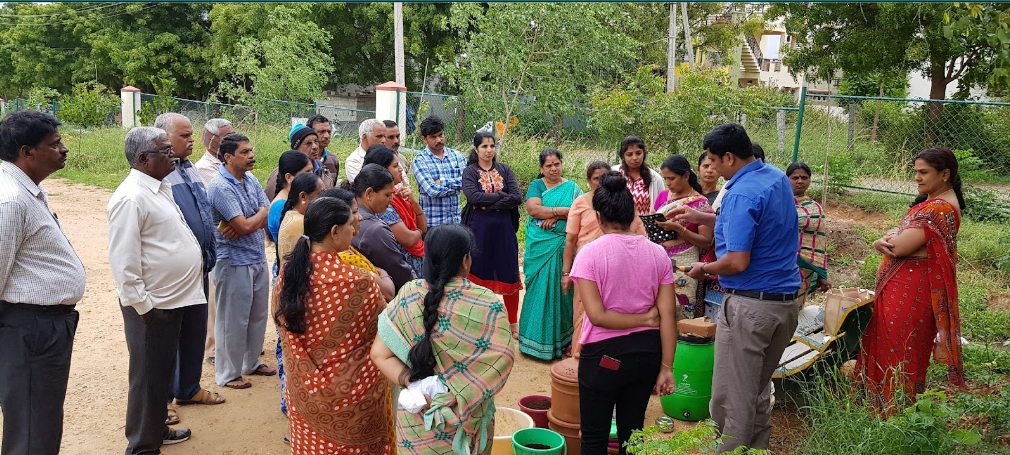
We have been running awareness campaigns across Mysore to show residents how to compost at home!
Learning sessions on composting in Mysore, Bangalore, India by Hasiru Dala
While we work in six wards (one zone) in Mysore city, in the nearby Nagawala Gram Panchayat we work across the entire area. Waste management is in a nascent stage with initial beginnings at segregated waste collection and management, but we noticed an impactful response to our awareness sessions on sustainable menstrual hygiene. Over 90% of the menstruating persons converted to use the cloth pads and menstrual cups we distributed during our sessions.
In Bengaluru, zero waste management efforts in Ward 177 and in the City Armed Reserve at Adugodi prove that waste management is most efficient as a collaboration between residents, waste workers, and officials. Residents banded together to compost 25 kgs of organic waste in a communal lane composter. Local pourakarmikas (municipal officials) ensure that leaf litter from the streets is composted. The composting activities in this ward have been extended to composting between 30-40 kgs of flower waste from a nearby temple.
In Adugodi, police quarters with 1400 households generate nearly 1 ton of organic waste, which is processed at the biomethanation plant. The BioCNG is then diverted for cooking food for 80-85 dogs of the armed reserve police.
Hasiru Dala has also been running a solid waste management facility in SDM, Dharwad. We have been able to get segregation of waste done at source through a series of awareness activities and we have been efficiently handling the recycling and disposal of dry waste. The wet waste generated had too much oil and was not compostable. Hence, this is being reused by diverting it to a piggery where this waste is being fed to pigs. Installing a biogas plant here is in the planning stage.
What we find as we work in urban and rural areas is that waste management in general but organic waste management as well is a collaborative process. It requires the active participation of government operations, residents and citizens, and the waste pickers in collection, segregation, and processing.
This would require local governments to have standards and budgeting for waste management, for an in-depth effort to recruit, train and upskill the informal labor and for residents to segregate waste at home. As we have shown in Mysore Zone 8 and Nagawala, this work is easiest to do in decentralized, local efforts, resulting in clean surroundings, a well-served workforce, and a circular economy even in food and agriculture.
—————————
Works Cited
Levine, J., and Daisy Chung. “The other greenhouse gas.” Reuters, 5 August 2023, https://www.reuters.com/graphics/FOOD-WASTE/METHANE/gdpzwqwqovw/. Accessed 9 November 2023.
“Waste Pickers.” WIEGO, https://www.wiego.org/waste-pickers. Accessed 9 November 2023.
The island Province of Siquijor serves as a success story in the global fight against plastic pollution
14 November 2023 – Nairobi, Kenya – As the third intergovernmental negotiations (INC-3) on plastic pollution go underway in Nairobi, Kenya; delegates and environmental advocates are made aware of the island Province of Siquijor in the Philippines as a success story in the global fight against plastic pollution and as a reminder for the need for a strong global treaty to address plastic pollution beyond local actions.
Known for its stunning scenery and attracting a significant number of tourists annually, Siquijor has not been immune to the environmental impact of plastic pollution. However, in 2017, the government embarked on a mission to combat this issue head-on. Collaborating with organizations such as the Mother Earth Foundation (MEF) Philippines and the Global Alliance for Incinerator Alternatives (GAIA) Asia Pacific, they reached out to various sectors, launched informative campaigns, and implemented laws banning styrofoam products while regulating the use of other single-use plastics (SUPs).
During a Global Plastics Treaty side event, “Visions for an Ambitious and Just Treaty” organized by Bloomberg Philanthropies in Nairobi, Vice Governor Dr. Mei Ling Quezon-Brown of Siquijor Island highlighted the success of the island’s efforts in combating the plastic crisis. Emphasizing the significance of local solutions, Quezon-Brown pointed out that the island’s initiatives are anchored in national policies, such as the Ecological Solid Waste Management Act and Republic Act No. 11038, laws that mandate proper solid waste management and the protection of designated areas.
Quezon-Brown emphasized the initiation and subsequent extensions of the No Single-Use Plastic Provincial Ordinance, emphasizing the island’s dedication to comprehensive solutions. The ordinance signifies a proactive measure in tackling the plastic problem locally, aligning seamlessly with broader national policies.
The Province has made remarkable strides, achieving proper waste segregation for the whole island and an impressive 58% waste diversion rate achieved through composting and recycling. As a tangible result of these efforts, waste collection frequency has been significantly reduced, reflecting a substantial decrease in plastic waste.
She states, “At the core of Siquijor’s initiative is the passion and dedication of the Provincial Zero Waste Task Force leaders, who have undergone capacity-strengthening training and advocacy for improved working conditions. The establishment of the Waste Workers Association solidifies its pivotal role in the island’s Zero Waste initiatives.”
The success story of Siquijor also unfolds through multi-stakeholder collaboration, exemplified by the Siquijor Provincial Zero Waste Management Council and partnerships with civil society organizations through the Provincial Zero Waste Task Force. Together, these collaborations have played a crucial role in implementing effective solid waste management plans.
Sustainable interventions, such as the introduction of innovative reuse systems and the establishment of pilot Zero Waste stores and eateries, underscore the island’s commitment to fostering a culture of sustainability and environmental responsibility.
The urgency of the global plastic crisis is not lost on Siquijor Island. Recognizing the interconnected nature of environmental issues, the island advocates for a comprehensive approach.
With Siquijor Island’s multi-stakeholder approach as an example, Vice Governor Quezon- Brown stresses, “Active participation in the ongoing Global Plastics Treaty negotiations reinforces the island’s commitment to seeking legally binding solutions, including a total ban on SUPs and increased promotion of Reuse and Refill systems. We have the solutions. We didn’t start the plastic crisis, but together we can end it.”
As a pioneer member of the Zero Waste Cities Network, Siquijor Island extends an invitation to all other cities and INC-3 delegates to embrace similar initiatives. The island acknowledges that the battle against plastic pollution is a collective endeavor that requires global cooperation and a paradigm shift towards real Zero Waste solutions.
“May the success of Siquijor Island inspire governments to invest in real solutions in tackling the plastic crisis. However, we hope it will also be a timely reminder for all that while real solutions are already happening – the problem is much bigger and urgent that only an ambitious global plastics treaty could address,” says Froilan Grate, Director of GAIA Asia Pacific.
He adds, “These local solutions should be supported, but we need to ensure that we are addressing the systemic problems, including the unabated production of plastics. Otherwise, Siquijor and other islands and cities will continue to bear the brunt of both the impact of plastic pollution and the cost of managing it. The Global Plastics Treaty should ensure that the burden and cost of managing plastic pollution is borne by those most responsible for it – the plastic-petrochemical companies and the fast-moving consumer goods companies .”
GAIA Asia Pacific: Sonia G. Astudillo, +63 9175969286, sonia@no-burn.org
GAIA members in the Global South tackle the plastic crisis head-on at INC-3 for a Globally Binding Plastics Treaty
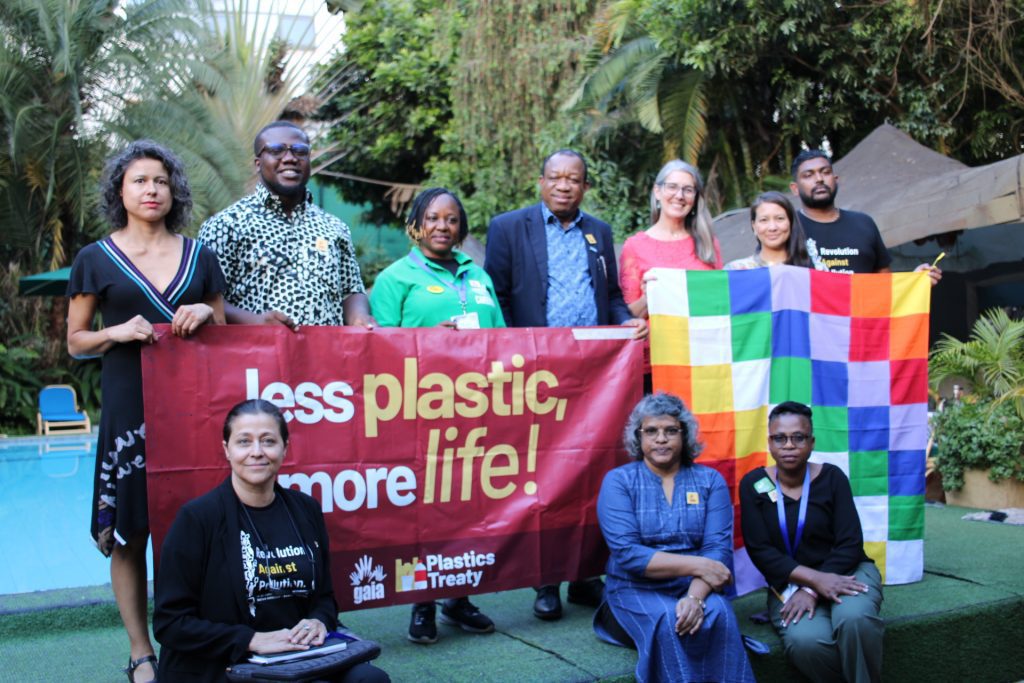
Global South Representatives at INC-3 Media Briefing
14 November 2023 – Nairobi, Kenya – As the third session of the Intergovernmental Negotiating Committee (INC) on Plastic Pollution begins this week to negotiate a global plastics treaty, the Global Alliance for Incinerator Alternatives (GAIA) hosted a media briefing to voice the demands of the Global South. Featuring representatives from a coalition of civil society organizations, including Acción Ecológica México, Aotearoa Plastic Pollution Alliance/New Zealand Product Stewardship Council/Massey University Political Ecology Research Centre, Asociación Nacional de Recicladores de Chile, Consumers’ Association of Penang and Sahabat Alam Malaysia, Foundation For Environment And Development, GAIA Latin America & the Caribbean, Green Africa Youth Organisation, South African Waste Pickers Association, and the Sustainable Research and Action for Environmental Development, this united front of civil society organizations have called on their leaders to urgently address the plastic crisis.
With the problem escalating to massive proportions, the INCs stand as a decisive turning point in the battle against plastic pollution. These negotiations are not only an opportunity to address environmental concerns but also to tackle issues that affect the health and rights of individuals and communities. One of these issues is waste colonialism, which is the practice of illegal exporting of waste, from economically powerful countries in the Global North, to lower-income countries in the Global South, who are ill-equipped to handle this waste. In Latin America and the Caribbean, the trade of waste is extensive. In the period from 2018 to 2021, the shipment of plastic garbage to Mexico had a growth of 121%, according to a 2023 report.
Alejandra Parra, GAIA Latin America & the Caribbean’s Zero Waste and Plastics Advisor says that, “To stop waste colonialism, we need to reduce plastics production. To make recycling really useful, we need to reduce plastics production. To manage waste in an environmentally healthy manner, we need to reduce plastics production. To achieve the climate goals, we need to reduce plastics production. To respect human rights and planetary boundaries, we need to reduce plastics production. And that is what we must achieve with this plastics treaty that is currently being negotiated. But some countries don’t want this and are acting so this process fails. That is why we need to unite our voices because we are the ones suffering the worst consequences of plastics pollution and we need to be heard.”
Emphasizing that the plastic crisis didn’t start with the Global South, speakers stressed the need to correct a narrative that unfairly singles them out as the main culprits of plastic pollution. This narrative overlooks the significant role of the Global North, which not only contributes heavily to plastic production but also exports toxic plastic waste to developing nations, often disguising this under the guise of “trade.” With many African countries struggling with extreme poverty, they fall victim to toxic, unrecyclable plastic waste, e-waste, textile waste, and a range of different technological false solutions from corporations to attain economic development.
Merrisa Naidoo, GAIA/BFFP Africa Plastics Campaigner, underscores this point, stating, “Colonialism continues to manifest on the African continent in the form of ‘waste trade’ that permits the importation of toxic and non-recyclable waste into the continent from Global North countries.”
In detailing the situation in Africa, she explains, “Every day, markets in Accra, Ghana, and rivers in Kenya are inundated with Europe’s addiction for fast fashion, particularly plastic fiber-based apparel. This unjust practice places economic, social, and environmental burdens on Africa and its future generations. It reflects a disregard for Africa’s sovereignty and the laws in place to protect its people. Therefore, the Global Plastics Treaty must prioritize closing trade loopholes through a global plastics trade tracking system, imposing trade bans on plastics and associated chemicals post-phase-out, and strengthening the Y48 listing of plastics waste in Annex II of the Basel Convention to explicitly include paper waste contaminated with plastics, textiles, and refuse-derived fuel (RDF) to halt the dumping of these mixed plastic wastes on the continent. Africa is not a dumping ground!””
In addition, the Global South is advocating for a comprehensive set of crucial measures. These include reducing plastic production, discontinuing harmful technologies like incineration, imposing strict limits on toxic chemicals in plastics, and adopting a transparent approach to chemical use. The delegation underscores the importance of a just transition, the implementation of mandatory Extended Producer Responsibility (EPR) based on the Zero Waste hierarchy, and a steadfast commitment to translating policies into practical operational regulations. These mechanisms are important to preserve traditional knowledge within the Global South, which has abided by principles of preservation and reuse for centuries. Our investment in these systems will allow us to return to regenerative indigenous knowledge that illustrates understanding and respect for the unique ecosystems in which we live.
Arpita Bhagat, GAIA Asia Pacific’s Plastic Policy Officer, emphasizes, “Prior to the industry introducing toxic plastics into our local systems, causing harm to our land and sea; cultures in the Asia and Pacific region prioritized co-existing with nature. This cultural value has also positioned us at the forefront of adopting Zero Waste solutions.”
She goes on to say, “The most significant opportunity for addressing global plastics pollution lies in an international agreement. This agreement should advocate for a policy mechanism mandating the transition away from plastics. We need a treaty grounded in human rights and justice, recognizing the role of petrochemicals in plastics by mandating a reduction in production, banning harmful chemicals and polymers, and discontinuing polluting technologies like incineration, plastics-to-fuel, and chemical recycling. Moreover, it should underscore scaling up reuse, safeguarding indigenous peoples’ rights, and facilitating a just transition for informal workers and waste pickers away from plastics and into Zero Waste systems. To ensure the effectiveness of this instrument, a conflict of interest policy is essential to prevent the industry’s disproportionate influence on negotiations and avoid maintaining the status quo.”
Furthermore, the delegation further underlines the importance of inclusion by advocating for the participation of Waste Pickers, Indigenous Peoples, and Frontline Communities. Their focus extends to under-represented African, Asian, and Small Island Developing States (SIDS) countries, in addition to advocating for greater involvement of women and youth in global efforts to combat plastic pollution. Moreover, the delegation calls for the establishment of robust financial mechanisms to support the effective implementation of these essential measures.
The Global South is calling on the INC-3 delegates to create a strong, comprehensive, and globally binding plastics treaty that respects health, human rights, and centers justice with due consideration to the realities of the Global South. This approach underscores the interconnectedness of the plastic lifecycle, environmental justice, and the rights of marginalized communities.
14 de noviembre de 2023 – Nairobi, Kenia – Con motivo del inicio de la tercera sesión del Comité Intergubernamental de Negociación (INC por sus siglas en inglés) para negociar un tratado mundial para prevenir la contaminación por plásticos, la Alianza Global para Alternativas a la Incineración (GAIA) organizó una rueda de prensa para dar voz a las demandas del Sur Global. Con la participación de representantes de un grupo de organizaciones de la sociedad civil, entre ellas Acción Ecológica México, Aotearoa Plastic Pollution Alliance, New Zealand Product Stewardship Council, Massey University Political Ecology Research Centre, Asociación Nacional de Recicladores de Chile, Consumers’ Association of Penang and Sahabat Alam Malaysia, Foundation For Environment And Development, GAIA América Latina y el Caribe, Green Africa Youth Organisation, Asociación de Recicladores de Sudáfrica y Sustainable Research and Action for Environmental Development, este frente de organizaciones de la sociedad civil hizo un llamado a sus tomadores de decisiones para que aborden urgentemente la crisis del plástico.
Dado que el problema está alcanzando proporciones masivas, las sesiones de los INC suponen un punto de inflexión decisivo en la batalla contra la contaminación por plásticos. Estas negociaciones no sólo brindan la oportunidad de abordar las preocupaciones medioambientales, sino también las cuestiones que afectan a la salud y los derechos de las personas y las comunidades. Uno de estos problemas es el colonialismo de la basura, que es la práctica de exportar ilegalmente residuos de países económicamente poderosos del Norte Global a países de ingresos más bajos del Sur Global, que no cuentan con la infraestructura necesaria para manejar estos residuos. En América Latina y el Caribe, el comercio de residuos es una práctica extendida. Por ejemplo, en el periodo de 2018 a 2021, el envío de basura plástica a México tuvo un crecimiento del 121%, según un informe de 2023.
Alejandra Parra, Asesora en plástico y basura cero de GAIA América Latina y el Caribe, afirma que “para acabar con el colonialismo de la basura, necesitamos reducir la producción de plásticos. Para que el reciclaje sea realmente útil, necesitamos reducir la producción de plásticos. Para gestionar los residuos de una manera ambientalmente sana, necesitamos reducir la producción de plásticos. Para alcanzar los objetivos climáticos, debemos reducir la producción de plásticos. Para respetar los derechos humanos y los límites planetarios, necesitamos reducir la producción de plásticos. Y eso es lo que debemos conseguir con este tratado de plásticos que se está negociando actualmente. Pero algunos países no quieren esto, y están actuando para que este proceso fracase. Por eso necesitamos unir nuestras voces, porque somos los que sufrimos las peores consecuencias de la contaminación por plásticos y necesitamos que se nos escuche.”
Subrayando que la crisis del plástico no empezó en el Sur Global, las y los panelistas insistieron en la necesidad de corregir la narrativa que injustamente les señala como los principales culpables de la contaminación plástica. Esta narrativa pasa por alto la responsabilidad del Norte Global, que no sólo contribuye en gran medida a la producción de plástico, sino que también exporta residuos plásticos tóxicos a países en vías de desarrollo, a menudo disfrazado bajo la etiqueta de “comercio”. Muchos países africanos luchan contra la pobreza extrema y son víctimas de los residuos plásticos tóxicos y no reciclables, los residuos electrónicos, los residuos textiles y toda una serie de falsas soluciones tecnológicas de las empresas para alcanzar el desarrollo económico.
Merrisa Naidoo, campañista de plásticos de GAIA/BFFP en África, subraya este punto al afirmar: “El colonialismo sigue manifestándose en el continente africano en forma de “comercio de residuos” que permite la importación de residuos tóxicos y no reciclables al continente desde los países del Norte Global”.
Al detallar la situación en África, explica: “Cada día, los mercados de Accra (Ghana) y los ríos de Kenia se ven inundados por la adicción europea a la moda rápida, en particular a las prendas hechas de fibras de plástico. Esta práctica injusta supone una carga económica, social y medioambiental para África y sus futuras generaciones. Refleja un desprecio por la soberanía de África y las leyes vigentes para proteger a su población. Por lo tanto, el Tratado global de plásticos debe dar prioridad al cierre de las lagunas legales del comercio a través de un sistema mundial de seguimiento del comercio de plásticos, la imposición de prohibiciones comerciales de plásticos y productos químicos asociados después de su eliminación, y el fortalecimiento de la lista Y48 de residuos plásticos en el Anexo II del Convenio de Basilea para incluir explícitamente los residuos de papel contaminados con plásticos, textiles y combustibles derivados de residuos (CDR) para detener el vertido de estos residuos plásticos mezclados en el continente. África no es un vertedero.”
Además, el Sur Global aboga por un amplio conjunto de medidas cruciales. Entre ellas figuran la reducción de la producción de plásticos, el abandono de tecnologías nocivas como la incineración, la imposición de límites estrictos a las sustancias químicas tóxicas en los plásticos y la adopción de un enfoque de transparencia sobre el uso de sustancias químicas. La delegación subraya la importancia de una transición justa, la aplicación obligatoria de la Responsabilidad Extendida del Productor (REP) basada en la jerarquía basura cero, y un compromiso firme para traducir las políticas en normativas operativas prácticas. Estos mecanismos son importantes para preservar el conocimiento tradicional en el Sur Global, que ha acatado los principios de preservación y reutilización durante siglos. Nuestra inversión en estos sistemas nos permitirá volver a un conocimiento indígena regenerativo que ilustre la comprensión y el respeto por los ecosistemas únicos en los que vivimos.
Arpita Bhagat, responsable de Política de plásticos de GAIA Asia Pacífico, subraya: “Antes de que la industria introdujera plásticos tóxicos en nuestros sistemas locales, causando daños a nuestra tierra y nuestro mar; las culturas de la región de Asia y el Pacífico priorizaban la coexistencia con la naturaleza. Este valor cultural también nos ha situado a la vanguardia de la adopción de soluciones de Basura Cero.”
Y añade: “La oportunidad más importante para abordar la contaminación mundial por plásticos reside en un acuerdo internacional. Este acuerdo debería abogar por un mecanismo político que obligue a abandonar los plásticos. Necesitamos un tratado basado en los derechos humanos y la justicia, que reconozca el papel que juega la industria petroquímica en los plásticos y obligue a reducir su producción, prohíba los productos químicos y polímeros nocivos, y ponga fin a tecnologías contaminantes como la incineración, la conversión de plásticos en combustible y el reciclado químico. Además, debería hacer hincapié en el aumento de la reutilización, la salvaguarda de los derechos de los pueblos indígenas y la facilitación de una transición justa para los trabajadores informales y los recicladores, alejándose de los plásticos y hacia sistemas de Basura Cero. Para garantizar la eficacia de este instrumento, es esencial tener una política acerca del conflicto de intereses que impida la influencia desproporcionada de la industria en las negociaciones y evite que se perpetúe el “statu quo”.
Además, la delegación subraya la importancia de la inclusión abogando por la participación de los recicladores, los pueblos indígenas y las comunidades de primera línea. Su atención se extiende a los países subrepresentados de África, Asia y los Pequeños Estados Insulares en Desarrollo (PEID), además de abogar por una mayor participación de las mujeres y los jóvenes en los esfuerzos mundiales para combatir la contaminación por plásticos. Además, pide que se establezcan mecanismos financieros sólidos para apoyar la aplicación efectiva de estas medidas esenciales.
El Sur Global hace un llamamiento a los delegados del INC-3 para que elaboren un tratado sobre plásticos sólido, exhaustivo y vinculante a escala mundial que respete la salud, los derechos humanos y centre la justicia teniendo debidamente en cuenta las realidades del Sur Global. Este enfoque subraya la interconexión entre el ciclo de vida del plástico, la justicia medioambiental y los derechos de las comunidades marginadas.
GAIA is a network of grassroots groups as well as national and regional alliances representing more than 1000 organizations from 92 countries. With our work we aim to catalyze a global shift towards environmental justice by strengthening grassroots social movements that advance solutions to waste and pollution. We envision a just, Zero Waste world built on respect for ecological limits and community rights, where people are free from the burden of toxic pollution, and resources are sustainably conserved, not burned or dumped. www.no-burn.org
GAIA es una red de grupos de base y alianzas nacionales y regionales que representan a más de 1.000 organizaciones de 92 países. Con nuestro trabajo pretendemos catalizar un cambio global hacia la justicia medioambiental fortaleciendo los movimientos sociales de base que promueven soluciones a los residuos y la contaminación. Imaginamos un mundo justo, de Basura Cero, construido sobre el respeto a los límites ecológicos y los derechos comunitarios, donde las personas estén libres de la carga de la contaminación tóxica y los recursos se conserven de forma sostenible, no se quemen ni se viertan. www.no-burn.org
The third session of the intergovernmental negotiating committee on plastic pollution to develop an international legally binding instrument on plastic pollution will take place on 13 – 19 November 2023 in Nairobi, Kenya.
Join the Global South delegation as we put forward our demands to address the entire lifecycle of plastics, overall production reduction, putting a stop on incineration and similar harmful technologies, limiting toxic chemicals in plastics and calling for chemical transparency, a just transition, mandatory Extended Producer Responsibility (EPR) based on Zero Waste hierarchy; commitment to put regulations in place to operationalise policies; pushing for more upstream measures; robust financial mechanism for implementation and the inclusion of Waste Pickers, Indigenous Peoples and Frontline Communities, Under-represented African, Asian and SIDS Countries, Women and Youth.
La tercera sesión del comité intergubernamental de negociación sobre la contaminación por plásticos para desarrollar un instrumento internacional jurídicamente vinculante sobre la contaminación por plásticos tendrá lugar del 13 al 19 de noviembre de 2023 en Nairobi, Kenia.
Únete a la delegación del Sur Global en la presentación de nuestras demandas para abordar todo el ciclo de vida de los plásticos, la reducción general de la producción, la limitación de la presencia de sustancias químicas tóxicas en los plásticos en el continente y la transparencia química; una transición justa; la responsabilidad extendida del productor (REP) obligatoria basada en la jerarquía basura cero; el compromiso de poner en marcha reglamentos para hacer operativas las políticas; el impulso de más medidas previas; y el reconocimiento de los recicladores, los pueblos indígenas y las comunidades de primera línea, los países subrepresentados, las mujeres y los jóvenes.
14 November 2023, 4PM Kenya
Comfort Gardens Hotel, Township, United Nations Cres, Nairobi, Kenya
The Global Alliance for Incinerator Alternatives (GAIA) Asia Pacific, a network of 120 grassroots alliances in the region, said that the recently released Asian Development Bank’s (ADB) draft Environmental and Social Framework (ESF) for public commenting is failing to protect people and the environment in a world where six out of nine planetary boundaries are already breached. This raises the risk of large-scale, abrupt, and potentially irreversible environmental changes that further worsen social inequalities in the region.
Brex Arevalo, GAIA Asia Pacific’s Climate and Anti-Incineration Campaigner commented, “While the draft does express commitment to a circular economy and a just transition, there is a significant lack of operational clarity regarding these principles including clear commitments to multilateral environmental agreements and rights instruments signed by states, leaving us to question whether the Bank is protecting industry polluters instead of people and the environment.”
The ESF is a policy instrument that aims to avoid, minimize, and mitigate environmental and social harm from ADB’s development projects. It lays down the environmental and social safeguards requirements and principles for the public and private sector borrowers. It is a tool to enhance development outcomes and improve accountability. The draft ESF is undergoing a policy review process 14 years after its implementation.
Arevalo stresses that a safe and just circular economy should primarily set a principle upon lesser use of material resources in the economy, eliminating toxic and hazardous chemicals, ecosystem regeneration, and stamping out false solutions to circularity.
Arevalo also points out another significant omission in the draft, stating, “Yet another glaring oversight is the absence of safeguards concerning air pollution and the repeated default to offsetting or compensating for their pollution by doing other projects as an option for polluters.”
These proposals are particularly troubling, considering that the energy sector is one of ADB’s biggest portfolios that includes expensive and dirty technofixes such as waste-to-energy (WtE) incineration, refuse-derived fuel (RDF), cement kilns, and carbon capture utilization storage projects across Asia; undermining various environmental and human rights objectives adopted and signed by governments since 2009. These endeavors additionally result in higher emissions than coal-fired power plants, obstructing progress in the decarbonization of the energy sector, and exacerbating the climate crisis.
GAIA Asia Pacific also points out that the draft ESF does not address the whole range of toxic and hazardous chemicals of global concern that are found in the production and deployment of false solutions on waste. These include persistent organic pollutants (POPs), lead, cadmium, and mercury that are already being eliminated and regulated in various multilateral environmental agreements (MEAs).
Moreover, the draft ESF does not provide protection for the rights of informal workers such as wastepickers and recyclers even as it expresses commitment to just transition. These sectors, according to GAIA Asia Pacific, contribute largely to the recovery of materials crucial for an inclusive circular economy.
GAIA Asia Pacific’s statement was submitted in time for the ADB’s October 27 Board meeting where its members will discuss the working paper of the ESF draft. This forms part of Phase 3 of the consultation process that will proceed until March 2024.
19 October 2023 – The Global Alliance for Incinerator Alternatives (GAIA) Asia Pacific formally submitted its position on the proposed Philippine Sustainable Finance Taxonomy Guidelines (SFTG) to prevent the financing of industries that are harmful to the objectives of circular economy and just transition. Led by the Financial Sector Forum (FSF) of the Banko Sentral ng Pilipinas (BSP), the guidelines aim to classify investments and economic activities based on their environmental and social sustainability, shaping a path towards responsible investments in the Philippines.
GAIA Asia Pacific particularly commends the draft for its intent in addressing greenwashing, advocating a circular economy, and recognizing the negative impacts of landfills, waste incinerators, as well as other harmful activities like open burning of waste, open dumping, and the importation of toxic waste.
GAIA Asia Pacific recommended the classification of the waste sector as a climate adaptation sector and not only a climate mitigation area of investment to allow the mobilization of much-needed resources on development activities, awareness-raising and information sharing of best practices, reforms in waste sector regulation, reforms in spatial planning or the procurement process, research activities, and options which relate to risk management or disclosure.
The environmental network also highlighted critical gaps in the draft which could create pathways for environmental and social harm. GAIA Asia Pacific’s submission highlighted the need for alignment with Philippine laws that prohibit waste incinerators, as these incinerators produce greenhouse gas emissions and harmful byproducts that pose severe risks to both the environment and public health.
GAIA Asia Pacific also noted that the draft allows for the entry of high-risk projects as long as it demonstrates willingness to address those issues in a five-year remedial period which according to GAIA Asia Pacific, is not only too long for affected communities and the environment but also opens the door to continued generation of pollution, GHG emissions and human rights violations.
Further, GAIA Asia Pacific emphasizes the importance of harmonizing the SFTG with human rights conventions and international obligations, highlighting the need to broaden the definition of the impact on individuals residing near these investments.
GAIA Asia Pacific said that a taxonomy must demonstrate to investors and companies that sustainable economic activities require the provision of spaces for participation and access to grievance mechanisms as required in the Philippine Constitution and the human rights instruments as the foundation of a just transition to climate change action.
GAIA Asia Pacific also urged BSP to expand the consultations and conduct more stakeholder engagement on the guidelines. It also commented on the lack of information on the BSP website on the drafting, timelines of consultations and submissions, and two-way feedback loop. The gaps indicate a limitation in consultation engagements from civil society and communities affected by harmful investments and will critically impact the SFTG’s initial positive intentions.
The development of the SFTG reflects the global demand for financing of real solutions to climate change and the prevention of greenwashing through clear-cut guidelines of which economic activities are truly contributing to environmental, climate, and social objectives. Some of the sustainable taxonomies adopted by economies include crafting sustainability taxonomies, the ASEAN Taxonomy for Sustainable Finance, the European Union Taxonomy (which the SFTG benchmarks against), and national initiatives like Indonesia’s Green Taxonomy edition 1.0 and the Securities Commission of Malaysia’s Sustainable and Responsible Investment (SRI) Taxonomy.
Additionally, GAIA Asia Pacific’s active involvement in the ongoing consultation process on the Environmental and Social Framework of the Asian Development Bank (ADB) establishes an interconnected network of policy initiatives aimed at avoiding harm from development investments including climate change interventions that may in fact be false solutions.
Zero Waste Network Aotearoa’s Hui (Annual Meeting) in 2022. (Photo Courtesy of Zero Waste Network Aotearoa)
In pursuing a greener and more sustainable future, Zero Waste Network Aotearoa (ZWNA) has emerged as a pioneering force. They opened the first community recycling center in Kaitaia in 1989, then in the late 1990s ZWNA pioneers Warren Snow and Gerry Gillespie built the Zero Waste movement in New Zealand. Since then the network of Zero Waste hubs has grown steadily over the last 20 years.
Today, there are 1400 employees in member organizations across the network and with its Zero Waste roadmap, ZWNA is tirelessly advocating for practical projects across the country. We recently had a chat with Sue Coutts, environment advocate and ZWNA’s External Affairs Officer, who shared insights into the organization’s mission and ongoing initiatives.
What are ZWNA’s top priorities?
We wear two hats. One is a Zero Waste promotion hat and the other hat is for assisting the local scale businesses that make up the network. We also work closely with communities and provide support through social enterprises. It’s like building a network that operates as a collaborative club where everyone helps one another. This mutual support is essential because we can collectively achieve our goals by supporting each other’s causes.
As a network, our services encompass behavior change repair, composting, recycling, and reuse. Our approach is not about preaching or imposing a Zero Waste philosophy; instead, it’s about encouraging a domino effect and sharing knowledge. Additionally, our sister organization, Para Kore, is an organization focused on Indigenous Peoples (IPs) and they provide opportunities for IPs across the nation to promote Zero Waste and Māori culture. Taking these steps becomes more manageable when we collectively maximize our skill sets to make a meaningful difference in our communities.
Community March against an incinerator proposal in Te Awamutu, 07 October 2023. (Photo courtesy of Zero Waste Network Aotearoa)
What are the main ongoing campaigns?
Over the past two decades, we’ve diligently advocated for implementing a Container Return Scheme and put in a significant amount of effort to persuade the public. Our mission is to provide the necessary information for individuals to make well-informed decisions. This same approach guides our interactions with government officials.
Currently, we do not have waste-to-energy (WtE) facilities in the country but there are ongoing proposals for incinerators. Out of the three proposals, the pyrolysis project in Fielding has been withdrawn after undergoing an extensive evaluation process. Whether waste is buried or burned, we believe it still contributes to the same underlying issue. Our commitment lies in assisting both government and local communities to understand the implications of these proposals. With the coming general elections, we are hoping that the elected government will be more receptive to our cause.
What are your biggest accomplishments/achievements?
For nearly three decades, we’ve been advocating for sustainability. In those early days, our efforts were often met with skepticism, but today, it’s heartening to see that nearly half the country is fully committed to sustainable practices. One example of this growing support is the Container Return Scheme, with an astounding 89% of the population backing its implementation.
Our journey has been a lengthy process that involves a great deal of groundwork. We take pride in the fact that over the past 30 years, New Zealand has witnessed a significant shift towards a Zero Waste lifestyle, with a growing number of people opting to buy second-hand items and supporting Zero Waste stores.
What challenges are you facing? How is your work impacted by the COVID crisis?
While the COVID crisis did not have a massive impact and is not a major factor in our current situation, it did bring about some concerns. At the height of the pandemic, driven by fear, we witnessed a surge in single-use masks and containers.
Today, our challenges are more towards the implementation of effective product stewardship like the Container Return Scheme and the ongoing mission to persuade individuals to reduce their waste. These efforts, however, face formidable opposition from various corporate interests. For example, there is a push by the glass industry to exempt glass bottles from specific regulations.
What are the main environmental issues that your country/region is facing?
Water is becoming a concern now with issues related to both water pressure and quality. The demand for water resources is further worsened by intensive farming practices, leading to waste entering streams and the loss of valuable agricultural soil. The recent torrent of heavy rains has also triggered erosion, which is a considerable challenge for a country heavily reliant on agriculture.
Some areas rely on snowfall for their water supply, but much of it flows out to the sea due to a lack of proper storage. As such, many cities and towns face water scarcity issues, with more frequent droughts and hot, windy weather patterns. Additionally, the situation is intensified by varying opinions on how to strike a delicate balance between development and environmental protection.
How do you see your organization’s work evolving in the next few years?
We see ourselves as strengthening our network extensively. We believe in the importance of sharing and learning and we are dedicated to building strong relationships with other organizations such as GAIA Asia Pacific and Zero Waste Europe. With these networks, we look forward to connecting local sustainability groups with others worldwide.
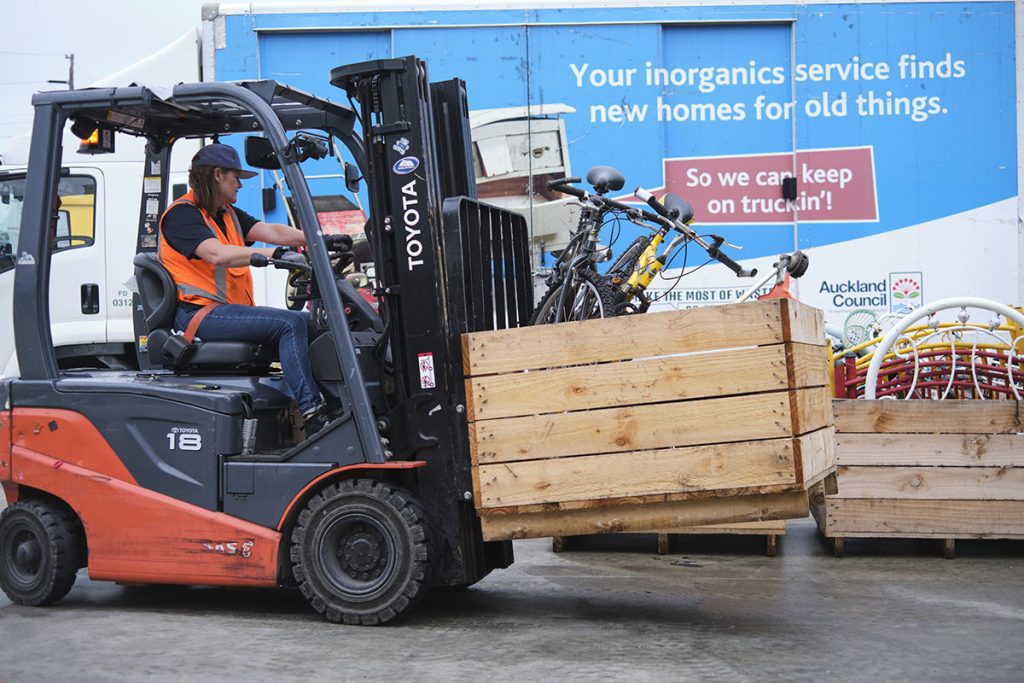
Unloading reusable goods at one of Auckland’s Zero Waste Hubs. (Photo courtesy of Zero Waste Network Aotearoa)
How does your work relate to social justice?
If you can empower people to tackle problems within their own communities it can have a ripple effect and allow them to address various issues. By fostering collaboration and building a resource base focused on local initiatives, community empowerment becomes a powerful force for positive change.
In Auckland, there’s a plan to establish more material recovery centers, and we’re actively connecting with individuals to make this a reality. This initiative not only generates jobs but also provides support to those undertaking this work, creating opportunities for both employment and resource development. This was already realized with the establishment of 10 centers including the Onehunga Community Recycling Centre, operated by Onehunga Zero Waste (OZW). Through this joint project between two social enterprises, Synergy Projects Trust and Localized Limited, OZW aims to inspire local communities to embrace a Zero Waste lifestyle, with a primary focus on practices like reuse, repair, repurposing, and upcycling. The project also seeks to generate local job opportunities and provide valuable training prospects for the community
This approach effectively bridges the gap between business models and community needs, opening doors for job opportunities and resource utilization. The commercial aspect of our work often involves collaborative ventures with communities and this integration of business and community efforts is vital for achieving sustainable change.
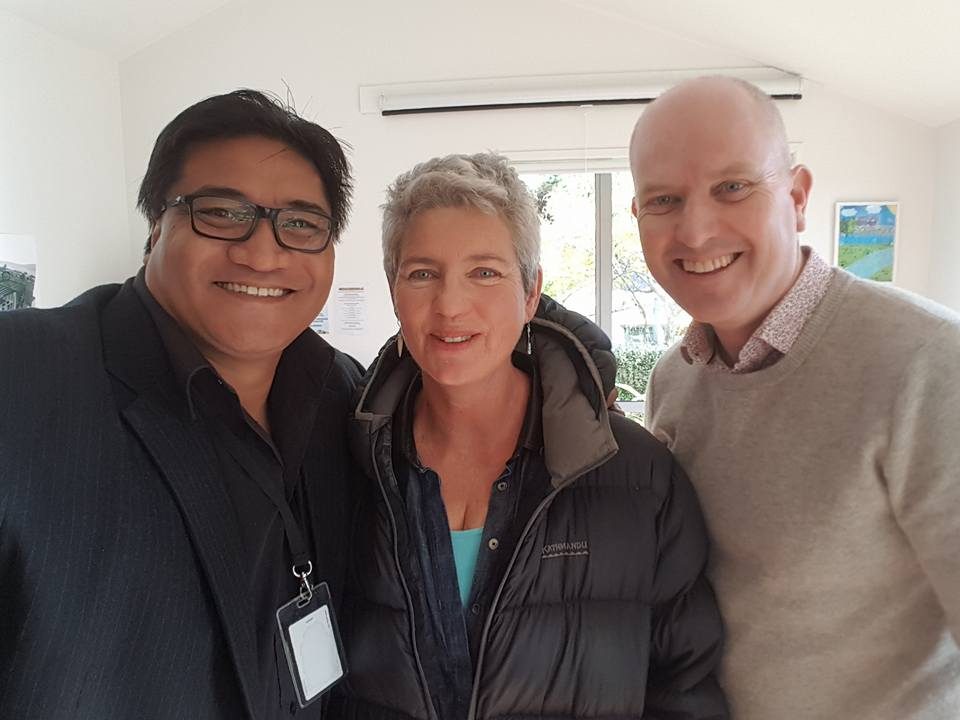
(L-R) Sei Brown, Zero Waste Network Aotearoa and Localised, Sue Coutts, Zero Waste Network Aotearoa, and Matthew Luxon, Localised. (Photo courtesy of Zero Waste Network Aotearoa)
Who do you admire most in environmental work?
Today, I want to give a special shoutout to our General Manager, Dorte Wray, who plays a crucial role in keeping our collective efforts running smoothly. Nevertheless, it is incredible how I encounter new heroes within environment work.
Environmental organizations are hard at work in every country and discovering what each of them is doing is a constant source of inspiration. I feel fortunate in my job as every day brings an opportunity to meet a new hero and that is a testament to the power of our shared mission.
****
Discover more about Zero Waste Network Aotearoa and their initiatives at https://zerowaste.co.nz/. Support their mission to promote Zero Waste practices and sustainability in Aotearoa (New Zealand) by becoming a member or by participating in their online and offline trainings and events. Visit their Facebook page: Zero Waste Network Aotearoa or connect with them through this link.