Asia Pacific

Creating zero waste communities, one city at a time

by Maria Sonia G. Astudillo

Zero Waste Asia is no longer a dream but a possibility.

GAIA-Asia Pacific and YPBB held the 1st Zero Waste Academy (ZWA) in Indonesia this past month of July. For 10 days, participants from 18 non-government organization (NGO),  and government officials from Bali, Bandung Raya, Gresik, Jakarta, Medan, and Surabaya, gathered in Bandung, Indonesia, to learn about zero waste and get a hands on experience on how to implement zero waste models in their communities. 

 This 10-day intensive workshop is the 5th ZWA held in the region. The first three were conducted in the Philippines and had participants from Asia, the Philippines, and different parts of the globe, respectively, while the 4th was held just a few months ago in Vietnam.

 The Zero Waste Academy tackles the global zero waste movement while showcasing zero waste models from local communities that stem from grassroots initiatives. Participants see first hand how zero waste is implemented, through lectures and site visits where they get to talk to the community leaders and waste workers in GAIA and YPBB’s zero waste projects in Bandung and Cimahi.

Beyond lectures and site visits, participants do actual profiling of the kerulahan (village) a first step needed to design village-specific waste management programs, that address the current situation and needs of the people living there.  Attendees also participate in the Waste Assessment and Brand Audit (WABA) to identify the types and sources of waste produced. The WABAs help identify the volume of each type of waste and the companies behind it. Such data is useful in lobbying for better waste management policies.

Once participants are equipped with enough know-how, they are then divided into groups to conduct door-to-door education to teach the community proper waste segregation.  An afternoon is spent following waste pickers as they do door-to-door collection – a pretty exciting day for most as they see first hand the work involved, get to know the workers and their work.


The participants of the Zero Waste Academy get to know people like Ripanto, a 67 year old waste collector from Cigugur, Cimahi.  He has been working as a waste collector for five years, earning 700,000 rupiah (US$50) a month. Ripanto has complained of hearing impairment, coughing, and constant flu as a consequence of his work.  He, along with three other waste collectors, used to work from 6:00 AM until 5:00 PM until waste segregation was introduced in June. This, according to him, has immensely reduced the number of working hours for them.  While a lot still has to be done, not everyone is segregating their waste yet, Ripanto remains positive that in time, positive changes will come.

At the ZWA in Indonesia, different methods of composting were also introduced such as biopori, bricks composting, bamboo composting, and the use of a biodigester.  Rain or shine the participants wanted to see actual composting areas in the middle of a park. As Satoko Shirai of Takagi Fund remarks, “this is an eco-park, not just an ordinary park!”

Currently YPBB is working on zero waste projects in Bandung and Cimahi cities, and Soreang in Bandung regency.  The team is also working to push for policies to reduce single use plastic.   


With Bandung City’s Kurangi (reduce), Pisahkan (segregate), Manfaatkan  (reuse) or Kangpisman program, Mayor Oded M. Danial wishes to set up a new culture.  The City is focused on five aspects of Kangpisman: regulation, manual, model on a regional scale, facility for waste decentralization system, and information system for waste management. They are also doing massive campaigning, collaborating with the education system involving all government agencies at the city level, and developing a volunteer network for Kangpisman work.

What’s next after 10 days of academy? At the end of each day, participants share their thoughts. While some are doubtful whether their communities are anywhere close to being able to implement zero waste models, most are excited about it. 

 Currently, the zero waste project (ZW) covers villages in Bandung and Cimahi cities, and Soreang, and it is set to expand to communities in Bali and Surabaya.

 Is zero waste really a possibility?  As the head of Cibeureum village in Cimahi said, zero waste it is about changing the mindset of people that waste is not just the responsibility of the government and NGOs but the people as well.  


_____________________________________________________________________


[1] Bandung City is the capital of Indonesia’s West Java province.  It has a population of close to 2.4 M.

[2] Cimahi City is located in Bandung Regency.  It has a population of over 500,000.

[3] Soreang is a subdistrict of the Bandung Regency, West Java, Indonesia.  It has a population of over 100,000.

La investigación recomienda soluciones, que incluyen la reducción progresiva de plásticos de un solo uso.

Según el nuevo reporte Plásticos y clima: los costos ocultos de un planeta plástico, solo en 2019, la producción e incineración de plástico va a sumar más de 850 millones de toneladas métricas de gases efecto invernadero a la atmósfera – el equivalente a 189 nuevas plantas a carbón. El rápido crecimiento global de la industria del plástico – alimentada por gas natural de bajo costo proveniente de la fracturación hidráulica – no solo está destruyendo el ambiente y poniendo en riesgo la salud humana, sino que también está debilitando los esfuerzos para reducir la contaminación por carbón y prevenir una catástrofe climática.

Esta es la conclusión de una nueva investigación sobre el impacto de la industria del plástico en el medio ambiente global hecha por el Centro de Derecho Ambiental Internacional, el Proyecto de integridad ambiental, la Alianza FracTracker, la Alianza Global para Alternativas a la Incineración, 5 Gyres y Break Free From Plastic.

Este nuevo reporte recoge investigaciones sobre las emisiones de gases efecto invernadero del plástico en cada etapa de ciclo de vida del plástico, desde su fuente como combustibles fósiles pasando por el refinamiento y fabricación hasta las emisiones masivas en el fin de la visa útil del plástico (y después), para crear la revisión más completa a la fecha de los impactos climáticos del plástico.

Con la constante y rápida expansión de las industrias del plástico y de las petroquímicas, están dadas las condiciones para que los impactos climáticos del plástico se aceleren drásticamente durante la próxima década, amenazando la capacidad de la comunidad global para mantener el aumento de la temperatura global bajo los 1.5ºC. Si la producción y uso de plástico crece como se planea actualmente, para el año 2030 las emisiones podrían alcanzar 1.34 Gt al año – equivalente a lo que emitirían más de 295 plantas a carbón de 500 mega watts. Para el año 2050, la producción y disposición de plástico podría generar 56 Gt de emisiones, lo que equivale al 14% de todo el presupuesto de carbono restante en la Tierra.

El rápido crecimiento de la industria a lo largo de la última década, impulsada por gas natural de bajo costo proveniente del boom de la fracturación hidráulica, ha sido más dramático en Estados Unidos, donde se está experimentando un impresionante crecimiento en infraestructura para el plástico en la costa del Golfo y en el valle del río Ohio.

Por ejemplo, en el oeste de Pensilvania, se está construyendo una nueva planta de productos de gas natural de Shell para proveer a la industria del plástico (llamado “cracker de etileno”) que podría emitir hasta 2,25 millones de toneladas de gases efecto invernadero cada año (toneladas equivalentes de dióxido de carbono). Según el reporte Plástico y Clima, una nueva planta de etileno en la refinería Baytown de Exxonmobil en la costa del Golfo de Texas va a liberar hasta 1,4 millones de toneladas. Las emisiones anuales de estas dos instalaciones nuevas serían equivalentes a sumar casi 800.000 automóviles nuevos a las calles.

El plástico en el medio ambiente es una de las fuentes de emisiones menos investigadas y una pieza clave que falta en investigaciones previas sobre los impactos del plástico en el medio ambiente. Los océanos absorben una cantidad importante de gases efecto invernadero producidos en el planeta -casi un 40% de todo el dióxido de carbono producido por los humanos desde el comienzo de la era industrial. El reporte destaca cómo un pequeño, pero creciente organismo de investigación indica que el plástico descartado en el medio ambiente puede estar alterando la capacidad natural de absorber dióxido de carbono.

Plástico y Clima utiliza hipótesis conservadoras para hacer una proyección de los impactos del plástico en el medio ambiente en un escenario habitual, lo que significa que probablemente los reales impactos climáticos del plástico sobrepasen estas proyecciones.

El reporte identifica una serie de acciones que se pueden tomar para reducir los impactos climáticos, concluyendo que la forma más efectiva de abordar la crisis del plástico es reducir drásticamente la producción de plásticos innecesarios, comenzando con prohibiciones nacionales y globales para casi todo tipo de plástico desechable de un solo uso.

Las soluciones propuestas incluyen:

  • terminar la producción y uso de plásticos desechables y de un solo uso.
  • detener el desarrollo de nueva infraestructura para petróleo, gas y petroquímica.
  • fomentar la transición hacia comunidades basura cero.
  • implementar responsabilidad extendida del productor como un componente fundamentar de las economías circulares.
  • adoptar y hacer cumplir objetivos ambiciosos para reducir emisiones de gases efecto invernadero de todos los sectores, incluida la producción de plástico.

Mother Earth Foundation,

Adressing Solid Waste Management in the Philippines

Maria Sonia G. Astudillo

If one talks of Zero Waste program implementation in Southeast Asia, one organization readily comes to mind: Mother Earth Foundation (MEF).

MEF was set up in the Philippines in September 1998 by a group of 15 women and men passionate about bringing proper waste management and environment protection to the community—an advocacy that is close to their hearts and which they planned on doing for a long time. 

More than 20 years later, MEF has become a go-to organization for enabling local governments and NGOs in implementing Zero Waste programs in communities. Thus far, MEF has worked with four urban cities, eight barangays (villages), one province, and one island province in the Philippines—some of which are recognized outside of the Philippines as Zero Waste models. MEF has likewise enabled and/or supported other organizations in Asia to implement Zero Waste programs in their own countries.

Led by Women and Driven by ‘Inner Ecology’

It was a garbage crisis in one of the upscale villages in Quezon City that brought MEF to people’s radar. Sonia Mendoza, its chairman, along with four other women volunteers, also members of MEF, rallied the villagers to segregate their waste, and converted an empty lot into a central composting area and garden. Soon people started coming to the village to see their model and learn how to duplicate it. 

What sets MEF apart in their waste management training is the module on Inner Ecology. In this module, the group emphasizes the value of setting one’s heart and mind to care for the environment. They do not jump right away into lectures on how to reduce-reuse-recycle, segregate, and compost. They first talk about the value of caring for the environment. This module was primarily taught by former actor Roy Alvarez who was also one of MEF’s founding members. From Inner Ecology, they go into the whole system of waste management. They have a collection system in place, as well as recycling which involves not just the community but the waste workers. 

Zero Waste Cities Models

Through the years, MEF has made their program more holistic by involving cities, the youth, waste workers, and piloting a Zero Waste store.  

To date, MEF has Zero Waste models in four cities in the Philippinesthe City of San Fernando, Malabon City, Tacloban City, and Navotas Cityand is working with the province of Nueva Vizcaya, which is composed of 15 municipalities.

MEF has always emphasized the importance of support from local government officials in effective community Zero Waste program implementation. In the City of San Fernando, for example, the mayor gave Php150,000 (roughly US$3,000) to each barangay for them to build their materials recovery facility (MRF) and Php50,000 (roughly US$1,000) in construction materials for private subdivisions. The city, which has 35 barangays, now has 92 operational MRFs. Through their Zero Waste project, waste that goes to the landfill has been greatly reduced. Estimates show that if San Fernando would abandon its Zero Waste program and bring all of its wastes to the landfill, it would spend Php 70 million (roughly US$1.4M) a year for hauling alone. With its Zero Waste program in place, the city is spending only Php15 million (roughly US$300,000).

MEF staff demonstrating proper waste segregation. Photo courtesy of Mother Earth Foundation

MEF, together with GAIA and Citizen consumer and civic Action Group (CAG), co-developed the Waste Assessment and Brand Audit (WABA) tool which is being used as the basis of the Break Free From Plastic (BFFP) movement cleanup and brand audits. WABA data showing the volume of single-use plastic from big corporations greatly supported the call to big corporations to drastically reduce the production of single-use plastics. MEF likewise developed the household WABA tool which is being used in the Zero Waste Cities project.

Sharing Knowledge and Experience

In partnership with GAIA Asia Pacific, MEF conducts Zero Waste Academies, an intensive training program on community Zero Waste implementation. Academy participants are representatives from GAIA member organizations and government bureaucrats interested in implementing Zero Waste programs in their own communities or countries.

The four Zero Waste Academies implemented in the past three years include participants from the Philippines, Indonesia, India, Malaysia, Vietnam, Albania, Morocco, Tunisia, Ghana, United States,  and South Africa. Participants have started their own Zero Waste initiatives in Indonesia, Vietnam, India, Malaysia, and the Philippines.

Zero Waste Youth and Waste Workers Appreciation Day

Recognizing the role played by the youth in communities and schools, MEF helped establish the Zero Waste Youth Pilipinas and continues to engage the youth in Zero Waste Schools, Youth Camps, Youth Convergence, and Youth Caravans. MEF through their youth volunteers is instrumental in the declaration of January as Zero Waste Month in the Philippines.  

MEF has high regard for waste workers. It considers waste workers as the backbone of community Zero Waste implementation. This is reflected in the design of its community Zero Waste program which highlights the importance of waste workers and encourages and enables cities and communities to formally absorb the waste workers into their waste management system.

Once a year, a day is set for Waste Workers Appreciation Day where waste workers in all of MEF’s project sites are treated to a day of pampering. They are given free medical and dental check-ups, manicure and pedicure, and massage courtesy of MEF volunteers and treated to performances courtesy of MEF staff.

MEF, through its Zero Waste store, JuanaZero, also provides scholarship grants to deserving children of waste workers. The store is currently housed in the MEF office in Quezon City. It is a refilling station for common household condiments and other Zero Waste products. The plan is to set up a store in all MEF project sites. To date, the scholarships are available to 50 children.

MEF in the Coming Years

While there were challenges along the way, MEF which now includes a team of around 12 men and women in the field holds on to the vision of a Zero Waste Philippines. They want Zero Waste models to be replicated and a Zero Waste Museum is also in its ambitious pipeline.    

Is there hope for the waste management issue in the Philippines? Mendoza believes so. “Hope springs eternal for me for the Philippines and the world,” she said, adding: “Love Mother Earth with all your heart!.”

***

Mother Earth Foundation is a Philippines NGO actively engaged in addressing waste and toxic pollution, climate change, and other health and environmental justice issues, and best known for its Zero Waste advocacy.

Everyone knows what causes climate change: fossil fuels. What’s less known is that plastic is also a climate polluter, as it is made from fossil fuels, such as crude oil, coal, and natural gas.  New research published by Center for International Environmental Law (CIEL) makes this inextricable link visible, by examining greenhouse gas (GHG) emissions from each stage of plastic’s lifecycle, from wellhead to refinery, incinerators, and in the oceans.  

The research clearly shows that burning plastic in incinerators creates the most CO2 emissions among any plastic waste management method.

  • Burning a metric ton of plastic in an incinerator results in almost one ton of CO2 emissions, factoring in energy production from the process. 
  • Globally, burning plastic packaging adds 16 million metric tons of GHGs into the air, equivalent to more than 2.7 million homes’ electricity use for one year.
  • If the petrochemical industry massively expands by 2050, GHG emissions from plastic packaging incineration will increase to 309 million metric tons.
  • The climate impact of plastic waste incineration in the U.S. was about 5.9 million metric tons in 2015, which is equivalent to 1.26 million passenger vehicles driven for one year, or more than half a billion gallons of gasoline consumed.

Everyone knows what causes climate change: fossil fuels. What’s less known is that plastic is also a climate polluter, as it is made from fossil fuels, such as crude oil, coal, and natural gas.  New research published by Center for International Environmental Law (CIEL) makes this inextricable link visible, by examining greenhouse gas (GHG) emissions from each stage of plastic’s lifecycle, from wellhead to refinery, incinerators, and in the oceans.  

The research clearly shows that burning plastic in incinerators creates the most CO2 emissions among any plastic waste management method. Waste incineration, also referred to as Waste-to-Energy, is the primary source of GHG emissions from plastic waste management, even after considering the electricity that can be generated during the process. According to the analysis of potential GHG emissions from plastic incineration, conducted on plastic packaging waste, burning a metric ton of plastic in an incinerator results in almost one ton of CO2 emissions. If the power generation potential had not been accounted for, the net CO2 emissions would have amounted to 2.9 metric tons per ton of plastic burned.

Globally, burning plastic packaging adds 16 million metric tons of GHGs into the air, which is equivalent to more than 2.7 million homes’ electricity use for one year.

Globally, burning plastic packaging adds 16 million metric tons of GHGs into the air, which is equivalent to more than 2.7 million homes’ electricity use for one year. If the petrochemical industry massively expands by 2050, GHG emissions from plastic packaging incineration will increase to 309 million metric tons. These estimates only account for plastic packaging, which represents 40% of whole plastic waste stream, and only the 64% of plastic packaging waste that is managed after use. That is just a little more than a quarter of all plastic waste. Therefore, possibilities for far greater climate impact lie in the remaining portion.

The U.S. is the second largest plastic consumer and generates almost 38 million tons of plastic waste each year. The climate impact of plastic waste incineration in the U.S. was about 5.9 million metric tons in 2015, which is equivalent to 1.26 million passenger vehicles driven for one year, or more than half a billion gallons of gasoline consumed. Despite the urgency in tackling plastic pollution and climate change by reducing the amount of plastic used and burned, the incineration industry has worked to portray themselves as “renewable energy,” misleading decision makers and the general public into providing them with renewable energy subsidies that should be going to real renewables.

In Oregon, there’s a big fight going on between the biggest incinerator company in the U.S., Covanta, and the activists who are trying to keep taxpayers’ money from being wasted for decades to come. The company has been pouring thousands of dollars into the state legislature to try to get included in the state’s cap and trade policy so that they can be seen as “renewable.” This incinerator is the 20th largest source of CO2 emissions in the state and the highest greenhouse gas emitter in Marion County. Covanta also extends its influence to New York, for another legislative process on renewable energy credits, where they are complaining about how much money they’re going to lose if New York State moves forward with its plans to reduce carbon emissions. The legislation would put a price on carbon emissions, and would cost Covanta an estimated $322 million over 10 years, and potential shutdown. Similar fights have taken place throughout the country for decades, which resulted in 23 states officially classifying waste incineration as renewable energy. The industry has long been using these subsidies to prop up their business.

So-called “Plastic-to-fuel” technologies, such as gasification and pyrolysis, and emerging proposals for chemical recycling are yet another climate mitigation strategy that the industry has put forward. These techno-fixes raise more questions than answers, however, as few facilities have operated on a commercial scale and the industry is known for high-profile failures and wasted investments. With such scarcity in the data on environmental impacts of these technologies, the responsibility to prove climate benefits of the final product – which will be another form of fossil fuel – remains to be borne by the industry. In the meantime, global incineration giants work closely with major plastic producers to promote gasification and pyrolysis. Earlier this year, BASF, Braskem, DSM, ExxonMobil, Henkel, Procter & Gamble, Suez and Veolia formed the Alliance to End Plastic Waste (AEPW) and pledged to invest $1.5 billion over the next five years into research and development of plastic waste management technologies including pyrolysis and chemical recycling, which was immediately criticized for the fact that they are investing more than $180 billion in new plastic manufacturing facilities.

For every metric ton of plastic packaging waste recycled, more than one ton of CO2 emissions is avoided, as it reduces the need for virgin material production and associated energy use.

The research also showed the excellent climate benefits of plastic recycling. For every metric ton of plastic packaging waste recycled, more than one ton of CO2 emissions is avoided, as it reduces the need for virgin material production and associated energy use. Recycling is also three times more energy efficient than extraction of virgin materials, and is estimated to become as much as 48 times more energy efficient by 2050 as recycling capacity improves. However, recycling should not be held as a primary solution to ever-increasing plastic. Current recycling capacity, in any country, falls short of the amount of plastic waste that is flooding our lands, rivers, and oceans. There’s simply too much plastic in the world, and it has outpaced all existing waste management methods to date.  There is no way that recycling can keep up, and besides, plastic can only be recycled a certain number of times before it becomes waste. While recycling has a firm place in our transition to less plastic production and consumption, it will eventually decrease as we phase out the use of unnecessary plastic products and packaging. Therefore, recycling should be used as a bridge on the road to zero waste, not as a crutch to prop up single-use plastic production.

At the end of the day, it all comes down to the urgent need to shift our economies from an extractive one toward a low-carbon, climate resilient alternative. The industry’s plans to massively expand both petrochemical production and waste incineration is a direct threat to our communities and environment. Half-measures and solutions like plastic recycling and regrettable substitutions will become tomorrow’s problem. The research clearly shows that waste prevention coupled with reduced plastic production is by far the best way to reduce GHG emissions. Putting an end to our unsustainable production and consumption patterns is the only path forward to turn the tide on ever-intensifying climate change.

La casa de Lily binty Kamal está ahora a la sombra de la planta de reciclaje de plásticos en Telok Gong. Ella creció ahí y comentó que cuando era niña, su casa estaba rodeada de bosques, el aire era limpio, podía sentir el olor de las hojas y de las flores y solía pescar en los arroyos. Ahora, no hay flores, el agua está contaminada y sus hijos no pueden pescar ni salir porque hay demasiados camiones circulando por el barrio. Los caminos están llenos de trozos de plástico.

Lily Kamal mira con desgano a su hija que monta su bicicleta en los 3 metros del living de su casa. “No quiero que estén aquí”, dice sobre las plantas de reciclaje de plástico que proliferan en Telok Gong.

RESUMEN EJECUTIVO

Cuando China tomó medidas para proteger su territorio de la contaminación por plástico importado mediante el cierre de sus puertas a las importaciones de residuos plásticos a comienzos de 2018, la industrial global de reciclaje de plástico se sumió en el caos.

Los países ricos se habían acostumbrado a exportar su problema con el plástico, dándole poca importancia o haciendo pocos esfuerzos para asegurar que el plástico que estaban exportando se reciclara y no dañara otros países. Estados Unidos y países europeos no solo exportaron sus residuos plásticos, sino que también la contaminación asociada a deshacerse de ellos.

El año pasado China promulgó una ley llamada National Sword, por razones económicas y ambientales que incluye la contaminación por la importación y procesamiento de residuos plásticos. Al rechazar ser el vertedero del mundo, la política China -y sus repercusiones- revelaron el verdadero costo del consumo desenfrenado, la producción de plástico, los problemas y limitaciones del reciclaje como solución para un mundo que se ahoga en su propio plástico.

Los residuos plásticos, y los problemas ambientales y a la salud que causan- fueron desviados a otros lugares, sobrecargando su infraestructura y aumentando los problemas de la contaminación plástica en países en desarrollo inundados en la basura de los países ricos.

Este reporte continúa la investigación de GAIA sobre los efectos de la ley china National Sword y las consecuencias más amplias de la contaminación plástica, mientras el mundo intenta adaptarse al nuevo escenario del reciclaje mundial de plástico. Como la crisis se profundiza, este reporte se centra en tres países del Sudeste Asiático y en especial en las historias de las personas del lugar, que han estado en la primera línea del problema mundial del plástico.

Malasia importó más residuos que cualquier otro país, mientras que Tailandia tuvo el porcentaje más alto en cuanto al aumento de importaciones de residuos plásticos a nivel mundial con más de un 1000%.

Las importaciones de Indonesia aumentaron a finales de 2018 cuando Malasia y Tailandia empezaron a imponer sus propias restricciones.

A través de las historias de las personas que se enfrentan a las importaciones de plástico en sus comunidades, este reporte revela las complejas dimensiones humanas de un mercado mundial en crisis, desde las organizaciones de base que se están movilizando en contra de la contaminación plástica, hasta los desafíos que enfrentan los gobiernos de los países en desarrollo para la implementación de nuevas prohibiciones basadas en la National Sword, el crimen, las amenazas, la corrupción que gobiernan el comercio de los residuos y los constantes incentivos económicos que permiten su proliferación.  

Los peligros que enfrentan las personas que trabajan en el comercio de los residuos evidencian la verdad fundamental sobre los desechos plásticos: el reciclaje no es suficiente.

El comercio mundial de residuos plásticos pone en riesgo a las personas y a las comunidades, tiene impactos a largo plazo en la salud y en el medioambiente, facilita la continua producción de nuevos plásticos y su uso descontrolado. El reciclaje es visto como una solución, pero en realidad tan solo un 9% del plástico que se ha producido en el mundo desde 1950 se ha reciclado.

Como los países que históricamente dependían de la exportación del plástico recolectado ahora están mejorando su infraestructura para reciclarlo en forma local, queda en evidencia que el reciclaje por sí solo no es suficiente para absorber las cantidades cada vez mayores de plástico de un solo uso y sin valor que se producen y se dejan en las estanterías de las tiendas. Esto significa que los esfuerzos para transformar el reciclaje del plástico se deben complementar mediante una transformación a gran escala de producción y consumo.

A medida que las exportaciones de desechos plásticos continúan descendiendo, ahora más países están en la mira. El gobierno de Malasia, luego de tomar una posición de restricción de importaciones de plástico afronta los problemas para su implementación. No reciben ingresos fiscales de los operadores ilegales de reciclaje de plástico, pero son quienes asumen el costo de la limpieza, el cumplimiento de las normas y el monitoreo, en vez de que lo hagan las industrias o los países que son los principales responsables del problema. En Indonesia, un creciente comercio de residuos está sumergiendo localidades enteras en plástico y provocando conflictos.

En Tailandia, una campesina que vive junto un camino de una fábrica de residuos plásticos tiene un mensaje para los estadounidenses: “Ustedes son egoístas.”

La contaminación plástica ha hecho que se enferme y que ya no pueda tomar su agua. “No saquen la basura de su país. Es su basura y saben que es tóxica”, dice. “¿Por qué botan su basura en Tailandia?

Recomendaciones

Varios agentes pueden tomar importantes medidas para salvaguardar la salud humana y el medio ambiente, incluyendo las siguientes acciones:

  • Los gobiernos deben actuar en forma colectiva a través de las Naciones Unidas y de acuerdos internacionales vinculantes para enfrentar la producción, exportación, reciclaje y disposición de los plásticos.
  • Los países en desarrollo deben imponer prohibiciones para la importación de plásticos para prevenir el envío de residuos desde países de altos ingresos a comunidades pobres y  que carecen de recursos.
  • El sector privado, que es el creador del problema del plástico, está en la mejor posición para abordarlo rápidamente. El rediseño de productos, envases y sistemas de entrega para eliminar el uso de productos y envases plásticos de un solo uso es la mejor solución para la contaminación plástica.
  • Los gobiernos nacionales y locales deben priorizar la reducción en origen mediante prohibiciones a los productos y envases plásticos problemáticos y exigiendo Responsabilidad Extendida del Productor.
  • Los gobiernos deben hacer que los derechos de los recicladores y de los trabajadores del reciclaje sean centrales para la reforma del sistema. Los incentivos económicos para aceptar residuos plásticos son una fuerza dominante que habla de un gran fracaso para combatir la pobreza y asegurar sustentos decentes para todos.
  • Los gobiernos deben prohibir la incineración de plásticos, ya sea a cielo abierto, cementeras, en operaciones de plástico a combustible, como combustible en calderas artesanales o en quemas en vertederos. El cierre del comercio de residuos plásticos por sí solo no es suficiente si las comunidades pobres y marginalizadas continúan albergando tecnologías de disposición contaminantes.
  • Los países exportadores deben hacerse responsables por su reducción de plástico y reciclarlo en forma local. La inversión en infraestructura para el reciclaje local debe alcanzar resultados exitosos a nivel ambiental y social y prevenir más exportaciones. No obstante, el reciclaje de plástico no se debe usar como justificación para seguir produciendo plástico de un solo uso, sino representar un camino hacia basura cero.

REPORTE COMPLETO AQUÍ: DISCARDED: COMMUNITIES ON THE FRONTLINES OF THE GLOBL PLASTIC CRISIS 

MANILA, Philippines (April 10, 2019) — A day before Nestlé’s Annual General Meeting, over a hundred activists belonging to the global #breakfreefromplastic movement trooped to Nestlé’s Philippine headquarters today to demand accountability for their role in abetting the country’s  plastic pollution crisis.

Accompanied by four higantes (Philippine giant mascot) carrying a serpent-like plastic monster, the groups delivered a demand letter and “invoice from the Filipino people” outlining the costs of Nestlé’s single-use plastic packaging to human health impacts, environmental pollution, death of wildlife, damage to livelihoods and businesses, greenhouse gas emissions, and waste management costs.

“For the longest time, companies like Nestlé have been passing  on the costs and impacts of their plastic pollution to our people, communities, and environment. Their continuing reliance on single-use plastics for packaging their products has brought on terrible consequences  for   nature, marked by polluted beaches and suffering wildlife, not to mention  potentially serious effects on our health,” said Sonia Mendoza, chair of Mother Earth Foundation.

The Philippines, along with other Southeast Asian countries, are reeling from the impacts of plastic pollution brought about by the influx of products wrapped in sachets or smaller plastic packaging aimed at reaching lower income brackets in developing countries. However, communities and governments often bear the brunt of managing the disposal of these plastic packaging while multinational corporations’ continued production and use of single-use plastic packaging have been escaping scrutiny and accountability.

Nestle Philippines’ Christine Ponce-Garcia, Assistant Vice President for Corporate Affairs, receives the invoice from representatives from #breakfreefromplastic member organizations. Photo by Sonia Astudillo

In brand audits conducted in coastal areas, as well as in cities and municipalities throughout the country, Nestlé’s throwaway plastic packaging outnumbered the amount of packaging from other manufacturers. In a five-year household waste assessment and brand audits conducted in seven cities and municipalities by MEF, Nestlé was found to be the top household plastic polluter, with Nestlé-branded packaging trash accounting  for almost 15% of the total branded residual waste audited.

Further, waste and brand audits conducted in six Philippine and Indonesian hospitals in 2018 also found Nestle (along with Monde Nissin and Danone) as one of the top three biggest single-use plastic waste producers. Finally, in September 2017, #breakfreefromplastic member organizations in the Philippines conducted an unprecedented  eight-day coastal cleanup,  waste and brand audit on Freedom Island,  a critical habitat for migratory birds off Manila Bay. The audit identified the top brands found to be polluting the island. Multinational corporations like Nestle led the top corporate plastic polluters ranking.

“It is totally unjust that Nestlé is passing the burden for managing what is essentially an unmanageable waste problem on our  local governments and citizens. Why should taxpayers assume the pollution legacy of a multi-billion dollar company?  Our government should start charging Nestlé and similar companies for their share of our waste management costs. Our taxes should be used to support educational, health and other social services for Filipinos, and not to cover up the pollution footprint of multinational companies,” said Aileen Lucero, National Coordinator of the Ecowaste Coalition.

In a briefing paper released today, the groups have estimated that  the cost for the management of residual wastes (which is mostly single-use plastics) is around PHP 5.8 to 7.2 million per day, or around PHP 2.1 to 2.6 billion per year.

Activists to Nestle: “Own up, pay up, clean up!” Photo by Sonia Astudillo

“Corporations like Nestlé must redesign their production and start investing in alternative packaging materials and delivery systems that are ecologically sustainable for the people and the planet. We also want to see clear targets and timelines from the company on how they intend to reduce their plastic footprint. It is lamentable that instead of prioritizing reduction measures, the company is still fixated in promoting false and controversial solutions like chemical recycling and pyrolysis to respond to this crisis. The time for greenwashing is over, Nestlé, it’s time to clean up your act!” added Beau Baconguis, Regional Plastics Campaigner of the Global Alliance for Incinerator Alternatives and Asia-Pacific coordinator of #breakfreefromplastic.

“We are here today because we have had enough. Nestlé claims to care about its plastic pollution, but has actually continued to increase its reliance on throwaway plastics. In 2018, the company produced 1.7 million metric tons of plastic packaging, which is a 13 percent increase from the 1.5 million metric tons they produced in 2017. While they claim to be taking this crisis seriously, their actions are not backing that up. As a major contributor to plastic pollution, Nestlé must take immediate action to reduce its production of throwaway packaging and invest in refill and reuse delivery systems for the sake of our planet,” added Abigail Aguilar, Greenpeace Campaigner.

Nestle’s plastic sachets returned home as a serpent-like plastic monster. Photo by Sonia Astudillo

NOTES:

Last year, brand audits led by Break Free From Plastic member organizations in 42 countries, found Nestlé as the third most frequent multinational brand collected in cleanups.

In the Philippines, the National Solid Waste Management Commission (NSWMC) estimated that waste generation in the country in 2016 is at 40,000 tons per day (tpd). If we assume that all this goes to landfill, the cost for managing this waste is around PHP 32 million to 40 million daily. The NSWMC data cites that residuals comprise 18% of waste generated.

CONTACTS

Jed Alegado, Communications Officer for Asia Pacific, Break Free from Plastic | jed@breakfreefromplastic.org | +63 917-607-0248 Sonia Astudillo, Communications Officer, GAIA Asia Pacific | sonia@no-burn.org | +63 917-596-9286

About BFFP –  #breakfreefromplastic is a global movement envisioning a future free from plastic pollution. Since its launch in September 2016, over 1,400 non-governmental organizations from across the world have joined the movement to demand massive reductions in single-use plastics and to push for lasting solutions to the plastic pollution crisis. These organizations share the common values of environmental protection and social justice, which guide their work at the community level and represent a global, unified vision. www.breakfreefromplastic.org.

El equivalente a un año de uso de sachets en Filipinas puede cubrir toda la red de Metro de Manila a poco más de 30 cm de profundidad.

Nueva evidencia cuantitativa revela el alcance de la contaminación plástica en Filipinas.

Manila, Filipinas (marzo, 2019) – En Filipinas se usan más de 163 millones de envases sachet plásticos, 48 millones de bolsas plásticas y 45 millones de envoltorios plásticos todos los días. Estas cifras fueron reveladas en un nuevo reporte hecho por la organización ambiental Alianza Global para Alternativas a la Incineración (GAIA) y sostiene que el plástico desechable de un sólo uso es el mayor obstáculo para el manejo de recursos y residuos. Además, la organización hace un llamado a los gobiernos y productores para que regulen y dejen de generar plásticos de un sólo uso.

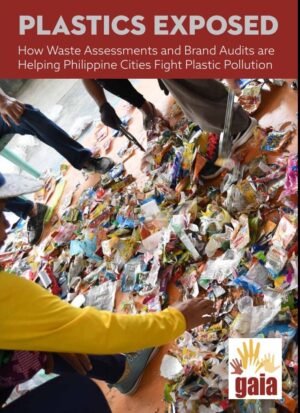
El reporte, Plásticos al descubierto: cómo las evaluaciones de desechos y las auditorias de marca están ayudando Filipinas a combatir la contaminación plástica, usa datos de  usa datos de análisis de desechos domésticos y auditorias de marca realizados por Mother Earth Foundation en seis ciudades y siete municipalidades del país durante los últimos cinco años. Los hallazgos del reporte muestran como las ciudades y municipalidades de Filipinas luchan contra los residuos plásticos. A pesar de los esfuerzos de muchas localidades para instaurar programas de basura cero, aún siguen en la batalla contra los plásticos que les impiden alcanzar sus objetivos de basura cero.  Con la proyección del aumento de la producción de plástico en todo el mundo, incluida Filipinas, los gobiernos nacionales, así como las autoridades de los gobiernos locales, necesitan información contundente y estrategias efectivas para la inminente crisis de contaminación por plástico.

Las ciudades y los municipios pueden luchar contra la contaminación plástica utilizando datos de análisis de desechos y auditorías de marca“, señala Sonia Mendoza, directora de Mother Earth Foundation. “Las ciudades pueden fortalecer las regulaciones, mejorar los servicios de gestión, reducir el volumen de residuos y sus correspondientes costos de manejo. También pueden usar la información para alcanzar prohibiciones o regulaciones contra las bolsas plásticas y obligar a que las compañías asuman su responsabilidad por la contaminación plástica.”

Según GAIA, las cifras muestras que el enorme volumen de residuos plásticos que se generan a diario supera la capacidad de manejo de los barangays, las ciudades y los municipios y la única forma de manejar los plásticos de un sólo uso es reducirlo. “El problema es la gran cantidad de plásticos de un solo uso producidos, no solo la forma en la que se manejan los desechos“, dijo Froilan Grate, director ejecutivo de GAIA Asia-Pacífico. “El plástico es un problema de contaminación y comienza en el momento en el que se fabrica“. La limpieza se deja a las ciudades y municipios que utilizan el dinero de los contribuyentes para tratar los residuos. Las empresas crean residuos en forma de envases plásticos y ganan millones, deben hacerse responsables de la contaminación que generan.

Según el reporte, las ciudades y los municipios tratan un número alto de residuos plásticos de marca en comparación a los que no tienen (al menos 54% del total de los residuos). Diez empresas son responsables de 60% y cuatro empresas multinacionales son responsables por el 36% de todos los residuos con marca recolectados en los sitios de muestra. 

Debido a la falta de políticas nacionales sobre plásticos, algunos gobiernos locales en Filipinas han creado regulaciones para las bolsas plásticas. Sin embargo, los plásticos de marca que incluyen sachets y otros embalajes primarios utilizados por algunos de los fabricantes más grandes del mundo no están cubiertos en estas regulaciones. GAIA afirma que los fabricantes debieran reducir la producción de envases de plástico desechables, por ejemplo, mediante innovaciones como sistemas de entrega alternativos o envases reutilizables, se podría abordar una gran parte del problema de residuos plásticos del país, incluida la fuga de residuos a ríos y mares.

“El caso de Filipinas es solo una muestra de lo que está sucediendo en todo el mundo”, señaló Von Hernández, Coordinador Global del movimiento #breakfreefromplastic. “Esta es una crisis global que necesita intervenciones globales.” Necesitamos políticas y regulaciones sólidas que prohíban plásticos de un solo uso y que hagan que las empresas se hagan responsables de su rol en la perpetuación de décadas de contaminación plástica.” 

El informe presenta varias recomendaciones para que el gobierno filipino aborde de manera efectiva la contaminación plástica, incluyendo: la estandarización de datos desglosados sobre envases plásticos en análisis de desechos, al igual que la información de marca, instituir una prohibición nacional de bolsas plásticas y regulaciones para otros productos plásticos de un solo uso, embalaje y sistemas de entrega y reforzar la prohibición de la incineración de residuos. Además, GAIA le está solicitando a las empresas productoras que sean transparentes respecto a los envases plásticos que producen, que asuman la responsabilidad de sus envases y que dejen de producir inmediatamente envases plásticos desechables.

El reporte se puede ver aquí (en inglés): Plastic Exposed 

[This Executive Summary has been updated to reflect the correct figures on plastic bag use in the Philippines: every day, almost 48 million shopping bags are used throughout the Philippines, or roughly 17.5 billion pieces a year.]

EXECUTIVE SUMMARY

Single-use disposable plastic is the greatest obstacle to sound waste and resource management. Inadequate waste management systems and human negligence are often cited as the main contributors to plastic waste leakage into terrestrial and marine environments—but waste and brand audit data in many parts of the world are helping reveal that the unfettered production of disposable plastic is the actual problem. As long as the mass production of throwaway plastics continues unabated, cities and countries will find it harder and harder to cope. Put simply, disposable plastic is a pollution problem, and the only way to prevent it is to stop it at source.

The data in the Plastics Exposed: How Waste Assessments and Brand Audits are Helping Philippine Cities Fight Plastic Pollution report was gathered through the waste assessment and brand audit (WABA) tool developed by the NGO Mother Earth Foundation (MEF), a group implementing GAIA’s Zero Waste Cities project in the Philippines. Currently, there is a lack of extensive data in the country regarding the production, consumption, and disposal of single-use plastics and plastic packaging. For example, there is no data on the total sachet production of companies, which make up a significant portion of throwaway plastics in dumps, waterways, and beaches. Traditional waste assessment and characterization surveys (WACS) also do not distinguish between the different types of plastic packaging, preventing effective policy making for their proper management. This report therefore also highlights the importance of WABAs as a vital tool to give detailed information about the types, volume, and number of plastic waste in a city, and to support strategies to deal effectively with this problematic waste stream.

As a tool, WABAs help 1) expose the role of specific corporations in the global proliferation of plastic waste; 2) unmask how the industry has passed on the blame for the waste they produce to the consumers of their products, and the responsibility for clean-up of their packaging to governments; and 3) reinforce the need for corporations to accept liability for the full life-cycle impacts of their products and the packaging in which their products are sold.

This report compiles data from 21 waste assessments conducted in six cities and seven municipalities across the Philippines by MEF and local government project partners, with the support of GAIA and funding from the Plastic Solutions Fund. Data from these 21 waste assessments were used to extrapolate national data, including estimates about the use and disposal of different types of plastic residuals. Among the 21 sites where waste assessments were conducted, 15 sites have additional brand audit data. These data provide a snapshot of how much plastic waste, particularly those with branded packaging, are discarded by households.

Based on WABAs conducted in areas across the Philippines, findings highlighted in this report confirm that:

  1. Organic waste comprise more than 50% of generated waste in the Philippines, affirming that organic waste management is an important strategy that will create substantial waste reduction for local governments.
  2. Disaggregating data on the different types of plastic residuals gives a clearer picture of waste generation, providing valuable information on policy actions needed to substantially reduce this highly problematic waste stream.
  3. The strict implementation of plastic bag regulations produces dramatically significant results in lowering plastic bag use. However, the existence of a plastic bag regulation in a city or municipality does not automatically equate to lower plastic bag use.
  4. Almost 164 million pieces of sachets are used in the Philippines daily, equating to around 59.7 billion pieces of sachets yearly. With the absence of policies mandating liability and accountability for the production of this problematic waste stream, cities and municipalities are left to deal with this problem using taxpayers’ money.
  5. While more attention should be given to ensure the reusability of packaging and products, it is important to acknowledge that within current waste management systems, recycling plays an important role in supporting livelihoods, and creating additional income for households, villages and/or municipalities and cities.
  6. More than 50% of all unrecyclable residual waste discarded in the country is branded waste, and only 10 companies are responsible for 60% of all branded waste in the study sites. This highlights the urgent need for interventions that involve manufacturers in taking responsibility for their plastic waste, primarily by drastically reducing production of throwaway plastic packaging.

Using WABA data, this research extrapolates national estimates on annual per capita use of plastic shopping bags, plastic labo, and sachets in the Philippines. Findings show that:

  1. The average Filipino uses 591 pieces of sachets, 174 shopping bags, and 163 plastic labo bags, yearly.
  2. Everyday, almost 48 million shopping bags are used throughout the Philippines, or roughly 17.5 billion pieces a year.
  3. Plastic labo bag use throughout the Philippines is at 45.2 million pieces per day, or 16.5 billion pieces a year.
  4. Around three million diapers are discarded in the Philippines daily, or 1.1 billion diapers annually.

These figures show that the sheer volume of residual waste generated daily is beyond the capacity of barangays, cities and municipalities to manage: the problem is the huge amount of single-use plastics being produced, not the way the waste is managed. Experiences in GAIA’s Zero Waste Cities project sites show that after implementing Zero Waste strategies (for example establishing working materials recovery facilities or MRFs, conducting door to door segregated collection, composting organics, and maximizing recycling of high-value materials, etc.) cities can only achieve a maximum of 70-80% waste diversion (i.e. maximizing the sustainable management of discards to avoid landfilling and other final disposal methods) compared to their pre-Zero Waste program baseline. Despite expanding Zero Waste strategies, cities and municipalities will be left with around 20% of waste that they cannot manage—sachets and other single use plastics—preventing them from fully achieving Zero Waste goals.

Clearly, plastics are a global problem with local repercussions, and it is the cities and municipalities, as well as ordinary citizens, who bear the brunt of the problem. But the plastic crisis can be tackled, starting with using WABA as a tool.

Several case studies of Zero Waste Cities project sites in the Philippines featured in this report show how WABA data was used in waste and resource management planning to:

  1. maximize waste diversion rates;
  2. create a system to efficiently collect segregated waste from previously hard-to-reach areas while creating jobs for informal waste workers;
  3. design eco-sheds for materials recovery facility;
  4. design community composting facilities;
  5. predict landfill capacity and lifespan, and support investment in Zero Waste strategies; and
  6. reveal trends in plastic use in a city and municipality for monitoring and improvement of regulations.

While this report is focused on examples from the Philippines, the experiences related here are not unique, and the recommendations in this report are applicable in other countries. Cities all over Asia and in the developing world in general are faced with the same problem of plastic residuals, most of which have been identified as branded plastic packaging from multinational corporations (MNCs) based in the global north. This points to the need for a global plastic regulation to reduce and eventually eliminate the production of single-use plastic products and packaging.

Based on the findings, this report gives the following recommendations:

  1. WACS protocols should include disaggregated data on different types of plastic bags and packaging.
  2. Cities and municipalities should include brand data in waste assessments.
  3. The Philippine government should institute a comprehensive national plastic bag ban that promotes reusable bags.
  4. Governments should regulate other single-use plastic products, and mandate companies to redesign products and packaging and put in place alternative delivery systems.
  5. Governments should mandate diaper companies to improve recovery options for, and present viable alternatives to, disposable diapers.
  6. Waste incineration is an unsustainable practice that abets plastic pollution and must be stopped. In the Philippines, the government must retain and strengthen the ban against waste incineration.
  7. Corporations must be transparent about the plastic packaging they produce, assume accountability and liability for the packaging, and immediately stop producing throwaway plastic packaging through innovations in redesign and product delivery