In this discussion paper, GAIA and SOMO synthesise insights from our June 2026 virtual learning circle on lithium-ion battery overproduction. The session brought together more than twenty participants from industry, research, civil society, labour organisations, and affected community advocates — spanning China, Latin America, Europe, and the United States. Global manufacturing capacity for lithium-ion batteries is now estimated at two to five times greater than current demand — a structural gap expected to persist well into the 2030s. This paper asks: what is driving it, who pays the price, and what can we do about it?
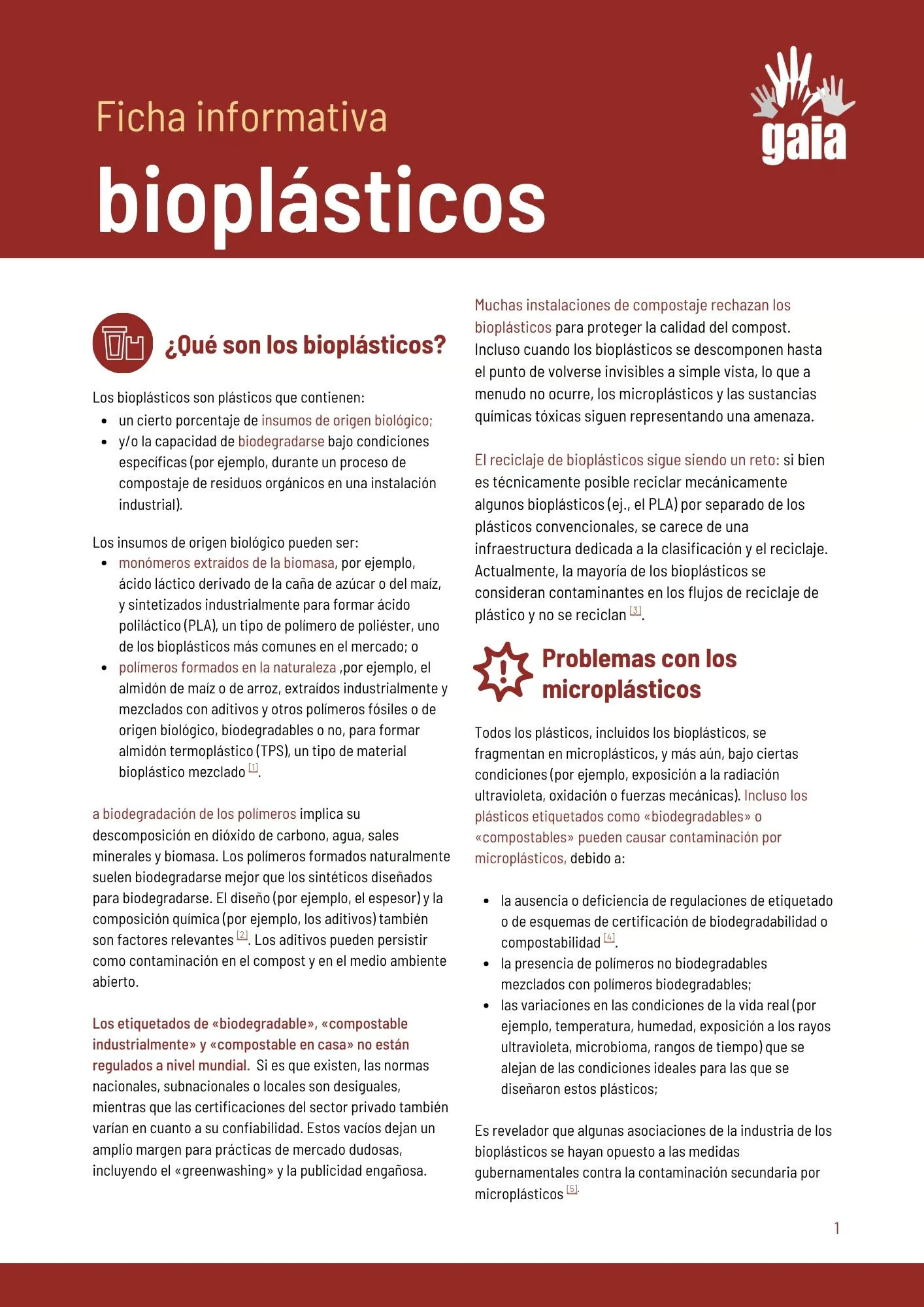
«Bio» no significa que sea bueno o seguro. Con demasiada frecuencia, el énfasis en el uso de los bioplásticos sirve sólo para encubrir con argumentos ecológicos la sobreproducción masiva de plásticos de un solo uso o de corta vida útil. Los bioplásticos actuales son, en su gran mayoría, sustitutos lamentables de los plásticos convencionales de un solo uso, que terminan en los vertederos y perpetúan la contaminación por microplásticos.
Related Resources
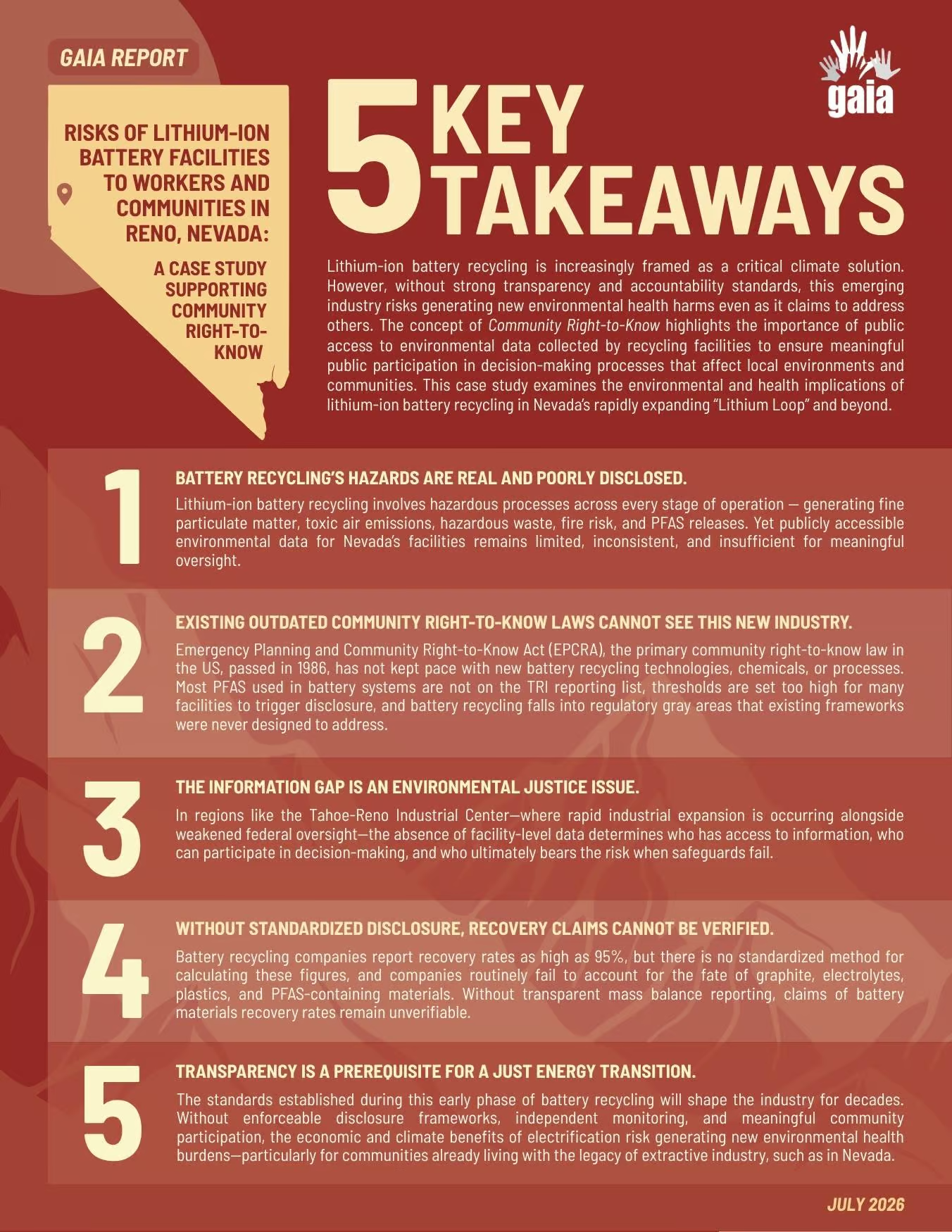
5 Key Takeaways of Case Study: Risks of Lithium-ion Battery Facilities to Workers and Communities in Reno, NV
United States & Canada - Batteries -
The concept of Community Right-to-Know underscores the importance of public access to environmental data collected by recycling facilities to ensure meaningful public participation in decision-making processes that affect local environments and communities. This fact sheet highlights the five key takeaways of the report, Risks of Lithium-ion Battery Facilities to Workers and Communities in Reno, which examines the environmental and health implications of lithium-ion battery recycling in Nevada’s rapidly expanding “Lithium Loop” and beyond.
GAIA Joins International Civil Society to Call for COP 26 Postponement
Manchester, UK–GAIA joins international civil society in calling on the UK Government and the UNFCCC Bureau to postpone COP 26 until they can ensure a genuinely inclusive and safe summit. The historical inequities in terms of access to the COP have been exacerbated by the COVID-19 pandemic, vaccine inequity and travel restrictions. We stand in solidarity with all those who will be excluded and we’ll be working to amplify their voices and demands.
At the same time, the urgency of action to achieve climate justice is greater than ever. Even in the absence of a COP, parties and non-parties must redouble their efforts to eliminate emissions, strengthen adaptation, and share the financial resources necessary for these actions. Whether the COP goes forward in November or at a later date, we will do our best to attend with an inclusive delegation to call out burning waste as a false solution to climate change, to advocate for the phase-out of GHG-intensive waste streams like single-use plastic, and to support community-driven zero waste solutions through systems change.
Press contacts:
Claire Arkin, Global Communications Lead
claire@no-burn.org |
###
GAIA is a worldwide alliance of more than 800 grassroots groups, non-governmental organizations, and individuals in over 90 countries. With our work we aim to catalyze a global shift towards environmental justice by strengthening grassroots social movements that advance solutions to waste and pollution. We envision a just, zero waste world built on respect for ecological limits and community rights, where people are free from the burden of toxic pollution, and resources are sustainably conserved, not burned or dumped.
The EcoWaste Coalition: A Formidable Coalition of Environment and Social Justice Advocates
Interview with Aileen Lucero by Dan Abril
Discussing environment groups in the Philippines would not be complete without putting the spotlight on the EcoWaste Coalition. Always the face of environmental activism in the country, any venture of the coalition – with their placards, creative action, and no compromise stand – is sure to land a page in newspapers and/or a segment in the evening news. However, what most people are not aware of is that the EcoWaste Coalition is more than a group of intense environmentalists.
A brief history of EWC
Formed over two decades ago, the organization has grown from a small assembly to a strong coalition of 150 organizations working on Zero Waste solutions and chemical control.
Aileen Lucero, the coalition’s National Director, has been with the group since the early 2000s. She shares that her role as the coalition’s lead is quite taxing but otherwise very fulfilling.
Recounting the Coalition’s history, she shares, “The EcoWaste Coalition began as an assembly campaigning for the urgent adoption of the Clean Air Bill, and was brought together in 1999 by Greenpeace and the Action Center of Catholic Bishops Conference of the Philippines (CBCP). Then, we were known as the Clean Air Coalition.”
With the passing of the bill into law, the assembly, fueled by its initial success, moved to become The EcoWaste Coalition. This time, switching the team’s focus to solid waste management.
For one afternoon, despite her busy schedule, we sat down and talked to Aileen about the EcoWaste Coalition: its work, goals, and the implications of being one of the most vocal and visible environment advocacy groups in the Philippines.
The EWC’s Top Priorities
Balancing the different priorities and advocacies of 150 organizations is challenging but through a regular General Assembly that is held every two years, we align various objectives into one goal. In 2018, we presented a new vision and a new mission – and that is working towards Zero Waste in communities.
The Zero Waste advocacy still complements our original advocacy on solid waste management since the Philippine law on solid waste is made up of components, such as true waste management, clean production, and a ban on incineration.
The ECW’s main ongoing campaigns
Our goals are to promote meaningful laws and to stop regressive policies. As a coalition, we also highlight our members’ work and best practices particularly in the areas of ecological agriculture, Zero Waste, and chemical safety.
The EWC’s biggest accomplishments and achievements
We have a lot of campaigns and success stories but what we are most proud of is being instrumental in the passage of the Clean Air Act and successfully adding a section that bans incineration. We are also proud of taking the lead in sending wastes back to source countries. The downside to these achievements is that it makes us readily identifiable to the industries we are standing up against. Come to think of it, maybe it is fair to say that the threats we receive are also an achievement because it means that we’re a formidable devil’s advocate when it comes to these pressing issues.
Challenges EWC is facing. Changes brought about by COVID-19
Being at the forefront of exposés and investigations, we’re always at the receiving end of threats and lawsuits from big companies and landfill owners. But we don’t back down. We play their game. If they harass us, we inform members and send out news releases so that these entities are put under the spotlight by the media in relation to the former’s attempts at intimidation.
The COVID-19 pandemic has also increased the difficulty faced by members who work directly with communities. This was further compounded by a lack of access or unfamiliarity with technology by some of our members. When the first lockdown was lifted, members still had to practice proper social distancing and other safety measures when they conducted brand audits and went to communities to help set up equipment so members from these far-flung communities can attend webinars In places where there is really a lack of technology, we used flipcharts and organized community gatherings in town meeting halls.
Main environment issues faced by the Philippines and Southeast Asia
While there have been improvements in the last 2 decades, the Philippines primarily lacks the political will to enforce laws because the environment is always the least priority. For example, the Clean Air Act lacks stringent implementation. Shockingly, policymakers are now pushing for false solutions which go against these very environmental laws. The Solid Waste Management Board is another example. It only has us as a lone CSO representative, while the rests are government agencies or industry representatives. We need more representatives from the environmental sector who are willing and able to influence policymakers, mobilize supporters, and stay true to their stand in the face of criticism.
Organization’s work in the next several years
We see the Coalition growing stronger with more members and lending more voice for stringent policies. We also want to see the Coalition step out of our watchdog reputation and evolve to become a policy influencer.
Thoughts on the waste crisis that many countries are facing right now
Plastic waste is a massive problem for The Philippines and other Southeast Asian countries. I can’t speak for those in other countries but, here, if only there was a robust implementation of the solid waste management law, then we would not have this much historical waste. It’s a shame because there are communities here in the Philippines which have adopted Zero Waste measures and are proudly doing well. An important lesson to learn here is thatthe implementation of the national solid waste management strategies in this country must keep up and align with the Zero Waste efforts of local government units (LGUs).
On collaborating with other NGOs in the region
We have a strong relationship with our regional partners, specifically in providing ample support in amplifying each other’s campaigns or sharing experts on the issue at hand. Recently, we collaborated with IPEN Southeast Asia on assessing the waste trade here in Southeast and East Asia. IPEN did magnificent research work and gathered substantial insights and data, without which we would not have been able to come up with such a comprehensive and informative webinar for all.
EcoWaste Coalition’s work and social justice
Right from the start, we have always included social and environmental justice in our calls — from clean air and Zero Waste to, more evidently, the informal waste sector and the health effects of dumpsites and landfills.
We want to erase the idea that consumers are to blame for plastic waste, and we want to stress that landfills and incinerators are not safe. If such facilities are truly safe, why not construct one beside a government official’s mansion? Why build it in poor communities?
People in environment work most admired
Four people come to mind. The first two would be Von Hernandez and Manny Calonzo. Because of their work, we have the Clean Air Act and we have the EcoWaste Coalition. Next, there’s Fr. Edu Gariguez. His dedication to preserving communities and the ecology of Mindoro is inspiring. And of course, there is Dr. Jorge Emmanuel. He is very knowledgeable, helpful, and eloquent. Despite being involved in this work for almost two decades, I still learn a lot from them, and for that, I will always admire them.
GAIA-BFFP Asia Pacific Media Fellowship reaches out to key media professionals and creates awareness on environmental issues rarely covered by the media.
Interview with Dr Mahmood A. Khwaja and Ms Maryam Shabbir by Sonia Astudillo and Dan Abril
With its strong credentials, the Sustainable Development Policy Institute (SDPI) is Pakistan’s most sought-after NGO on social and environmental issues. Two of its prominent figures – Dr Mahmood A. Khwaja and Ms Maryam Shabbir are passionate about their advocacies and their enthusiasm is infectious.
SDPI’s Senior Adviser, Dr Khwaja recalls, “I have been with SDPI for over 25 years and this is a most cherished experience for me. Through SDPI, I got to know other people and other organizations and I’ve gained a lot working with them on issues such as Zero Waste.”
Meanwhile, fervent environmentalist Ms Shabbir who joined the organization in 2013 shares, “Being a young lady it was a challenge to get taken seriously. However, I see the gradual change and people no longer associate proficiency with age.” A researcher for SDPI, she increasingly got involved in the organization’s communications work and eventually took over the role, “I didn’t recognize the value of communications before, I then realized that research not communicated is research left undone.”
Indeed, SDPI’s website and social media pages are filled with years of research and data. Even with the limitations imposed by the pandemic, SDPI continued with conducting research and launching publications. Late last June, SDPI released a report on climate-induced migration among women. The report documents the stories of women from the rural areas and how displacement had increased their vulnerability to sexual violence and economic insecurity. However, SDPI’s work is not limited to climate change. From food security to plastic waste and to hazardous chemicals, SDPI is truly a remarkable organization.
A brief history of SDPI
The foundations of SDPI were laid down as a follow-up to the UN Rio Conference in 1992, conceived by SDPI’s Founding Executive Director, Dr Tariq Banuri and others, including some members of the Pakistan Delegation at the Rio Conference. According to Dr Khwaja, “It was called the Earth Summit but nobody talked about the environment.” It was also an opportune time as the government voiced a need for an independent non-profit organization to analyze environment-related policies and push for program advisories.
With initial funding provided by the Swedish Government, SDPI was established with the main objective of achieving sustainable development. Dr Khwaja explains, “Our approach is holistic. We mean it includes all social aspects such as peace, security, and the environment. Our definition is not limited to industries or the economy.”
SDPI is also one of GAIA’s earliest members. Dr Khwaja remembers, “We were invited to GAIA conferences. Like in South Korea, where we were first introduced to the recycling of electronics. It was such an experience to see huge equipment getting dismantled in 15 minutes.”
To discuss SDPI further, GAIA sat down with Dr Khwaja and Ms Shabbir who shared their current work and future direction.
Can you tell us more about SDPI’s work?
Our work can be described as a three-pronged approach to meeting our objective. We do research, we strategize campaigns based on research findings, and then we conduct awareness-raising. We also provide capacity-building support for other NGOs, the private sector, and even the government.
We also coordinate, cooperate, and involve the government in a lot of our projects. However, it’s a challenge to work with them but without this mutual support, our advisories and proposals will never get implemented.
Social media is also an important component of our work. It is such an easy and yet effective way of popularizing our work and reaching out to prominent figures and the mass audience.
What are SDPI’s main ongoing campaigns?
We work on a lot of issues but one urgent issue we address is plastic waste. It is very harmful to the environment and it affects our nullahs (water pathways). Plastic waste clogs up our water systems and causes flooding; especially during the monsoons. The government has short-term and long-term plans to ban SUPs and we provided recommendations on how to involve people.
We also have an ongoing campaign on climate change. On that issue, we talk to different political parties and invite them on board. We send them recommendations and encourage them to participate in the discussion by asking questions on how to address the impact of climate change.
Among others, our latest book, “Poisons In Our Environment”, was released in August of 2020 and it describes the initial site assessment (ISA) of 38 waste sites in the country.
What are SDPI’s top priorities?
Aside from plastic waste and climate change, we also prioritize addressing land pollution. I would also like to add that when we had an initial assessment of the identified waste sites, farmers came up to us and shared that they used to have large harvests but now it only yields dry grass. Because of the surrounding industries, acres of land have become useless. We have done so much to address pollution but there is still so much to do.
What are SDPI’s biggest achievements?
We were able to introduce environment-related legislation and sensitize policymakers on climate change. We were also able to implement pollution charges of 100 rupees per pollution unit and this fee was suggested by the industry sector itself. We found that it is easier for them to comply when they agree to the charges.
We also consider our identification of contaminated sites as an achievement since it is the result of years of hard work. Our work on mercury also provided vital information on where it is being imported and how much it is used in the country. With the mercury inventory, we were able to move forward and address it.
What challenges are you facing and how was your work impacted by the COVID crisis?
First, it is a challenge to work with the government and to bring them to a pace equal to ours. Second, government officials are not environment experts and you have to educate them first. And third, it is difficult to source funds. Several times, we were declined funding because what we do is not in line with the funder’s vision. That’s a sad reality not only for SDPI but for other non-profits as well.
Then in international meetings, the disparity between rich countries and developing economies is quite evident. With coal use, for example, richer countries do not understand the ground realities of poor countries including Pakistan. They have the technology, the money, and the experts to switch to advanced, clean energy sources. However, Pakistan can not be at that level yet. We do not advocate coal use but the reality is, it will take some time for us to switch to alternative energy sources.
As for COVID-related difficulties, our first thought was how to continue working. We lost one important aspect of our daily lives: social interaction. As such, project completion can be difficult since some partners are not used to the technology and prefer traditional methods. The truth is, this new system does not provide the opportunity for everyone to get involved and it has affected the way we gather inputs from stakeholders.
In addition, the cost of almost everything has gone up. For organizations, it can be difficult to meet costs. Despite these, we were still able to launch publications and continue to engage with officials and communities so overcoming these difficulties can also be considered an achievement.
What are the main environmental issues that your country or region is facing?
Pollution. It is a transboundary issue and it cannot be solved by one country alone. What we need is a legally binding policy in South Asia and Southeast Asia. Since Asian countries share the same problems, we should work on a regional level and sign a pollution control agreement. If air pollution is minimized in one country, the neighbouring countries won’t be affected, inshallah.
How do you see your organization’s work evolving in the next few years?
In the interest of the public and the environment, we will retain our current priorities and we will move to face the challenges. We are exploring less-explored initiatives such as regional research programs and regional services in areas of hazardous wastes and chemicals.
And as we mentioned earlier, we also want to push for regional cooperation to solve our common problems. We believe that, collectively, we can find solutions and hold authorities and polluting industries responsible.
How does SDPI’s work on waste relate to social justice?
We have a very active reach-out policy to marginalized sectors and we institute a “No Discrimination” principle. If discrimination is seen, we react as strongly as possible. The concept of social injustice however can be very hard to accept for some people. People do not agree with it as much as they support environmental issues. But SDPI supports social justice principles.
Who do you admire most in environmental work, in PK or the world?
Maryam Shabbir
Not really related to the environment but there are people who affected my work, first my mentor, Dr Abbib Suleri, Executive Director of SDPI, he guided me a lot. If you don’t have a mentor and you have a skill, then your potential is not realized. Also, Dr Vaqqar Ahmed, Joint Executive Director of SDPI. He is still young but he already published several books and articles. He is an inspiration.
Dr Mahmood A. Khwaja
I admire my colleague Maryam, she is a passionate environmentalist and such a very thorough researcher. I admire her for that. I also admire Manny Calonzo and Dr Romy Quijano. I have seen them work at the national and regional level and when you see them in action, they are so motivating and inspiring.
However, for me, the position is irrelevant. I value anybody who is competent, skilful, and committed. Anyone with those traits, I admire. And I am glad to say that SDPI’s supporting staff display those qualities.
Interested in SDPI’s work? Dr Mahmood A. Khwaja may be reached through his email: khwaja@sdpi.org
Zero Waste events – One of the best ways to beat plastic pollution at an organizational and community level
Contributed by Abishek Pradhan (Zero Waste Himalaya)
The Himalayan Cleanup, Ladakh, 2018.
A report by the United Nations Environment Program says, ‘Around the world, one million plastic drinking bottles are purchased every minute, while 5 trillion single-use plastic bags are used worldwide every year. In total, half of all plastic produced is designed to be used only once — and then thrown away.
Plastic waste is now so ubiquitous in the natural environment that scientists have even suggested it could serve as a geological indicator of the Anthropocene era.
Today, we produce about 300 million tonnes of plastic waste every year. That’s nearly equivalent to the weight of the entire human population.
Our addiction to plastic, especially single-use or disposable plastic, has severe environmental consequences and impacts our well being.
Researchers estimate that more than 8.3 billion tonnes of plastic has been produced since the early 1950s of which only 9% has been recycled. The rest of that plastic has ended up in either a landfill, burnt, or the natural environment.‘
India Prime Minister Shri Narendra Modi, delivering his 2019 Independence Day speech at Red Fort, pitched for freedom for India from single-use plastic by 2022. He explained how plastic clogs drains and causes other civic problems but that is just a small part of the problem. Plastics do not degrade and disintegrate into microplastic that has gone all pervasive. Microplastics have been found inside human placenta, water, soil, air, salt, human poo, the arctic, Mt Everest, and plants. It is estimated that an average person ingests an amount of plastic equivalent to the size of a credit card in one week. Plastic pollution is a toxic threat to our and planetary life.
The waste crisis is not a littering problem, it is an exploitation of the ecological resources, a big factor in sustainable city planning and administration, an issue of animals rights, a human health issue, and a severe product design crisis. Only through actions at all levels (administrative, community and individual) can this crisis be addressed and progress can only be made collectively. Waste management must have a strategy that systematically reduces waste and is the responsibility of the individual, community, institutions and companies. Waste must be designed out and must be addressed at a systemic level.
We are facing a serious waste crisis in the mountains, and also in our own hometown. The dumping grounds are overfilling as our indiscriminate consumption of disposable plastic has increased. No amount of management after waste has already been created would be able to take care of the problem. We have to think of measures that do not create waste in the first place or as little waste as possible.
As organizations working for the welfare of common citizens we must be advocates of sustainability / sustainable development and always lead by example.
Here’s what will help in making your events sustainable at every step on the way,
PRE-EVENT PLANNING:
1.Assessment
The organizers must identify plastic, non biodegradable, and non-recyclable items, opt to avoid them altogether or replace them with reusable or compostable alternatives.
2.Sustainability Communications
Crafting sustainability communications with the vendors, collaborators, service providers, and participants curating the event’s overall sustainability strategy including goal setting and executing plans to help achieve this.
Sometimes donors bring in items such as plastic water bottles, Tetrapak juice items, other plastic packaged offerings which might be hard to refuse once it has been provided. There is a need to engage with them early on to tell them of your Zero Waste intentions so that they are sensitized towards providing the right kind of support that does not result in adding to the waste heap.
DURING EVENT IMPLEMENTATION:
1. Infrastructure
Setting up color-coded dustbins, bags, and signages at your event to help drive waste segregation at source.
2.Stakeholder Training
Training various stakeholders including the food stall vendors on the waste segregation process to be followed.
3. Volunteers / Organizing Team
Our team on ground must help build excitement and participation for the event being a Zero Waste event.
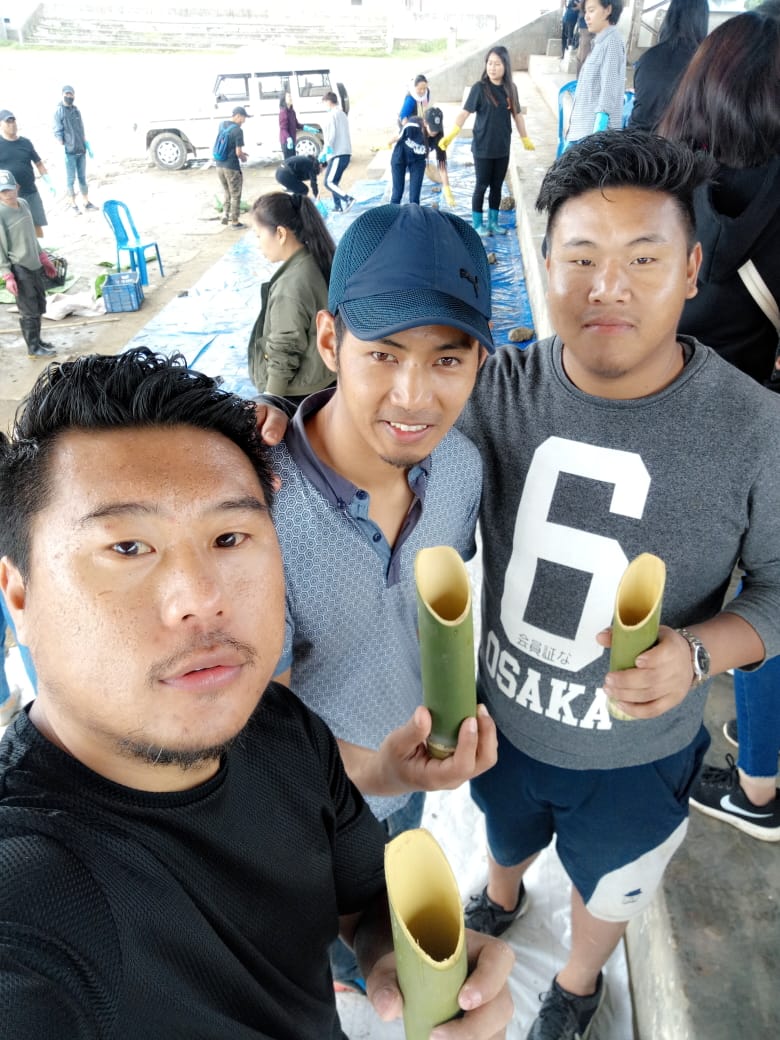
The Himalayan Cleanup, Nagaland, 2019.
4. On-Site Waste Sorting
The team must consist of trained volunteers to manage, segregate, and sort the event waste into multiple categories for resource recovery.
5. Food Donations
The excess food must not be wasted and should be either donated to people in need or at least used as animal feed.
POST EVENT:
1. Sustainable Disposal
Working with our local partners to recycle and compost your event waste and repurpose them into valuable resources.
2. Waste Audit & Recommendation
Providing a detailed waste audit report and further recommendations post the event for improved efforts in later events.
Important pointers for organizing a Zero Waste Event.
Say NO to FLEX.
Use Cloth Banners instead and it’s best to reuse even those.
Don’t use single-use cutlery.
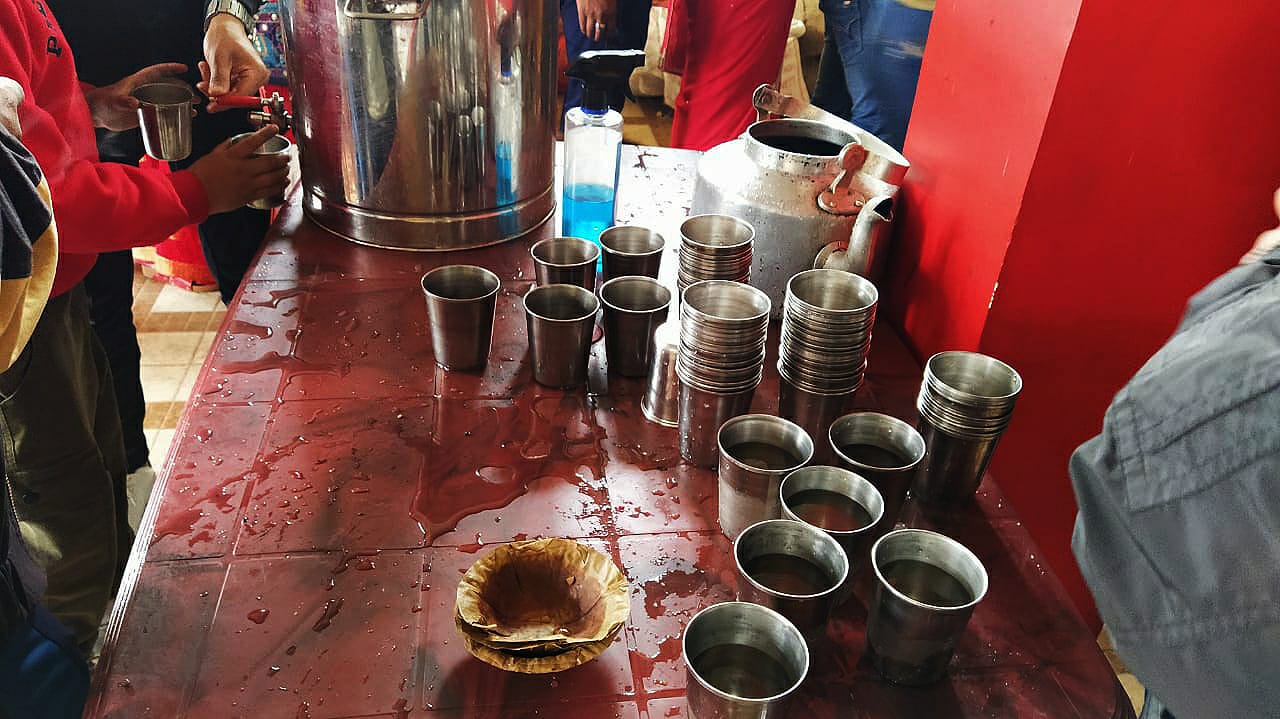
Using reusable cutlery must always be the priority. T here are biodegradable options available but exploiting any resource for extreme convenience is both unethical and unsustainable.
Don’t distribute or sell packaged water.
Water is a necessity for life but plastic is the largest and the worst polluter. Use reusable flasks, bottles, and cups. Ask the sponsors or service providers for inverted container dispensers and ask for a refill option such as a portable water filter. Ensure enough water availability so that emergency use of packaged water is avoided and announce where the water is available.
Avoid balloons, plastic flags, flashy plastic flexs, or any plastic item that will be used for the sake of the event and then sent off to the landfill to contaminate the ecology for thousands of years.
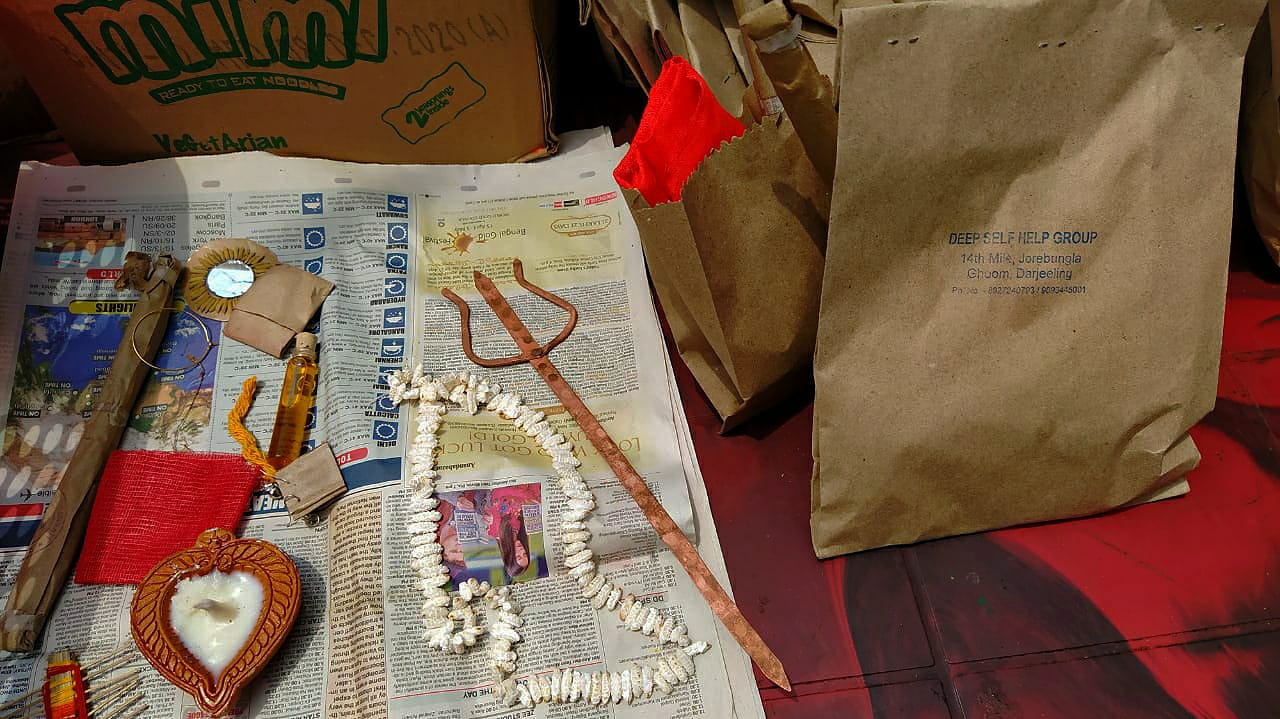
Use biodegradable, recycled, local, and handmade stuff.
Be mindful while planning, managing and executing. Try to keep the carbon footprint of the event to the minimum. It is important to understand that there can be no true welfare in unsustainable events.
The people look up to us, they imitate our actions with the thought that whatever NGOs and CSOs are doing is progressive and empowering but promoting the rampant use of Single-Use Plastics and jeopardizing the collective health of the planet for the sake of convention and convenience is ignorant, immoral, and unsustainable.
We hope you will do your part in building a Zero Waste Himalaya and make your events Zero Waste and Sustainable. The people and principles you serve, look up to you.
” Unless someone like you cares a whole awful lot,
Nothing is going to get better. It’s not. “
Dr. Seuss
In Solidarity!
The Himalayan Cleanup Team, Zero Waste Himalaya
The ADB plays a critical role in this historic period of greater need for development finance in the transition to a green, just and resilient future for the region. As ADB and governments are pursuing COVID-19-related stimulus and recovery initiatives, it is increasingly important to factor in economic and social costs so solutions that are beneficial to human health, the environment, and the economy are prioritized.
To do this, ADB has to prioritize its investments to economic activities that respond to climate, environmental, and social challenges of our times. Unfortunately, its development projects have received much criticism from civil society groups for financing development projects that aggravate environmental deterioration, widen health inequities, reinforce community displacement, harm local jobs, and infringe on human rights objectives.
The Global Alliance on Incinerator Alternatives (GAIA) sends our submission to ADB’s draft Energy Policy. The scope of this review is on WTE — which our global alliance of 800 organizations worldwide (in partnership with grassroots organizations, scientific communities, and local governments) have been pushing to be phased out in order to reduce plastic pollution and establish Zero Waste systems.
How do you create positive change and a more inclusive world? Start by supporting sustainable ventures, Anne Poggenpohl shared, a venture builder at Enviu. To date, Enviu has grown 18 world-changing companies in the Netherlands, Kenya, India, Chile, and Indonesia.
“When we founded Enviu in 2004, our dream was the same as it is today: an economy that serves people and the planet. An economy enriching the lives of all people, providing access to basic needs. An economy that sustainably utilizes the valuable and limited resources our planet endows,” Anne said.
To ease the transition into this equitable economy, Enviu leverages on strategic, synergistic partnerships and creates long-term entrepreneurial programs that disrupt value chains and drive industries toward a “new normal.”
“We determine what business interventions are needed along the value chain. We validate new, sustainable business models by creating, replicating, or accelerating ventures,” Anne said. “We use what’s already there and add what’s missing.”
RIDDING INDONESIA OF ITS PLASTIC WASTE PROBLEM
Enviu runs the Zero Waste Living Lab (ZWLL) program to tackle plastic pollution in Indonesia.Each venture helps develop the market for Zero Waste consumption so that a truly sustainable lifestyle is possible.
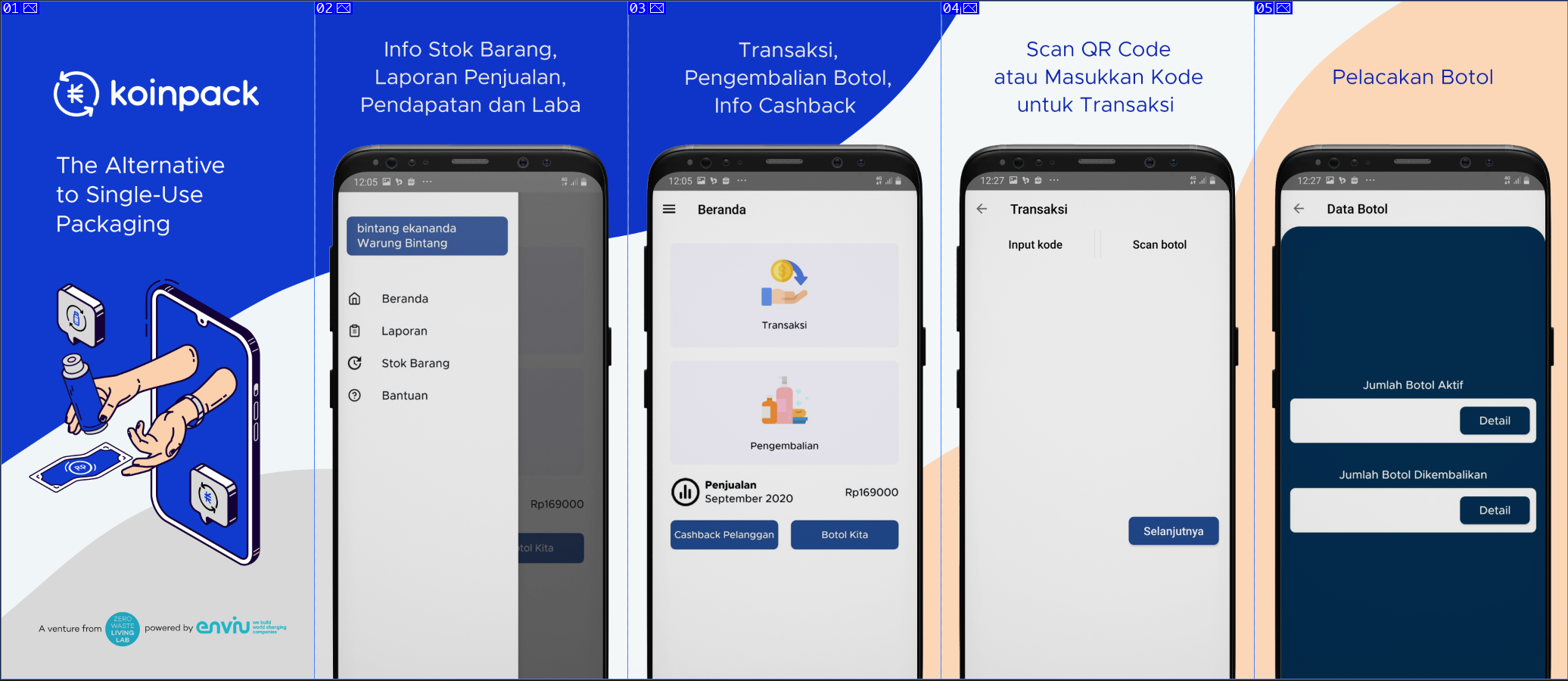
Koinpack (established March 2020) leads the waste reduction effort by providing reusable bottles as alternatives to single-use plastic sachets. Customers of the warung (a highly frequented store) get cashbacks and incentives upon returning these bottles. “Consumers get more value for their money and can generate savings by returning their reusable containers,” Anne said.
Koinpack delivers new stock and ensures the empty packs are collected, cleaned, and refilled. The warung owners are able to check inventory, track stock orders and estimate stockouts, and process customer transactions online. After eight months, Koinpack avoided more than 10,000 sachets at two warungs and four waste banks; upscaling to 1,000 sales points will avoid four million sachet throwaways.
Shifting from single-use to reuse benefits not just the resellers but also fast-moving consumer goods companies (FMCGs). “Prior to Koinpack, a solution that targeted the low-end market using this type of packaging did not exist. Being the first ones to showcase that such a solution is not only possible but even scalable is what makes Koinpack stand out,” Anne said.
A BURGEONING REUSE REVOLUTION
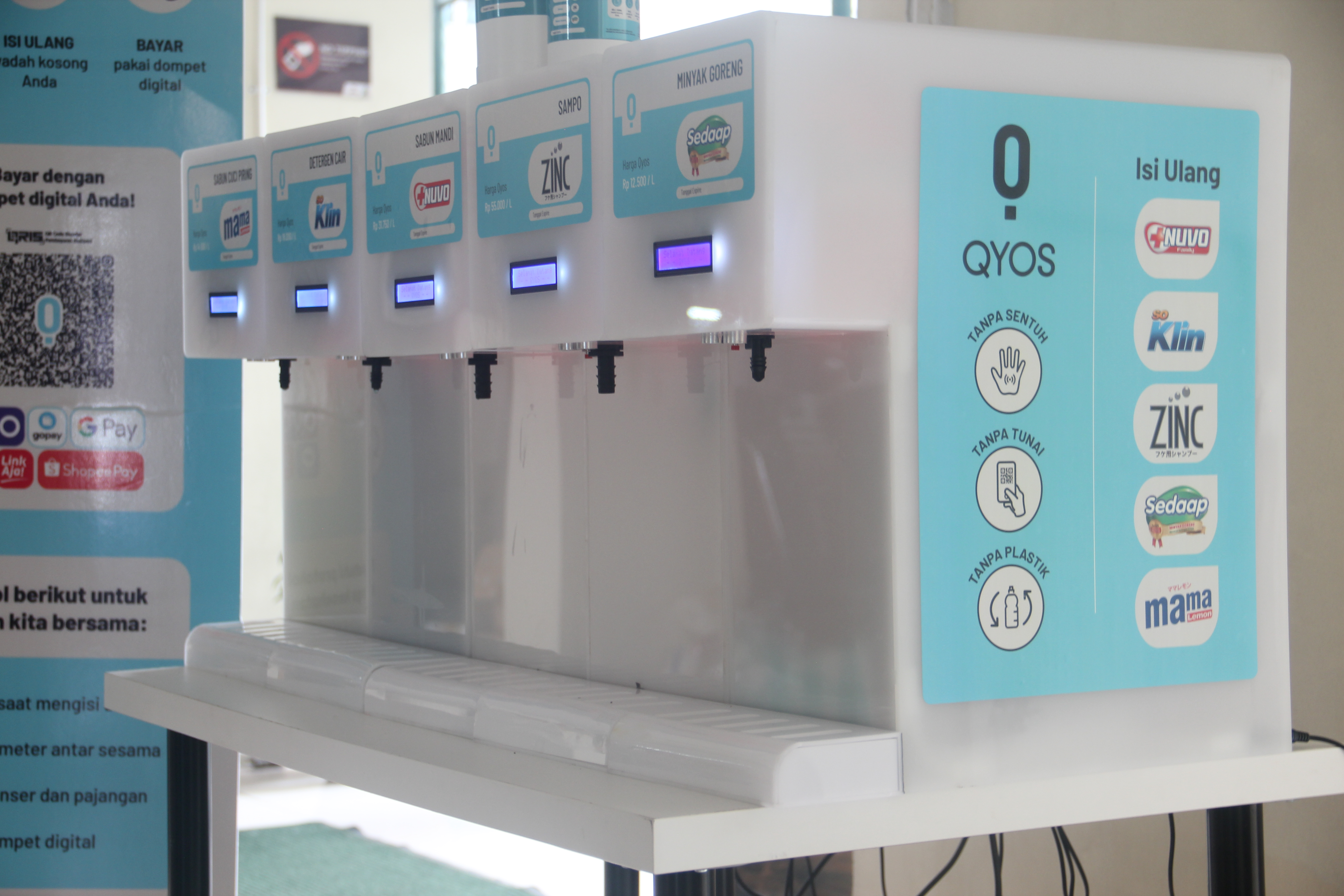
Koinpack has other “reuse sister ventures” under Enviu’s lab. Notably, QYOS (established June 2020) maintains 24/7 refill vending machines with reusable containers that, similar to Koinpack, are created by global packaging solutions company ALPLA. The cashless and touch-less machines, which dispense precise amounts of product (dish soap, body wash, or even hand sanitizer), are placed at high-density residential areas. This enables more households to refill at the QYOS station instead of purchasing their daily necessities in single-use plastic packaging.
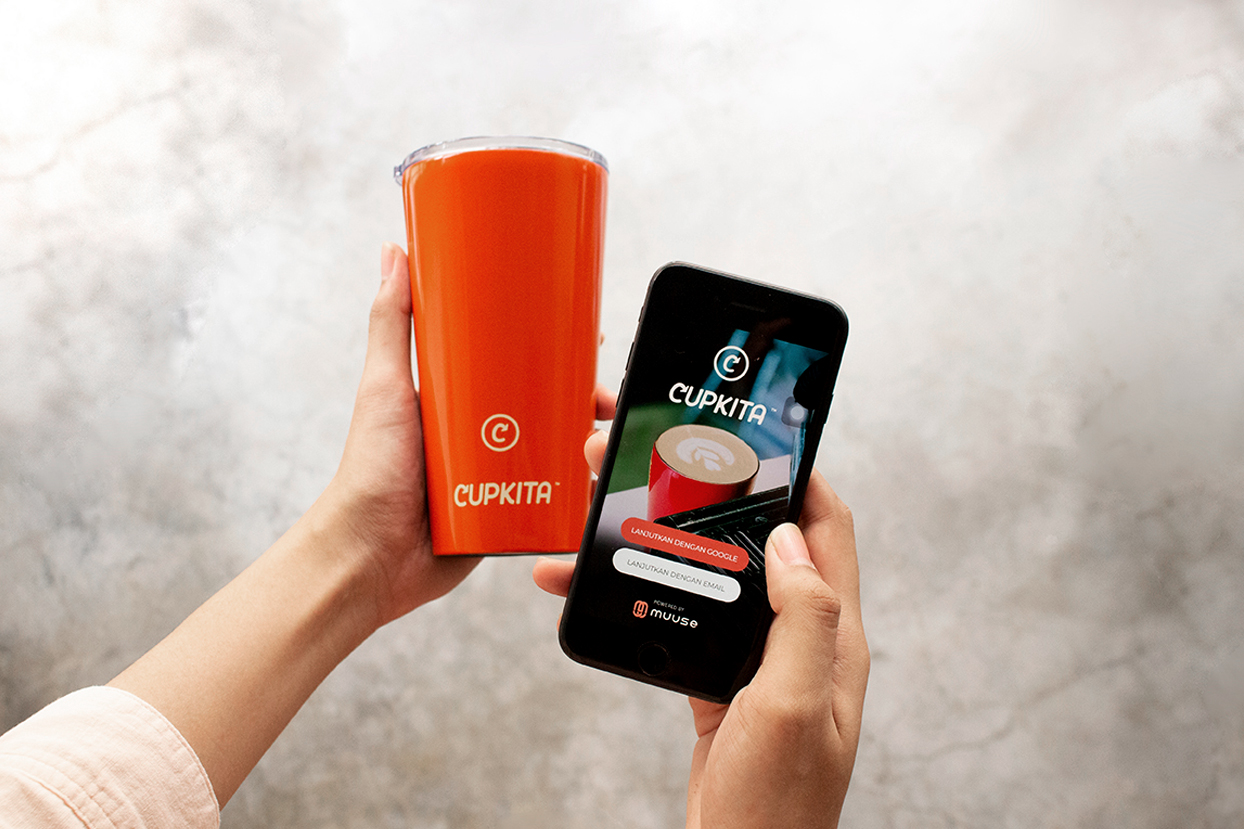
Pursuing a “borrow-reuse-return” scheme, CupKita (established July 2020) allows customers of popular cafés in Indonesia to refuse disposable coffee cups. Instead, they pay via mobile app to rent a reusable cup, and get a cashback upon returning it. Each cup is individually coded and must be returned within seven days; the customer is charged a fee if he keeps it. Based on average coffee sales, CupKita envisions saving anywhere from 525 kilograms to around 2,000 kilograms of disposables per store annually.
Other ventures under the lab include Econesia (established 2019), which offers a full-service water filtration system to residences, retail establishments, and hotels—thereby encouraging consumption of tap water and reducing demand for bottled water, while using refillable glass bottles instead of disposable plastic bottles. In the future, Econesia intends to help hotels go plastic-free by phasing out single-use amenities (shampoo, soap, dental kit, etc.).
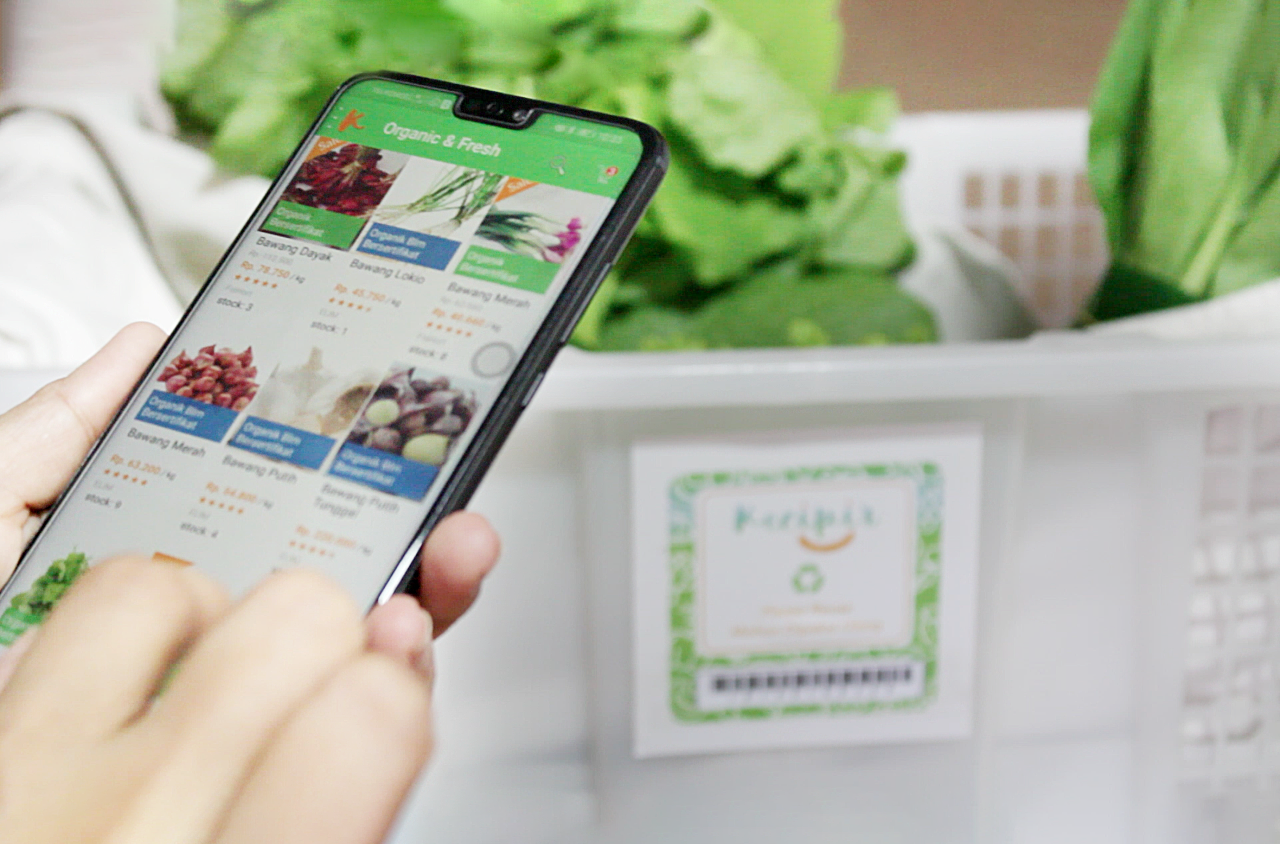
Finally, Kecipir (established April 2013, became a joint venture with Enviu in June 2019), manages an online store for local and in-season organic produce bought directly from farmer suppliers at fair prices. Customers can pick up the items fresh (less than a day’s harvesting)—and plastic-free—from Kecipir-exclusive distributors. Using Kecipir’s platform, organic becomes more affordable to customers and the farmers increase their profit.
PROVE IT WORKS, LET OTHERS COPY
Every venture consists of a separate on-the-ground local team that takes care of running and scaling the reuse business model, from operations to marketing-related activities. Each team has one or two venture builders who are responsible for the day-to-day business development, and are supported by Enviu’s back-office such as the marketing and communication team in Indonesia, as well as the Netherlands.
Moreover, Enviu’s team is also actively involved in connecting local and regional ecosystems, such as raising awareness and sharing inspiring stories about available solutions to the plastic crisis. They organize events, including webinars and forums, where key stakeholders from various sectors discuss pathways toward a future without plastic pollution.
“Ultimately, by enabling a plastic-free reuse lifestyle in Indonesia, we expect the impact reach of our ventures to go far beyond the national market. Apart from closing the tap on plastic in the region, our reuse businesses are intended to serve as a global showcase market that will inspire more Zero Waste solutions across the globe,” Anne said.
This article is part of the book, BUSINESS UNUSUAL: Enterprises paving the way to Zero Waste, a collection of feature articles on select enterprises in Asia Pacific that practice and promote Zero Waste principles. Published by Global Alliance for Incinerator Alternatives, the publication may be downloaded for free at www.no-burn.org/Business-Unusual.
by Marlet D. Salazar
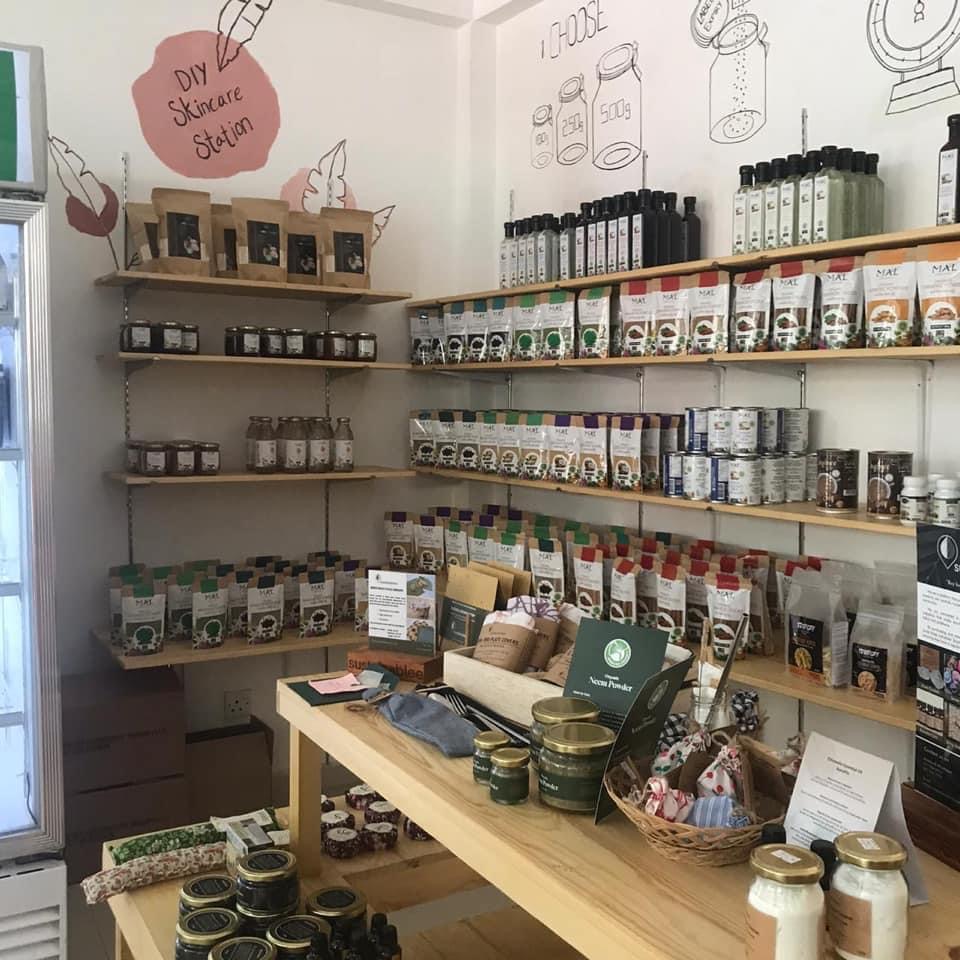
It was a couple of advocacies that led to the founding of the family-owned GreenCare Organic store in Sri Lanka. The owners wanted to sell organic vegetables grown on their family’s farm and promote the Zero Waste principle.
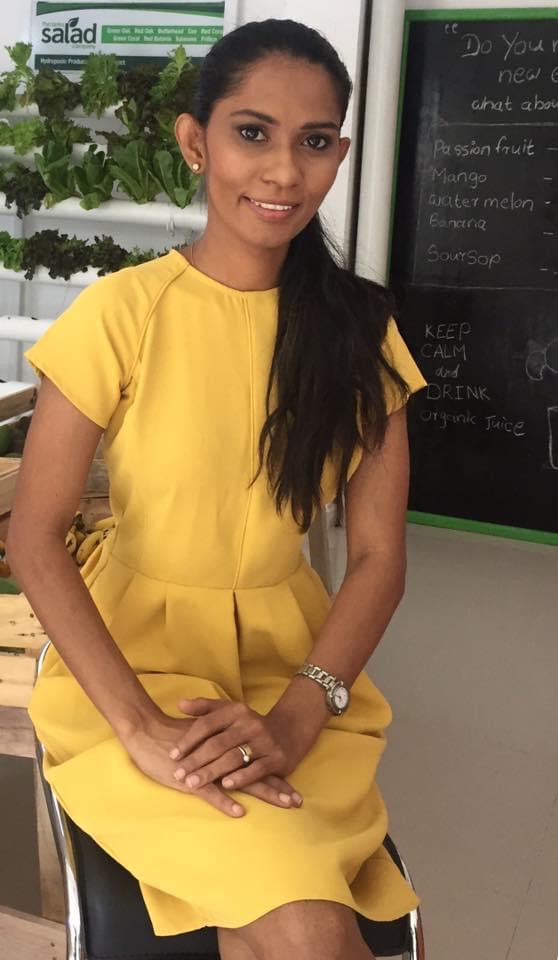
Udara Rathnayake, the co-founder of GreenCare, said that the store or supermarket which is based in Colombo is like a one-stop shop of organic produce and merchandise. Initially, the store sold organic vegetables that Udara’s mother planted and harvested from their farm.
“My mother used to grow organic fruits and vegetables for our daily consumption when we were small. When we moved to Colombo for our higher studies, we missed our mother’s produce and the healthy food she served,” she said.
In 2017, the Meethotamulla garbage dump disaster happened, rocking Sri Lanka. Nineteen people, including five children, died and 40 homes were damaged when a 300-foot high pile of garbage shifted then collapsed following floods and a fire. The tragedy compelled Udara to strengthen her drive to reduce single-use plastic.
“I was thinking: who was responsible for that tragedy?” she said. “Those people lost their lives because we threw away our plastics and garbage. I realized we need to find a solution to give justice to the people who died and also I have to make a difference.”
GreenCare as a company is four years old and the store is two years old. Initially, Udara and her family would attend fairs to sell their vegetable produce. Realizing that there is a market for organic vegetables, she and her family established the store.
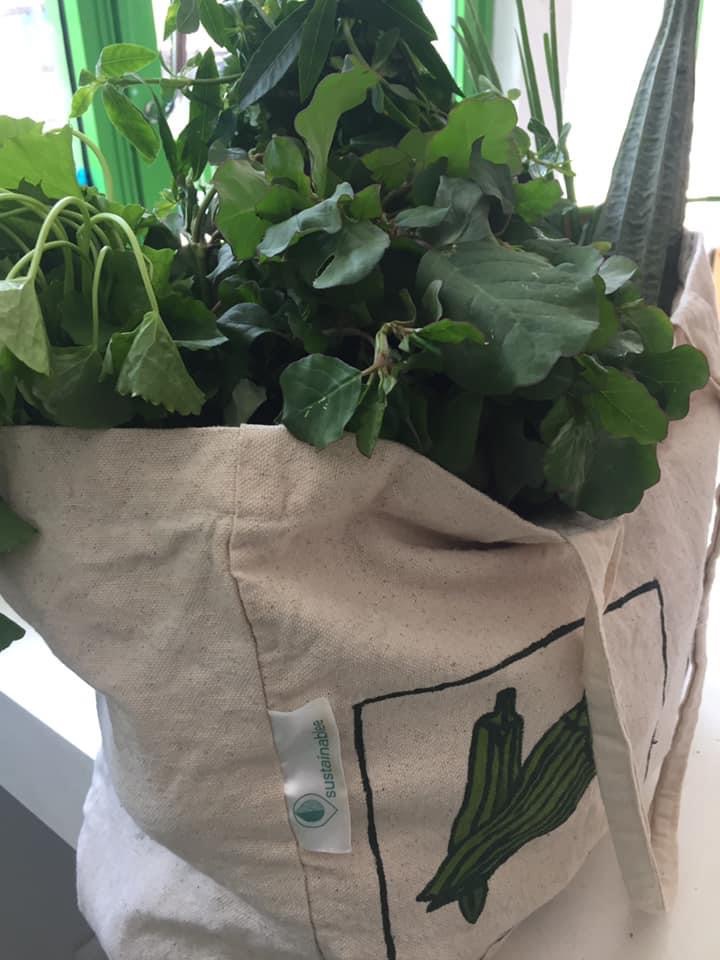
But GreenCare has very strict rules that customers either should bring their own reusable bags or the store can provide paper bags.
“After setting up the store, we thought of introducing the practice of Zero Waste and from day one, we only used paper bags,” she said. “[Admittedly], we are not Zero Waste yet but this is more than 50% or more than 80% Zero Waste,” she said.
Still, GreenCare strongly encourages—and educates — its customers to be extra mindful of the waste they generate. The store buys reusable bottles and other containers that could be used for edible products. The micro-businesses that sell their goods through GreenCare are not allowed to use any type of plastic in their packaging.
“When we discuss the concept and encourage them to try it, we give them a glass bottle and encourage them to bring it back,” she explained. “We will pay a small amount if they bring the bottles back.”
While there are still some who don’t buy the idea of shifting to reusables, Udara said that the majority of their customer base is “more educated and more knowledgeable.”
She admitted, though, that the goods sold in their store can be a bit expensive because their products are organic as well as homemade and small scale.
“Our products are from our own farms. We do not source from others because we want to make sure that the products are truly organic,” Udara said.
She added that they have a different customer base. “These are those who allow you to reuse, those who can understand the concept, and those who are knowledgeable. Our target market is high-end, or those who have the buying power.”
According to Udara, the store doesn’t spend on any marketing. They rely on “a little bit of movement here or the word of mouth.”
She added that she, herself, talks to people and introduces the GreenCare concept of organic farming and goods and reducing waste.
She explained: “We cannot think of the cost because it is the mindset as well as the behavior that we need to change.”
Like other stores, the COVID-19 pandemic also affected the GreenCare store but Udara said that like everybody else, they needed to adapt and resorted to delivering their goods. The packaging is of utmost importance but they still don’t allow plastics, especially single-use plastics.
In fact, according to Udara, they are looking at opening more stores. “Besides the fact that it is a good business, having more stores will allow us to educate more people about reducing waste and the health benefits of organic farming.
This article is part of the book, BUSINESS UNUSUAL: Enterprises paving the way to Zero Waste, a collection of feature articles on select enterprises in Asia Pacific that practice and promote Zero Waste principles. Published by Global Alliance for Incinerator Alternatives, the publication may be downloaded for free at www.no-burn.org/Business-Unusual.
by Marlet Salazar
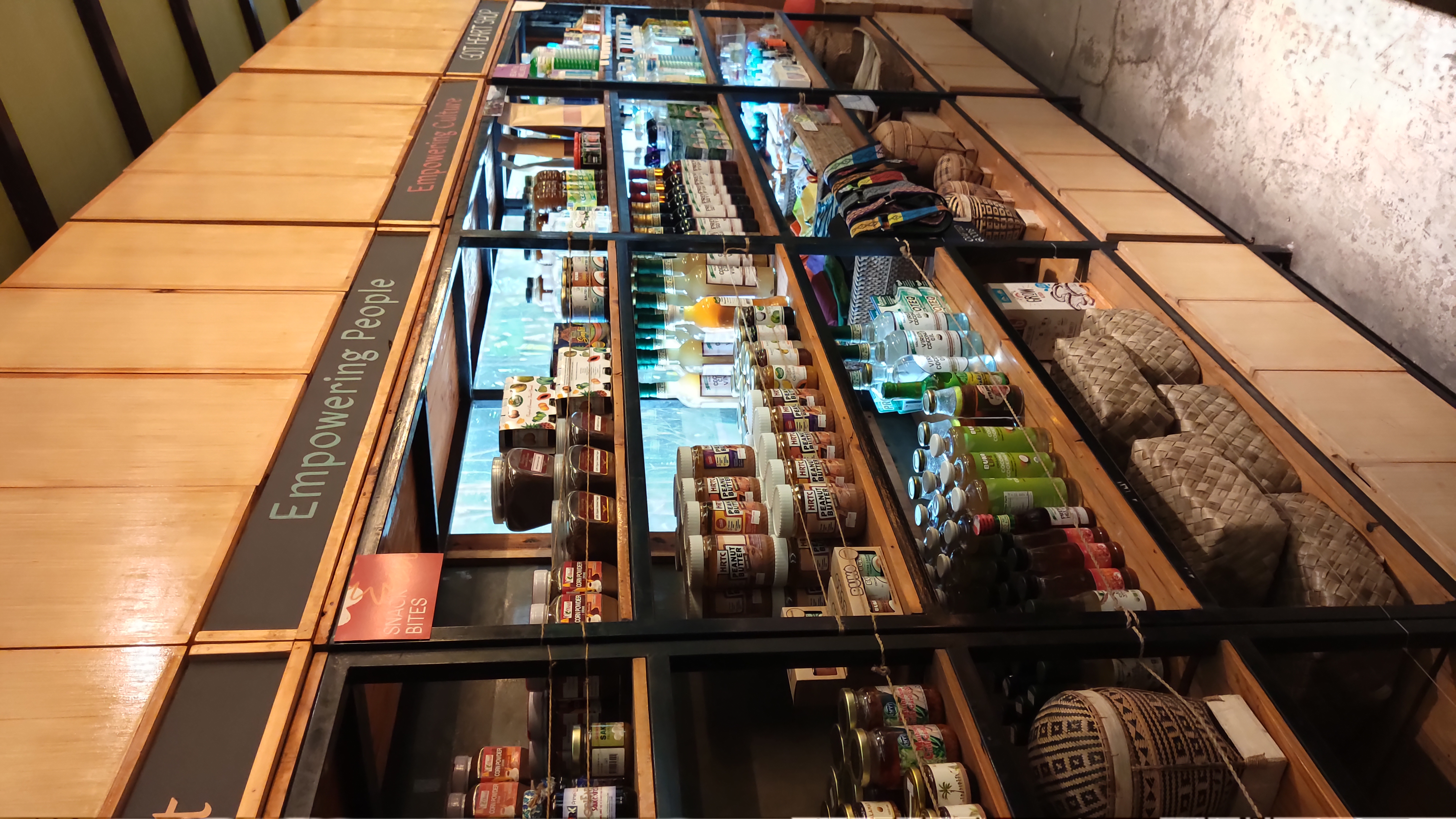
Got Heart Shop has set its heart on helping micro-enterprises and the indigenous peoples.A social enterprise that curates local food and non-food products from their partners, the shop does not only provide a venue for farmers to sell their products but also assists them in developing what it calls “businesses that are sustainable, holistic, independent, and dignified.”
Supporting a broad range of advocacies from using organic products to locally made produce, Got Heart Shop is also actively promoting Zero Waste.
Melissa Yeung-Yap founded the Got Heart Foundation in 2007, years after a visit to an orphanage where she realized there is a role she needed to play—to create a better world by empowering the marginalized sector and assisting them to live a life they can be proud of.
Working with different communities, the Foundation saw the struggles of micro-enterprises and understood that what prevented them from moving their businesses to the next level was sales and marketing. The communities had to resort to middlemen that undersold their products, thus losing the opportunity to increase their revenue.
Because of this, they decided to pool the resources of the Foundation together to put up their very own Got Heart Shop where they can sell their community’s quality products at a fair price that actually benefits the community.
In 2012, Melissa started Got Heart Shop with stores in White Plains (inside Earth Kitchen) and Esteban Abada, Loyola Heights, both along Katipunan, in Quezon City, Philippines. The shop also carries the Eat Your Straw’s Edible Straw and Earthlings brands that manufacture products like silicone menstrual cups, coffee cups, and dish sponges.
According to Melissa, Got Heart is one of the first stores that embraced Zero Waste in the country. Being a pioneer, one of their key challenges was figuring out how this type of social enterprise will be accepted and eventually flourish. Endless trial and errors while learning by doing helped them to keep it up and running. “We just kept innovating and iterating accordingly,” she said.
She added: “Buying these Zero Waste products will promote the triple Ps bottom line that Got Heart has been holding on for almost 12 years: the People, the Planet, and the Profit.”
Like many social enterprises, Got Heart walks the talk. They eliminated any and all forms of packaging; hence, they do not produce so much residual waste.
Located in a neighborhood of mixed social classes, Got Heart caters to residents within the area as well as students from different campuses and workers from nearby offices.
However, as the pandemic accelerated digital transformation across all industries, the shop ramped up its online store and now engages its customers from different places through their social media platforms.
“[Our] customers [have] been very supportive,” Melissa said. “We have a lot of regular customers who are already aware of the Zero Waste drill such as bringing sanitized containers for refilling.”
Philippine businesses were heavily affected by the COVID-19 pandemic. And while Got Heart was also hit, the pandemic did not deter them from pursuing their advocacy. To help people practice their Zero Waste habit, they now offer delivery through couriers and/or delivery apps. They likewise expanded their operations by using an online platform. They use sterilized reusable containers to ship the products, especially the soaps, which are the best-seller.
“There are a lot of things you can’t control during a pandemic but just keep on working on the things you can control,” Melissa said.
According to Melissa, consistency and follow-throughs are what make “habits” like Zero Waste successful. For her, one has to be true to their objective, first and foremost, because it would help any social enterprise—or any business for that matter—to find its footing and become successful, however people define success.
“We always do whatever we can to lessen any environmental impact of the products we sell,” she said.
This article is part of the book, BUSINESS UNUSUAL: Enterprises paving the way to Zero Waste, a collection of feature articles on select enterprises in Asia Pacific that practice and promote Zero Waste principles. Published by Global Alliance for Incinerator Alternatives, the publication may be downloaded for free at www.no-burn.org/Business-Unusual.