







Contributed by UFC and DUT
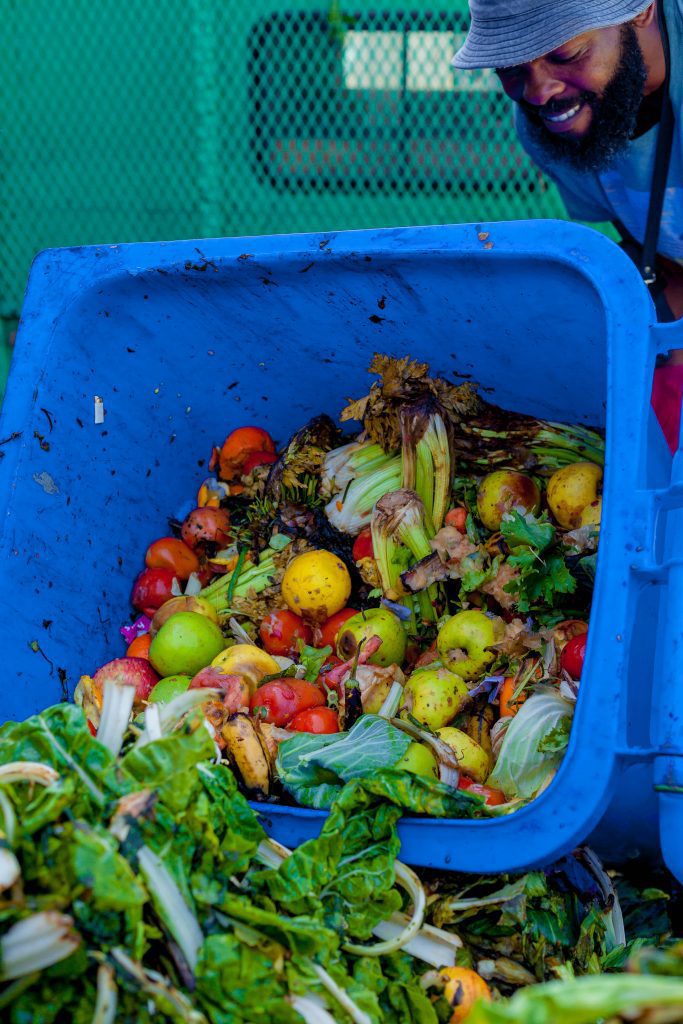
Over the past two years, our Warwick Zero Waste project team and partners have been implementing an innovative composting pilot – taking organic fruit and vegetable waste from the Early Morning Market (EMM) (Markets of Warwick, inner-City Durban, South Africa) and composting this with garden waste at the Durban Botanic Gardens. Starting small and growing incrementally, the pilot is now composting over 2 tonnes of organic waste weekly with plans to scale up further and replicate this local closed loop model across the city. Composting organic waste as opposed to landfilling reduces methane emissions is an important step for mitigating climate change!

Over the course of 2022 and 2023 (end September), the pilot project has diverted over 44 tonnes (44852,34kgs) of organic waste from landfill to produce nutrient rich compost. In 2022, we diverted 2680,25kgs of organic waste from the EMM (608,4kgs equivalent of CH4 per wet ton of organic waste using 227kg CH4 (Methane) per wet tonne organic waste (Zhao et al. 2019 in GAIA, 2022). In 2023, as scaling up commenced, we have thus far diverted 31132kgs of EMM organic waste (7066,96kgs equivalent of CH4 per wet ton of organic waste using 227kg CH4 (Methane) per wet tonne organic waste (Zhao et al. 2019 in GAIA, 2022). Samples of the compost undergo regular testing to refine our ‘recipe’ as we compost larger volumes to ensure a quality end product.

In addition, the Warwick Zero Waste Project offers various other co-benefits, including the opportunities to create jobs, to foster transversal partnerships for municipalities, to improve capacity building and skills development, and of course, to enrich our soils to grow healthy food. We have completed a cost benefit analysis on the pilot which shows significant savings for the municipality if they were to divert all organic waste from the city-managed markets instead of sending them to landfills. The model shows further how savings from this diversion may be reinvested to improve the working conditions for informal traders in the market spaces – crucial to ensuring that social and environmental justice are realized as we move to a zero-waste future.
The composting pilot is a partnership project involving the Urban Futures Centre and the Department of Horticulture at the Durban University of Technology, local non-governmental organizations groundWork and Asiye eTafuleni, and city partners: the eThekwini Municipality’s Parks Recreation and Culture Department, the Business Support, Tourism and Markets Unit, and the Cleansing and Solid Waste Unit.
The composting pilot is also one component of what is a much bigger zero-waste project. You can get a sense of the bigger project from our website: https://africazerowastehub.org.za/
Here are two short videos on our composting pilot: