






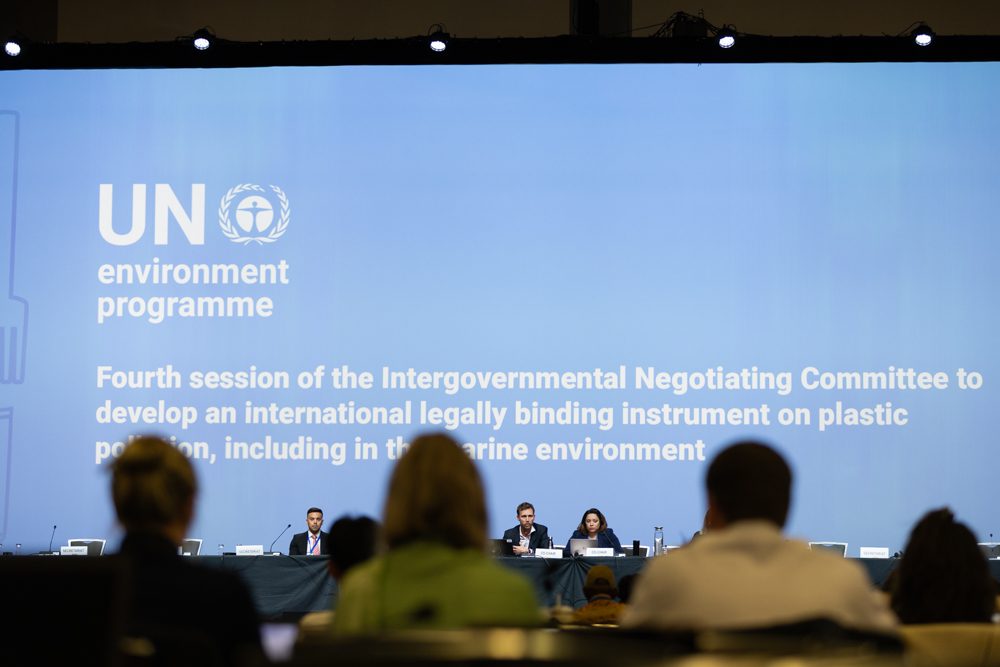
Open Letter to the Chair of the Intergovernmental Negotiating Committee on Plastic Pollution
Your excellency, Amb. Julio Cordano,
The release of the Aid to Negotiations marks a key step in the process to develop a legally binding international instrument to end plastic pollution. Unfortunately, rather than bringing the Parties closer to delivering the ambition mandated by the United Nations Environment Assembly (UNEA) Resolution 5/14, the document raises profound concerns about both its substance and the process by which it was developed.
Your Aid to Negotiations is not a neutral facilitation document. It is a political document that makes choices. These choices consistently favor the lowest common denominator – about what is prioritized, what is sidelined, and what is left unresolved. And time and again, sacrificing the ambition mandated by governments in Resolution 5/14.
The result is deeply troubling: rather than facilitating progress towards an ambitious, fit-for-purpose treaty supported by a majority of countries, as demonstrated in previous rounds of negotiations, the Aid to Negotiations text is an insidious attempt to compromise on the wishlist of a small group of petrostates.
Rather than helping Parties conclude a treaty capable of truly ending plastic pollution, the document renders ineffective the core elements needed to achieve its objective. It systematically removes obligations to address upstream measures, weakens the financial mechanisms necessary to ensure effective implementation of the instrument, and excessively relies on voluntary, non-binding, nationally determined measures whilst sidelining binding ones. It gives disproportionate weight to positions advanced by a small group of countries that have consistently sought to delay, dilute, and derail negotiations, while disregarding proposals supported by broad majorities of Parties.
Since your assumption of the Chairmanship, observers—particularly those representing the communities most impacted by plastic pollution—have repeatedly been denied access to the process. This has effectively turned what should be an inclusive, transparent, and fair multilateral process into almost a year-long series of closed-door meetings, under the pretext of an informal Member State-led process. The ambiguity in the Rules of Procedure regarding observer participation in informal meetings has been repeatedly invoked to justify our exclusion. Such restrictions undermine the transparency, inclusivity, and legitimacy of the process. Those living on the frontlines of the plastics crisis cannot be expected to accept decisions being made about their lives, livelihoods and communities from behind closed doors. Yet, we remain attentive, engaged and determined to achieve an ambitious, fit-for-purpose treaty that protects human health and ensures environmental justice to all. The Aid-to-Negotiations text carries a conscious choice. Specifically:
- Conference Room Papers supported by large numbers of ambitious governments on key upstream measures have been ignored, while weaker downstream options championed by a handful of spoiler countries are prioritized
- The text regress us instead of building on progress achieved over the past five negotiation sessions
- The interpretation of “balance” consistently result in lower ambition
- Texts that have been officially rejected by the International Negotiations Committee at INC-5.2 are considered as references
- Low-ambition text that has not been previously negotiated in the formal INC process, has been introduced
These are not rhetorical questions. They go to the heart of whether this process is still serving the mandate governments agreed to in Nairobi in 2022.
UNEA 5/14 Is Not Open for Renegotiation
There is no legitimate disagreement about the treaty’s purpose. Governments agreed that this instrument must end plastic pollution through a comprehensive approach addressing the full lifecycle of plastics. Yet, the document repeatedly treats upstream obligations as optional, secondary, or politically unrealistic while upending the waste hierarchy and prevention principles.
Plastic pollution does not begin at the waste stage; it begins with fossil fuel extraction, petrochemical production and ever-increasing plastic production. No amount of geopolitical influence can override the prevailing scientific evidence when it comes to reordering the stages of the plastics lifecycle. The science is clear: the plastics crisis must be addressed across its full lifecycle, and no political maneuvering can change that reality.
Three-quarters of greenhouse gas emissions from primary plastic production occur before polymers are even manufactured. Waste management systems cannot solve a crisis driven by unchecked production. Only around 9% of all plastics ever produced have been recycled. A treaty that does not address production cannot end plastic pollution if it ignores its primary driver.
Consensus cannot become a Veto
The document also perpetuates another false narrative: that consensus at any cost is necessary for success. It is not.
More than 115 countries support maintaining the ability to adopt decisions by voting after all efforts to reach consensus have been exhausted. This reflects a standard and widely accepted practice under international law. Without this safeguard, an impasse shaped by a handful of minority countries seeking to delay or weaken the treaty could render any progress or achievement supported by the overwhelming majority of governments meaningless.
The climate regime offers a clear warning: overreliance on consensus has delayed, weakened, and postponed critical decisions for decades. The plastics crisis cannot afford to wait 30 years for urgent action.
Consensus should be the preferred outcome, not a permanent veto for those most invested in preserving the status quo. Consensus is not interchangeable with unanimity.
The document points toward a Framework Convention
The most worrying feature of the Aid to Negotiations is its overall direction. Throughout your communications, you have emphasized that the treaty should be “concise”, “adaptable,” and capable of evolving over time. Taken together with the removal of substantive obligations throughout the document, this suggests a deliberate shift toward a framework convention. A treaty that establishes broad aspirations today while postponing binding and urgent measures until future protocols is spineless. That is not what governments mandated in the UNEA 5/14 Resolution.
Framework conventions delay action, postpone difficult decisions, and require years, sometimes decades, of additional negotiations before meaningful obligations exist, if they are ever achieved. The world does not have that time.
The plastics treaty must include binding global control measures from the outset, supported by annexes that can be strengthened over time by independent, science-based evidence. This is how a treaty can both evolve and remain relevant and effective.
Transparency has been replaced by Opaqueness
The concerns extend far beyond the text itself. The process through which this document has been developed has lacked transparency from the outset – and this deficit has become increasingly pronounced since you assumed the Chairmanship of the Committee.
Governments, rights-holders and observers have no clear understanding of how negotiating advances were discarded, why widely supported proposals disappeared, or on what basis competing options were selected.
A Chair’s document should faithfully reflect Parties’ positions; it should not quietly rewrite them. When choices consistently favor those seeking weaker obligations, confidence and trust in the neutrality of the process inevitably erode.
With a document so consistently aligned with the agenda of countries seeking the weakest possible treaty, it is reasonable to ask: Whose positions is this document actually reflecting and representing?
At every stage of this process, meaningful civil society and rightsholders participation has been systematically sidelined, increasingly reduced to the margins and, in practice, denied altogether. Governments face language barriers that prevent meaningful participation from any non-English-speaking delegation. Indigenous Peoples, waste pickers, frontline communities, women, youth, scientists, and public health experts have repeatedly been prevented from fully and effectively engaging in this process.
In your 4th letter to the Committee, you proposed a new multi-stakeholder action agenda. Observers are not asking for another forum; we are asking to participate in the negotiations and to have the right to engage with our country’s representatives present at the negotiations.
We also reject the false equivalence implied by the term “Observers.” Communities living with plastic pollution are rights-holders. Corporations whose business models depend on expanding plastic production are not. The Tobacco Convention recognized this distinction and succeeded in solving the problem it was intended to address. The Plastics Treaty must do the same.
Leadership requires Upholding the Mandate, not Lowering It
The Committee won’t succeed by producing a document that everyone dislikes equally. Your responsibility is not to protect the comfort and interests of the least ambitious Parties. It is not to make a treaty that is politically convenient for spoiler countries. It is to facilitate negotiations that allow governments to deliver the treaty they were mandated to negotiate.
The Aid to Negotiations does the opposite: it narrows ambition. It privileges obstruction. It weakens obligations. And it risks steering this process toward a treaty incapable of ending plastic pollution.
A Note to Ambitious Countries
We, Observers, recognize that this process has been intense, demanding, and frustrating. Yet, we have not come this far to agree to a text that does not fulfill the mandate of Resolution 5/14. We request that Governments reject any negotiating text that retreats from the agreed mandate.
The world did not launch these negotiations to produce another framework for future discussions. It was launched to end plastic pollution. That remains the benchmark by which this process should be judged.
Civil society will stand with ambitious countries that reject a weak treaty. Your leadership is needed to avoid a catastrophic outcome. No treaty remains a better option than a bad treaty.
We also encourage you to consider negotiating a treaty outside the UN. The UNEP umbrella has consistently failed to deliver a fair process, and unfair processes do not result in strong outcomes. A treaty driven by the ambitious majority, guided by a genuine desire to end plastic pollution and by the power and experience of countries that have demonstrated commitment to the process has a winning chance to deliver the needed outcomes. If you decide to move in the direction of a Coalition of the Willing, civil society will stand firmly alongside you applauding your braveness, supporting your decisiveness and ready to work with you.